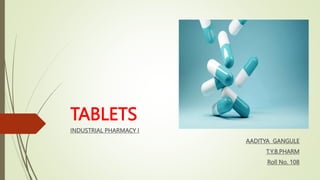
TABLETS
INDUSTRIAL PHARMACY I
AADITYA GANGULE
T.Y.B.PHARM
Roll No. 108
INTRODUCTION
 Definition:-
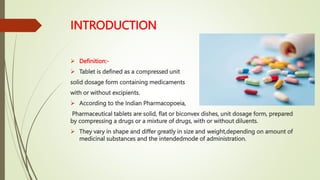
 Tablet is defined as a compressed unit
solid dosage form containing medicaments
with or without excipients.
 According to the Indian Pharmacopoeia,
Pharmaceutical tablets are solid, flat or biconvex dishes, unit dosage form, prepared
by compressing a drugs or a mixture of drugs, with or without diluents.
 They vary in shape and differ greatly in size and weight,depending on amount of
medicinal substances and the intendedmode of administration.
Different Types of Tablets
A) Tablets ingested orally:
 Compressed tablet, e.g. Paracetamol tablet▸
 Multiple compressed tablet>
 Delayed release tablet, e.g. Enteric coated Bisacodyl tablet
 Sugar coated tablet, e.g. Multivitamin tablet
 Film coated tablet, e.g. Metronidazole tablet
 Chewable tablet, e.g. Antacid tablet(B)
B) Tablets used in oral cavity:
 Buccal tablet, e.g. Vitamin-c Tablet
 Sublingual tablet, e.g. Vicks Menthol tablet
 Troches or lozenges
 Dental cone(c)
c) Tablets administered by other route:
 Implantation tablet
 Suppositories or Inserts, e.g. Clotrimazole tablet(D)
D) Tablets used to prepare solution:
 Effervescent tablet, e.g. Dispirin tablet (Aspirin)
 Dispensing tablet, e.g. Enzyme tablet (Digiplex)
 Hypodermic tablet
 Tablet triturates e.g. Enzyme tablet (Digiplex)
Tablet Additives
 In addition to active ingredients, tablet contains a number of inert materials known
as additives or excipients. Different excipients are:
1)Diluent
2)Binder and adhesive
3)Disintegrents
4)Lubricants and glidants
5)Coloring agents
6) Flavoring agents
7)Sweetening agents
1) Diluents
 Diluents are fillers used to make required bulk of the tablet when the drug dosage itselfis
inadequate to produce the bulk.
 Secondary reason is to provide better tablet properties such as improve cohesion, to permit use of
direct compression manufacturing or to promote flow.
 A diluents should have following properties:
1. They must be non toxic
2. They must be commercially available in acceptable grade
3. There cost must be low
Commonly used tablet diluents
1. Lactose-anhydrous and spray dried lactose
2. Directly compressed starch-Sta Rx 1500
3. Hydrolyzed starch-Emdex and Celutab
4. Microcrystalline cellulose-Avicel (PH 101and PH 102)
5. Dibasic calcium phosphate dehydrate
6. Calcium sulphate dehydrate
7. Mannitol
8. Sorbitol
9. Sucrose-Sugartab, DiPac, Nutab
10. Dextrose
2. Binders and Adhesives
 These materials are added either dry or in wet- form to form granules or to form
cohesive compacts for directly compressed tablet. Example:
 Acacia, tragacanth- Solution for 10-25% Conc.
 Cellulose derivatives- Methyl cellulose, HPC, HPMC
 Gelatin- 10-20% solution
 Glucose-50% solutionPolyvinylpyrrolidone (PVP)- 2% conc.
 Starch paste-10-20% solution
 Sodium alginate
3. Disintegrants
 Added to a tablet formulation to facilitate its breaking or disintegration when it contact
in water in the GIT.
 Example: Starch-5-20% of tablet weight. Starch derivative - Primogel and Explotab (1-
8%)Clays- Veegum HV, bentonite 10% level in colored tablet only Cellulose derivatives-
Ac-Di-Sol (sodium carboxy methyl PVP (Polyvinyl pyrrolidone), cross-linked
 Supecellulose Cellulose Alginater disintegrants: Swells up to ten fold within 30 seconds
when contact water.
 Example: Cross carmellose-cross-linked cellulose, Cross povidone- cross-linked
povidone (polymer), Sodium starch glycolate-cross-linked starch. These cross-linked
products swell upto 10 fold with in 30 seconds when in contact with water.A portion of
disintegrant is added before granulation and a portion before compression, which serve
as glidants or lubricant.Evaluation of carbon dioxide in effervescent tablets is also one
way of disintegration
4) Lubricant and glidants
 Glidants are intended to promote flow of granules or powder material by reducing
the friction between the particles.
 Example:
 Lubricants-
 Stearic acid, Stearic acid salt Stearic acid, Magnesium stearate, Tale,
PEG(Polyethylene glycols), Surfactants
 Glidants-
 Corn Starch-5-10% conc., Tale-5% conc., Silica derivative - Colloidal silicas such as
Cab-O-Sil, Syloid, Aerosil in 0.25-3% conc.185.
5) Colouring agent
 The use of colors and dyes in a tablet has three purposes:
(1) Masking of off color drugs
(2) Product Identification
(3) Production of more elegant product
 All coloring agents must be approved and certified by FDA. Two forms of colors are used in tablet
preparation - FD&C and D & C dyes.
 Example: FD & C yellow 6-sunset yellow FD & C yellow 5- TartrazineFD&C green 3- Fast GreenFD &
C blue 1- Brilliant BlueFD & C blue 2 - Indigo carmineD & C red 3- Erythrosine.19D&C red 22-Eosin
Y6.
 6) Flavoring agents:
 For chewable tablet- flavor oil are used
 7) Sweetening agents:
For chewable tablets:
Sugar, mannitol.
 Saccharine (artificial): 500 time's sweeter than sucrose
 Disadvantage: Bitter aftertaste and carcinogenic
 Aspartame (artificial)
 Disadvantage: Lack of stability in presence of moisture.
THANK YOU

TABLETS AADI-1.pptx

  • 1.
    TABLETS INDUSTRIAL PHARMACY I AADITYAGANGULE T.Y.B.PHARM Roll No. 108
  • 2.
    INTRODUCTION  Definition:-  Tabletis defined as a compressed unit solid dosage form containing medicaments with or without excipients.  According to the Indian Pharmacopoeia, Pharmaceutical tablets are solid, flat or biconvex dishes, unit dosage form, prepared by compressing a drugs or a mixture of drugs, with or without diluents.  They vary in shape and differ greatly in size and weight,depending on amount of medicinal substances and the intendedmode of administration.
  • 3.
    Different Types ofTablets A) Tablets ingested orally:  Compressed tablet, e.g. Paracetamol tablet▸  Multiple compressed tablet>  Delayed release tablet, e.g. Enteric coated Bisacodyl tablet  Sugar coated tablet, e.g. Multivitamin tablet  Film coated tablet, e.g. Metronidazole tablet  Chewable tablet, e.g. Antacid tablet(B) B) Tablets used in oral cavity:  Buccal tablet, e.g. Vitamin-c Tablet  Sublingual tablet, e.g. Vicks Menthol tablet  Troches or lozenges  Dental cone(c)
  • 4.
    c) Tablets administeredby other route:  Implantation tablet  Suppositories or Inserts, e.g. Clotrimazole tablet(D) D) Tablets used to prepare solution:  Effervescent tablet, e.g. Dispirin tablet (Aspirin)  Dispensing tablet, e.g. Enzyme tablet (Digiplex)  Hypodermic tablet  Tablet triturates e.g. Enzyme tablet (Digiplex)
  • 5.
    Tablet Additives  Inaddition to active ingredients, tablet contains a number of inert materials known as additives or excipients. Different excipients are: 1)Diluent 2)Binder and adhesive 3)Disintegrents 4)Lubricants and glidants 5)Coloring agents 6) Flavoring agents 7)Sweetening agents
  • 6.
    1) Diluents  Diluentsare fillers used to make required bulk of the tablet when the drug dosage itselfis inadequate to produce the bulk.  Secondary reason is to provide better tablet properties such as improve cohesion, to permit use of direct compression manufacturing or to promote flow.  A diluents should have following properties: 1. They must be non toxic 2. They must be commercially available in acceptable grade 3. There cost must be low
  • 7.
    Commonly used tabletdiluents 1. Lactose-anhydrous and spray dried lactose 2. Directly compressed starch-Sta Rx 1500 3. Hydrolyzed starch-Emdex and Celutab 4. Microcrystalline cellulose-Avicel (PH 101and PH 102) 5. Dibasic calcium phosphate dehydrate 6. Calcium sulphate dehydrate 7. Mannitol 8. Sorbitol 9. Sucrose-Sugartab, DiPac, Nutab 10. Dextrose
  • 8.
    2. Binders andAdhesives  These materials are added either dry or in wet- form to form granules or to form cohesive compacts for directly compressed tablet. Example:  Acacia, tragacanth- Solution for 10-25% Conc.  Cellulose derivatives- Methyl cellulose, HPC, HPMC  Gelatin- 10-20% solution  Glucose-50% solutionPolyvinylpyrrolidone (PVP)- 2% conc.  Starch paste-10-20% solution  Sodium alginate
  • 9.
    3. Disintegrants  Addedto a tablet formulation to facilitate its breaking or disintegration when it contact in water in the GIT.  Example: Starch-5-20% of tablet weight. Starch derivative - Primogel and Explotab (1- 8%)Clays- Veegum HV, bentonite 10% level in colored tablet only Cellulose derivatives- Ac-Di-Sol (sodium carboxy methyl PVP (Polyvinyl pyrrolidone), cross-linked  Supecellulose Cellulose Alginater disintegrants: Swells up to ten fold within 30 seconds when contact water.  Example: Cross carmellose-cross-linked cellulose, Cross povidone- cross-linked povidone (polymer), Sodium starch glycolate-cross-linked starch. These cross-linked products swell upto 10 fold with in 30 seconds when in contact with water.A portion of disintegrant is added before granulation and a portion before compression, which serve as glidants or lubricant.Evaluation of carbon dioxide in effervescent tablets is also one way of disintegration
  • 10.
    4) Lubricant andglidants  Glidants are intended to promote flow of granules or powder material by reducing the friction between the particles.  Example:  Lubricants-  Stearic acid, Stearic acid salt Stearic acid, Magnesium stearate, Tale, PEG(Polyethylene glycols), Surfactants  Glidants-  Corn Starch-5-10% conc., Tale-5% conc., Silica derivative - Colloidal silicas such as Cab-O-Sil, Syloid, Aerosil in 0.25-3% conc.185.
  • 11.
    5) Colouring agent The use of colors and dyes in a tablet has three purposes: (1) Masking of off color drugs (2) Product Identification (3) Production of more elegant product  All coloring agents must be approved and certified by FDA. Two forms of colors are used in tablet preparation - FD&C and D & C dyes.  Example: FD & C yellow 6-sunset yellow FD & C yellow 5- TartrazineFD&C green 3- Fast GreenFD & C blue 1- Brilliant BlueFD & C blue 2 - Indigo carmineD & C red 3- Erythrosine.19D&C red 22-Eosin Y6.
  • 12.
     6) Flavoringagents:  For chewable tablet- flavor oil are used  7) Sweetening agents: For chewable tablets: Sugar, mannitol.  Saccharine (artificial): 500 time's sweeter than sucrose  Disadvantage: Bitter aftertaste and carcinogenic  Aspartame (artificial)  Disadvantage: Lack of stability in presence of moisture.
  • 13.