

Taxation:
Part 2
Prepared by Sandrea Butcher
Objectives
• distinguish between direct and indirect taxes
• state examples of direct and indirect taxes
DIRECT TAXES?
This type of tax is
usually applied to
income and capital
and is paid by
individuals.
Examples
1. Income tax
• A percentage of the taxpayer’s income
over a certain threshold amount is taken
from their wage packet.
• It is normally paid by the employer.
Exercise
• Assume Antonio is paid $55,000 per
annum. He is allowed a personal
allowance of $25,000 because he has
expenses to cover every year. The income
tax rate is 12% of taxable income.
a. Calculate his taxable income.
b. Determine his monthly tax payable.
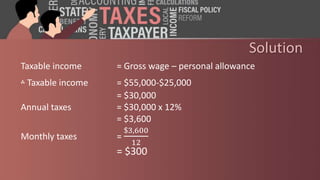
Solution
Taxable income = Gross wage – personal allowance
‫؞‬ Taxable income = $55,000-$25,000
= $30,000
Annual taxes = $30,000 x 12%
= $3,600
Monthly taxes =
$3,600
12
= $300
2. Corporation tax
• This is a tax which is applied to the
declared profits of an incorporated
business.
• Therefore sole traders and partnerships
do not pay corporate profits.
3. Capital gains tax
• This is a tax on increases in the value of
assets.
• The tax is levied on the increase in the
sale price of the asset compared to the
price of the asset when it was initially
purchased.
Example
• Pierre purchased 1100 shares issued by
Pet Stop Inc in June 2018. Each share was
sold at $0.25. In June 2019 he sold each
share at $0.41. Capital gains tax in the
country is 5%.
• Calculate the capital gains tax that Pierre
would have to pay in 2019.
Solution
Capital gains ($0.41-$0.25) =$0.16 per share.
Total gains were $0.16 x 1100 = $176
Capital gains tax = $176 x 5%
=$8.80
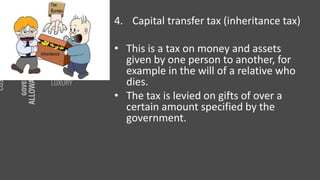
4. Capital transfer tax (inheritance tax)
• This is a tax on money and assets
given by one person to another, for
example in the will of a relative who
dies.
• The tax is levied on gifts of over a
certain amount specified by the
government.
INDIRECT TAXES
• These taxes are levied on consumption of goods and
services and are usually paid by the manufacturers or
importers.
• These taxes can either be:
– specific taxes - tax is a certain amount levied on
each good, such as a $5 tax on every bottle of rum
– ‘ad valorem’ taxes – a percentage applied to the
value of the good, such as 14% tax
Examples
1. Custom duty
• These are taxes applied to imported goods.
• They are paid by the importer at the point of entry
and passed onto customers.
Example
• Hunte & Browne Motors imports a car valued at
$10,000.
• The customs duties on new cars is 250%.
• The company will pay ($10,000 x 250% =) $25,000 in
customs duties
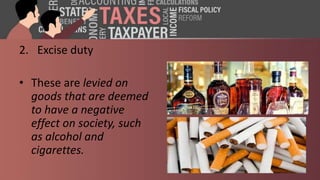
2. Excise duty
• These are levied on
goods that are deemed
to have a negative
effect on society, such
as alcohol and
cigarettes.
• There is a 10% excise
tax on sweetened
beverages in Barbados.
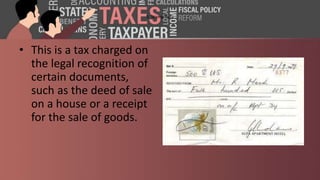
3. Stamp duty
• This is a tax charged on
the legal recognition of
certain documents,
such as the deed of sale
on a house or a receipt
for the sale of goods.
4. Sales/consumption tax
• This kind of tax is applied to goods and services that are
consumed.
• A consumption tax is collected for the government by
• producers.
• Examples of sales/consumption taxes include:
• Value Added Tax in Barbados (VAT) - 17.5%
• General Consumption Tax in Jamaica (GCT) – 15%
• Sales Tax in Miami (7%)
• Sales Tax in New York (4%)
The end

Direct vs indirect taxes

  • 1.
  • 2.
    Objectives • distinguish betweendirect and indirect taxes • state examples of direct and indirect taxes
  • 3.
  • 4.
    This type oftax is usually applied to income and capital and is paid by individuals.
  • 5.
    Examples 1. Income tax •A percentage of the taxpayer’s income over a certain threshold amount is taken from their wage packet. • It is normally paid by the employer.
  • 6.
    Exercise • Assume Antoniois paid $55,000 per annum. He is allowed a personal allowance of $25,000 because he has expenses to cover every year. The income tax rate is 12% of taxable income. a. Calculate his taxable income. b. Determine his monthly tax payable.
  • 7.
    Solution Taxable income =Gross wage – personal allowance ‫؞‬ Taxable income = $55,000-$25,000 = $30,000 Annual taxes = $30,000 x 12% = $3,600 Monthly taxes = $3,600 12 = $300
  • 8.
    2. Corporation tax •This is a tax which is applied to the declared profits of an incorporated business. • Therefore sole traders and partnerships do not pay corporate profits.
  • 9.
    3. Capital gainstax • This is a tax on increases in the value of assets. • The tax is levied on the increase in the sale price of the asset compared to the price of the asset when it was initially purchased.
  • 10.
    Example • Pierre purchased1100 shares issued by Pet Stop Inc in June 2018. Each share was sold at $0.25. In June 2019 he sold each share at $0.41. Capital gains tax in the country is 5%. • Calculate the capital gains tax that Pierre would have to pay in 2019.
  • 11.
    Solution Capital gains ($0.41-$0.25)=$0.16 per share. Total gains were $0.16 x 1100 = $176 Capital gains tax = $176 x 5% =$8.80
  • 12.
    4. Capital transfertax (inheritance tax) • This is a tax on money and assets given by one person to another, for example in the will of a relative who dies. • The tax is levied on gifts of over a certain amount specified by the government.
  • 13.
  • 14.
    • These taxesare levied on consumption of goods and services and are usually paid by the manufacturers or importers.
  • 15.
    • These taxescan either be: – specific taxes - tax is a certain amount levied on each good, such as a $5 tax on every bottle of rum – ‘ad valorem’ taxes – a percentage applied to the value of the good, such as 14% tax
  • 16.
    Examples 1. Custom duty •These are taxes applied to imported goods. • They are paid by the importer at the point of entry and passed onto customers.
  • 17.
    Example • Hunte &Browne Motors imports a car valued at $10,000. • The customs duties on new cars is 250%. • The company will pay ($10,000 x 250% =) $25,000 in customs duties
  • 18.
    2. Excise duty •These are levied on goods that are deemed to have a negative effect on society, such as alcohol and cigarettes.
  • 19.
    • There isa 10% excise tax on sweetened beverages in Barbados.
  • 20.
    3. Stamp duty •This is a tax charged on the legal recognition of certain documents, such as the deed of sale on a house or a receipt for the sale of goods.
  • 21.
    4. Sales/consumption tax •This kind of tax is applied to goods and services that are consumed. • A consumption tax is collected for the government by • producers.
  • 22.
    • Examples ofsales/consumption taxes include: • Value Added Tax in Barbados (VAT) - 17.5% • General Consumption Tax in Jamaica (GCT) – 15% • Sales Tax in Miami (7%) • Sales Tax in New York (4%)
  • 23.