Foreign Exchange Rate
Introduction
This chapter defines the meaning of foreign
exchange and related terms, how foreign exchange
rate is determined, study of foreign exchange rate
regimes (fixed and flexible exchange rate) and their
differences; thereafter hybrid systems of exchange
rate and operation of foreign exchange market.
Foreign Exchange Rate
Foreign Exchange And Its Related Concepts
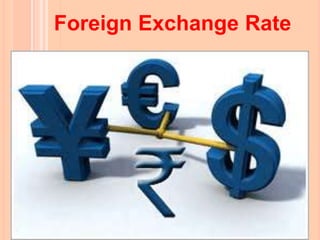
Foreign exchange refers to all the currencies of the rest of
the world other than the domestic currency of the country.
For example, in India, US dollar is the foreign exchange.
The rate at which one currency is exchanged for another is
called Foreign Exchange Rate.
In other words, the foreign exchange rate is the price of
one currency stated in terms of another currency. For
example, if one U.S dollar exchanges for 60 Indian rupees,
then the rate of exchange is 1$ = Rs. 60 or 1 Rs = 1/60 or
0.0166 U.S. dollar.
Foreign exchange market is the market where the
national currencies are converted, exchanged or traded for
one another.
Foreign Exchange Rate
Functions of a foreign exchange market
(a) Transfer Function: Transfer function refers to transferring
of purchasing power among countries.
(b) Credit Function: It implies provision of credit in terms of
foreign exchange for the export and import of goods and
services across different countries of the world.
(c) Hedging Function: Hedging function pertains to protecting
against foreign exchange risks. Where Hedging is an activity
which is designed to minimize the risk of loss.
Foreign Exchange Rate
Sources of demand of foreign exchange:
The demand (or outflow) of foreign exchange comes from the
people who need it to make payments in foreign currencies.
It is demanded by the domestic residents for the following
reasons:
(a) Imports of Goods and Services: When India imports
goods and services, foreign exchange is demanded to make
the payment for imports of goods and services.
(b) Tourism: Foreign exchange is demanded to meet
expenditure incurred in foreign tours.
(c) Unilateral Transfers Sent Abroad: Foreign exchange is
required for making unilateral transfers like sending gifts to
other countries.
Foreign Exchange Rate
(d) Purchase of Assets in Foreign Countries: It is demanded
to make payment for purchase of assets, like land, shares,
bonds, etc. in foreign countries.
(e) Repayment of loans to Foreigners: As and when we have
to pay interest and repay the loans to foreign lenders, we
require foreign exchange.
(d) Speculation: Demand for foreign exchange arises when
people want to make gains from appreciation of currency.
Foreign Exchange Rate
Types of exchange rate regimes:
1. Fixed exchange rate system (Pegged exchange rate
system):
(a) Meaning:
(i) The system of exchange rate in which exchange rate is
officially declared and fixed by the government is called fixed
exchange rate system.
(ii) When domestic currency is tied to the value of foreign
currency, it is known as
pegging.
(iii) To maintain stability in fixed exchange rate system,
government buy foreign currency when exchange rate
appreciates and sell foreign currency when exchange rate
depreciate. This process is called Pegging operation, i.e., all
efforts made by the central bank to keep the rate of
exchange stable.
Foreign Exchange Rate
Note:
(i) Fixed exchange rate is not determined by the forces of
demand and supply in the market. Such a rate of exchange
has been associated with Gold Standard System during
1880-1914.
(ii) According to this system, value of every currency is
determined in terms of gold. Accordingly, ratio between gold
value of the two countries was fixed as exchange rate
between those currencies.
(iii) For example, Value of one dollar = 100 gms of gold.
Value of a rupee = 5 gms of gold
Then, 1 dollar = 100/5 = Rs. 20
Foreign Exchange Rate
(b) Merits of fixed exchange rate system:
(i) Stability: It ensures stability, in the international money
market/exchange market. Day to day fluctuations are
avoided. It helps formulation of long term economic policies,
particularly relating to exports and imports.
(ii) Encourages international trade: Fixed exchange rate
system implies low risk and low uncertainty of future
payments. It encourages international trade.
(iii) Co-ordination of macro policies: Fixed exchange rate
helps co-ordination of macro policies across different
countries of the world. Long term economic policies can be
drawn in the area of international trade and bilateral trade
agreements.
Foreign Exchange Rate
(c) Demerits of fixed exchange rate system:
(i) Huge international reserves: Fixed exchange rate system
is often supported with huge international reserves of gold.
This is because different currencies are directly or indirectly
convertible into gold.
(ii) Restricted movement of capital: Fixed exchange rate
restricts the movement of capital across different parts of the
world. Accordingly, international growth process suffers.
Foreign Exchange Rate
(iii) Discourages venture capital: Venture capital in the
international money market refers to investments in the
purchase of foreign exchange in the international money
market with a view to earn profits. Fixed exchange rate
system discourages such investments. Fixed exchange rate
discourages venture capital in the international money
market.
(d) Devaluation of currency: Devaluation refers to decrease
in the value of domestic
currency in terms of foreign currency by the government. It is
a part of fixed
exchange rate.
(e) Revaluation of currency: Revaluation refers to increase in
the value of domestic
currency by the central government. It is a part of fixed
exchange rate.
Foreign Exchange Rate
(iii) Discourages venture capital: Venture capital in the
international money market refers to investments in the
purchase of foreign exchange in the international money
market with a view to earn profits. Fixed exchange rate
system discourages such investments. Fixed exchange rate
discourages venture capital in the international money
market.
(d) Devaluation of currency: Devaluation refers to decrease
in the value of domestic
currency in terms of foreign currency by the government. It is
a part of fixed
exchange rate.
(e) Revaluation of currency: Revaluation refers to increase in
the value of domestic
currency by the central government. It is a part of fixed
exchange rate.
Flexible exchange rate (floating
exchange rate system)
Meaning:
(i) The system of exchange rate in which value of a currency
is allowed to float freely as determined by demand for and
supply of foreign exchange is called flexible exchange rate
system.
(ii) Under this system, the central banks, without intervention,
allow the exchange rate to adjust to equate the supply and
demand for foreign currency.
(iii) The foreign exchange market is busy at all times by
changes in the exchange rates.
Merits of flexible exchange rate system:
(i) No need for international reserves: Flexible exchange rate
system is not to be supported with international reserves.
(ii) International capital movements: Flexible exchange rate
system enhances movement of capital across different
countries of the world. This is due to the fact that member
countries are no longer required to keep huge international
reserves.
(iii) Venture capital: Flexible exchange rate promotes venture
capital in foreign exchange market. Trading in international
currencies itself becomes an important economic activity.
Demerits of flexible exchange rate system:
(i) Instability: It causes instability in the international money
market. Exchange rate tends to fluctuate like price of goods
in the commodity market.
(ii) International trade: Instability in foreign exchange market
causes instability in the area of international trade. It
becomes difficult to draw long period policies of exports and
imports.
(iii) Macro policies: While fixed exchange rate helps
coordination of macro policies, flexible exchange rate makes
it a difficult proposition. Day to day fluctuations in exchange
rate makes bilateral trade agreements a difficult exercise.
Currency depreciation
Currency depreciation refers to decrease in the value of
domestic currency in terms of foreign currency. It makes
the domestic currency less valuable and more of it is
required to buy a foreign currency. It is a part of flexible
exchange rate.
For example, rupee is said to be depreciating if
price of $1 rises from ? 60 to Rs. 65.
Effect of depreciation of domestic currency on
exports: Depreciation of domestic currency means a fall
in the price of domestic currency (say, rupee) in terms of
a foreign currency (say, $). It means, with the same
amount of dollars, more goods can be purchased from
India, i.e., exports to USA will increase as they will
become relatively cheaper.
Managed floating rate system
Managed floating exchange rate is a mixture of a flexible
exchange rate (the float part) and a fixed exchange rate
(the Managed part).
In other words, it refers to a system in which foreign
exchange is determined by free market forces (demand
and supply forces), which can be influenced by the
intervention of the central bank in foreign exchange
market.
Under this system, also called Dirty floating,
central banks intervene to buy or sell foreign currencies
in an attempt to stabilize exchange rate movements in
case of extreme appreciation or depreciation.
Currency appreciation
Currency appreciation refers to increase in the value of
domestic currency in terms of foreign currency. The
domestic currency becomes more valuable and less of it
is required to buy a-foreign currency. It is a part of flexible
exchange rate.
For example, Indian rupee appreciates when
price of $1 falls from Rs. 60 to Rs. 55.
Effect of appreciation of domestic currency on imports:
Appreciation of domestic currency means a rise in the
price of domestic currency (say, rupee) in terms of a
foreign currency (say, $). Now, one rupee can be
exchanged for more $, i.e., with the same amount of
money, more goods can be purchased from the USA. It
leads to increase in imports from the USA as American
goods will become relatively cheaper.
Kinds Of Foreign Exchange Rate
1. Spot market for foreign exchange:
If the operation is of daily nature, it is called spot market or
current market. The exchange rate that prevails in the spots
market for foreign exchange is called spot rate.
In other words, spot rate of exchange refers to the rate
at which foreign currency is available on the spot.
2. Forward market for foreign exchange:
A market for foreign exchange for future delivery is known as
forward market.Exchange rate that prevails in a forward
contract for purchase or sale of foreign exchange is called
forward rate.
Thus, forward rate is the rate at which a future
contract for foreign currency is bought and sold.
Other Types Of Exchange Rate System
1. Wider band System:
(a) It is a system that allows wider adjustment in the fixed
exchange rate system.
Wider band System:
(a) It is a system that allows wider adjustment in the fixed
exchange rate system.
(b) It allows adjustment upto 10% around the “parity”
between any two currencies in the internationahmoney
market.
(c) For example, if one US dollar is fixed as equal to fifty
Indian rupees, 10% revision (upward or downward) is to be
allowed in this exchange rate of 1: 50. Exchange rate may be
revised as,
1: 60 + 10% = 1: 66 or as 1: 60 – 10% = 1 : 54
2. Crawling peg system:
(a) It allows “small” but regular adjustments in the exchange
rate for different currencies.
(b) Not more than (+) 1% adjustment is allowed at a time.
Indeed, it is a small adjustment.
(c) But it can crawl, i.e., it can be repeated at regular
intervals.
Some Important Terms
1. Nominal exchange rate (NER): The number of units of
domestic currency required to purchase a unit of foreign
currency is called nominal exchange rate. Thus, $1 = Rs. 60.
It may move to $1 = Rs. 65, and so on.
2. Nominal effective exchange rate (NEER):
NEER is the measure of average relative strength of a given
currency with respect to other currencies without eliminating
the effect of change in price.
3. Real exchange rate (RER): RER is the exchange rate
which is calculated after eliminating the effects of price
change. Therefore, RER is based on constant prices.
4. Real effective exchange rate (REER): REER is the
measure of average relative strength of a given currency with
respect to other currencies after eliminating the effects of
price change.
5. Parity value: In the context of exchange rate in foreign
exchange market, parity value refers to the value of one
3. Real exchange rate (RER): RER is the exchange rate
which is calculated after eliminating the effects of price
change. Therefore, RER is based on constant prices.
4. Real effective exchange rate (REER): REER is the
measure of average relative strength of a given currency with
respect to other currencies after eliminating the effects of
price change.
5. Parity value: In the context of exchange rate in foreign
exchange market, parity value refers to the value of one
currency in terms of the other for a given basket of goods
and services. If a U.S. dollar buys 50 times the goods and
services in India, compared to a rupee, the parity value of a
US dollar should be 50 : 1. Accordingly, the exchange rate
between rupee and a US dollar ought to be Rs. 50 : 1$. Any
change in the parity value would imply a corresponding
change in exchange rate.
Words that Matter
1. Foreign exchange: It refers to all the currencies of the rest
of the world other than the domestic currency of the country.
For example, in India, US dollar is the foreign exchange.
2. Foreign Exchange Rate: The rate at which one currency is
exchanged for another is called Foreign Exchange Rate.
3. Foreign exchange market: It is the market where the
national currencies are converted, exchanged or traded for
one another.
4. Hedging function: Hedging function pertains to protecting
against foreign exchange risks, where Hedging is an activity
which is designed to minimize the risk of loss.
5. Fixed exchange rate system: The system of exchange rate
in which exchange rate is officially declared and fixed by the
government is called fixed exchange rate system.
Words that Matter
6. Pegging: When domestic currency is tied to the value of
foreign currency, it is known as pegging.
7. Pegging operations: It refers to all efforts made by the
central government to keep the rate of exchange stable.
8. Venture capital: Venture capital in the international money
market refers to investments in the purchase of foreign
exchange in the international money market with a view to
earn profits.
9. Devaluation: It refers to decrease in the value of domestic
currency in terms of foreign currency by the government. It is
a part of fixed exchange rate.
10. Revaluation: It refers to increase in the value of domestic
currency by the central government. It is a part of fixed
exchange rate.
of the other for a given basket of goods and services.
Words that Matter
11. Flexible Exchange Rate: The system of exchange rate in
which value of a currency is allowed to float freely as
determined by demand for and supply of foreign exchange is
called flexible exchange rate system.
12. Currency depreciation: It refers to decrease in the value
of domestic currency in terms of foreign currency. It makes
the domestic currency less valuable and more of it is
required to buy a foreign currency. It is a part of flexible
exchange rate.
13. Currency appreciation: It refers to increase in the value of
domestic currency in terms of foreign currency. The domestic
currency becomes more valuable and less of it is required to
buy a foreign currency. It is a part of flexible exchange rate.
Words that Matter
14. Managed floating exchange rate: It is a mixture of a
flexible exchange rate (the float part) and a fixed exchange
rate) the Managed part).
15.Spot Rate: If the operation is of daily nature, it is called
spot market or current market.
16. Forward Rate: A market for foreign exchange for future
delivery is known as forward market.
17. Nominal Exchange Rate (NER): The number of units of
domestic currency required to purchase a unit of foreign
currency is called nominal exchange rate.
18. Nominal Effective Exchange Rate (NEER): It is the
measure of average relative strength of a given currency with
respect to other currencies without eliminating the effect of
change in price.
Words that Matter
19. Real Exchange Rate (RER): It is the exchange rate which
is calculated after eliminating the effects of price change.
Therefore, RER is based on constant prices.
20. Real Effective Exchange Rate (REER): It is the measure
of average relative strength of a given currency with respect
to other currencies after eliminating the effects of price
changes.
21. Parity value: It refers to the value of one currency in
terms of the other for a given basket of goods and services.
Determination of Foreign Exchange
Exchange rate in a free exchange market is
determined at a point, where demand
for foreign exchange is equal to the
supply of foreign exchange.
Let us assume that there are
two countries – India and U.S.A – and
the exchange rate of their currencies
i.e., rupee and dollar is to be
determined. Presently, there is floating
or flexible exchange regime in both
India and U.S.A. Therefore, the value
of currency of each country in terms of
the other currency depends upon the
demand for and supply of their
currencies.
Let us assume that there are two countries – India and U.S.A – and the exchange rate of
their currencies i.e., rupee and dollar is to be determined. Presently, there is floating or
flexible exchange regime in both India and U.S.A. Therefore, the value of currency of
each country in terms of the other currency depends upon the demand for and supply
of their currencies.
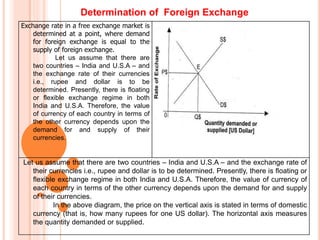
In the above diagram, the price on the vertical axis is stated in terms of domestic
currency (that is, how many rupees for one US dollar). The horizontal axis measures
the quantity demanded or supplied.
In the above diagram, the demand curve [D$] is downward sloping.
This means that less foreign exchange is demanded as the exchange
rate increases. This is due to the fact that the rise in price of foreign
exchange increases the rupee cost of foreign goods, which make them
more expensive. As a result, imports decline. Thus, the demand for
foreign exchange also decreases. The supply curve [S$] is upward
sloping which means that supply of foreign exchange increases as the
exchange rate increases.
This makes home country’s goods become cheaper to
foreigners since rupee is depreciating in value. The demand for our
exports should therefore increase as the exchange rate increases. The
increased demand for our exports translates into greater supply of foreign
exchange. Thus, the supply of foreign exchange increases as the
exchange rate increases.
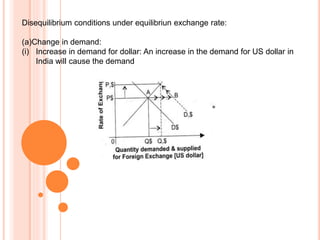
Disequilibrium conditions under equilibriun exchange rate:
(a)Change in demand:
(i) Increase in demand for dollar: An increase in the demand for US dollar in
India will cause the demand
Change in Supply
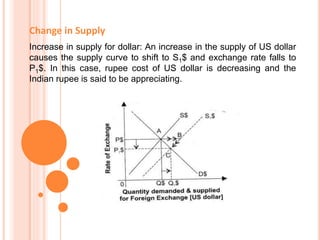
Increase in supply for dollar: An increase in the supply of US dollar
causes the supply curve to shift to S1$ and exchange rate falls to
P1$. In this case, rupee cost of US dollar is decreasing and the
Indian rupee is said to be appreciating.
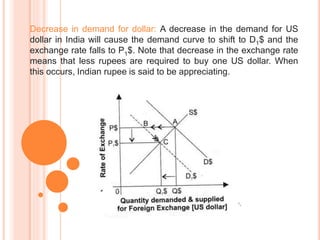
Decrease in demand for dollar: A decrease in the demand for US
dollar in India will cause the demand curve to shift to D1$ and the
exchange rate falls to P1$. Note that decrease in the exchange rate
means that less rupees are required to buy one US dollar. When
this occurs, Indian rupee is said to be appreciating.
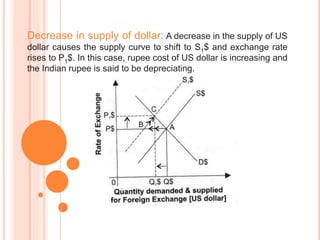
Decrease in supply of dollar: A decrease in the supply of US
dollar causes the supply curve to shift to S1$ and exchange rate
rises to P1$. In this case, rupee cost of US dollar is increasing and
the Indian rupee is said to be depreciating.
Foreign exchnge rate

Foreign exchnge rate

  • 1.
  • 2.
    Introduction This chapter definesthe meaning of foreign exchange and related terms, how foreign exchange rate is determined, study of foreign exchange rate regimes (fixed and flexible exchange rate) and their differences; thereafter hybrid systems of exchange rate and operation of foreign exchange market. Foreign Exchange Rate
  • 3.
    Foreign Exchange Rate ForeignExchange And Its Related Concepts Foreign exchange refers to all the currencies of the rest of the world other than the domestic currency of the country. For example, in India, US dollar is the foreign exchange. The rate at which one currency is exchanged for another is called Foreign Exchange Rate. In other words, the foreign exchange rate is the price of one currency stated in terms of another currency. For example, if one U.S dollar exchanges for 60 Indian rupees, then the rate of exchange is 1$ = Rs. 60 or 1 Rs = 1/60 or 0.0166 U.S. dollar. Foreign exchange market is the market where the national currencies are converted, exchanged or traded for one another.
  • 4.
    Foreign Exchange Rate Functionsof a foreign exchange market (a) Transfer Function: Transfer function refers to transferring of purchasing power among countries. (b) Credit Function: It implies provision of credit in terms of foreign exchange for the export and import of goods and services across different countries of the world. (c) Hedging Function: Hedging function pertains to protecting against foreign exchange risks. Where Hedging is an activity which is designed to minimize the risk of loss.
  • 5.
    Foreign Exchange Rate Sourcesof demand of foreign exchange: The demand (or outflow) of foreign exchange comes from the people who need it to make payments in foreign currencies. It is demanded by the domestic residents for the following reasons: (a) Imports of Goods and Services: When India imports goods and services, foreign exchange is demanded to make the payment for imports of goods and services. (b) Tourism: Foreign exchange is demanded to meet expenditure incurred in foreign tours. (c) Unilateral Transfers Sent Abroad: Foreign exchange is required for making unilateral transfers like sending gifts to other countries.
  • 6.
    Foreign Exchange Rate (d)Purchase of Assets in Foreign Countries: It is demanded to make payment for purchase of assets, like land, shares, bonds, etc. in foreign countries. (e) Repayment of loans to Foreigners: As and when we have to pay interest and repay the loans to foreign lenders, we require foreign exchange. (d) Speculation: Demand for foreign exchange arises when people want to make gains from appreciation of currency.
  • 7.
    Foreign Exchange Rate Typesof exchange rate regimes: 1. Fixed exchange rate system (Pegged exchange rate system): (a) Meaning: (i) The system of exchange rate in which exchange rate is officially declared and fixed by the government is called fixed exchange rate system. (ii) When domestic currency is tied to the value of foreign currency, it is known as pegging. (iii) To maintain stability in fixed exchange rate system, government buy foreign currency when exchange rate appreciates and sell foreign currency when exchange rate depreciate. This process is called Pegging operation, i.e., all efforts made by the central bank to keep the rate of exchange stable.
  • 8.
    Foreign Exchange Rate Note: (i)Fixed exchange rate is not determined by the forces of demand and supply in the market. Such a rate of exchange has been associated with Gold Standard System during 1880-1914. (ii) According to this system, value of every currency is determined in terms of gold. Accordingly, ratio between gold value of the two countries was fixed as exchange rate between those currencies. (iii) For example, Value of one dollar = 100 gms of gold. Value of a rupee = 5 gms of gold Then, 1 dollar = 100/5 = Rs. 20
  • 9.
    Foreign Exchange Rate (b)Merits of fixed exchange rate system: (i) Stability: It ensures stability, in the international money market/exchange market. Day to day fluctuations are avoided. It helps formulation of long term economic policies, particularly relating to exports and imports. (ii) Encourages international trade: Fixed exchange rate system implies low risk and low uncertainty of future payments. It encourages international trade. (iii) Co-ordination of macro policies: Fixed exchange rate helps co-ordination of macro policies across different countries of the world. Long term economic policies can be drawn in the area of international trade and bilateral trade agreements.
  • 10.
    Foreign Exchange Rate (c)Demerits of fixed exchange rate system: (i) Huge international reserves: Fixed exchange rate system is often supported with huge international reserves of gold. This is because different currencies are directly or indirectly convertible into gold. (ii) Restricted movement of capital: Fixed exchange rate restricts the movement of capital across different parts of the world. Accordingly, international growth process suffers.
  • 11.
    Foreign Exchange Rate (iii)Discourages venture capital: Venture capital in the international money market refers to investments in the purchase of foreign exchange in the international money market with a view to earn profits. Fixed exchange rate system discourages such investments. Fixed exchange rate discourages venture capital in the international money market. (d) Devaluation of currency: Devaluation refers to decrease in the value of domestic currency in terms of foreign currency by the government. It is a part of fixed exchange rate. (e) Revaluation of currency: Revaluation refers to increase in the value of domestic currency by the central government. It is a part of fixed exchange rate.
  • 12.
    Foreign Exchange Rate (iii)Discourages venture capital: Venture capital in the international money market refers to investments in the purchase of foreign exchange in the international money market with a view to earn profits. Fixed exchange rate system discourages such investments. Fixed exchange rate discourages venture capital in the international money market. (d) Devaluation of currency: Devaluation refers to decrease in the value of domestic currency in terms of foreign currency by the government. It is a part of fixed exchange rate. (e) Revaluation of currency: Revaluation refers to increase in the value of domestic currency by the central government. It is a part of fixed exchange rate.
  • 13.
    Flexible exchange rate(floating exchange rate system) Meaning: (i) The system of exchange rate in which value of a currency is allowed to float freely as determined by demand for and supply of foreign exchange is called flexible exchange rate system. (ii) Under this system, the central banks, without intervention, allow the exchange rate to adjust to equate the supply and demand for foreign currency. (iii) The foreign exchange market is busy at all times by changes in the exchange rates.
  • 14.
    Merits of flexibleexchange rate system: (i) No need for international reserves: Flexible exchange rate system is not to be supported with international reserves. (ii) International capital movements: Flexible exchange rate system enhances movement of capital across different countries of the world. This is due to the fact that member countries are no longer required to keep huge international reserves. (iii) Venture capital: Flexible exchange rate promotes venture capital in foreign exchange market. Trading in international currencies itself becomes an important economic activity.
  • 15.
    Demerits of flexibleexchange rate system: (i) Instability: It causes instability in the international money market. Exchange rate tends to fluctuate like price of goods in the commodity market. (ii) International trade: Instability in foreign exchange market causes instability in the area of international trade. It becomes difficult to draw long period policies of exports and imports. (iii) Macro policies: While fixed exchange rate helps coordination of macro policies, flexible exchange rate makes it a difficult proposition. Day to day fluctuations in exchange rate makes bilateral trade agreements a difficult exercise.
  • 16.
    Currency depreciation Currency depreciationrefers to decrease in the value of domestic currency in terms of foreign currency. It makes the domestic currency less valuable and more of it is required to buy a foreign currency. It is a part of flexible exchange rate. For example, rupee is said to be depreciating if price of $1 rises from ? 60 to Rs. 65. Effect of depreciation of domestic currency on exports: Depreciation of domestic currency means a fall in the price of domestic currency (say, rupee) in terms of a foreign currency (say, $). It means, with the same amount of dollars, more goods can be purchased from India, i.e., exports to USA will increase as they will become relatively cheaper.
  • 17.
    Managed floating ratesystem Managed floating exchange rate is a mixture of a flexible exchange rate (the float part) and a fixed exchange rate (the Managed part). In other words, it refers to a system in which foreign exchange is determined by free market forces (demand and supply forces), which can be influenced by the intervention of the central bank in foreign exchange market. Under this system, also called Dirty floating, central banks intervene to buy or sell foreign currencies in an attempt to stabilize exchange rate movements in case of extreme appreciation or depreciation.
  • 18.
    Currency appreciation Currency appreciationrefers to increase in the value of domestic currency in terms of foreign currency. The domestic currency becomes more valuable and less of it is required to buy a-foreign currency. It is a part of flexible exchange rate. For example, Indian rupee appreciates when price of $1 falls from Rs. 60 to Rs. 55. Effect of appreciation of domestic currency on imports: Appreciation of domestic currency means a rise in the price of domestic currency (say, rupee) in terms of a foreign currency (say, $). Now, one rupee can be exchanged for more $, i.e., with the same amount of money, more goods can be purchased from the USA. It leads to increase in imports from the USA as American goods will become relatively cheaper.
  • 19.
    Kinds Of ForeignExchange Rate 1. Spot market for foreign exchange: If the operation is of daily nature, it is called spot market or current market. The exchange rate that prevails in the spots market for foreign exchange is called spot rate. In other words, spot rate of exchange refers to the rate at which foreign currency is available on the spot. 2. Forward market for foreign exchange: A market for foreign exchange for future delivery is known as forward market.Exchange rate that prevails in a forward contract for purchase or sale of foreign exchange is called forward rate. Thus, forward rate is the rate at which a future contract for foreign currency is bought and sold. Other Types Of Exchange Rate System 1. Wider band System: (a) It is a system that allows wider adjustment in the fixed exchange rate system.
  • 20.
    Wider band System: (a)It is a system that allows wider adjustment in the fixed exchange rate system. (b) It allows adjustment upto 10% around the “parity” between any two currencies in the internationahmoney market. (c) For example, if one US dollar is fixed as equal to fifty Indian rupees, 10% revision (upward or downward) is to be allowed in this exchange rate of 1: 50. Exchange rate may be revised as, 1: 60 + 10% = 1: 66 or as 1: 60 – 10% = 1 : 54
  • 21.
    2. Crawling pegsystem: (a) It allows “small” but regular adjustments in the exchange rate for different currencies. (b) Not more than (+) 1% adjustment is allowed at a time. Indeed, it is a small adjustment. (c) But it can crawl, i.e., it can be repeated at regular intervals.
  • 22.
    Some Important Terms 1.Nominal exchange rate (NER): The number of units of domestic currency required to purchase a unit of foreign currency is called nominal exchange rate. Thus, $1 = Rs. 60. It may move to $1 = Rs. 65, and so on. 2. Nominal effective exchange rate (NEER): NEER is the measure of average relative strength of a given currency with respect to other currencies without eliminating the effect of change in price. 3. Real exchange rate (RER): RER is the exchange rate which is calculated after eliminating the effects of price change. Therefore, RER is based on constant prices. 4. Real effective exchange rate (REER): REER is the measure of average relative strength of a given currency with respect to other currencies after eliminating the effects of price change. 5. Parity value: In the context of exchange rate in foreign exchange market, parity value refers to the value of one
  • 23.
    3. Real exchangerate (RER): RER is the exchange rate which is calculated after eliminating the effects of price change. Therefore, RER is based on constant prices. 4. Real effective exchange rate (REER): REER is the measure of average relative strength of a given currency with respect to other currencies after eliminating the effects of price change. 5. Parity value: In the context of exchange rate in foreign exchange market, parity value refers to the value of one currency in terms of the other for a given basket of goods and services. If a U.S. dollar buys 50 times the goods and services in India, compared to a rupee, the parity value of a US dollar should be 50 : 1. Accordingly, the exchange rate between rupee and a US dollar ought to be Rs. 50 : 1$. Any change in the parity value would imply a corresponding change in exchange rate.
  • 24.
    Words that Matter 1.Foreign exchange: It refers to all the currencies of the rest of the world other than the domestic currency of the country. For example, in India, US dollar is the foreign exchange. 2. Foreign Exchange Rate: The rate at which one currency is exchanged for another is called Foreign Exchange Rate. 3. Foreign exchange market: It is the market where the national currencies are converted, exchanged or traded for one another. 4. Hedging function: Hedging function pertains to protecting against foreign exchange risks, where Hedging is an activity which is designed to minimize the risk of loss. 5. Fixed exchange rate system: The system of exchange rate in which exchange rate is officially declared and fixed by the government is called fixed exchange rate system.
  • 25.
    Words that Matter 6.Pegging: When domestic currency is tied to the value of foreign currency, it is known as pegging. 7. Pegging operations: It refers to all efforts made by the central government to keep the rate of exchange stable. 8. Venture capital: Venture capital in the international money market refers to investments in the purchase of foreign exchange in the international money market with a view to earn profits. 9. Devaluation: It refers to decrease in the value of domestic currency in terms of foreign currency by the government. It is a part of fixed exchange rate. 10. Revaluation: It refers to increase in the value of domestic currency by the central government. It is a part of fixed exchange rate. of the other for a given basket of goods and services.
  • 26.
    Words that Matter 11.Flexible Exchange Rate: The system of exchange rate in which value of a currency is allowed to float freely as determined by demand for and supply of foreign exchange is called flexible exchange rate system. 12. Currency depreciation: It refers to decrease in the value of domestic currency in terms of foreign currency. It makes the domestic currency less valuable and more of it is required to buy a foreign currency. It is a part of flexible exchange rate. 13. Currency appreciation: It refers to increase in the value of domestic currency in terms of foreign currency. The domestic currency becomes more valuable and less of it is required to buy a foreign currency. It is a part of flexible exchange rate.
  • 27.
    Words that Matter 14.Managed floating exchange rate: It is a mixture of a flexible exchange rate (the float part) and a fixed exchange rate) the Managed part). 15.Spot Rate: If the operation is of daily nature, it is called spot market or current market. 16. Forward Rate: A market for foreign exchange for future delivery is known as forward market. 17. Nominal Exchange Rate (NER): The number of units of domestic currency required to purchase a unit of foreign currency is called nominal exchange rate. 18. Nominal Effective Exchange Rate (NEER): It is the measure of average relative strength of a given currency with respect to other currencies without eliminating the effect of change in price.
  • 28.
    Words that Matter 19.Real Exchange Rate (RER): It is the exchange rate which is calculated after eliminating the effects of price change. Therefore, RER is based on constant prices. 20. Real Effective Exchange Rate (REER): It is the measure of average relative strength of a given currency with respect to other currencies after eliminating the effects of price changes. 21. Parity value: It refers to the value of one currency in terms of the other for a given basket of goods and services.
  • 29.
    Determination of ForeignExchange Exchange rate in a free exchange market is determined at a point, where demand for foreign exchange is equal to the supply of foreign exchange. Let us assume that there are two countries – India and U.S.A – and the exchange rate of their currencies i.e., rupee and dollar is to be determined. Presently, there is floating or flexible exchange regime in both India and U.S.A. Therefore, the value of currency of each country in terms of the other currency depends upon the demand for and supply of their currencies. Let us assume that there are two countries – India and U.S.A – and the exchange rate of their currencies i.e., rupee and dollar is to be determined. Presently, there is floating or flexible exchange regime in both India and U.S.A. Therefore, the value of currency of each country in terms of the other currency depends upon the demand for and supply of their currencies. In the above diagram, the price on the vertical axis is stated in terms of domestic currency (that is, how many rupees for one US dollar). The horizontal axis measures the quantity demanded or supplied.
  • 30.
    In the abovediagram, the demand curve [D$] is downward sloping. This means that less foreign exchange is demanded as the exchange rate increases. This is due to the fact that the rise in price of foreign exchange increases the rupee cost of foreign goods, which make them more expensive. As a result, imports decline. Thus, the demand for foreign exchange also decreases. The supply curve [S$] is upward sloping which means that supply of foreign exchange increases as the exchange rate increases. This makes home country’s goods become cheaper to foreigners since rupee is depreciating in value. The demand for our exports should therefore increase as the exchange rate increases. The increased demand for our exports translates into greater supply of foreign exchange. Thus, the supply of foreign exchange increases as the exchange rate increases.
  • 31.
    Disequilibrium conditions underequilibriun exchange rate: (a)Change in demand: (i) Increase in demand for dollar: An increase in the demand for US dollar in India will cause the demand
  • 32.
    Change in Supply Increasein supply for dollar: An increase in the supply of US dollar causes the supply curve to shift to S1$ and exchange rate falls to P1$. In this case, rupee cost of US dollar is decreasing and the Indian rupee is said to be appreciating.
  • 33.
    Decrease in demandfor dollar: A decrease in the demand for US dollar in India will cause the demand curve to shift to D1$ and the exchange rate falls to P1$. Note that decrease in the exchange rate means that less rupees are required to buy one US dollar. When this occurs, Indian rupee is said to be appreciating.
  • 34.
    Decrease in supplyof dollar: A decrease in the supply of US dollar causes the supply curve to shift to S1$ and exchange rate rises to P1$. In this case, rupee cost of US dollar is increasing and the Indian rupee is said to be depreciating.