Defining Representation
and Mediation
“Representation is a process of
mediation” Discuss
Representation
Define what representation is
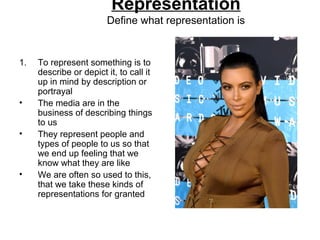
1. To represent something is to
describe or depict it, to call it
up in mind by description or
portrayal
• The media are in the
business of describing things
to us
• They represent people and
types of people to us so that
we end up feeling that we
know what they are like
• We are often so used to this,
that we take these kinds of
representations for granted
Representation
Define what representation is
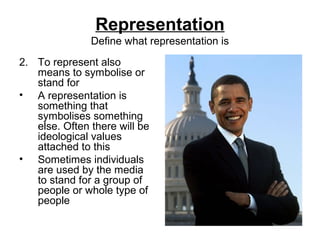
2. To represent also
means to symbolise or
stand for
• A representation is
something that
symbolises something
else. Often there will be
ideological values
attached to this
• Sometimes individuals
are used by the media
to stand for a group of
people or whole type of
people
Representation is…
• The constructed and mediated
presentation of people, things, ideas,
places
• Representation is the process by which
the media present the ‘real world’
• Most importantly to represent is to ‘re-
present’
You can represent…
• Individuals –
• Groups – Teenagers
• Places – New York
• Nations – Iran
• Ideas – Religion/ the family
• Regions/Location – North of England
What are important questions to
ask?
• WHO or WHAT is being represented?
• HOW is the representation created?
• WHO has created the representation?
• WHY is the representation created in that
way? What is the intention?
• WHAT is the effect of the representation?
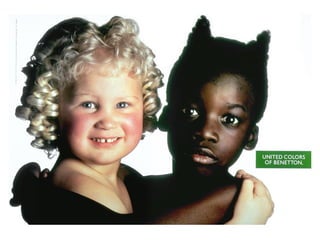
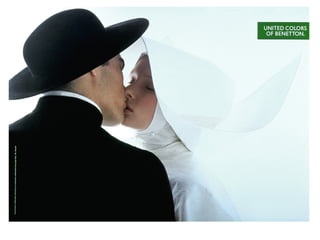
• All of these conflicts were based on taboos, on
the impossibility of co-existence, on a difference
that separates rather than unites. By
acknowledging these differences and
prohibitions, the brand appeared more involved.
It took sides, rather than presenting a simple
“objective” portrayal of the world; it made a
commitment to foster the cohabitation of
opposites, to break down barriers and ensure
dialogue. Benetton had a plan: to integrate
opposites, to unite differences under a single
flag, the flag of its own logo.
How are representations
constructed?
• Any representation is a mixture of:
1. The thing itself
2. The opinions of the people doing the
representation*
3. The reaction of the individual to the
representation*
4. The context of the society in which the
representation is taking place*
So what’s mediation?
• A representation is the final product after all of the decisions
have been made.
• Meaning is made in the construction of the representation and the
combination of all the choices coming together (MEDIATION) in
order for the audience to ‘read’ and interpret the information
provided
• Every time we encounter a media text, we are not seeing reality, but
someone’s version of it.
• This may seem like an obvious point, but it is something that is
easily forgotten when we get caught up in enjoying a text. If you see
a picture of a celebrity kissing her boyfriend, you may find it
unsurprising that the picture has been altered and does not show
the reality of the situation, but in fact we should bear this in mind
whatever we encounter in the media.
• The media place us at one remove from reality: they take something
that is real, a person or an event and they change its form to
produce whatever text we end up with. This is called mediation. You
should be looking for this with any media text.
• The selection process is:
1.The decision over what is chosen to be
represented and what is rejected
2.The choices made when organising the
representation
3.The options taken to focus the audience in
a certain way, mediation always ends up
with us, the audience being pushed
towards concentrating on one aspect of
the text and ignoring others
1. Selection (what is chosen)
• Whatever ends up on the screen or in the
paper, much more will have been left out
• Any news story has been selected from
hundreds of others which the producers
decided for you were less interesting
• Any picture has been chosen from an
enormous number of alternatives
2. Organisation
• The various elements will be organised
carefully in ways that real life is not
• In visual media this involves mise-en-
scene and the organisation of narrative
• In the recording of an album the
production might involve re-mixing a track.
• Any medium you can think of will have an
equivalent to these.
3. Focussing
• Mediation always ends up with us, the audience being
encouraged towards concentrating on one aspect of the
text and ignoring others.
• If you are watching a film the camera will pan towards an
important character.
• In a tabloid the headlines will scream, for your attention.
• It can be easy to ignore how different from our everyday
lives this is. If you are walking through a field, you are
unlikely to see a sign saying “look at this amazing tree.”
You make your own decisions about what is worth our
attention.
• The media text, through mediation, tries to do this for us.
REPRESENTATION
• The result of this process of mediation is
that we are given a version of reality which
is altered:
• Those are never the real people that we
are seeing but representations of them
which have somehow been created.
• It is time now to look at this idea of
representation and how it happens.

G325 representation (Collective Identities)

  • 2.
    Defining Representation and Mediation “Representationis a process of mediation” Discuss
  • 3.
    Representation Define what representationis 1. To represent something is to describe or depict it, to call it up in mind by description or portrayal • The media are in the business of describing things to us • They represent people and types of people to us so that we end up feeling that we know what they are like • We are often so used to this, that we take these kinds of representations for granted
  • 4.
    Representation Define what representationis 2. To represent also means to symbolise or stand for • A representation is something that symbolises something else. Often there will be ideological values attached to this • Sometimes individuals are used by the media to stand for a group of people or whole type of people
  • 5.
    Representation is… • Theconstructed and mediated presentation of people, things, ideas, places • Representation is the process by which the media present the ‘real world’ • Most importantly to represent is to ‘re- present’
  • 6.
    You can represent… •Individuals – • Groups – Teenagers • Places – New York • Nations – Iran • Ideas – Religion/ the family • Regions/Location – North of England
  • 7.
    What are importantquestions to ask? • WHO or WHAT is being represented? • HOW is the representation created? • WHO has created the representation? • WHY is the representation created in that way? What is the intention? • WHAT is the effect of the representation?
  • 9.
    • All ofthese conflicts were based on taboos, on the impossibility of co-existence, on a difference that separates rather than unites. By acknowledging these differences and prohibitions, the brand appeared more involved. It took sides, rather than presenting a simple “objective” portrayal of the world; it made a commitment to foster the cohabitation of opposites, to break down barriers and ensure dialogue. Benetton had a plan: to integrate opposites, to unite differences under a single flag, the flag of its own logo.
  • 11.
    How are representations constructed? •Any representation is a mixture of: 1. The thing itself 2. The opinions of the people doing the representation* 3. The reaction of the individual to the representation* 4. The context of the society in which the representation is taking place*
  • 13.
    So what’s mediation? •A representation is the final product after all of the decisions have been made. • Meaning is made in the construction of the representation and the combination of all the choices coming together (MEDIATION) in order for the audience to ‘read’ and interpret the information provided • Every time we encounter a media text, we are not seeing reality, but someone’s version of it. • This may seem like an obvious point, but it is something that is easily forgotten when we get caught up in enjoying a text. If you see a picture of a celebrity kissing her boyfriend, you may find it unsurprising that the picture has been altered and does not show the reality of the situation, but in fact we should bear this in mind whatever we encounter in the media. • The media place us at one remove from reality: they take something that is real, a person or an event and they change its form to produce whatever text we end up with. This is called mediation. You should be looking for this with any media text.
  • 14.
    • The selectionprocess is: 1.The decision over what is chosen to be represented and what is rejected 2.The choices made when organising the representation 3.The options taken to focus the audience in a certain way, mediation always ends up with us, the audience being pushed towards concentrating on one aspect of the text and ignoring others
  • 15.
    1. Selection (whatis chosen) • Whatever ends up on the screen or in the paper, much more will have been left out • Any news story has been selected from hundreds of others which the producers decided for you were less interesting • Any picture has been chosen from an enormous number of alternatives
  • 16.
    2. Organisation • Thevarious elements will be organised carefully in ways that real life is not • In visual media this involves mise-en- scene and the organisation of narrative • In the recording of an album the production might involve re-mixing a track. • Any medium you can think of will have an equivalent to these.
  • 17.
    3. Focussing • Mediationalways ends up with us, the audience being encouraged towards concentrating on one aspect of the text and ignoring others. • If you are watching a film the camera will pan towards an important character. • In a tabloid the headlines will scream, for your attention. • It can be easy to ignore how different from our everyday lives this is. If you are walking through a field, you are unlikely to see a sign saying “look at this amazing tree.” You make your own decisions about what is worth our attention. • The media text, through mediation, tries to do this for us.
  • 18.
    REPRESENTATION • The resultof this process of mediation is that we are given a version of reality which is altered: • Those are never the real people that we are seeing but representations of them which have somehow been created. • It is time now to look at this idea of representation and how it happens.

Editor's Notes

  • #9 http://www.nytimes.com/1991/07/23/business/the-media-business-advertising-benetton-stirs-more-controversy.html?pagewanted=1
  • #11 http://linda03.wordpress.com/2008/01/08/united-colors-of-benetton-and-its-crazy-adverts/