Music Video
Analysis
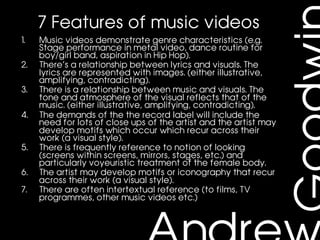
7 Features of music videos
1.  Music videos demonstrate genre characteristics (e.g.
Stage performance in metal video, dance routine for
boy/girl band, aspiration in Hip Hop).
2.  There’s a relationship between lyrics and visuals. The
lyrics are represented with images. (either illustrative,
amplifying, contradicting).
3.  There is a relationship between music and visuals. The
tone and atmosphere of the visual reflects that of the
music. (either illustrative, amplifying, contradicting).
4.  The demands of the the record label will include the
need for lots of close ups of the artist and the artist may
develop motifs which occur which recur across their
work (a visual style).
5.  There is frequently reference to notion of looking
(screens within screens, mirrors, stages, etc.) and
particularly voyeuristic treatment of the female body.
6.  The artist may develop motifs or iconography that recur
across their work (a visual style).
7.  There are often intertextual reference (to films, TV
programmes, other music videos etc.)
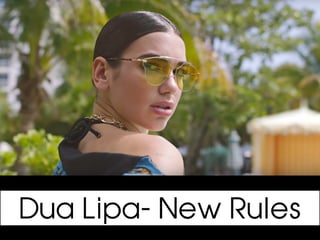
Dua Lipa- New Rules
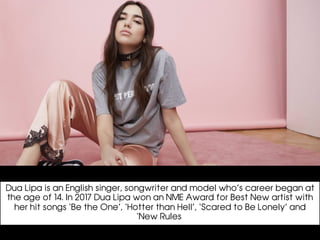
Dua Lipa is an English singer, songwriter and model who’s career began at
the age of 14. In 2017 Dua Lipa won an NME Award for Best New artist with
her hit songs ‘Be the One’, ‘Hotter than Hell’, ‘Scared to Be Lonely’ and
‘New Rules’
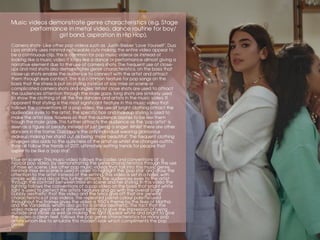
Mise en scene- This music video follows the codes and conventions of a
typical pop video, by demonstrating the genre characteristics through the use
of mise en scene. Like other pop music videos that fall into this music genre,
minimal mise en scene is used in order to highlight the ‘pop star’ and draw the
attention to the artist instead of the setting. This video is set in a hotel, with
simple walls and décor this further attracts the audiences eyes to the artist
through the contrast between mise en scene and her styling. In this video the
lighting follows the conventions of a pop video on the basis that bright white
light is used to perfect the artists features and go with the overall bright
bubbly aesthetic that the video and the lyrics give off that are general
characteristics of pop videos. The repeated pastel colour palette used
throughout the frames gives the video a 1950’s theme by the likes of Martha
and the Vandellas, whom also go for a similar aesthetic. The fact that the
video makes great use of different lighting to give the impression of being
outside and inside as well as making the light appear white and bright to give
the video a clean feel, follows the pop genre characteristics for many pop
artists whom like to emulate this modern look which compliments the pop
genre.
Camera shots- Like other pop videos such as Justin Bieber ‘Love Yourself’, Dua
Lipa similarly uses minimal noticeable cuts making the entire video appear to
be a continuous clip, this is common for pop music videos as instead of
looking like a music video it looks like a dance or performance almost giving a
narrative element due to the use of camera shots. The frequent use of close-
ups and mid shots also demonstrates genre characteristics, on the basis that
close-up shots enable the audience to connect with the artist and attract
them through eye contact. This is a common feature for pop songs on the
basis that the stress is put on styling instead of say mise on scene or
complicated camera shots and angles. Whilst close shots are used to attract
the audiences attention through the male gaze, long shots are similarly used
to show the clothing of all the the dancers and artists in the music video. It
apparent that styling is the most significant feature in this music video that
follows the conventions of a pop video, the use of bright clothing attract the
audiences eyes to the artist, the specific hair and makeup styling is used to
make the artist look flawless so that the audience aspires to be like them
trough the male gaze. This further attracts the audience as the ‘pop artist’ is
seen as a figure of beauty instead of just being a singer. Whilst there are other
dancers in the frame, Dua Lipa is the only individual wearing glamorous
makeup making her stand out as being ‘more beautiful’. The frequent clothing
changes also adds to the quirkiness of the artist as whilst she changes outfits,
they all follow the trends of 2017, ultimately setting trends for people that
aspire to be like a ‘pop star’.
	
Music videos demonstrate genre characteristics (e.g. Stage
performance in metal video, dance routine for boy/
girl band, aspiration in Hip Hop).
There’s a relationship between lyrics and
visuals. The lyrics are represented with
images. (either illustrative, amplifying,
contradicting).
	
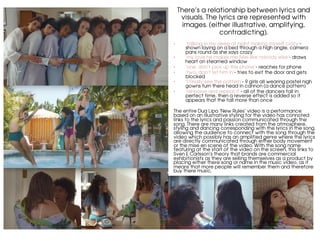
•  ‘talking in my sleep at night making myself crazy’-
shown laying on a bed through a high angle, camera
pans round as she says crazy
•  ‘my love he makes me feel like nobody else’- draws
heart on steamed window
•  ‘one, don’t pick up the phone’- reaches for phone
•  ‘two, don’t let him in’- tries to exit the door and gets
blocked
•  ‘I finally see the pattern’- 9 girls all wearing pastel nigh
gowns turn there head in cannon (a dance pattern)
•  ‘rehearse and repeat it’- all of the dancers fall in
perfect time, then a reverse effect is added so it
appears that the fall more than once
The entire Dua Lipa ‘New Rules’ video is a performance
based on an illustrative styling for the video has connoted
links to the lyrics and passion communicated through the
song. There are many links created from the atmosphere,
styling and dancing corresponding with the lyrics in the song,
allowing the audience to connect with the song through the
video which possibly has an amplified genre where the lyrics
are directly communicated through either body movement
or the mise en scene of the video. With the song name
featuring at the start of the video on the screen, this links to
Sven E Carlsson’s theory that brands are commercial
exhibitionists as they are selling themselves as a product by
placing either there song or name in the music video, as it
means that more people will remember them and therefore
buy there music.
There is a relationship between music and
visuals. The tone and atmosphere of the
visual reflects that of the music. (either
illustrative, amplifying, contradicting).
	
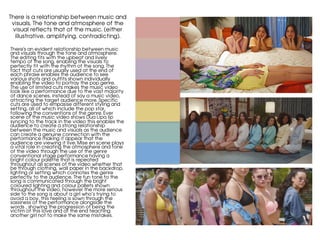
There's an evident relationship between music
and visuals through the tone and atmosphere.
The editing fits with the upbeat and lively
tempo of the song, enabling the visuals to
perfectly fit with the rhythm of the song. The
fact that cuts are usually used at the end of
each phrase enables the audience to see
various shots and outfits shown individually
enabling the video to portray the pop genre.
The use of limited cuts makes the music video
look like a performance due to the vast majority
of dance scenes, instead of say a music video,
attracting the target audience more. Specific
cuts are used to empasise different styling and
setting, all of which include the pop star,
following the conventions of the genre. Ever
scene of the music video shows Dua Lipa lip
syncing to the track in the video this enables the
audience to create a strong relationship
between the music and visuals as the audience
can create a genuine connection with the
performance making it appear that the
audience are viewing it live. Mise en scene plays
a vital role in creating the atmosphere and tone
of the video through the use of the genre
conventional stage performance having a
bright colour palette that is repeated
throughout all scenes of the video whether that
be through clothing, wall paper in the backdrop,
lighting or setting which connotes the genre
perfectly to the audience. The fun tone to the
song is communicated through the bright
coloured lighting and colour pallets shown
throughout the video, however the more serious
side to the song is about a girl who’s trying to
avoid a boy, this feeling is sown through the
sassiness of the performance alongside the
words , showing the progression of being the
victim of this love and at the end teaching
another girl not to make the same mistakes.
The demands of the the record label will
include the need for lots of close ups of the
artist and the artist may develop motifs
which occur which recur across their work
(a visual style).
	
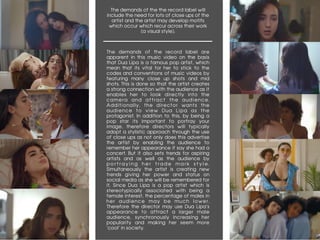
The demands of the record label are
apparent in this music video on the basis
that Dua Lipa is a famous pop artist, which
mean that its vital for her to stick to the
codes and conventions of music videos by
featuring many close up shots and mid
shots. This is done so that the artist creates
a strong connection with the audience as it
enables her to look directly into the
camera and attract the audience.
Additionally, the director wants the
audience to view Dua Lipa as the
protagonist. In addition to this, by being a
pop star its important to portray your
image, therefore directors will typically
adopt a stylistic approach through the use
of close ups as not only does this advertise
the artist by enabling the audience to
remember her appearance if say she had a
concert. But it also sets trends for aspiring
artists and as well as the audience by
p o r t r a y i n g h e r t r a d e m a r k s t y l e .
Simultaneously the artist is creating new
trends giving her power and status on
social media as she will be remembered for
it. Since Dua Lipa is a pop artist which is
stereotypically associated with being a
female interest, the percentage of males in
her audience may be much lower.
Therefore the director may use Dua Lipa’s
appearance to attract a larger male
audience, synchronously increasing her
popularity and making her seem more
‘cool’ in society.
There is frequently reference to notion of looking
(screens within screens, mirrors, stages, etc.) and
particularly voyeuristic treatment of the female
body.
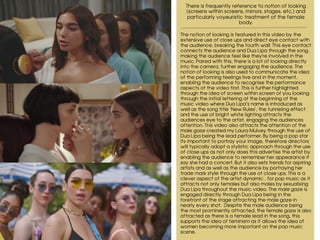
The notion of looking is featured in this video by the
extensive use of close ups and direct eye contact with
the audience, breaking the fourth wall. This eye contact
connects the audience and Dua Lipa through the song,
making the audience feel like they're involved in the
music. Paired with this, there is a lot of looking directly
into the camera, further engaging the audience. The
notion of looking is also used to communicate the idea
of the performing feelings live and in the moment,
enabling the audience to recognise the performance
aspects of the video first. This is further highlighted
through the idea of screen within screen of you looking
through the initial lettering at the beginning of the
music video where Dua Lipa’s name is introduced as
well as the song title ‘New Rules’, the tunneling effect
and the use of bright white lighting attracts the
audiences eye to the artist, engaging the audiences
attention. This video also attracts the attention of the
male gaze created my Laura Mulvey through the use of
Dua Lipa being the lead performer. By being a pop star
its important to portray your image, therefore directors
will typically adopt a stylistic approach through the use
of close ups as not only does this advertise the artist by
enabling the audience to remember her appearance if
say she had a concert. But it also sets trends for aspiring
artists and as well as the audience by portraying her
trade mark style through the use of close ups. This is a
clever aspect of the artist dynamic , for pop music as it
attracts not only females but also males by sexualising
Dua Lipa throughout the music video. The male gaze is
engaged directly through Dua Lipa being in the
forefront of the stage attracting the male gaze in
nearly every shot. Despite the male audience being
the most prominently attracted, the female gaze is also
attracted as there is a female lead in the song, this
supports the idea of feminism as it allows the idea of
women becoming more important on the pop music
scene.
The artist may develop motifs or
iconography that recur across their work
(a visual style).
	
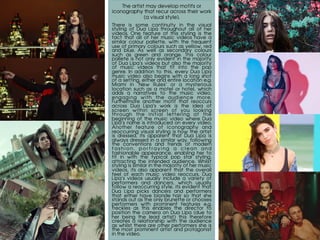
There is some continuity in the visual
styling of Dua Lipa throughout all of her
videos. One feature of this styling is the
fact that all of her music videos have a
similar colour pallette, with the frequent
use of primary colours such as yellow, red
and blue. As well as secondary colours
such as green and orange. This colour
pallete is not only evident in the majority
of Dua Lipa’s videos but also the majority
of music videos that fit into the pop
genre. In addition to this, every Dua Lipa
music video also begins with a long shot
of a setting, either and entire location e.g.
Miami in ‘New Rules’ or a mysterious
location such as a motel or hotel, which
adds a narratives to the music video,
engaging with the audience more.
Furthermore another motif that reoccurs
across Dua Lipa’s work is the idea of
screen within screen of you looking
through the initial lettering at the
beginning of the music video where Dua
Lipa’s name is introduced on every video.
Another feature of iconography and
reoccurring visual styling is how the artist
is dressed, its apparent that Dua Lipa is
always dressed in a similar way, following
the conventions and trends of modern
f a s h i o n , p o r t r a y i n g a c l e a n a n d
fashionable appearance, enabling her to
fit in with the typical pop star styling,
attracting the intended audience. Whilst
styling is similar in the majority of her music
videos, its also apparent that the overall
feel of each music video reoccurs, Dua
Lipa’s videos usually include a variety of
performers and dancers, which usually
follow a reoccurring style, its evident that
Dua Lipa picks dancers and performers
that either have blonde hair so that she
stands out as the only brunette or chooses
performers with prominent features e.g.
freckles as this enables the director to
position the camera on Dua Lipa (due to
her being the lead artist) this therefore
creates a relationship with the audience
as whilst there are other performers she is
the most prominent artist and protagonist
in the video.
There are often intertextual reference (to films, TV programmes, other
music videos etc.)
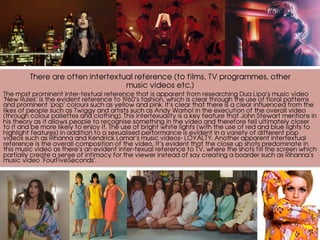
	The most prominent inter-textual reference that is apparent from researching Dua Lipa’s music video
‘New Rules’ is the evident reference to 1960’s fashion, which is clear through the use of floral patterns
and prominent ‘pop’ colours such as yellow and pink. It’s clear that there is a clear influenced from the
likes of people such as Twiggy and artists such as Andy Warhol in the execution of the overall video
(through colour pallettes and clothing). This intertexuality is a key feature that John Stewart mentions in
his theory as it allows people to recognise something in the video and therefore fell ultimately closer
to it and be more likely to enjoy it. The use of bright white lights (with the use of red and blue lights to
highlight features) in addition to a sexualised performance is evident in a variety of different pop
videos such as Rihanna and Kendrick Lamar’s music videos- LOYALTY. Another apparent intertextual
reference is the overall composition of the video, It’s evident that the close up shots predominate in
this music video as there’s an evident inter-texual reference to TV, where the shots fill the screen which
partially create a sense of intimacy for the viewer instead of say creating a boarder such as Rihanna’s
music video ‘FourFiveSeconds’.
Rihanna-	Stay	
Rihanna- Stay
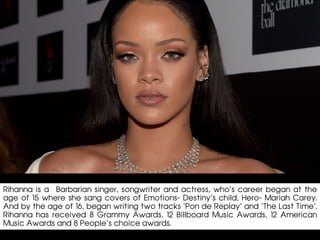
Rihanna is a Barbarian singer, songwriter and actress, who’s career began at the
age of 15 where she sang covers of Emotions- Destiny’s child, Hero- Mariah Carey.
And by the age of 16, began writing two tracks ‘Pon de Replay’ and ‘The Last Time’.
Rihanna has received 8 Grammy Awards, 12 Billboard Music Awards, 12 American
Music Awards and 8 People’s choice awards.
Music videos demonstrate genre
characteristics (e.g. Stage performance
in metal video, dance routine for boy/
girl band, aspiration in Hip Hop).
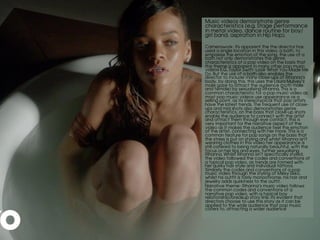
Camerawork- Its apparent the the director has
used a single location in this video, a bath, to
empasise the emotion of the song, the use of a
bath not only demonstrates the genre
characteristics of a pop video on the basis that
this theme is apparent in many other pop music
videos E.G. Taylor Swift- Look What You Made Me
Do. But the use of a bath also enables the
director to include many close-ups of Rihanna’s
body, by doing this, this uses the Laura Mulvey’s
male gaze to attract the audience (both male
and female) by sexualising Rihanna. This is a
common characteristic for a pop music video as
most pop music videos use appearance as a
selling point, as its stereotypical that pop artists
have the latest trends. The frequent use of close-
ups and mid shots also demonstrates genre
characteristics, on the basis that close-up shots
enable the audience to connect with the artist
and attract them through eye contact, this is
very important for the narrative aspect of the
video as it makes the audience feel the emotion
of the artist, connecting with her more. This is a
common feature for pop songs on the basis that
the stress is put on styling and whilst Rihanna isn't
wearing clothes in this video her appearance is
still catered to being naturally beautiful, with the
focus on her lips and eyes, further sexualising
Rihanna. Whilst Rihanna isn’t specifically styled,
the video followed the codes and conventions of
a typical pop video, as trends are formed with
her quirky hair style and individual tattoos.
Similarly the codes and conventions of a pop
music video through the styling of Mikky Ekko,
whilst his outfit is fairly monochrome, his hair and
jewelry adds quirkiness to the outfit.
Narrative theme- Rihanna’s music video follows
the common codes and conventions of a
narrative pop video, with a typical boy
relationship/breakup story line. Its evident that
directors choose to use this story as it can be
applied to the wide audience that pop music
caters to, attracting a wider audience
There’s a relationship between lyrics and visuals.
The lyrics are represented with images. (either
illustrative, amplifying, contradicting).
	
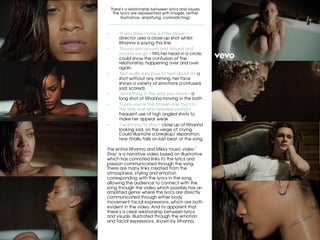
•  ‘If you dare come a little closer’-
director uses a close-up shot whilst
Rihanna is saying this line
•  ‘Round and around and around and
around we go’- tilts her head in a circle,
could show the confusion of the
relationship, happening over and over
again.
•  ‘Not really sure how to feel about it’- a
shot without any miming, her face
shows a variety of emotions (confused,
sad, scared)
•  ‘Something in the way you move’- a
long shot of Rihanna moving in the bath
•  ‘Funny you’re the broken one, but I’m
the only one who needed saving’-
frequent use of high angled shots to
make her appear weak
•  ‘I want you to stay’- close up of Rihanna
looking sad, on the verge of crying.
Could illustrate a breakup/ separation,
tear finally falls on last beat of the song.
The entire Rihanna and Mikky music video ’
Stay’ is a narrative video based on illustrative
which has connoted links to the lyrics and
passion communicated through the song.
There are many links created from the
atmosphere, styling and emotion
corresponding with the lyrics in the song,
allowing the audience to connect with the
song through the video which possibly has an
amplified genre where the lyrics are directly
communicated through either body
movement facial expressions, which are both
evident in the video. And its apparent that
there’s a clear relationship between lyrics
and visuals, illustrated through the emotion
and facial expressions, shown by Rihanna.
There is a relationship between music and
visuals. The tone and atmosphere of the visual
reflects that of the music. (either illustrative,
amplifying, contradicting).
In this video there are clear links between the
music and visuals, connecting tone and
atmosphere. The editing of the music video
fits with the slow tempo of the song as there
are very limited cuts and locations are also
limited in the entire video, meaning that the
calm, emotional mood is able to be continued
perfectly throughout the entire video. The
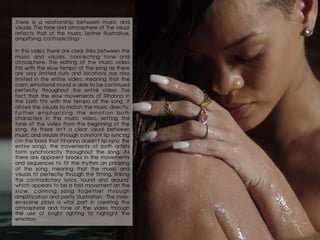
fact that the slow movements of Rihanna in
the bath fits with the tempo of the song, it
allows the visuals to match the music directly,
further emphasizing the emotion both
characters in the music video, setting the
tone of the video from the beginning of the
song. As there isn’t a clear visual between
music and visuals through constant lip syncing
(on the basis that Rihanna doesn’t lip sync the
entire song), the movements of both artists
form synchronicity throughout the song. As
there are apparent breaks in the movements
and sequences to fit the rhythm an phrasing
of the song, meaning that the music and
visuals fit perfectly through the timing, linking
the contradictory lyrics ‘round and around’
which appears to be a fast movement an the
slow, calming song together through
amplification and partly illustration. The mise-
en-scene plays a vital part in creating the
atmosphere and tone of the video through
the use of bright lighting to highlight the
emotion.
The demands of the the record label will include the need for lots of close ups of the artist and the
artist may develop motifs which occur which recur across their work (a visual style).
	
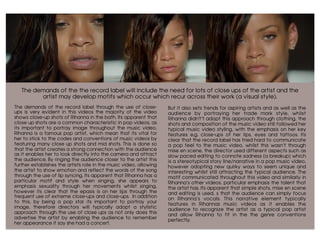
The demands of the record label through the use of close-
ups is very evident in this videos the majority of the video
shows close-up shots of Rihanna in the bath. Its apparent that
close up shots are a common characteristic in pop videos, as
its important to portray image throughout the music video,
Rihanna is a famous pop artist, which mean that its vital for
her to stick to the codes and conventions of music videos by
featuring many close up shots and mid shots. This is done so
that the artist creates a strong connection with the audience
as it enables her to look directly into the camera and attract
the audience. By ringing the audience closer to the artist this
further establishes the artists role in the music video, allowing
the artist to show emotion and reflect the words of the song
through the use of lip syncing. Its apparent that Rihanna has a
particular motif and style when singing, she appears to
emphasis sexuality through her movements whilst singing,
however its clear that the epasis is on her lips through the
frequent use of extreme close-ups and close-ups. In addition
to this, by being a pop star its important to portray your
image, therefore directors will typically adopt a stylistic
approach through the use of close ups as not only does this
advertise the artist by enabling the audience to remember
her appearance if say she had a concert.
But it also sets trends for aspiring artists and as well as the
audience by portraying her trade mark style, whilst
Rihanna didn't’t adopt this approach through clothing, the
shots and composition of the music video still followed her
typical music video styling, with the emphasis on her key
features e.g. close-ups of her lips, eyes and tattoos. Its
clear that the record label has tried hard to communicate
a pop feel to the music video, whilst this wasn’t through
mise en scene, the director used different aspects such as
slow paced editing to connote sadness (a breakup) which
is a stereotypical story line/narrative in a pop music video,
however adopting new quirky ways to seem unique and
interesting whilst still attracting the typical audience. The
motif communicated throughout this video and similarly in
Rihanna’s other videos, particular emphasis the talent that
the artist has. Its apparent that simple shots, mise en scene
and editing is used, s that the audience can simply focus
on Rihanna’s vocals. This narrative element typically
features in Rihannas music videos as it enables the
audience to recognize the artist as a typical pop artist
and allow Rihanna to fit in the the genre conventions
perfectly.
There is frequently reference to notion of looking
(screens within screens, mirrors, stages, etc.) and
particularly voyeuristic treatment of the female body.
	
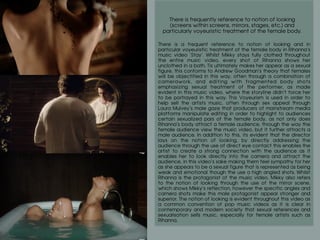
There is a frequent reference to notion of looking and in
particular voyeuristic treatment of the female body in Rihanna’s
music video ‘Stay’. Whilst Mikky stays fully clothed throughout
the entire music video, every shot of Rihanna shows her
unclothed in a bath. Tis ultimately makes her appear as a sexual
figure, this conforms to Andrew Goodman’s theory that females
will be objectified in this way, often through a combination of
camerawork, and editing with fragmented body shots
emphasizing sexual treatment of the performer, as made
evident in this music video, where the storyline didn’t force her
to be portrayed in this way. This Voyeurism is used in order to
help sell the artists music, often through sex appeal through
Laura Mulvey’s male gaze that producers of mainstream media
platforms manipulate editing in order to highlight to audiences
certain sexualized pars of the female body, as not only does
Rihanna’s body attract a female audience, through the way the
female audience view the music video, but it further attracts a
male audience. In addition to this, its evident that the director
lays on the notion of looking, by directly addressing the
audience through the use of direct eye contact this enables the
artist to create a strong connection with the audience as it
enables her to look directly into the camera and attract the
audience, in this video’s sake making them feel sympathy for her
as she appears to be a sexual figure that is represented as being
weak and emotional though the use o high angled shots. Whilst
Rihanna is the protagonist of the music video, Mikky also refers
to the notion of looking through the use of the mirror scene,
which shows Mikky’s reflection, however the specific angles and
camera shots make this male protagonist appear stronger and
superior. The notion of looking is evident throughout this video as
a common convention of pop music videos as it is clear in
contemporary and modern society that sexual references and
sexualisation sells music, especially for female artists such as
Rihanna.
The artist may develop motifs or iconography that
recur across their work (a visual style).
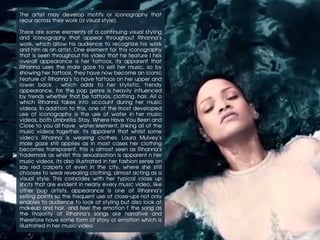
There are some elements of a continuing visual styling
and iconography that appear throughout Rihanna’s
work, which allow his audience to recognize his work
and him as an artist. One element for this iconography
that is seen throughout his video that he feature I hsis
overall appearance is her tattoos, its apparent that
Rihanna uses the male gaze to sell her music, so by
showing her tattoos, they have now become an iconic
feature of Rihanna’s to have tattoos on her upper and
lower back , which adds to her stylistic, trendy
appearance, for the pop genre is heavily influenced
by trends whether that be tattoos, clothing, hair. All o
which Rihanna takes into account during her music
videos. In addition to this, one of the most developed
use of iconography is the use of water in her music
videos, both Umbrella, Stay, Where Have You Been and
Close to you all have water element, linking all of the
music videos together, its apparent that whilst some
video’s Rihanna is wearing clothes, Laura Mulvey’s
male gaze still applies as in most cases her clothing
becomes transparent, this is almost seen as Rihanna’s
trademark as whilst this sexualisation is apparent n her
music videos, its also illustrated in her fashion sense on
say red carpets of even in the city, where she still
chooses to wear revealing clothing, almost acting as a
visual style. This coincides with her typical close up
shots that are evident in nearly every music video, like
other pop artists, appearance is one of Rihanna’s
selling points so the frequent use of close-ups not only
enables to audience to look at styling but also look at
makeup and hair, and feel the emotion f the song as
the majority of Rihanna’s songs are narrative and
therefore have some form of story or emotion which is
illustrated in her music video.
There are often intertextual reference
(to films, TV programmes, other music
videos etc.)
	
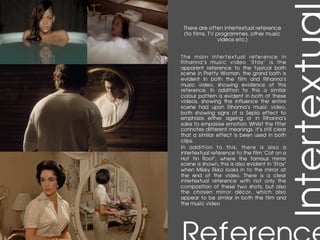
The main intertextual reference in
Rihanna’s music video ‘Stay’ is the
apparent reference to the typical bath
scene in Pretty Woman, the grand bath is
evident in both the film and Rihanna’s
music video, showing evidence of this
reference. In addition to this a similar
colour pattern is evident in both of these
videos, showing the influence the entire
scene had upon Rihanna’s music video,
both showing signs of a Sepia effect to
emphasis either ageing or in Rihanna’s
sake to empasise emotion. Whilst the filter
connotes different meanings, it’s still clear
that a similar effect is been used in both
clips.
In addition to this, there is also a
intertextual reference to the film ‘Cat on a
Hot tin Roof’, where the famous mirror
scene is shown, this is also evident in ‘Stay’
when Mikky Ekko looks in to the mirror at
the end of the video. There is a clear
intertextual reference with not only the
composition of these two shots, but also
the chosen mirror décor, which also
appear to be similar in both the film and
the music video
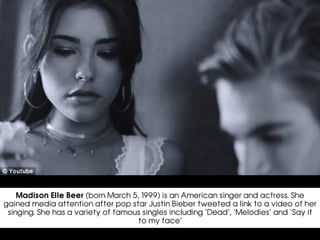
Madison Beer - Say It To My Face
Madison Elle Beer (born March 5, 1999) is an American singer and actress. She
gained media attention after pop star Justin Bieber tweeted a link to a video of her
singing. She has a variety of famous singles including ‘Dead’, ‘Melodies’ and ‘Say it
to my face’
Music videos demonstrate genre characteristics. (e.g. stage performance in
metal videos, dance routine for boy/girl band, aspiration in Hip Hop).
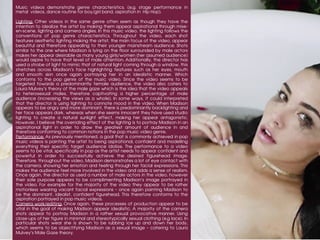
Lighting: Other videos in the same genre often seem as though they have the
intention to idealize the artist by making them appear aspirational through mise-
en-scene, lighting and camera angles. In this music video, the lighting follows the
conventions of pop genre characteristics. Throughout the video, each shot
features aesthetic lighting making the artist, the main focus of the video, appear
beautiful and therefore appealing to their younger mainstream audience. Shots
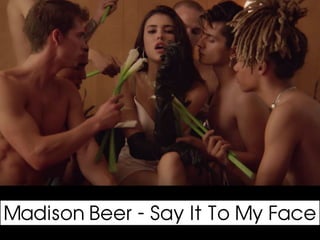
similar to the one where Madison is lying on the floor surrounded by male actors
makes her appear desirable as many young girls/women (her assumed audience)
would aspire to have that level of male attention. Additionally, the director has
used a strobe of light to mimic that of natural light coming through a window, this
stretches across Madison’s face highlighting features such as her eyes, mouth
and smooth skin once again portraying her in an idealistic manner. Which
conforms to the pop genre of the music video. Since the video seems to be
targeted towards a predominantly female audience, the video also caters to
Laura Mulvey’s theory of the male gaze which is the idea that the video appeals
to heterosexual males, therefore captivating a higher percentage of male
audience (increasing the views as a whole). In some ways, it could interpreted
that the director is using lighting to connote mood in the video. When Madison
appears to be angry and more dominant, there is predominantly backlighting and
her face appears dark, whereas when she seems innocent they have used studio
lighting to create a natural sunlight effect, making her appear antagonistic.
However, I believe the overriding effect of the lighting is to portray Madison in an
aspirational light in order to draw the greatest amount of audience in and
therefore conforming to common notions in the pop music video genre.
Performance: As previously mentioned, a goal that is commonly achieved in pop
music videos is painting the artist to being aspirational, confident and modelling
everything their specific target audience idolize. The performance to a video
seems to be vital, specifically in pop as the artist needs to appear confident and
powerful in order to successfully achieve the desired figurehead image.
Therefore, throughout the video, Madison demonstrates a lot of eye contact with
the camera, showing her emotion and feeling through her facial expressions. This
makes the audience feel more involved in the video and adds a sense of realism.
Once again, the director as used a number of male actors in the video, however
their sole purpose appears to be complimenting Madison’s image portrayed in
the video. For example for the majority of the video they appear to be rather
motionless wearing vacant facial expressions – once again painting Madison to
be the dominant, idealist, confident figurehead. This therefore conforms to the
aspiration portrayed in pop music videos.
Camera work/editing: Once again, these processes of production appear to be
vital in the goal of making Madison appear idealistic. A majority of the camera
shots appear to portray Madison in a rather sexual provocative manner. Using
close-ups of her figure in minimal and stereotypically sexual clothing (e.g lace). In
particular shots wear she is shown to be rubbing ice up and down her body,
which seems to be objectifying Madison as a sexual image – catering to Laura
Mulvey’s Male Gaze theory.
There is a relationship between lyrics and visuals. The lyrics are represented with images. (either illustrative, amplifying,
contradicting).
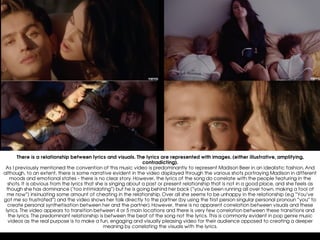
As I previously mentioned the convention of this music video is predominantly to represent Madison Beer in an idealistic fashion. And
although, to an extent, there is some narrative evident in the video displayed through the various shots portraying Madison in different
moods and emotional states - there is no clear story. However, the lyrics of the song do correlate with the people featuring in the
shots. It is obvious from the lyrics that she is singing about a past or present relationship that is not in a good place, and she feels as
though she has dominance (‘too intimidating”) but he is going behind her back (“you’ve been running all over town, making a fool of
me now”) insinuating some amount of cheating in the relationship. Over all she seems to be unhappy in the relationship (e.g “You’ve
got me so frustrated”) and the video shows her talk directly to the partner (by using the first person singular personal pronoun “you” to
create personal synthetisation between her and the partner). However, there is no apparent correlation between visuals and these
lyrics. The video appears to transition between 4 or 5 main locations and there is very few correlation between these transitions and
the lyrics. The predominant relationship is between the beat of the song not the lyrics. This is commonly evident in pop genre music
videos as the real purpose is to make a fun, engaging and visually pleasing video for their audience opposed to creating a deeper
meaning by correlating the visuals with the lyrics.
There is a relationship between music and
visuals. The tone and atmosphere of the
visual reflects that of the music. (either
illustrative, amplifying, contradicting).
	
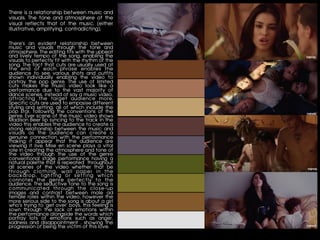
There's an evident relationship between
music and visuals through the tone and
atmosphere. The editing fits with the upbeat
and lively tempo of the song, enabling the
visuals to perfectly fit with the rhythm of the
song. The fact that cuts are usually used at
the end of each phrase enables the
audience to see various shots and outfits
shown individually enabling the video to
portray the pop genre. The use of limited
cuts makes the music video look like a
performance due to the vast majority of
dance scenes, instead of say a music video,
attracting the target audience more.
Specific cuts are used to empasise different
styling and setting, all of which include the
pop star, following the conventions of the
genre. Ever scene of the music video shows
Madison Beer lip syncing to the track in the
video this enables the audience to create a
strong relationship between the music and
visuals as the audience can create a
genuine connection with the performance
making it appear that the audience are
viewing it live. Mise en scene plays a vital
role in creating the atmosphere and tone of
the video through the use of the genre
conventional stage performance having a
natural palette that is repeated throughout
all scenes of the video whether that be
through clothing, wall paper in the
backdrop, lighting or setting which
connotes the genre perfectly to the
audience. The seductive tone to the song is
communicated through the close-up
images and contrast between male ad
female roles within the video, however the
more serious side to the song is about a girl
who’s trying to ‘get over’ boys, this feeling is
sown through the lack of emotions within
the performance alongside the words which
portray lots of emotions such as anger,
sadness and disappointment , showing the
progression of being the victim of this love.
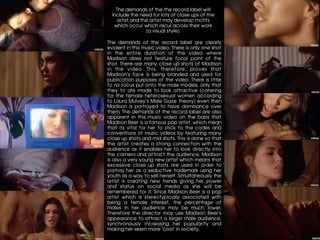
The demands of the the record label will
include the need for lots of close ups of the
artist and the artist may develop motifs
which occur which recur across their work
(a visual style).
	
The demands of the record label are clearly
evident in this music video. There is only one shot
in the entire duration of the video where
Madison does not feature focal point of the
shot. There are many close up shots of Madison
in the video. This, therefore, proves that
Madison’s face is being branded and used for
publication purposes of the video. There is little
to no focus put onto the male models, only that
they to are made to look attractive (catering
for the female heterosexual women according
to Laura Mulvey’s Male Gaze theory) even then
Madison is portrayed to have dominance over
them. The demands of the record label are also
apparent in this music video on the basis that
Madison Beer is a famous pop artist, which mean
that its vital for her to stick to the codes and
conventions of music videos by featuring many
close up shots and mid shots. This is done so that
the artist creates a strong connection with the
audience as it enables her to look directly into
the camera and attract the audience, Madison
is also a very young new artist which means that
excessive close up shots are used in order to
portray her as a seductive trademark using her
youth as a way to sell herself. Simultaneously the
artist is creating new trends giving her power
and status on social media as she will be
remembered for it. Since Madison Beer is a pop
artist which is stereotypically associated with
being a female interest, the percentage of
males in her audience may be much lower.
Therefore the director may use Madison Beer’s
appearance to attract a larger male audience,
synchronously increasing her popularity and
making her seem more ‘cool’ in society.
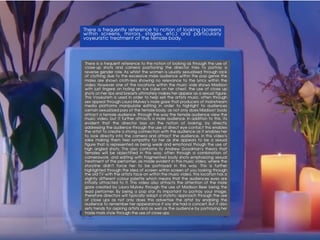
There is frequently reference to notion of looking (screens
within screens, mirrors, stages, etc.) and particularly
voyeuristic treatment of the female body.
There is a frequent reference to the notion of looking as through the use of
close-up shots and camera positioning the director tries to portray a
reverse gender role. As whilst the women is usually sexualised through lack
of clothing due to the excessive male audience within the pop genre the
males are shown cloth-less showing no relevance to the lyrics within the
video. However one of the locations within the music vide shows Madison
with just lingere on holing an ice cube on her chest, the use of close up
shots on her lips and breasts ultimately makes her appear as a sexual figure,
This Voyeurism is used in order to help sell the artists music, often through
sex appeal through Laura Mulvey’s male gaze that producers of mainstream
media platforms manipulate editing in order to highlight to audiences
certain sexualized pars of the female body, as not only does Madison’ body
attract a female audience, through the way the female audience view the
music video, but it further attracts a male audience. In addition to this, its
evident that the director lays on the notion of looking, by directly
addressing the audience through the use of direct eye contact this enables
the artist to create a strong connection with the audience as it enables her
to look directly into the camera and attract the audience, in this video’s
sake making them feel sympathy for her as she appears to be a sexual
figure that is represented as being weak and emotional though the use of
high angled shots. This also conforms to Andrew Goodman’s theory that
females will be objectified in this way, often through a combination of
camerawork, and editing with fragmented body shots emphasizing sexual
treatment of the performer, as made evident in this music video, where the
storyline didn’t force her to be portrayed in this way. This is further
highlighted through the idea of screen within screen of you looking through
the old TV with the artists face on within the music video, this location has a
slightly different colour palette which means that the audiences eyes are
initially attracted to it. This video also attracts the attention of the male
gaze created by Laura Mulvey through the use of Madison Beer being the
lead performer. By being a pop star its important to portray your image,
therefore directors will typically adopt a stylistic approach through the use
of close ups as not only does this advertise the artist by enabling the
audience to remember her appearance if say she had a concert. But it also
sets trends for aspiring artists and as well as the audience by portraying her
trade mark style through the use of close ups.
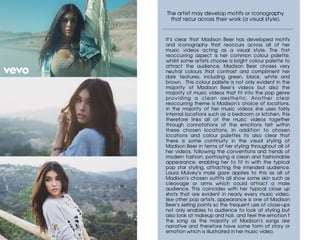
The artist may develop motifs or iconography
that recur across their work (a visual style).
	
It’s clear that Madison Beer has developed motifs
and iconography that reoccurs across all of her
music videos acting as a visual style. The first
reoccurring aspect is her common colour palette,
whilst some artists choose a bright colour palette to
attract the audience, Madison Beer choses very
neutral colours that contrast and compliment her
dark features, including green, black, white and
brown. . This colour pallete is not only evident in the
majority of Madison Beer’s videos but also the
majority of music videos that fit into the pop genre
providing a clean aesthetic. Another clear
reoccurring theme is Madison’s choice of locations,
in the majority of her music videos she uses fairly
internal locations such as a bedroom or kitchen, this
therefore links all of the music videos together
through connotations of the emotions felt within
these chosen locations. In addition to chosen
locations and colour palettes its also clear that
there is some continuity in the visual styling of
Madison Beer in terms of her styling throughout all of
her videos, following the conventions and trends of
modern fashion, portraying a clean and fashionable
appearance, enabling her to fit in with the typical
pop star styling, attracting the intended audience.
Laura Mulvey’s male gaze applies to this as all of
Madison’s chosen outfits all show some skin such as
cleavage or arms which could attract a male
audience. This coincides with her typical close up
shots that are evident in nearly every music video,
like other pop artists, appearance is one of Madison
Beer’s selling points so the frequent use of close-ups
not only enables to audience to look at styling but
also look at makeup and hair, and feel the emotion f
the song as the majority of Madison’s songs are
narrative and therefore have some form of story or
emotion which is illustrated in her music video.
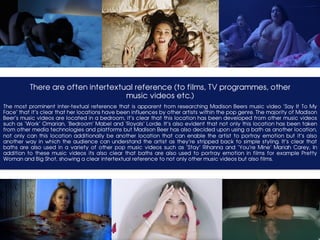
There are often intertextual reference (to films, TV programmes, other
music videos etc.)
	The most prominent inter-textual reference that is apparent from researching Madison Beers music video ‘Say It To My
Face’ that it’s clear that her locations have been influences by other artists within the pop genre. The majority of Madison
Beer’s music videos are located in a bedroom, it’s clear that this location has been developed from other music videos
such as ‘Work’ Omarian, ‘Bedroom’ Mabel and ‘Royals’ Lorde. It’s also evident that not only this location has been taken
from other media technologies and platforms but Madison Beer has also decided upon using a bath as another location,
not only can this location additionally be another location that can enable the artist to portray emotion but it’s also
another way in which the audience can understand the artist as they’re stripped back to simple styling. It’s clear that
baths are also used in a variety of other pop music videos such as ‘Stay’ Rihanna and ‘You’re Mine’ Mariah Carey, In
addition to these music videos its also clear that baths are also used to portray emotion in films for example Pretty
Woman and Big Shot, showing a clear intertextual reference to not only other music videos but also films.

Music video analysis

  • 1.
  • 2.
    7 Features ofmusic videos 1.  Music videos demonstrate genre characteristics (e.g. Stage performance in metal video, dance routine for boy/girl band, aspiration in Hip Hop). 2.  There’s a relationship between lyrics and visuals. The lyrics are represented with images. (either illustrative, amplifying, contradicting). 3.  There is a relationship between music and visuals. The tone and atmosphere of the visual reflects that of the music. (either illustrative, amplifying, contradicting). 4.  The demands of the the record label will include the need for lots of close ups of the artist and the artist may develop motifs which occur which recur across their work (a visual style). 5.  There is frequently reference to notion of looking (screens within screens, mirrors, stages, etc.) and particularly voyeuristic treatment of the female body. 6.  The artist may develop motifs or iconography that recur across their work (a visual style). 7.  There are often intertextual reference (to films, TV programmes, other music videos etc.)
  • 3.
  • 4.
    Dua Lipa isan English singer, songwriter and model who’s career began at the age of 14. In 2017 Dua Lipa won an NME Award for Best New artist with her hit songs ‘Be the One’, ‘Hotter than Hell’, ‘Scared to Be Lonely’ and ‘New Rules’
  • 5.
    Mise en scene-This music video follows the codes and conventions of a typical pop video, by demonstrating the genre characteristics through the use of mise en scene. Like other pop music videos that fall into this music genre, minimal mise en scene is used in order to highlight the ‘pop star’ and draw the attention to the artist instead of the setting. This video is set in a hotel, with simple walls and décor this further attracts the audiences eyes to the artist through the contrast between mise en scene and her styling. In this video the lighting follows the conventions of a pop video on the basis that bright white light is used to perfect the artists features and go with the overall bright bubbly aesthetic that the video and the lyrics give off that are general characteristics of pop videos. The repeated pastel colour palette used throughout the frames gives the video a 1950’s theme by the likes of Martha and the Vandellas, whom also go for a similar aesthetic. The fact that the video makes great use of different lighting to give the impression of being outside and inside as well as making the light appear white and bright to give the video a clean feel, follows the pop genre characteristics for many pop artists whom like to emulate this modern look which compliments the pop genre. Camera shots- Like other pop videos such as Justin Bieber ‘Love Yourself’, Dua Lipa similarly uses minimal noticeable cuts making the entire video appear to be a continuous clip, this is common for pop music videos as instead of looking like a music video it looks like a dance or performance almost giving a narrative element due to the use of camera shots. The frequent use of close- ups and mid shots also demonstrates genre characteristics, on the basis that close-up shots enable the audience to connect with the artist and attract them through eye contact. This is a common feature for pop songs on the basis that the stress is put on styling instead of say mise on scene or complicated camera shots and angles. Whilst close shots are used to attract the audiences attention through the male gaze, long shots are similarly used to show the clothing of all the the dancers and artists in the music video. It apparent that styling is the most significant feature in this music video that follows the conventions of a pop video, the use of bright clothing attract the audiences eyes to the artist, the specific hair and makeup styling is used to make the artist look flawless so that the audience aspires to be like them trough the male gaze. This further attracts the audience as the ‘pop artist’ is seen as a figure of beauty instead of just being a singer. Whilst there are other dancers in the frame, Dua Lipa is the only individual wearing glamorous makeup making her stand out as being ‘more beautiful’. The frequent clothing changes also adds to the quirkiness of the artist as whilst she changes outfits, they all follow the trends of 2017, ultimately setting trends for people that aspire to be like a ‘pop star’. Music videos demonstrate genre characteristics (e.g. Stage performance in metal video, dance routine for boy/ girl band, aspiration in Hip Hop).
  • 6.
    There’s a relationshipbetween lyrics and visuals. The lyrics are represented with images. (either illustrative, amplifying, contradicting). •  ‘talking in my sleep at night making myself crazy’- shown laying on a bed through a high angle, camera pans round as she says crazy •  ‘my love he makes me feel like nobody else’- draws heart on steamed window •  ‘one, don’t pick up the phone’- reaches for phone •  ‘two, don’t let him in’- tries to exit the door and gets blocked •  ‘I finally see the pattern’- 9 girls all wearing pastel nigh gowns turn there head in cannon (a dance pattern) •  ‘rehearse and repeat it’- all of the dancers fall in perfect time, then a reverse effect is added so it appears that the fall more than once The entire Dua Lipa ‘New Rules’ video is a performance based on an illustrative styling for the video has connoted links to the lyrics and passion communicated through the song. There are many links created from the atmosphere, styling and dancing corresponding with the lyrics in the song, allowing the audience to connect with the song through the video which possibly has an amplified genre where the lyrics are directly communicated through either body movement or the mise en scene of the video. With the song name featuring at the start of the video on the screen, this links to Sven E Carlsson’s theory that brands are commercial exhibitionists as they are selling themselves as a product by placing either there song or name in the music video, as it means that more people will remember them and therefore buy there music.
  • 7.
    There is arelationship between music and visuals. The tone and atmosphere of the visual reflects that of the music. (either illustrative, amplifying, contradicting). There's an evident relationship between music and visuals through the tone and atmosphere. The editing fits with the upbeat and lively tempo of the song, enabling the visuals to perfectly fit with the rhythm of the song. The fact that cuts are usually used at the end of each phrase enables the audience to see various shots and outfits shown individually enabling the video to portray the pop genre. The use of limited cuts makes the music video look like a performance due to the vast majority of dance scenes, instead of say a music video, attracting the target audience more. Specific cuts are used to empasise different styling and setting, all of which include the pop star, following the conventions of the genre. Ever scene of the music video shows Dua Lipa lip syncing to the track in the video this enables the audience to create a strong relationship between the music and visuals as the audience can create a genuine connection with the performance making it appear that the audience are viewing it live. Mise en scene plays a vital role in creating the atmosphere and tone of the video through the use of the genre conventional stage performance having a bright colour palette that is repeated throughout all scenes of the video whether that be through clothing, wall paper in the backdrop, lighting or setting which connotes the genre perfectly to the audience. The fun tone to the song is communicated through the bright coloured lighting and colour pallets shown throughout the video, however the more serious side to the song is about a girl who’s trying to avoid a boy, this feeling is sown through the sassiness of the performance alongside the words , showing the progression of being the victim of this love and at the end teaching another girl not to make the same mistakes.
  • 8.
    The demands ofthe the record label will include the need for lots of close ups of the artist and the artist may develop motifs which occur which recur across their work (a visual style). The demands of the record label are apparent in this music video on the basis that Dua Lipa is a famous pop artist, which mean that its vital for her to stick to the codes and conventions of music videos by featuring many close up shots and mid shots. This is done so that the artist creates a strong connection with the audience as it enables her to look directly into the camera and attract the audience. Additionally, the director wants the audience to view Dua Lipa as the protagonist. In addition to this, by being a pop star its important to portray your image, therefore directors will typically adopt a stylistic approach through the use of close ups as not only does this advertise the artist by enabling the audience to remember her appearance if say she had a concert. But it also sets trends for aspiring artists and as well as the audience by p o r t r a y i n g h e r t r a d e m a r k s t y l e . Simultaneously the artist is creating new trends giving her power and status on social media as she will be remembered for it. Since Dua Lipa is a pop artist which is stereotypically associated with being a female interest, the percentage of males in her audience may be much lower. Therefore the director may use Dua Lipa’s appearance to attract a larger male audience, synchronously increasing her popularity and making her seem more ‘cool’ in society.
  • 9.
    There is frequentlyreference to notion of looking (screens within screens, mirrors, stages, etc.) and particularly voyeuristic treatment of the female body. The notion of looking is featured in this video by the extensive use of close ups and direct eye contact with the audience, breaking the fourth wall. This eye contact connects the audience and Dua Lipa through the song, making the audience feel like they're involved in the music. Paired with this, there is a lot of looking directly into the camera, further engaging the audience. The notion of looking is also used to communicate the idea of the performing feelings live and in the moment, enabling the audience to recognise the performance aspects of the video first. This is further highlighted through the idea of screen within screen of you looking through the initial lettering at the beginning of the music video where Dua Lipa’s name is introduced as well as the song title ‘New Rules’, the tunneling effect and the use of bright white lighting attracts the audiences eye to the artist, engaging the audiences attention. This video also attracts the attention of the male gaze created my Laura Mulvey through the use of Dua Lipa being the lead performer. By being a pop star its important to portray your image, therefore directors will typically adopt a stylistic approach through the use of close ups as not only does this advertise the artist by enabling the audience to remember her appearance if say she had a concert. But it also sets trends for aspiring artists and as well as the audience by portraying her trade mark style through the use of close ups. This is a clever aspect of the artist dynamic , for pop music as it attracts not only females but also males by sexualising Dua Lipa throughout the music video. The male gaze is engaged directly through Dua Lipa being in the forefront of the stage attracting the male gaze in nearly every shot. Despite the male audience being the most prominently attracted, the female gaze is also attracted as there is a female lead in the song, this supports the idea of feminism as it allows the idea of women becoming more important on the pop music scene.
  • 10.
    The artist maydevelop motifs or iconography that recur across their work (a visual style). There is some continuity in the visual styling of Dua Lipa throughout all of her videos. One feature of this styling is the fact that all of her music videos have a similar colour pallette, with the frequent use of primary colours such as yellow, red and blue. As well as secondary colours such as green and orange. This colour pallete is not only evident in the majority of Dua Lipa’s videos but also the majority of music videos that fit into the pop genre. In addition to this, every Dua Lipa music video also begins with a long shot of a setting, either and entire location e.g. Miami in ‘New Rules’ or a mysterious location such as a motel or hotel, which adds a narratives to the music video, engaging with the audience more. Furthermore another motif that reoccurs across Dua Lipa’s work is the idea of screen within screen of you looking through the initial lettering at the beginning of the music video where Dua Lipa’s name is introduced on every video. Another feature of iconography and reoccurring visual styling is how the artist is dressed, its apparent that Dua Lipa is always dressed in a similar way, following the conventions and trends of modern f a s h i o n , p o r t r a y i n g a c l e a n a n d fashionable appearance, enabling her to fit in with the typical pop star styling, attracting the intended audience. Whilst styling is similar in the majority of her music videos, its also apparent that the overall feel of each music video reoccurs, Dua Lipa’s videos usually include a variety of performers and dancers, which usually follow a reoccurring style, its evident that Dua Lipa picks dancers and performers that either have blonde hair so that she stands out as the only brunette or chooses performers with prominent features e.g. freckles as this enables the director to position the camera on Dua Lipa (due to her being the lead artist) this therefore creates a relationship with the audience as whilst there are other performers she is the most prominent artist and protagonist in the video.
  • 11.
    There are oftenintertextual reference (to films, TV programmes, other music videos etc.) The most prominent inter-textual reference that is apparent from researching Dua Lipa’s music video ‘New Rules’ is the evident reference to 1960’s fashion, which is clear through the use of floral patterns and prominent ‘pop’ colours such as yellow and pink. It’s clear that there is a clear influenced from the likes of people such as Twiggy and artists such as Andy Warhol in the execution of the overall video (through colour pallettes and clothing). This intertexuality is a key feature that John Stewart mentions in his theory as it allows people to recognise something in the video and therefore fell ultimately closer to it and be more likely to enjoy it. The use of bright white lights (with the use of red and blue lights to highlight features) in addition to a sexualised performance is evident in a variety of different pop videos such as Rihanna and Kendrick Lamar’s music videos- LOYALTY. Another apparent intertextual reference is the overall composition of the video, It’s evident that the close up shots predominate in this music video as there’s an evident inter-texual reference to TV, where the shots fill the screen which partially create a sense of intimacy for the viewer instead of say creating a boarder such as Rihanna’s music video ‘FourFiveSeconds’.
  • 12.
  • 13.
    Rihanna is aBarbarian singer, songwriter and actress, who’s career began at the age of 15 where she sang covers of Emotions- Destiny’s child, Hero- Mariah Carey. And by the age of 16, began writing two tracks ‘Pon de Replay’ and ‘The Last Time’. Rihanna has received 8 Grammy Awards, 12 Billboard Music Awards, 12 American Music Awards and 8 People’s choice awards.
  • 14.
    Music videos demonstrategenre characteristics (e.g. Stage performance in metal video, dance routine for boy/ girl band, aspiration in Hip Hop). Camerawork- Its apparent the the director has used a single location in this video, a bath, to empasise the emotion of the song, the use of a bath not only demonstrates the genre characteristics of a pop video on the basis that this theme is apparent in many other pop music videos E.G. Taylor Swift- Look What You Made Me Do. But the use of a bath also enables the director to include many close-ups of Rihanna’s body, by doing this, this uses the Laura Mulvey’s male gaze to attract the audience (both male and female) by sexualising Rihanna. This is a common characteristic for a pop music video as most pop music videos use appearance as a selling point, as its stereotypical that pop artists have the latest trends. The frequent use of close- ups and mid shots also demonstrates genre characteristics, on the basis that close-up shots enable the audience to connect with the artist and attract them through eye contact, this is very important for the narrative aspect of the video as it makes the audience feel the emotion of the artist, connecting with her more. This is a common feature for pop songs on the basis that the stress is put on styling and whilst Rihanna isn't wearing clothes in this video her appearance is still catered to being naturally beautiful, with the focus on her lips and eyes, further sexualising Rihanna. Whilst Rihanna isn’t specifically styled, the video followed the codes and conventions of a typical pop video, as trends are formed with her quirky hair style and individual tattoos. Similarly the codes and conventions of a pop music video through the styling of Mikky Ekko, whilst his outfit is fairly monochrome, his hair and jewelry adds quirkiness to the outfit. Narrative theme- Rihanna’s music video follows the common codes and conventions of a narrative pop video, with a typical boy relationship/breakup story line. Its evident that directors choose to use this story as it can be applied to the wide audience that pop music caters to, attracting a wider audience
  • 15.
    There’s a relationshipbetween lyrics and visuals. The lyrics are represented with images. (either illustrative, amplifying, contradicting). •  ‘If you dare come a little closer’- director uses a close-up shot whilst Rihanna is saying this line •  ‘Round and around and around and around we go’- tilts her head in a circle, could show the confusion of the relationship, happening over and over again. •  ‘Not really sure how to feel about it’- a shot without any miming, her face shows a variety of emotions (confused, sad, scared) •  ‘Something in the way you move’- a long shot of Rihanna moving in the bath •  ‘Funny you’re the broken one, but I’m the only one who needed saving’- frequent use of high angled shots to make her appear weak •  ‘I want you to stay’- close up of Rihanna looking sad, on the verge of crying. Could illustrate a breakup/ separation, tear finally falls on last beat of the song. The entire Rihanna and Mikky music video ’ Stay’ is a narrative video based on illustrative which has connoted links to the lyrics and passion communicated through the song. There are many links created from the atmosphere, styling and emotion corresponding with the lyrics in the song, allowing the audience to connect with the song through the video which possibly has an amplified genre where the lyrics are directly communicated through either body movement facial expressions, which are both evident in the video. And its apparent that there’s a clear relationship between lyrics and visuals, illustrated through the emotion and facial expressions, shown by Rihanna.
  • 16.
    There is arelationship between music and visuals. The tone and atmosphere of the visual reflects that of the music. (either illustrative, amplifying, contradicting). In this video there are clear links between the music and visuals, connecting tone and atmosphere. The editing of the music video fits with the slow tempo of the song as there are very limited cuts and locations are also limited in the entire video, meaning that the calm, emotional mood is able to be continued perfectly throughout the entire video. The fact that the slow movements of Rihanna in the bath fits with the tempo of the song, it allows the visuals to match the music directly, further emphasizing the emotion both characters in the music video, setting the tone of the video from the beginning of the song. As there isn’t a clear visual between music and visuals through constant lip syncing (on the basis that Rihanna doesn’t lip sync the entire song), the movements of both artists form synchronicity throughout the song. As there are apparent breaks in the movements and sequences to fit the rhythm an phrasing of the song, meaning that the music and visuals fit perfectly through the timing, linking the contradictory lyrics ‘round and around’ which appears to be a fast movement an the slow, calming song together through amplification and partly illustration. The mise- en-scene plays a vital part in creating the atmosphere and tone of the video through the use of bright lighting to highlight the emotion.
  • 17.
    The demands ofthe the record label will include the need for lots of close ups of the artist and the artist may develop motifs which occur which recur across their work (a visual style). The demands of the record label through the use of close- ups is very evident in this videos the majority of the video shows close-up shots of Rihanna in the bath. Its apparent that close up shots are a common characteristic in pop videos, as its important to portray image throughout the music video, Rihanna is a famous pop artist, which mean that its vital for her to stick to the codes and conventions of music videos by featuring many close up shots and mid shots. This is done so that the artist creates a strong connection with the audience as it enables her to look directly into the camera and attract the audience. By ringing the audience closer to the artist this further establishes the artists role in the music video, allowing the artist to show emotion and reflect the words of the song through the use of lip syncing. Its apparent that Rihanna has a particular motif and style when singing, she appears to emphasis sexuality through her movements whilst singing, however its clear that the epasis is on her lips through the frequent use of extreme close-ups and close-ups. In addition to this, by being a pop star its important to portray your image, therefore directors will typically adopt a stylistic approach through the use of close ups as not only does this advertise the artist by enabling the audience to remember her appearance if say she had a concert. But it also sets trends for aspiring artists and as well as the audience by portraying her trade mark style, whilst Rihanna didn't’t adopt this approach through clothing, the shots and composition of the music video still followed her typical music video styling, with the emphasis on her key features e.g. close-ups of her lips, eyes and tattoos. Its clear that the record label has tried hard to communicate a pop feel to the music video, whilst this wasn’t through mise en scene, the director used different aspects such as slow paced editing to connote sadness (a breakup) which is a stereotypical story line/narrative in a pop music video, however adopting new quirky ways to seem unique and interesting whilst still attracting the typical audience. The motif communicated throughout this video and similarly in Rihanna’s other videos, particular emphasis the talent that the artist has. Its apparent that simple shots, mise en scene and editing is used, s that the audience can simply focus on Rihanna’s vocals. This narrative element typically features in Rihannas music videos as it enables the audience to recognize the artist as a typical pop artist and allow Rihanna to fit in the the genre conventions perfectly.
  • 18.
    There is frequentlyreference to notion of looking (screens within screens, mirrors, stages, etc.) and particularly voyeuristic treatment of the female body. There is a frequent reference to notion of looking and in particular voyeuristic treatment of the female body in Rihanna’s music video ‘Stay’. Whilst Mikky stays fully clothed throughout the entire music video, every shot of Rihanna shows her unclothed in a bath. Tis ultimately makes her appear as a sexual figure, this conforms to Andrew Goodman’s theory that females will be objectified in this way, often through a combination of camerawork, and editing with fragmented body shots emphasizing sexual treatment of the performer, as made evident in this music video, where the storyline didn’t force her to be portrayed in this way. This Voyeurism is used in order to help sell the artists music, often through sex appeal through Laura Mulvey’s male gaze that producers of mainstream media platforms manipulate editing in order to highlight to audiences certain sexualized pars of the female body, as not only does Rihanna’s body attract a female audience, through the way the female audience view the music video, but it further attracts a male audience. In addition to this, its evident that the director lays on the notion of looking, by directly addressing the audience through the use of direct eye contact this enables the artist to create a strong connection with the audience as it enables her to look directly into the camera and attract the audience, in this video’s sake making them feel sympathy for her as she appears to be a sexual figure that is represented as being weak and emotional though the use o high angled shots. Whilst Rihanna is the protagonist of the music video, Mikky also refers to the notion of looking through the use of the mirror scene, which shows Mikky’s reflection, however the specific angles and camera shots make this male protagonist appear stronger and superior. The notion of looking is evident throughout this video as a common convention of pop music videos as it is clear in contemporary and modern society that sexual references and sexualisation sells music, especially for female artists such as Rihanna.
  • 19.
    The artist maydevelop motifs or iconography that recur across their work (a visual style). There are some elements of a continuing visual styling and iconography that appear throughout Rihanna’s work, which allow his audience to recognize his work and him as an artist. One element for this iconography that is seen throughout his video that he feature I hsis overall appearance is her tattoos, its apparent that Rihanna uses the male gaze to sell her music, so by showing her tattoos, they have now become an iconic feature of Rihanna’s to have tattoos on her upper and lower back , which adds to her stylistic, trendy appearance, for the pop genre is heavily influenced by trends whether that be tattoos, clothing, hair. All o which Rihanna takes into account during her music videos. In addition to this, one of the most developed use of iconography is the use of water in her music videos, both Umbrella, Stay, Where Have You Been and Close to you all have water element, linking all of the music videos together, its apparent that whilst some video’s Rihanna is wearing clothes, Laura Mulvey’s male gaze still applies as in most cases her clothing becomes transparent, this is almost seen as Rihanna’s trademark as whilst this sexualisation is apparent n her music videos, its also illustrated in her fashion sense on say red carpets of even in the city, where she still chooses to wear revealing clothing, almost acting as a visual style. This coincides with her typical close up shots that are evident in nearly every music video, like other pop artists, appearance is one of Rihanna’s selling points so the frequent use of close-ups not only enables to audience to look at styling but also look at makeup and hair, and feel the emotion f the song as the majority of Rihanna’s songs are narrative and therefore have some form of story or emotion which is illustrated in her music video.
  • 20.
    There are oftenintertextual reference (to films, TV programmes, other music videos etc.) The main intertextual reference in Rihanna’s music video ‘Stay’ is the apparent reference to the typical bath scene in Pretty Woman, the grand bath is evident in both the film and Rihanna’s music video, showing evidence of this reference. In addition to this a similar colour pattern is evident in both of these videos, showing the influence the entire scene had upon Rihanna’s music video, both showing signs of a Sepia effect to emphasis either ageing or in Rihanna’s sake to empasise emotion. Whilst the filter connotes different meanings, it’s still clear that a similar effect is been used in both clips. In addition to this, there is also a intertextual reference to the film ‘Cat on a Hot tin Roof’, where the famous mirror scene is shown, this is also evident in ‘Stay’ when Mikky Ekko looks in to the mirror at the end of the video. There is a clear intertextual reference with not only the composition of these two shots, but also the chosen mirror décor, which also appear to be similar in both the film and the music video
  • 21.
    Madison Beer -Say It To My Face
  • 22.
    Madison Elle Beer(born March 5, 1999) is an American singer and actress. She gained media attention after pop star Justin Bieber tweeted a link to a video of her singing. She has a variety of famous singles including ‘Dead’, ‘Melodies’ and ‘Say it to my face’
  • 23.
    Music videos demonstrategenre characteristics. (e.g. stage performance in metal videos, dance routine for boy/girl band, aspiration in Hip Hop). Lighting: Other videos in the same genre often seem as though they have the intention to idealize the artist by making them appear aspirational through mise- en-scene, lighting and camera angles. In this music video, the lighting follows the conventions of pop genre characteristics. Throughout the video, each shot features aesthetic lighting making the artist, the main focus of the video, appear beautiful and therefore appealing to their younger mainstream audience. Shots similar to the one where Madison is lying on the floor surrounded by male actors makes her appear desirable as many young girls/women (her assumed audience) would aspire to have that level of male attention. Additionally, the director has used a strobe of light to mimic that of natural light coming through a window, this stretches across Madison’s face highlighting features such as her eyes, mouth and smooth skin once again portraying her in an idealistic manner. Which conforms to the pop genre of the music video. Since the video seems to be targeted towards a predominantly female audience, the video also caters to Laura Mulvey’s theory of the male gaze which is the idea that the video appeals to heterosexual males, therefore captivating a higher percentage of male audience (increasing the views as a whole). In some ways, it could interpreted that the director is using lighting to connote mood in the video. When Madison appears to be angry and more dominant, there is predominantly backlighting and her face appears dark, whereas when she seems innocent they have used studio lighting to create a natural sunlight effect, making her appear antagonistic. However, I believe the overriding effect of the lighting is to portray Madison in an aspirational light in order to draw the greatest amount of audience in and therefore conforming to common notions in the pop music video genre. Performance: As previously mentioned, a goal that is commonly achieved in pop music videos is painting the artist to being aspirational, confident and modelling everything their specific target audience idolize. The performance to a video seems to be vital, specifically in pop as the artist needs to appear confident and powerful in order to successfully achieve the desired figurehead image. Therefore, throughout the video, Madison demonstrates a lot of eye contact with the camera, showing her emotion and feeling through her facial expressions. This makes the audience feel more involved in the video and adds a sense of realism. Once again, the director as used a number of male actors in the video, however their sole purpose appears to be complimenting Madison’s image portrayed in the video. For example for the majority of the video they appear to be rather motionless wearing vacant facial expressions – once again painting Madison to be the dominant, idealist, confident figurehead. This therefore conforms to the aspiration portrayed in pop music videos. Camera work/editing: Once again, these processes of production appear to be vital in the goal of making Madison appear idealistic. A majority of the camera shots appear to portray Madison in a rather sexual provocative manner. Using close-ups of her figure in minimal and stereotypically sexual clothing (e.g lace). In particular shots wear she is shown to be rubbing ice up and down her body, which seems to be objectifying Madison as a sexual image – catering to Laura Mulvey’s Male Gaze theory.
  • 24.
    There is arelationship between lyrics and visuals. The lyrics are represented with images. (either illustrative, amplifying, contradicting). As I previously mentioned the convention of this music video is predominantly to represent Madison Beer in an idealistic fashion. And although, to an extent, there is some narrative evident in the video displayed through the various shots portraying Madison in different moods and emotional states - there is no clear story. However, the lyrics of the song do correlate with the people featuring in the shots. It is obvious from the lyrics that she is singing about a past or present relationship that is not in a good place, and she feels as though she has dominance (‘too intimidating”) but he is going behind her back (“you’ve been running all over town, making a fool of me now”) insinuating some amount of cheating in the relationship. Over all she seems to be unhappy in the relationship (e.g “You’ve got me so frustrated”) and the video shows her talk directly to the partner (by using the first person singular personal pronoun “you” to create personal synthetisation between her and the partner). However, there is no apparent correlation between visuals and these lyrics. The video appears to transition between 4 or 5 main locations and there is very few correlation between these transitions and the lyrics. The predominant relationship is between the beat of the song not the lyrics. This is commonly evident in pop genre music videos as the real purpose is to make a fun, engaging and visually pleasing video for their audience opposed to creating a deeper meaning by correlating the visuals with the lyrics.
  • 25.
    There is arelationship between music and visuals. The tone and atmosphere of the visual reflects that of the music. (either illustrative, amplifying, contradicting). There's an evident relationship between music and visuals through the tone and atmosphere. The editing fits with the upbeat and lively tempo of the song, enabling the visuals to perfectly fit with the rhythm of the song. The fact that cuts are usually used at the end of each phrase enables the audience to see various shots and outfits shown individually enabling the video to portray the pop genre. The use of limited cuts makes the music video look like a performance due to the vast majority of dance scenes, instead of say a music video, attracting the target audience more. Specific cuts are used to empasise different styling and setting, all of which include the pop star, following the conventions of the genre. Ever scene of the music video shows Madison Beer lip syncing to the track in the video this enables the audience to create a strong relationship between the music and visuals as the audience can create a genuine connection with the performance making it appear that the audience are viewing it live. Mise en scene plays a vital role in creating the atmosphere and tone of the video through the use of the genre conventional stage performance having a natural palette that is repeated throughout all scenes of the video whether that be through clothing, wall paper in the backdrop, lighting or setting which connotes the genre perfectly to the audience. The seductive tone to the song is communicated through the close-up images and contrast between male ad female roles within the video, however the more serious side to the song is about a girl who’s trying to ‘get over’ boys, this feeling is sown through the lack of emotions within the performance alongside the words which portray lots of emotions such as anger, sadness and disappointment , showing the progression of being the victim of this love.
  • 26.
    The demands ofthe the record label will include the need for lots of close ups of the artist and the artist may develop motifs which occur which recur across their work (a visual style). The demands of the record label are clearly evident in this music video. There is only one shot in the entire duration of the video where Madison does not feature focal point of the shot. There are many close up shots of Madison in the video. This, therefore, proves that Madison’s face is being branded and used for publication purposes of the video. There is little to no focus put onto the male models, only that they to are made to look attractive (catering for the female heterosexual women according to Laura Mulvey’s Male Gaze theory) even then Madison is portrayed to have dominance over them. The demands of the record label are also apparent in this music video on the basis that Madison Beer is a famous pop artist, which mean that its vital for her to stick to the codes and conventions of music videos by featuring many close up shots and mid shots. This is done so that the artist creates a strong connection with the audience as it enables her to look directly into the camera and attract the audience, Madison is also a very young new artist which means that excessive close up shots are used in order to portray her as a seductive trademark using her youth as a way to sell herself. Simultaneously the artist is creating new trends giving her power and status on social media as she will be remembered for it. Since Madison Beer is a pop artist which is stereotypically associated with being a female interest, the percentage of males in her audience may be much lower. Therefore the director may use Madison Beer’s appearance to attract a larger male audience, synchronously increasing her popularity and making her seem more ‘cool’ in society.
  • 27.
    There is frequentlyreference to notion of looking (screens within screens, mirrors, stages, etc.) and particularly voyeuristic treatment of the female body. There is a frequent reference to the notion of looking as through the use of close-up shots and camera positioning the director tries to portray a reverse gender role. As whilst the women is usually sexualised through lack of clothing due to the excessive male audience within the pop genre the males are shown cloth-less showing no relevance to the lyrics within the video. However one of the locations within the music vide shows Madison with just lingere on holing an ice cube on her chest, the use of close up shots on her lips and breasts ultimately makes her appear as a sexual figure, This Voyeurism is used in order to help sell the artists music, often through sex appeal through Laura Mulvey’s male gaze that producers of mainstream media platforms manipulate editing in order to highlight to audiences certain sexualized pars of the female body, as not only does Madison’ body attract a female audience, through the way the female audience view the music video, but it further attracts a male audience. In addition to this, its evident that the director lays on the notion of looking, by directly addressing the audience through the use of direct eye contact this enables the artist to create a strong connection with the audience as it enables her to look directly into the camera and attract the audience, in this video’s sake making them feel sympathy for her as she appears to be a sexual figure that is represented as being weak and emotional though the use of high angled shots. This also conforms to Andrew Goodman’s theory that females will be objectified in this way, often through a combination of camerawork, and editing with fragmented body shots emphasizing sexual treatment of the performer, as made evident in this music video, where the storyline didn’t force her to be portrayed in this way. This is further highlighted through the idea of screen within screen of you looking through the old TV with the artists face on within the music video, this location has a slightly different colour palette which means that the audiences eyes are initially attracted to it. This video also attracts the attention of the male gaze created by Laura Mulvey through the use of Madison Beer being the lead performer. By being a pop star its important to portray your image, therefore directors will typically adopt a stylistic approach through the use of close ups as not only does this advertise the artist by enabling the audience to remember her appearance if say she had a concert. But it also sets trends for aspiring artists and as well as the audience by portraying her trade mark style through the use of close ups.
  • 28.
    The artist maydevelop motifs or iconography that recur across their work (a visual style). It’s clear that Madison Beer has developed motifs and iconography that reoccurs across all of her music videos acting as a visual style. The first reoccurring aspect is her common colour palette, whilst some artists choose a bright colour palette to attract the audience, Madison Beer choses very neutral colours that contrast and compliment her dark features, including green, black, white and brown. . This colour pallete is not only evident in the majority of Madison Beer’s videos but also the majority of music videos that fit into the pop genre providing a clean aesthetic. Another clear reoccurring theme is Madison’s choice of locations, in the majority of her music videos she uses fairly internal locations such as a bedroom or kitchen, this therefore links all of the music videos together through connotations of the emotions felt within these chosen locations. In addition to chosen locations and colour palettes its also clear that there is some continuity in the visual styling of Madison Beer in terms of her styling throughout all of her videos, following the conventions and trends of modern fashion, portraying a clean and fashionable appearance, enabling her to fit in with the typical pop star styling, attracting the intended audience. Laura Mulvey’s male gaze applies to this as all of Madison’s chosen outfits all show some skin such as cleavage or arms which could attract a male audience. This coincides with her typical close up shots that are evident in nearly every music video, like other pop artists, appearance is one of Madison Beer’s selling points so the frequent use of close-ups not only enables to audience to look at styling but also look at makeup and hair, and feel the emotion f the song as the majority of Madison’s songs are narrative and therefore have some form of story or emotion which is illustrated in her music video.
  • 29.
    There are oftenintertextual reference (to films, TV programmes, other music videos etc.) The most prominent inter-textual reference that is apparent from researching Madison Beers music video ‘Say It To My Face’ that it’s clear that her locations have been influences by other artists within the pop genre. The majority of Madison Beer’s music videos are located in a bedroom, it’s clear that this location has been developed from other music videos such as ‘Work’ Omarian, ‘Bedroom’ Mabel and ‘Royals’ Lorde. It’s also evident that not only this location has been taken from other media technologies and platforms but Madison Beer has also decided upon using a bath as another location, not only can this location additionally be another location that can enable the artist to portray emotion but it’s also another way in which the audience can understand the artist as they’re stripped back to simple styling. It’s clear that baths are also used in a variety of other pop music videos such as ‘Stay’ Rihanna and ‘You’re Mine’ Mariah Carey, In addition to these music videos its also clear that baths are also used to portray emotion in films for example Pretty Woman and Big Shot, showing a clear intertextual reference to not only other music videos but also films.