1
Propp’s approach to
narrative
• Vladimir Propp studied hundreds of Russian folk and fairytales
before deciding that all narratives have a common structure.
• He observed that narratives are shaped and directed by certain
types of characters and specific kinds of actions
• He believed that there are 31 possible stages or functions in
any narrative.
• These may not all appear in a single story, but nevertheless
always appear in the same sequence.
• A function is a plot motif or event in the story.
• A tale may skip functions but it cannot shuffle their unvarying
order.
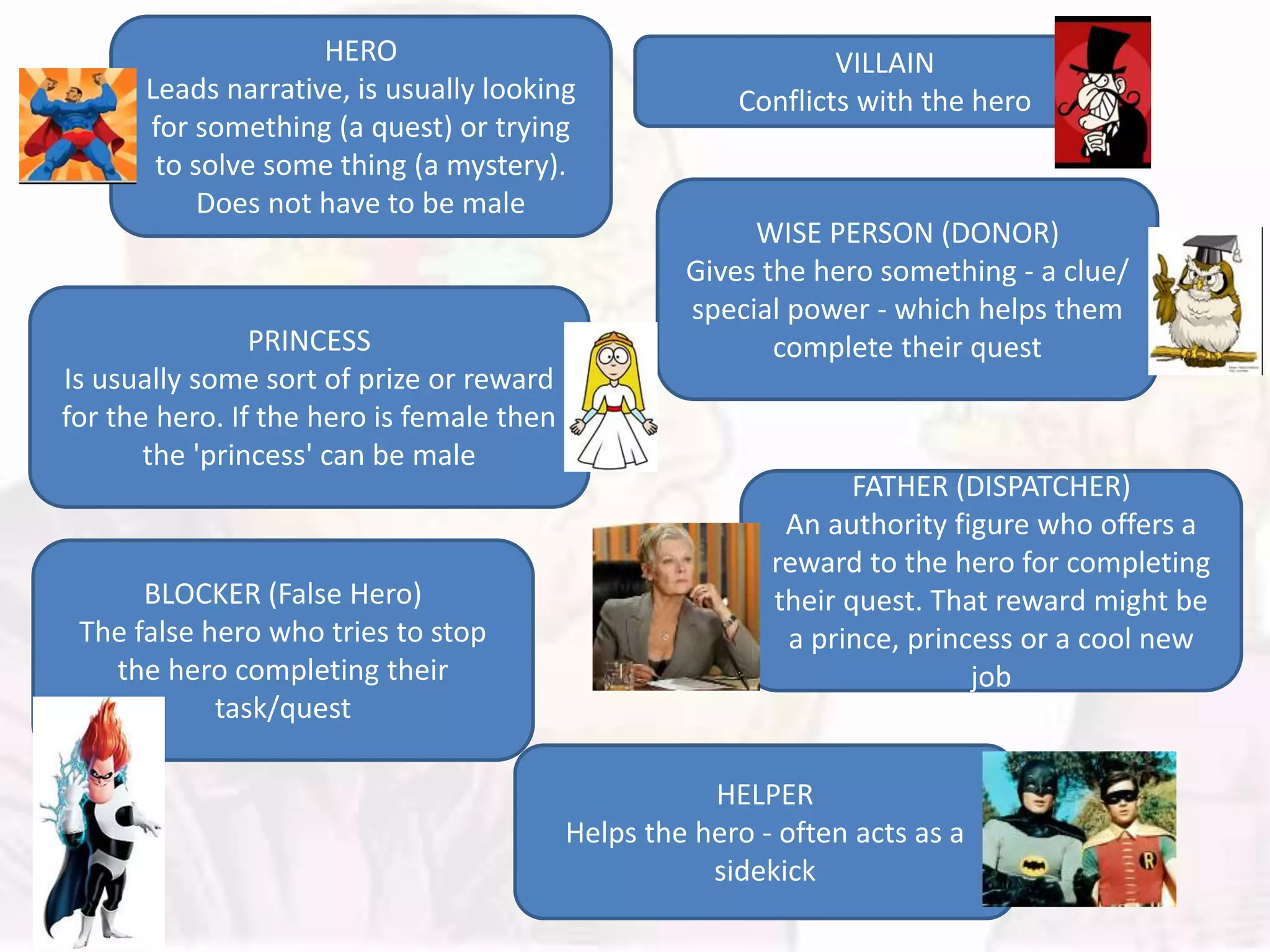
HERO
Leads narrative, is usually looking
for something (a quest) or trying
to solve some thing (a mystery).
Does not have to be male
VILLAIN
Conflicts with the hero
PRINCESS
Is usually some sort of prize or reward
for the hero. If the hero is female then
the 'princess' can be male
FATHER (DISPATCHER)
An authority figure who offers a
reward to the hero for completing
their quest. That reward might be
a prince, princess or a cool new
job
WISE PERSON (DONOR)
Gives the hero something - a clue/
special power - which helps them
complete their quest
BLOCKER (False Hero)
The false hero who tries to stop
the hero completing their
task/quest
HELPER
Helps the hero - often acts as a
sidekick
3
Todorov’s approach to narrative
• Todorov suggests that all narratives begin with
equilibrium or an initial situation (where everything
is balanced).
• This is followed by some form of disruption, which is
later resolved.
• With the resolution at the end of the narrative a new
equilibrium is usually established.
4
Todorov’s approach to narrative
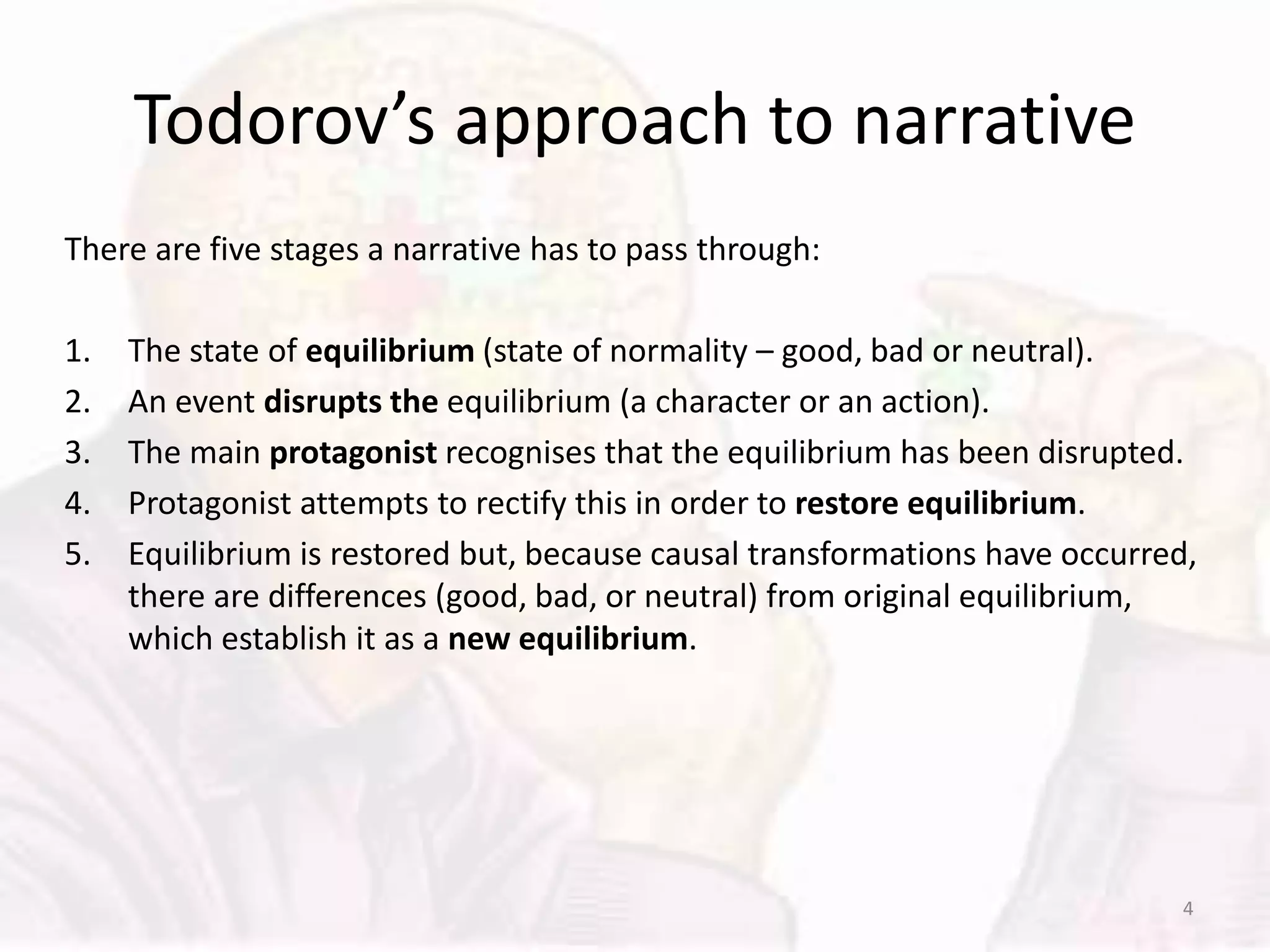
There are five stages a narrative has to pass through:
1. The state of equilibrium (state of normality – good, bad or neutral).
2. An event disrupts the equilibrium (a character or an action).
3. The main protagonist recognises that the equilibrium has been disrupted.
4. Protagonist attempts to rectify this in order to restore equilibrium.
5. Equilibrium is restored but, because causal transformations have occurred,
there are differences (good, bad, or neutral) from original equilibrium,
which establish it as a new equilibrium.
EQUILIBRIUM
Peter Parker is Spiderman doing
his superhero job. He has a secret
identity - MJ doesn't know
DISEQUILIBRIUM
Dr Otto Octavius with the help of Harry
Osborn creates a machine which blows up
and reincarnates him as a villain
Peter doesn't want to be Spiderman
anymore because it's preventing him from
being with MJ
NEW EQUILIBRIUM
Peter is Spiderman again defeats the
villain, saves the heroine
MJ knows Peter is Spiderman
DISRUPTION
RESOLUTION&
RESTOREDORDER
A SENSE OF
NORMALITY
• When you see one single film poster you need
to understand that it is always part of a much
large campaign (a series of posters that
released at different times leading up to the
release of a film)
• You can see examples of the types of posters I
a campaign on the next slide
Distribution & Marketing
• They normally contain an image with text. The text on movie posters
usually contains the film title in large lettering and often the names of the
main actors. It may also include a tag line, the name of the director, names
of characters, the release date, billing block.
Distribution & Marketing
Strong main image – to
encourage the audience
to go and see the film
star and or director
prominent to show that
they are a key selling
point
Title bold, in a dominant
position and font
chosen to reflect the
genre of the film
Tagline – usually
designed to arouse
curiosity of summarise
the film in a catchy way.
The poster can also
include critics quotes
Billing/Credit Block – the
details of key production
staff.
You can also include a
release or ‘At cinemas
everywhere now
For your homework you are
required to design the main
poster for your film
• On the next few slides I have included
examples of main film posters so that you can
get an idea of how to design your own. They
aren’t all Action-Adventure – just to give you
an idea of layout
• Click on the individual posters to view them
bigger
Distribution & Marketing

Half term homework (Yr9)

  • 1.
    1 Propp’s approach to narrative •Vladimir Propp studied hundreds of Russian folk and fairytales before deciding that all narratives have a common structure. • He observed that narratives are shaped and directed by certain types of characters and specific kinds of actions • He believed that there are 31 possible stages or functions in any narrative. • These may not all appear in a single story, but nevertheless always appear in the same sequence. • A function is a plot motif or event in the story. • A tale may skip functions but it cannot shuffle their unvarying order.
  • 2.
    HERO Leads narrative, isusually looking for something (a quest) or trying to solve some thing (a mystery). Does not have to be male VILLAIN Conflicts with the hero PRINCESS Is usually some sort of prize or reward for the hero. If the hero is female then the 'princess' can be male FATHER (DISPATCHER) An authority figure who offers a reward to the hero for completing their quest. That reward might be a prince, princess or a cool new job WISE PERSON (DONOR) Gives the hero something - a clue/ special power - which helps them complete their quest BLOCKER (False Hero) The false hero who tries to stop the hero completing their task/quest HELPER Helps the hero - often acts as a sidekick
  • 3.
    3 Todorov’s approach tonarrative • Todorov suggests that all narratives begin with equilibrium or an initial situation (where everything is balanced). • This is followed by some form of disruption, which is later resolved. • With the resolution at the end of the narrative a new equilibrium is usually established.
  • 4.
    4 Todorov’s approach tonarrative There are five stages a narrative has to pass through: 1. The state of equilibrium (state of normality – good, bad or neutral). 2. An event disrupts the equilibrium (a character or an action). 3. The main protagonist recognises that the equilibrium has been disrupted. 4. Protagonist attempts to rectify this in order to restore equilibrium. 5. Equilibrium is restored but, because causal transformations have occurred, there are differences (good, bad, or neutral) from original equilibrium, which establish it as a new equilibrium.
  • 7.
    EQUILIBRIUM Peter Parker isSpiderman doing his superhero job. He has a secret identity - MJ doesn't know DISEQUILIBRIUM Dr Otto Octavius with the help of Harry Osborn creates a machine which blows up and reincarnates him as a villain Peter doesn't want to be Spiderman anymore because it's preventing him from being with MJ NEW EQUILIBRIUM Peter is Spiderman again defeats the villain, saves the heroine MJ knows Peter is Spiderman DISRUPTION RESOLUTION& RESTOREDORDER A SENSE OF NORMALITY
  • 8.
    • When yousee one single film poster you need to understand that it is always part of a much large campaign (a series of posters that released at different times leading up to the release of a film) • You can see examples of the types of posters I a campaign on the next slide Distribution & Marketing
  • 9.
  • 10.
    • They normallycontain an image with text. The text on movie posters usually contains the film title in large lettering and often the names of the main actors. It may also include a tag line, the name of the director, names of characters, the release date, billing block. Distribution & Marketing Strong main image – to encourage the audience to go and see the film star and or director prominent to show that they are a key selling point Title bold, in a dominant position and font chosen to reflect the genre of the film Tagline – usually designed to arouse curiosity of summarise the film in a catchy way. The poster can also include critics quotes Billing/Credit Block – the details of key production staff. You can also include a release or ‘At cinemas everywhere now For your homework you are required to design the main poster for your film
  • 11.
    • On thenext few slides I have included examples of main film posters so that you can get an idea of how to design your own. They aren’t all Action-Adventure – just to give you an idea of layout • Click on the individual posters to view them bigger Distribution & Marketing
  • 12.

Editor's Notes

  • #5 BLOG TASK
  • #6 www.youtube.com/watch?v=ko5XG72v7Ss