 This section will cover the first of three major ―waves‖
of feminism.
 The word ―Wave‖ is used to categorize feminism
because it illustrates the forward motion—and then
resistance or loss of motion—of the women’s
movement(s). It helps to understand this movement in
by thinking of the motion of an actual wave (in, toward
the sand, then back out).
 As each wave of feminism pushed forward with
progress and change, the result was often a
"backward‖ motion (or a standstill) so to speak. In
women's studies, this is called a backlash.
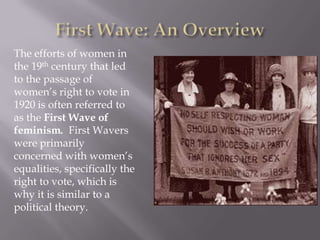
The efforts of women in
the 19th century that led
to the passage of
women’s right to vote in
1920 is often referred to
as the First Wave of
feminism. First Wavers
were primarily
concerned with women’s
equalities, specifically the
right to vote, which is
why it is similar to a
political theory.
1. 1840s – 1850s reform
movements that
coalesced with Seneca
Falls Convention in
1848
2. Led by Elizabeth
Cady Stanton,
Lecretia Mott, and
others.
3. Main focus was the
right to vote
4. Led primarily by
white women who
supported restrictions
based on race and
property ownership
Left: Lucretia
Mott (1793-1880);
Above, Elizabeth
Stanton (1815-
1902)
1. Relied on 15 ―facts‖ that proved ―the history of
mankind is a history of repeated injuries and
usurpations on the part of man toward woman,
having in direct object the establishment of an
absolute tyranny over her‖ (562)
2. Passed 12 Resolutions, arguing that ―woman is man’s
equal‖ and that *men* should encourage women to
speak, teach, participate in religious assemblies.
The latter strategy is important because it recognized
the need for both men AND women to participate in
―zealous and untiring efforts‖ of equal rights.
 Based on the
Declaration of
Independence
 Placed the onus on
women to take
action to protect
themselves for the
future
 Right to vote is a necessary tool for all other
aspects of emancipation; this focus had
advantages and disadvantages:
Advantages
1. Concrete reform
2. Mobilizing effect
3. Symbolized
participation of
women—as
individuals—in public
life.
Disadvantages
1. Required approval of male
voters/politicians.
2. Forced to adopt any
argument necessary (often
invoked traditional gender
roles)
3. Intensified racism, nativism,
and class bias
 Multiplicity of
Oppressions: the process
by which multiple forms
of oppression—race,
gender, class—are
connected.
 Because of this
multiplicity of
oppression, sexism is
―indissolubly linked‖ to
other forms of
oppression, abuse, and
inequality (557).
Anna Julia Cooper, African-American
feminist activist, (1858-1964)
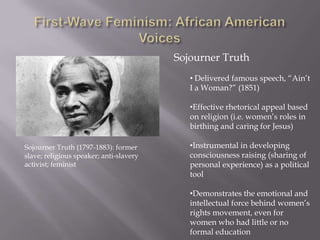
Sojourner Truth (1797-1883): former
slave; religious speaker; anti-slavery
activist; feminist
Sojourner Truth
• Delivered famous speech, ―Ain’t
I a Woman?‖ (1851)
•Effective rhetorical appeal based
on religion (i.e. women’s roles in
birthing and caring for Jesus)
•Instrumental in developing
consciousness raising (sharing of
personal experience) as a political
tool
•Demonstrates the emotional and
intellectual force behind women’s
rights movement, even for
women who had little or no
formal education
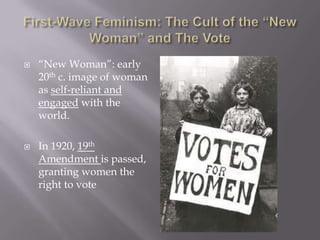
 ―New Woman‖: early
20th c. image of woman
as self-reliant and
engaged with the
world.
 In 1920, 19th
Amendment is passed,
granting women the
right to vote
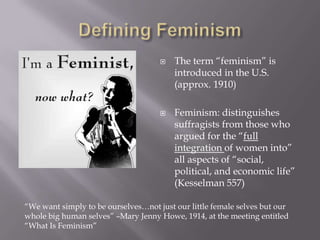
 The term ―feminism‖ is
introduced in the U.S.
(approx. 1910)
 Feminism: distinguishes
suffragists from those who
argued for the ―full
integration of women into‖
all aspects of ―social,
political, and economic life‖
(Kesselman 557)
―We want simply to be ourselves…not just our little female selves but our
whole big human selves‖ –Mary Jenny Howe, 1914, at the meeting entitled
―What Is Feminism‖
1. Legal and accessible birth
control
2. Expansion of educational
opportunities
3. Crusade against lynching and
other race-based violence and
injustice
4. Fight for improved working
conditions
Goals of the women’s
movement became
more diverse, with
leaders organizing
smaller groups
focused on other
issues affecting
women:
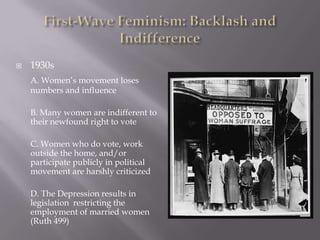
 1930s
A. Women’s movement loses
numbers and influence
B. Many women are indifferent to
their newfound right to vote
C. Women who do vote, work
outside the home, and/or
participate publicly in political
movement are harshly criticized
D. The Depression results in
legislation restricting the
employment of married women
(Ruth 499)
 1940s – World War II
prompts patriotic
movement that relies on
women’s work in factories
to support war efforts.
Two major consequences
are:
1. A lasting shift in
attitudes about women’s
aptitudes and proper roles
2. Married women workers
demonstrated work-family
balance
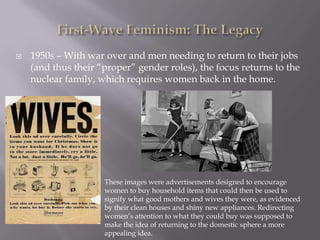
 1950s – With war over and men needing to return to their jobs
(and thus their ―proper‖ gender roles), the focus returns to the
nuclear family, which requires women back in the home.
These images were advertisements designed to encourage
women to buy household items that could then be used to
signify what good mothers and wives they were, as evidenced
by their clean houses and shiny new appliances. Redirecting
women’s attention to what they could buy was supposed to
make the idea of returning to the domestic sphere a more
appealing idea.

First-Wave Feminism

  • 2.
     This sectionwill cover the first of three major ―waves‖ of feminism.  The word ―Wave‖ is used to categorize feminism because it illustrates the forward motion—and then resistance or loss of motion—of the women’s movement(s). It helps to understand this movement in by thinking of the motion of an actual wave (in, toward the sand, then back out).  As each wave of feminism pushed forward with progress and change, the result was often a "backward‖ motion (or a standstill) so to speak. In women's studies, this is called a backlash.
  • 3.
    The efforts ofwomen in the 19th century that led to the passage of women’s right to vote in 1920 is often referred to as the First Wave of feminism. First Wavers were primarily concerned with women’s equalities, specifically the right to vote, which is why it is similar to a political theory.
  • 4.
    1. 1840s –1850s reform movements that coalesced with Seneca Falls Convention in 1848 2. Led by Elizabeth Cady Stanton, Lecretia Mott, and others. 3. Main focus was the right to vote 4. Led primarily by white women who supported restrictions based on race and property ownership Left: Lucretia Mott (1793-1880); Above, Elizabeth Stanton (1815- 1902)
  • 5.
    1. Relied on15 ―facts‖ that proved ―the history of mankind is a history of repeated injuries and usurpations on the part of man toward woman, having in direct object the establishment of an absolute tyranny over her‖ (562) 2. Passed 12 Resolutions, arguing that ―woman is man’s equal‖ and that *men* should encourage women to speak, teach, participate in religious assemblies. The latter strategy is important because it recognized the need for both men AND women to participate in ―zealous and untiring efforts‖ of equal rights.
  • 6.
     Based onthe Declaration of Independence  Placed the onus on women to take action to protect themselves for the future
  • 7.
     Right tovote is a necessary tool for all other aspects of emancipation; this focus had advantages and disadvantages: Advantages 1. Concrete reform 2. Mobilizing effect 3. Symbolized participation of women—as individuals—in public life. Disadvantages 1. Required approval of male voters/politicians. 2. Forced to adopt any argument necessary (often invoked traditional gender roles) 3. Intensified racism, nativism, and class bias
  • 8.
     Multiplicity of Oppressions:the process by which multiple forms of oppression—race, gender, class—are connected.  Because of this multiplicity of oppression, sexism is ―indissolubly linked‖ to other forms of oppression, abuse, and inequality (557). Anna Julia Cooper, African-American feminist activist, (1858-1964)
  • 9.
    Sojourner Truth (1797-1883):former slave; religious speaker; anti-slavery activist; feminist Sojourner Truth • Delivered famous speech, ―Ain’t I a Woman?‖ (1851) •Effective rhetorical appeal based on religion (i.e. women’s roles in birthing and caring for Jesus) •Instrumental in developing consciousness raising (sharing of personal experience) as a political tool •Demonstrates the emotional and intellectual force behind women’s rights movement, even for women who had little or no formal education
  • 10.
     ―New Woman‖:early 20th c. image of woman as self-reliant and engaged with the world.  In 1920, 19th Amendment is passed, granting women the right to vote
  • 11.
     The term―feminism‖ is introduced in the U.S. (approx. 1910)  Feminism: distinguishes suffragists from those who argued for the ―full integration of women into‖ all aspects of ―social, political, and economic life‖ (Kesselman 557) ―We want simply to be ourselves…not just our little female selves but our whole big human selves‖ –Mary Jenny Howe, 1914, at the meeting entitled ―What Is Feminism‖
  • 12.
    1. Legal andaccessible birth control 2. Expansion of educational opportunities 3. Crusade against lynching and other race-based violence and injustice 4. Fight for improved working conditions Goals of the women’s movement became more diverse, with leaders organizing smaller groups focused on other issues affecting women:
  • 13.
     1930s A. Women’smovement loses numbers and influence B. Many women are indifferent to their newfound right to vote C. Women who do vote, work outside the home, and/or participate publicly in political movement are harshly criticized D. The Depression results in legislation restricting the employment of married women (Ruth 499)
  • 14.
     1940s –World War II prompts patriotic movement that relies on women’s work in factories to support war efforts. Two major consequences are: 1. A lasting shift in attitudes about women’s aptitudes and proper roles 2. Married women workers demonstrated work-family balance
  • 15.
     1950s –With war over and men needing to return to their jobs (and thus their ―proper‖ gender roles), the focus returns to the nuclear family, which requires women back in the home. These images were advertisements designed to encourage women to buy household items that could then be used to signify what good mothers and wives they were, as evidenced by their clean houses and shiny new appliances. Redirecting women’s attention to what they could buy was supposed to make the idea of returning to the domestic sphere a more appealing idea.