Unit 8 – Assignment 1
TASK 2
Task 2
 Monopoly and Oligopoly
 Private Ownership and Public Ownership
 Vertical Integration and Horizontal Integration
 Multi-national Media Conglomerates
 Franchise
 Globalisation
 Cultural Imperialism
 Independent Film Distribution
Monopoly
 An economic market condition where one seller dominates the entire market.
 A single firm controls a large market share in the industry, thereby gaining the
ability to set price.
 A monopoly usually exists when barriers to entry are very high - either due to
technology, patents, distribution overheads, government regulation or capital-
intensive nature of the industry.
 Market making ability by virtue of being virtually the only possible seller in the
industry.
 Examples: Microsoft (Operating systems, productivity suites), Google (web search,
search advertising), News Corp (publishing/ print media)
http://www.diffen.com/difference/Monopoly_vs_Oligopoly
Oligopoly
http://www.economicsonline.co.uk/Business_economics/Cinema_case.html
Unlike a monopoly, where one corporation dominates a certain
market, an oligopoly consists of a select few companies having
significant influence over an industry.
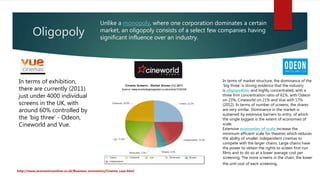
In terms of exhibition,
there are currently (2011)
just under 4000 individual
screens in the UK, with
around 60% controlled by
the ‘big three’ - Odeon,
Cineworld and Vue.
In terms of market structure, the dominance of the
‘big three’ is strong evidence that the industry
is oligopolistic and highly concentrated, with a
three firm concentration ratio of 61%, with Odeon
on 23%, Cineworld on 21% and Vue with 17%
(2012). In terms of number of screens, the shares
are very similar. Dominance in the market is
sustained by extensive barriers to entry, of which
the single biggest is the extent of economies of
scale.
Extensive economies of scale increase the
minimum efficient scale for theatres which reduces
the ability of smaller independent cinemas to
compete with the larger chains. Large chains have
the power to obtain the rights to screen first-run
films and to do so at a lower average cost per
screening. The more screens in the chain, the lower
the unit cost of each screening.
Vertical & Horizontal Integration
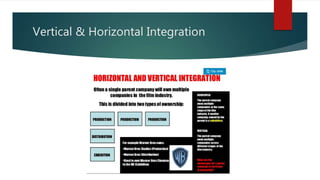
 Contrary to horizontal integration, which is a consolidation of many firms that
handle the same part of the production process, vertical integration is typified by
one firm engaged in different parts of production (e.g., growing raw materials,
manufacturing, transporting, marketing, and/or retailing).
Vertical Integration
 An ownership structure in which one conglomerate owns or operates all aspects of
production and distribution within a single segment of the media industry; for
example, movie studio, talent agency, movie theatres, DVD manufacturing plant
and video rental stores.
https://studysites.sagepub.com/mcquail6/Online%20reading
s/9b%20Croteau%20&%20Hoynes%20-Devereux-Ch-02.pdf
Horizontal Integration
 An ownership structure in which one conglomerate owns or operates different
kinds of media (for example, movie studios, television networks, music labels and
radio stations), concentrating ownership across the different segments of the
media industry.
https://studysites.sagepub.com/mcquail6/Online%20reading
s/9b%20Croteau%20&%20Hoynes%20-Devereux-Ch-02.pdf
Vertical & Horizontal Integration
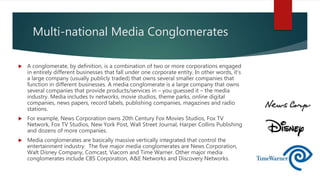
Multi-national Media Conglomerates
 A conglomerate, by definition, is a combination of two or more corporations engaged
in entirely different businesses that fall under one corporate entity. In other words, it’s
a large company (usually publicly traded) that owns several smaller companies that
function in different businesses. A media conglomerate is a large company that owns
several companies that provide products/services in – you guessed it – the media
industry. Media includes tv networks, movie studios, theme parks, online digital
companies, news papers, record labels, publishing companies, magazines and radio
stations.
 For example, News Corporation owns 20th Century Fox Movies Studios, Fox TV
Network, Fox TV Studios, New York Post, Wall Street Journal, Harper Collins Publishing
and dozens of more companies.
 Media conglomerates are basically massive vertically integrated that control the
entertainment industry. The five major media conglomerates are News Corporation,
Walt Disney Company, Comcast, Viacom and Time Warner. Other major media
conglomerates include CBS Corporation, A&E Networks and Discovery Networks.
Franchise
 A media franchise is a collection of media in which several derivative works have
been produced from an original work of media (usually a work of fiction), such as
a film, a work of literature, a television program or a video game.
 A multimedia franchise is a media franchise for which installments exist in
multiple forms of media, such as books, comic books, films, television series,
and video games. Multimedia franchises usually develop due to the popularization
of an original creative work, and then its expansion to other media
through licensing agreements, with respect to intellectual property in the
franchise's characters and settings,[1] although the trend later developed wherein
franchises would be launched in multiple forms of media simultaneously
https://en.wikipedia.org/wiki/Media_franchise
Globalisation & Cultural Imperialism
Click the
image

Unit 8 – assignment 1 task 2

  • 1.
    Unit 8 –Assignment 1 TASK 2
  • 2.
    Task 2  Monopolyand Oligopoly  Private Ownership and Public Ownership  Vertical Integration and Horizontal Integration  Multi-national Media Conglomerates  Franchise  Globalisation  Cultural Imperialism  Independent Film Distribution
  • 3.
    Monopoly  An economicmarket condition where one seller dominates the entire market.  A single firm controls a large market share in the industry, thereby gaining the ability to set price.  A monopoly usually exists when barriers to entry are very high - either due to technology, patents, distribution overheads, government regulation or capital- intensive nature of the industry.  Market making ability by virtue of being virtually the only possible seller in the industry.  Examples: Microsoft (Operating systems, productivity suites), Google (web search, search advertising), News Corp (publishing/ print media) http://www.diffen.com/difference/Monopoly_vs_Oligopoly
  • 4.
    Oligopoly http://www.economicsonline.co.uk/Business_economics/Cinema_case.html Unlike a monopoly,where one corporation dominates a certain market, an oligopoly consists of a select few companies having significant influence over an industry. In terms of exhibition, there are currently (2011) just under 4000 individual screens in the UK, with around 60% controlled by the ‘big three’ - Odeon, Cineworld and Vue. In terms of market structure, the dominance of the ‘big three’ is strong evidence that the industry is oligopolistic and highly concentrated, with a three firm concentration ratio of 61%, with Odeon on 23%, Cineworld on 21% and Vue with 17% (2012). In terms of number of screens, the shares are very similar. Dominance in the market is sustained by extensive barriers to entry, of which the single biggest is the extent of economies of scale. Extensive economies of scale increase the minimum efficient scale for theatres which reduces the ability of smaller independent cinemas to compete with the larger chains. Large chains have the power to obtain the rights to screen first-run films and to do so at a lower average cost per screening. The more screens in the chain, the lower the unit cost of each screening.
  • 5.
    Vertical & HorizontalIntegration  Contrary to horizontal integration, which is a consolidation of many firms that handle the same part of the production process, vertical integration is typified by one firm engaged in different parts of production (e.g., growing raw materials, manufacturing, transporting, marketing, and/or retailing).
  • 6.
    Vertical Integration  Anownership structure in which one conglomerate owns or operates all aspects of production and distribution within a single segment of the media industry; for example, movie studio, talent agency, movie theatres, DVD manufacturing plant and video rental stores. https://studysites.sagepub.com/mcquail6/Online%20reading s/9b%20Croteau%20&%20Hoynes%20-Devereux-Ch-02.pdf
  • 7.
    Horizontal Integration  Anownership structure in which one conglomerate owns or operates different kinds of media (for example, movie studios, television networks, music labels and radio stations), concentrating ownership across the different segments of the media industry. https://studysites.sagepub.com/mcquail6/Online%20reading s/9b%20Croteau%20&%20Hoynes%20-Devereux-Ch-02.pdf
  • 8.
  • 9.
    Multi-national Media Conglomerates A conglomerate, by definition, is a combination of two or more corporations engaged in entirely different businesses that fall under one corporate entity. In other words, it’s a large company (usually publicly traded) that owns several smaller companies that function in different businesses. A media conglomerate is a large company that owns several companies that provide products/services in – you guessed it – the media industry. Media includes tv networks, movie studios, theme parks, online digital companies, news papers, record labels, publishing companies, magazines and radio stations.  For example, News Corporation owns 20th Century Fox Movies Studios, Fox TV Network, Fox TV Studios, New York Post, Wall Street Journal, Harper Collins Publishing and dozens of more companies.  Media conglomerates are basically massive vertically integrated that control the entertainment industry. The five major media conglomerates are News Corporation, Walt Disney Company, Comcast, Viacom and Time Warner. Other major media conglomerates include CBS Corporation, A&E Networks and Discovery Networks.
  • 10.
    Franchise  A mediafranchise is a collection of media in which several derivative works have been produced from an original work of media (usually a work of fiction), such as a film, a work of literature, a television program or a video game.  A multimedia franchise is a media franchise for which installments exist in multiple forms of media, such as books, comic books, films, television series, and video games. Multimedia franchises usually develop due to the popularization of an original creative work, and then its expansion to other media through licensing agreements, with respect to intellectual property in the franchise's characters and settings,[1] although the trend later developed wherein franchises would be launched in multiple forms of media simultaneously https://en.wikipedia.org/wiki/Media_franchise
  • 11.
    Globalisation & CulturalImperialism Click the image