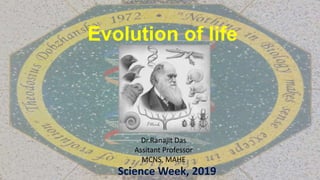
Evolution of life
Dr.Ranajit Das
Assitant Professor
MCNS, MAHE
Science Week, 2019
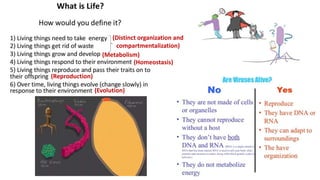
(Metabolism)
(Reproduction)
(Evolution)
(Homeostasis)
(Distinct organization and
compartmentalization)
Tree of life
Three domain system of classification (1977)
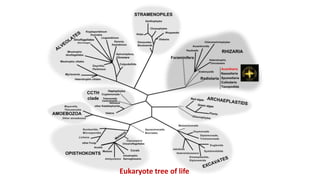
Eukaryote tree of life
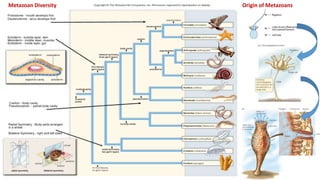
Origin of MetazoansMetazoan Diversity
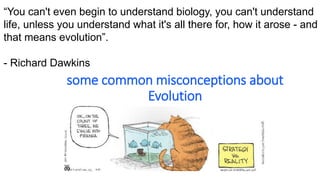
some common misconceptions about
Evolution
“You can't even begin to understand biology, you can't understand
life, unless you understand what it's all there for, how it arose - and
that means evolution”.
- Richard Dawkins
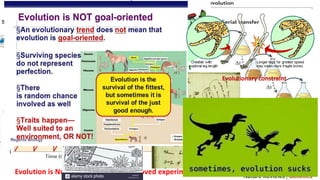
Evolution is NOT a theory: it can be proved experimentally
Evolutionary constraint
The evolution ‘controversy’
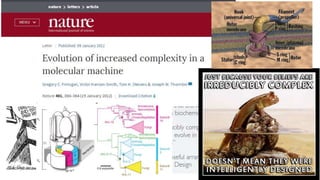
irreducible complexity
(IC): Some biochemical
structures are too
complex to be
explained by known
evolutionary
mechanisms and are
therefore result of
intelligent design.
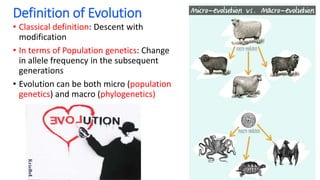
Definition of Evolution
• Classical definition: Descent with
modification
• In terms of Population genetics: Change
in allele frequency in the subsequent
generations
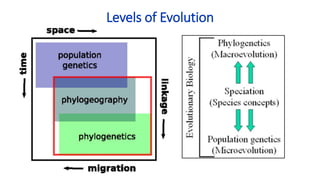
• Evolution can be both micro (population
genetics) and macro (phylogenetics)
25.1
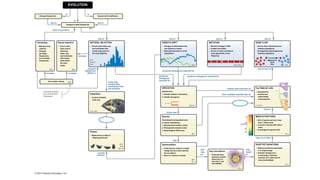
EVOLUTION
is
Change through time
is
is
due to due to
does not produce
Changes in allele frequencies
Descent with modification
due to
Inbreeding
• Mating among
relatives
• Changes
genotype
frequencies,
but not allele
frequencies
Sexual selection
25.6 25.6
• Occurs when
traits used in
attracting
mates vary,
and individuals
with certain
traits attract
the most
mates
includes
includes includes
NATURAL SELECTION
• Occurs when traits vary,
and individuals with
certain traits produce
the most offspring
24.1
24.3–5
25.2
exposes
deleterious
alleles to
Non-random mating
25.6
Text section where
you can find more
information
is the only
evolutionary
mechanism that
can produce
Adaptation
• Involves heritable
traits only
24.3, 24.5
Fitness
• Measured by number of
offspring produced
24.3,
24.5
25.1–6
usually
reduces
due to
25.3
GENETIC DRIFT
• Changes in allele frequencies
due entirely to chance
• Especially important in small
populations
due to due to
MUTATION
• Random changes in DNA
• Creates new alleles
• Occurs in every individual in
every generation, at low
frequency
15.4, 25.5
GENE FLOW
• Occurs when individuals move
between populations
• Homogenizes allele frequencies
between populations
Gene
flow 25.4
due to lack of
produces divergence required for
produces
divergence
required for
produces divergence required for
26.2–4
SPECIATION
Results from:
1. Genetic isolation, followed by
2. Genetic divergence
creates new branches on
form smallest possible tips on
The TREE OF LIFE
• Describes the
evolutionary
relationships
among species
1.3, 27.1
“prune”
MASS EXTINCTIONS
• 60% of species are lost in less
than 1 million years
• 5 events in the past 542 million
years
• Is analogous to genetic drift
27.4
may occur after
forms new
26.1
Species
Evolutionarily independent units
in nature, identified by:
1. Reproductive isolation, and/or
2. Phylogenetic analysis, and/or
3. Morphological differences
with
Synamorphies
• Traits that are unique to a single
lineage (found in some species
but not others)
• Arise in a common ancestor
26.1
27.1
that
may
be
Key innovations
• Traits that allow
species to exploit
resources in a
new way or use
new habitats
27.4
may
result
in
ADAPTIVE RADIATIONS
• Rapid and extensive speciation
in a single lineage
• Dramatic divergence in
morphology or behavior
(species use a wide array of
resources/habitats)
27.3
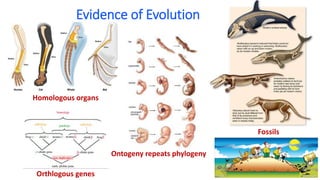
Evidence of Evolution
Fossils
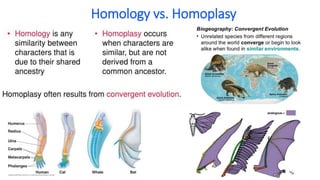
Homologous organs
Ontogeny repeats phylogeny
Orthlogous genes
Homology vs. Homoplasy
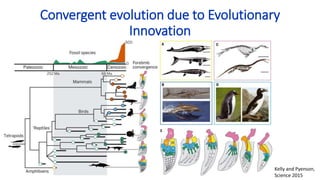
Convergent evolution due to Evolutionary
Innovation
Kelly and Pyenson,
Science 2015
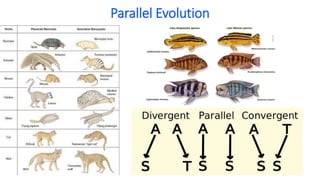
Parallel Evolution
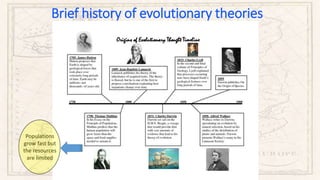
Brief history of evolutionary theories
Populations
grow fast but
the resources
are limited
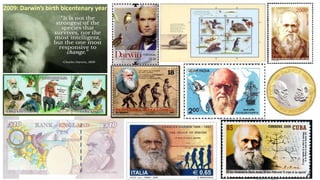
2009: Darwin’s birth bicentenary year
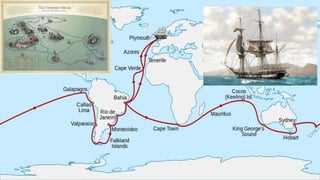
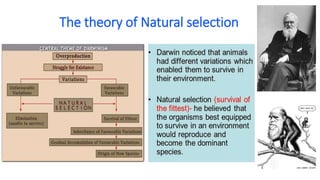
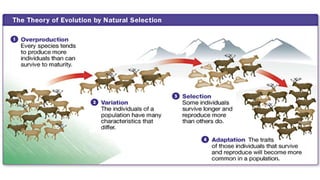
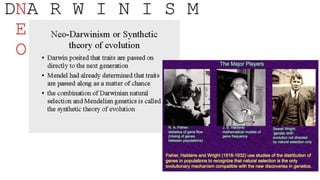
The theory of Natural selection
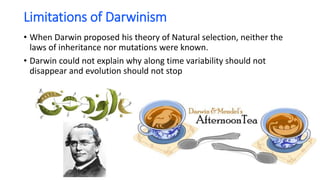
Limitations of Darwinism
• When Darwin proposed his theory of Natural selection, neither the
laws of inheritance nor mutations were known.
• Darwin could not explain why along time variability should not
disappear and evolution should not stop
Levels of Evolution
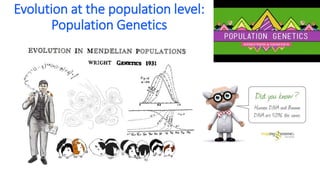
Evolution at the population level:
Population Genetics
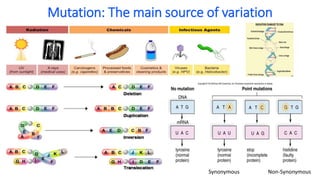
Mutation: The main source of variation
Synonymous Non-Synonymous
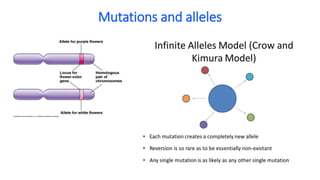
Mutations and alleles
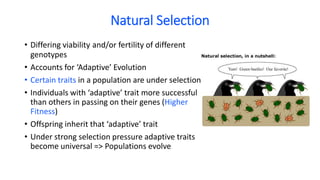
Natural Selection
• Differing viability and/or fertility of different
genotypes
• Accounts for ‘Adaptive’ Evolution
• Certain traits in a population are under selection
• Individuals with ‘adaptive’ trait more successful
than others in passing on their genes (Higher
Fitness)
• Offspring inherit that ‘adaptive’ trait
• Under strong selection pressure adaptive traits
become universal => Populations evolve
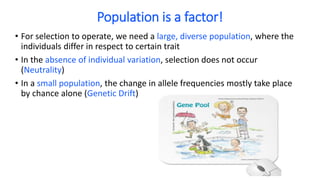
Population is a factor!
• For selection to operate, we need a large, diverse population, where the
individuals differ in respect to certain trait
• In the absence of individual variation, selection does not occur
(Neutrality)
• In a small population, the change in allele frequencies mostly take place
by chance alone (Genetic Drift)
• Sexual Selection
• Group Selection
• Kin Selection
• Ecological Selection
• Artificial Selection
Natural Selection is NOT the only Selection
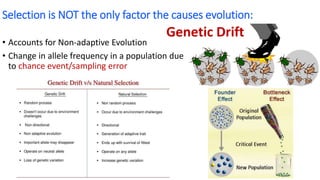
Selection is NOT the only factor the causes evolution:
• Accounts for Non-adaptive Evolution
• Change in allele frequency in a population due
to chance event/sampling error
Genetic Drift
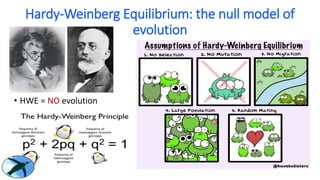
Hardy-Weinberg Equilibrium: the null model of
evolution
• HWE = NO evolution
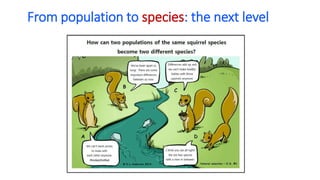
From population to species: the next level
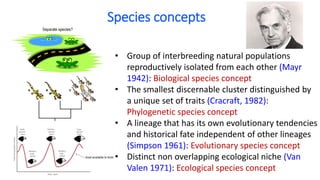
Species concepts
• Group of interbreeding natural populations
reproductively isolated from each other (Mayr
1942): Biological species concept
• The smallest discernable cluster distinguished by
a unique set of traits (Cracraft, 1982):
Phylogenetic species concept
• A lineage that has its own evolutionary tendencies
and historical fate independent of other lineages
(Simpson 1961): Evolutionary species concept
• Distinct non overlapping ecological niche (Van
Valen 1971): Ecological species concept
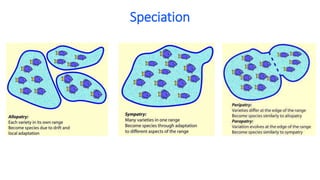
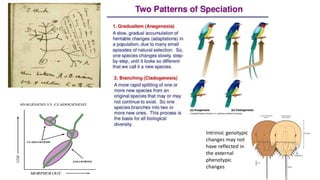
Speciation
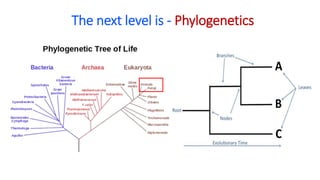
The next level is - Phylogenetics
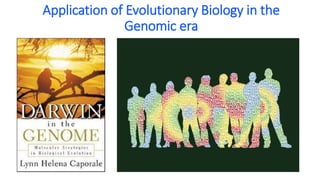
Application of Evolutionary Biology in the
Genomic era
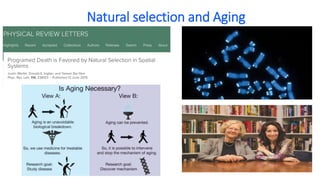
Natural selection and Aging
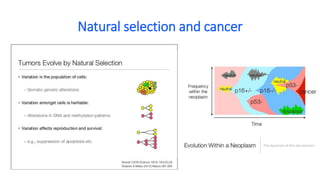
Natural selection and cancer
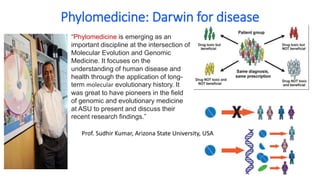
Phylomedicine: Darwin for disease
“Phylomedicine is emerging as an
important discipline at the intersection of
Molecular Evolution and Genomic
Medicine. It focuses on the
understanding of human disease and
health through the application of long-
term molecular evolutionary history. It
was great to have pioneers in the field
of genomic and evolutionary medicine
at ASU to present and discuss their
recent research findings.”
Prof. Sudhir Kumar, Arizona State University, USA
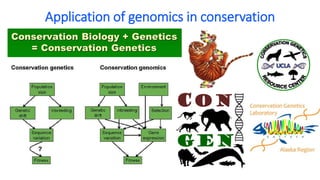
Application of genomics in conservation
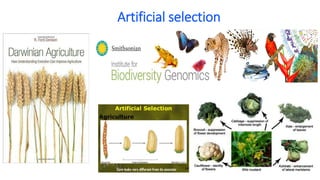
Artificial selection
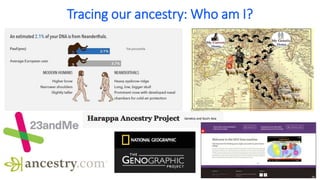
Tracing our ancestry: Who am I?
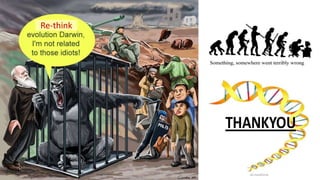
Re-think

Evolution of life 2019

  • 1.
    Evolution of life Dr.RanajitDas Assitant Professor MCNS, MAHE Science Week, 2019
  • 2.
  • 3.
    Tree of life Threedomain system of classification (1977) Eukaryote tree of life
  • 4.
  • 6.
    some common misconceptionsabout Evolution “You can't even begin to understand biology, you can't understand life, unless you understand what it's all there for, how it arose - and that means evolution”. - Richard Dawkins
  • 7.
    Evolution is NOTa theory: it can be proved experimentally Evolutionary constraint
  • 8.
    The evolution ‘controversy’ irreduciblecomplexity (IC): Some biochemical structures are too complex to be explained by known evolutionary mechanisms and are therefore result of intelligent design.
  • 9.
    Definition of Evolution •Classical definition: Descent with modification • In terms of Population genetics: Change in allele frequency in the subsequent generations • Evolution can be both micro (population genetics) and macro (phylogenetics)
  • 10.
    25.1 EVOLUTION is Change through time is is dueto due to does not produce Changes in allele frequencies Descent with modification due to Inbreeding • Mating among relatives • Changes genotype frequencies, but not allele frequencies Sexual selection 25.6 25.6 • Occurs when traits used in attracting mates vary, and individuals with certain traits attract the most mates includes includes includes NATURAL SELECTION • Occurs when traits vary, and individuals with certain traits produce the most offspring 24.1 24.3–5 25.2 exposes deleterious alleles to Non-random mating 25.6 Text section where you can find more information is the only evolutionary mechanism that can produce Adaptation • Involves heritable traits only 24.3, 24.5 Fitness • Measured by number of offspring produced 24.3, 24.5 25.1–6 usually reduces due to 25.3 GENETIC DRIFT • Changes in allele frequencies due entirely to chance • Especially important in small populations due to due to MUTATION • Random changes in DNA • Creates new alleles • Occurs in every individual in every generation, at low frequency 15.4, 25.5 GENE FLOW • Occurs when individuals move between populations • Homogenizes allele frequencies between populations Gene flow 25.4 due to lack of produces divergence required for produces divergence required for produces divergence required for 26.2–4 SPECIATION Results from: 1. Genetic isolation, followed by 2. Genetic divergence creates new branches on form smallest possible tips on The TREE OF LIFE • Describes the evolutionary relationships among species 1.3, 27.1 “prune” MASS EXTINCTIONS • 60% of species are lost in less than 1 million years • 5 events in the past 542 million years • Is analogous to genetic drift 27.4 may occur after forms new 26.1 Species Evolutionarily independent units in nature, identified by: 1. Reproductive isolation, and/or 2. Phylogenetic analysis, and/or 3. Morphological differences with Synamorphies • Traits that are unique to a single lineage (found in some species but not others) • Arise in a common ancestor 26.1 27.1 that may be Key innovations • Traits that allow species to exploit resources in a new way or use new habitats 27.4 may result in ADAPTIVE RADIATIONS • Rapid and extensive speciation in a single lineage • Dramatic divergence in morphology or behavior (species use a wide array of resources/habitats) 27.3
  • 11.
    Evidence of Evolution Fossils Homologousorgans Ontogeny repeats phylogeny Orthlogous genes
  • 12.
  • 13.
    Convergent evolution dueto Evolutionary Innovation Kelly and Pyenson, Science 2015
  • 14.
  • 16.
    Brief history ofevolutionary theories Populations grow fast but the resources are limited
  • 17.
    2009: Darwin’s birthbicentenary year
  • 19.
    The theory ofNatural selection
  • 21.
    Limitations of Darwinism •When Darwin proposed his theory of Natural selection, neither the laws of inheritance nor mutations were known. • Darwin could not explain why along time variability should not disappear and evolution should not stop
  • 22.
  • 23.
    Evolution at thepopulation level: Population Genetics
  • 25.
    Mutation: The mainsource of variation Synonymous Non-Synonymous
  • 26.
  • 27.
    Natural Selection • Differingviability and/or fertility of different genotypes • Accounts for ‘Adaptive’ Evolution • Certain traits in a population are under selection • Individuals with ‘adaptive’ trait more successful than others in passing on their genes (Higher Fitness) • Offspring inherit that ‘adaptive’ trait • Under strong selection pressure adaptive traits become universal => Populations evolve
  • 28.
    Population is afactor! • For selection to operate, we need a large, diverse population, where the individuals differ in respect to certain trait • In the absence of individual variation, selection does not occur (Neutrality) • In a small population, the change in allele frequencies mostly take place by chance alone (Genetic Drift)
  • 29.
    • Sexual Selection •Group Selection • Kin Selection • Ecological Selection • Artificial Selection Natural Selection is NOT the only Selection
  • 30.
    Selection is NOTthe only factor the causes evolution: • Accounts for Non-adaptive Evolution • Change in allele frequency in a population due to chance event/sampling error Genetic Drift
  • 31.
    Hardy-Weinberg Equilibrium: thenull model of evolution • HWE = NO evolution
  • 32.
    From population tospecies: the next level
  • 33.
    Species concepts • Groupof interbreeding natural populations reproductively isolated from each other (Mayr 1942): Biological species concept • The smallest discernable cluster distinguished by a unique set of traits (Cracraft, 1982): Phylogenetic species concept • A lineage that has its own evolutionary tendencies and historical fate independent of other lineages (Simpson 1961): Evolutionary species concept • Distinct non overlapping ecological niche (Van Valen 1971): Ecological species concept
  • 34.
  • 35.
    The next levelis - Phylogenetics
  • 37.
    Application of EvolutionaryBiology in the Genomic era
  • 38.
  • 39.
  • 40.
    Phylomedicine: Darwin fordisease “Phylomedicine is emerging as an important discipline at the intersection of Molecular Evolution and Genomic Medicine. It focuses on the understanding of human disease and health through the application of long- term molecular evolutionary history. It was great to have pioneers in the field of genomic and evolutionary medicine at ASU to present and discuss their recent research findings.” Prof. Sudhir Kumar, Arizona State University, USA
  • 41.
    Application of genomicsin conservation
  • 42.
  • 43.
  • 45.