EVOLUTION
Introduction 1
Sequences of origin 1
Evidences For Evolution 3
Process or Mechanism of Evolution 4
Some Mechanism of Evolution Points:- 6
Hardy – Weinberg Principle 6
Brief Account of Evolution 7
Extra points:- 9
Introduction
● Stochastic (random) process based on chance events or mutation.
● Reason of diversity in living is long-term evolutionary change
● Why abiogenesis is impossible in today’s condition :-Lack of energy resources,+nce of oxidising env.,+nce of
living forms
Sequences of origin
1. Origin of Universe :-Big-bang theory( Abbé lemaitre) 15-20 bya.
a. Universe evolved due to thermonuclear explosion
b. Release gases :- H and He (gases condensed:-Gravitation)
c. Explosion creates Expansion and cooling of universe( formation of galaxies,stars,planets)
d. 11 bya solar system and earth forms
2. Origin of earth:- Nebula (gas ball) concept :-4.5 bya,No atm
a. Volcanic lava covered earth surface
b. Releases NH3 ,CO2 ,CH4 and water vapour makes atm. reducing
c. UV rays from the sun broke up water into H and O and lighter H2 escaped.
d. O2 combined with NH3 and CH4 to form H2O, CO2 and others. ozone layer was formed.
e. As it cooled, water vapour fell as rain,and form oceans.
f. Life appeared 500 million years after earth formation
3. Origin of life :-
a. Cosmozoic or Panspermia (Greek thinkers ):- Units of life (Spores:-Pangene) were transferred to
different planets including earth
b. Theory of abiogenesis (Support. :-Von helmont)life came out of decaying matter (Spontaneous
Generation)(straw, mud) :-Disproved
c. Theory of biogenesis (Supporter :-F.Reddi(Meat),Harvey and Huxley),Louis pasteur:-life comes from
preexisting life,Louis Pasture Exp. showed that in pre-sterilized flasks, life did not come from killed
yeast while in another flask open to air, new living organism arose from ‘killed yeast’ :- Disproved
Theory of Chemical Origin (Naturalistic)Oparin (Russia)– Haldane(Eng) Evidences of theory
Most accepted
Formation of diverse org. from
inorg. constituents.
1. 1st Abiogenesis then
biogenesis.
2. Analysis of
meteorites indicates
similar processes are
occurring elsewhere
in space.
● 1st form of life could have come
from pre- pre-existing non-
living org. mol(e.g. RNA,
protein.).
● Formation of life was preceded
by chemical evolution
● O2 -nt in primitive atm.
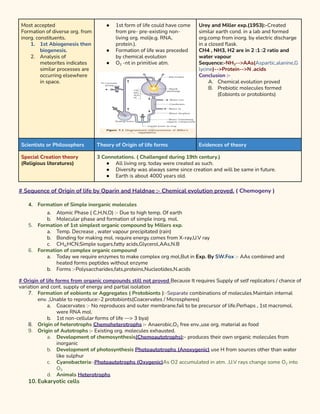
Urey and Miller exp.(1953):-Created
similar earth cond. in a lab and formed
org.comp from inorg. by electric discharge
in a closed flask.
CH4 , NH3, H2 are in 2 :1 :2 ratio and
water vapour
Sequence:-NH3-->AAs(Aspartic,alanine,G
lycine)-->Protein-->N .acids
Conclusion :-
A. Chemical evolution proved
B. Prebiotic molecules formed
(Eobionts or protobionts)
Scientists or Philosophers Theory of Origin of life forms Evidences of theory
Special Creation theory
(Religious literatures)
3 Connotations. ( Challenged during 19th century.)
● All living org. today were created as such.
● Diversity was always same since creation and will be same in future.
● Earth is about 4000 years old.
# Sequence of Origin of life by Oparin and Haldnae :- Chemical evolution proved. ( Chemogeny )
4. Formation of Simple inorganic molecules
a. Atomic Phase ( C,H,N,O) :- Due to high temp. Of earth
b. Molecular phase and formation of simple inorg. mol.
5. Formation of 1st simplest organic compound by Millers exp.
a. Temp. Decrease , water vapour precipitated (rain)
b. Bonding for making mol. require energy comes from X-ray,U.V ray
c. CH4;HCN;Simple sugars,fatty acids,Glycerol,AAs,N.B
6. Formation of complex organic compound
a. Today we require enzymes to make complex org mol,But in Exp. By SW.Fox :- AAs combined and
heated forms peptides without enzyme
b. Forms :-Polysaccharides,fats,proteins,Nucleotides,N.acids
# Origin of life forms from organic compounds still not proved Because It requires Supply of self replicators / chance of
variation and cont. supply of energy and partial isolation
7. Formation of eobionts or Aggregates ( Protobionts ):-Separate combinations of molecules.Maintain internal
env. ,Unable to reproduce:-2 protobionts(Coacervates / Microspheres)
a. Coacervates :- No reproduces and outer membrane.fail to be precursor of life.Perhaps , 1st macromol.
were RNA mol.
b. 1st non-cellular forms of life —> 3 bya)
8. Origin of heterotrophs Chemoheterotrophs :- Anaerobic,O2 free env.,use org. material as food
9. Origin of Autotrophs :- Existing org. molecules exhausted.
a. Development of chemosynthesis(Chemoautotrophs):- produces their own organic molecules from
inorganic
b. Development of photosynthesis Photoautotrophs (Anoxygenic) use H from sources other than water
like sulphur
c. Cyanobacteria:-Photoautotrophs (Oxygenic)As O2 accumulated in atm. ,U.V rays change some O2 into
O3
d. Animals Heterotrophs
10. Eukaryotic cells
Evidences For Evolution.
Evidences ( NCERT) Theory /EXAMPLES
Paleontological:
Father :- L.D.Vinci
Modern:- G.cuvier
Age of fossil by
● Radiocarbon
● Electron spin
resonance
● fossil DNA
(Advance)
● Fossils: Remains of hard parts of life-forms,found in different sedimentary layers
indicates geological period in which they existed:-Living fossil
(Peripatus,Sphenodon,King crab.)
● Rocks, form sediments and a cross-section of earth’s crust indicates arrangement of
sediments one over other during long history of earth.Horse,Dinosaurs evolution,
Geological time scale
● Missing Connecting links:- Archaeopteryx [ Birds(beaks,wings)-Reptiles (Tails
,caudal-vertebra) and Pteridosperm ( ferns - gymnosperm)
● Living Connecting links:-
○ Euglena ( Plant and Animals)
○ Proterospongia – Protozoa and Porifera
○ Neoplina (Annelida-Mollusca)
○ Peripatus ( Annelida and Arthropoda )
Embryological ● Recapitulation theory ( Von Bear)General str (Brian,spinal cord) developed first
then a special structure
● Biogenetic law by Ernst Haeckel (Modification of theory of recapitulation)
Ontogeny (own dev.) recapitulates(pass through) phylogeny(ancestral dev.)
● Early dev. In triploblastic (Platyhelminthes to mammals)
● Zygote to 3 germ layers
● vertebrates including humans develop a row of vestigial gill slits
● Temp. embryonic Str. egg tooth in birds (glorified reptiles)
● Organ dev.( 2 to 4 chamber heart )
Disproved by Karl Ernst von Baer.:-embryos never pass through adult stages of other
animals.
Natural Selection and
Adaptation
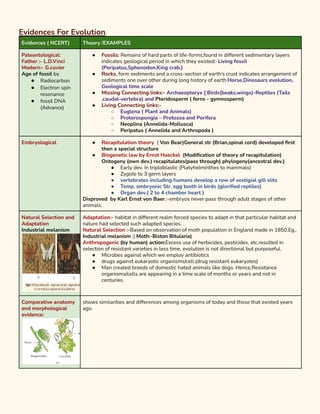
Industrial melanism
Adaptation:- habitat in different realm forced species to adapt in that particular habitat and
nature had selected such adapted species.
Natural Selection :-Based on observation of moth population in England made in 1850.Eg.,
Industrial melanism ,( Moth:-Biston Bitularia)
Anthropogenic (by human) action:Excess use of herbicides, pesticides, etc.resulted in
selection of resistant varieties in less time, evolution is not directional but purposeful.
● Microbes against which we employ antibiotics
● drugs against eukaryotic organisms/cell.(drug resistant eukaryotes)
● Man created breeds of domestic hated animals like dogs. Hence,Resistance
organisms/cells are appearing in a time scale of months or years and not in
centuries.
Comparative anatomy
and morphological
evidence:
shows similarities and differences among organisms of today and those that existed years
ago.
Biogeography
( Pangaea concept)
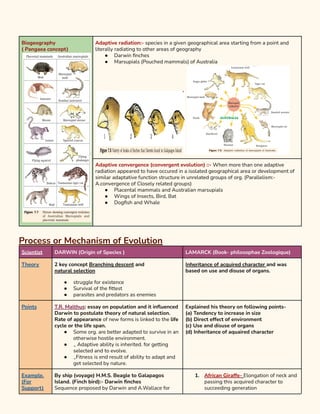
Adaptive radiation:- species in a given geographical area starting from a point and
literally radiating to other areas of geography
● Darwin finches
● Marsupials (Pouched mammals) of Australia
Adaptive convergence (convergent evolution) ::- When more than one adaptive
radiation appeared to have occured in a isolated geographical area or development of
similar adaptative function structure in unrelated groups of org. (Parallelism:-
A.convergence of Closely related groups)
● Placental mammals and Australian marsupials
● Wings of Insects, Bird, Bat
● Dogfish and Whale
Process or Mechanism of Evolution
Scientist DARWIN (Origin of Species ) LAMARCK (Book- philosophae Zoologique)
Theory 2 key concept Branching descent and
natural selection
● struggle for existence
● Survival of the fittest
● parasites and predators as enemies
Inheritance of acquired character and was
based on use and disuse of organs.
Points T.R. Malthus: essay on population and it influenced
Darwin to postulate theory of natural selection.
Rate of appearance of new forms is linked to the life
cycle or the life span.
● Some org. are better adapted to survive in an
otherwise hostile environment.
● „ Adaptive ability is inherited. for getting
selected and to evolve.
● „Fitness is end result of ability to adapt and
get selected by nature.
Explained his theory on following points-
(a) Tendency to increase in size
(b) Direct effect of environment
(c) Use and disuse of organs
(d) Inheritance of aquaired character
Example.
(For
Support)
By ship (voyage) H.M.S. Beagle to Galapagos
Island. (Finch bird):- Darwin finches
Sequence proposed by Darwin and A.Wallace for
1. African Giraffe- Elongation of neck and
passing this acquired character to
succeeding generation
organic evolution
● Struggle for existence.
(Overproduction, high fertility rate)
● Variations
● Constancy of population size
● Natural selection
Speciation :- Formation of one or more new species
from pre-existing species.
:-Occurrence of endemic species in South America
and Australia is due to continental separation .
● Allopatric ( D.finches ,Marsupial rad.)
○ Different geographic area
● Sympatric (Polyploidy)
○ Same geographic area
2. Snakes- Gradual degeneration and
Disappearence of Limbs.
Criticism 1. Unable to explain cause, origin and
inheritance of variations.
2. Theory of pangenesis (Darwin):- Every
organ of body produce minute hereditary
particles, called Pangenes or Gemmules
3. Darwin Ignores Mutation theory (Hugo de
vries) works on Oenothera lamarckiana :-
1. Weismann given Germplasm Th. Only
Germplasm reaches to next gen.
Experiment: Cut off tails of mice gen
after gen but tail is neither disappeared
nor shortened.
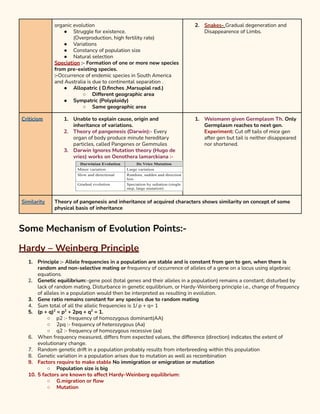
Similarity Theory of pangenesis and inheritance of acquired characters shows similarity on concept of some
physical basis of inheritance
Some Mechanism of Evolution Points:-
Hardy – Weinberg Principle
1. Principle :- Allele frequencies in a population are stable and is constant from gen to gen, when there is
random and non-selective mating or frequency of occurrence of alleles of a gene on a locus using algebraic
equations.
2. Genetic equilibrium:-gene pool (total genes and their alleles in a population) remains a constant; disturbed by
lack of random mating, Disturbance in genetic equilibrium, or Hardy-Weinberg principle i.e., change of frequency
of alleles in a population would then be interpreted as resulting in evolution.
3. Gene ratio remains constant for any species due to random mating
4. Sum total of all the allelic frequencies is 1/ p + q= 1
5. (p + q)2
= p2
+ 2pq + q2
= 1.
○ p2 :- frequency of homozygous dominant(AA)
○ 2pq :- frequency of heterozygous (Aa)
○ q2 :- frequency of homozygous recessive (aa)
6. When frequency measured, differs from expected values, the difference (direction) indicates the extent of
evolutionary change.
7. Random genetic drift in a population probably results from interbreeding within this population
8. Genetic variation in a population arises due to mutation as well as recombination
9. Factors require to make stable No immigration or emigration or mutation
○ Population size is big
10. 5 factors are known to affect Hardy-Weinberg equilibrium:
○ G.migration or flow
○ Mutation
○ G. recombination
○ Genetic drift:- Change of gene or allele frequency from one generation to next Occurs in interbreeding
within Small Population and Random/Chance Types
1. Bottleneck effect :- California seals ( same as industrial melanism)
2. Founder effect :- Migration of few people to new area
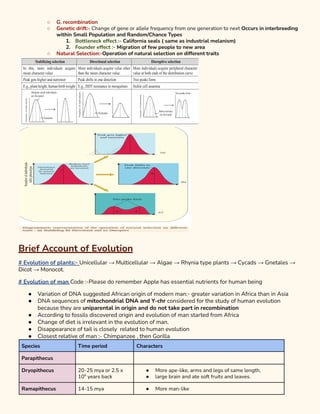
○ Natural Selection:-Operation of natural selection on different traits
Brief Account of Evolution
# Evolution of plants:- Unicellular → Multicellular → Algae → Rhynia type plants → Cycads → Gnetales →
Dicot → Monocot.
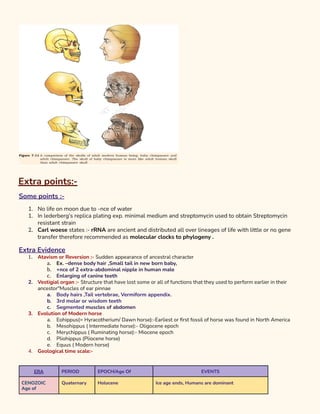
# Evolution of man Code :-Please do remember Apple has essential nutrients for human being
● Variation of DNA suggested African origin of modern man:- greater variation in Africa than in Asia
● DNA sequences of mitochondrial DNA and Y-chr considered for the study of human evolution
because they are uniparental in origin and do not take part in recombination
● According to fossils discovered origin and evolution of man started from Africa
● Change of diet is irrelevant in the evolution of man.
● Disappearance of tail is closely related to human evolution
● Closest relative of man :- Chimpanzee , then Gorilla
Species Time period Characters
Parapithecus
Dryopithecus 20-25 mya or 2.5 x
106
years back
● More ape-like, arms and legs of same length,
● large brain and ate soft fruits and leaves.
Ramapithecus 14-15 mya ● More man-like
● Walked erect and teeth like modern man
Australopithecus 3-4 mya
400-600 cc.
● Man-like primates, tall,
● walked straight, Ate fruits
● Fossils found in Tanzania and Ethiopia
Homo habilis 2 mya
650-800 cc
● First humans-like being
● herbivores and fossils found in East Africa
Homo erectus.
(Java or Peking man)
1.5 mya
900 cc
● The food was meat.
● Fossils found in Java.
Heidelberg man
H.sapiens
neanderthalensis
(Primitive man)
1 L -40k yr ago
1400 cc
● Hides to protect body
● Body buried after death.
● Fossils found in East and Central Asia.
H.sapiens fossilis
(Cro-magnon)
1650 cc ● Direct ancestor of modern man
H. sapiens sapiens
(Modern man)
75,000-10,000 years
ago
Started agriculture, human settlement started, and prehistoric
cave art developed.
Extra points:-
Some points :-
1. No life on moon due to -nce of water
1. In lederberg's replica plating exp. minimal medium and streptomycin used to obtain Streptomycin
resistant strain
2. Carl woese states :- rRNA are ancient and distributed all over lineages of life with little or no gene
transfer therefore recommended as molecular clocks to phylogeny .
Extra Evidence
1. Atavism or Reversion :- Sudden appearance of ancestral character
a. Ex. –dense body hair ,Small tail in new born baby,
b. +nce of 2 extra-abdominal nipple in human male
c. Enlarging of canine teeth
2. Vestigial organ :- Structure that have lost some or all of functions that they used to perform earlier in their
ancestor"Muscles of ear pinnae
a. Body hairs ,Tail vertebrae, Vermiform appendix.
b. 3rd molar or wisdom teeth
c. Segmented muscles of abdomen
3. Evolution of Modern horse
a. Eohippus(= Hyracotherium/ Dawn horse):-Earliest or first fossil of horse was found in North America
b. Mesohippus ( Intermediate horse):- Oligocene epoch
c. Merychippus ( Ruminating horse):- Miocene epoch
d. Pliohippus (Pliocene horse)
e. Equus ( Modern horse)
4. Geological time scale:-
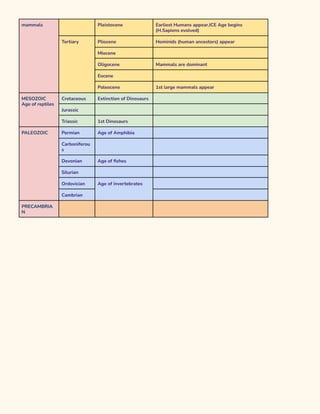
ERA PERIOD EPOCH/Age Of EVENTS
CENOZOIC
Age of
Quaternary Holocene Ice age ends, Humans are dominant
mammals Pleistocene Earliest Humans appear,ICE Age begins
(H.Sapiens evolved)
Tertiary Pliocene Hominids (human ancestors) appear
Miocene
Oligocene Mammals are dominant
Eocene
Paleocene 1st large mammals appear
MESOZOIC
Age of reptiles
Cretaceous Extinction of Dinosaurs
Jurassic
Triassic 1st Dinosaurs
PALEOZOIC Permian Age of Amphibia
Carboniferou
s
Devonian Age of fishes
Silurian
Ordovician Age of invertebrates
Cambrian
PRECAMBRIA
N
:
{ AIMS, JIMC-1-
-
Evolution (short note  ques).pdf

Evolution (short note ques).pdf

  • 1.
    EVOLUTION Introduction 1 Sequences oforigin 1 Evidences For Evolution 3 Process or Mechanism of Evolution 4 Some Mechanism of Evolution Points:- 6 Hardy – Weinberg Principle 6 Brief Account of Evolution 7 Extra points:- 9 Introduction ● Stochastic (random) process based on chance events or mutation. ● Reason of diversity in living is long-term evolutionary change ● Why abiogenesis is impossible in today’s condition :-Lack of energy resources,+nce of oxidising env.,+nce of living forms Sequences of origin 1. Origin of Universe :-Big-bang theory( Abbé lemaitre) 15-20 bya. a. Universe evolved due to thermonuclear explosion b. Release gases :- H and He (gases condensed:-Gravitation) c. Explosion creates Expansion and cooling of universe( formation of galaxies,stars,planets) d. 11 bya solar system and earth forms 2. Origin of earth:- Nebula (gas ball) concept :-4.5 bya,No atm a. Volcanic lava covered earth surface b. Releases NH3 ,CO2 ,CH4 and water vapour makes atm. reducing c. UV rays from the sun broke up water into H and O and lighter H2 escaped. d. O2 combined with NH3 and CH4 to form H2O, CO2 and others. ozone layer was formed. e. As it cooled, water vapour fell as rain,and form oceans. f. Life appeared 500 million years after earth formation 3. Origin of life :- a. Cosmozoic or Panspermia (Greek thinkers ):- Units of life (Spores:-Pangene) were transferred to different planets including earth b. Theory of abiogenesis (Support. :-Von helmont)life came out of decaying matter (Spontaneous Generation)(straw, mud) :-Disproved c. Theory of biogenesis (Supporter :-F.Reddi(Meat),Harvey and Huxley),Louis pasteur:-life comes from preexisting life,Louis Pasture Exp. showed that in pre-sterilized flasks, life did not come from killed yeast while in another flask open to air, new living organism arose from ‘killed yeast’ :- Disproved Theory of Chemical Origin (Naturalistic)Oparin (Russia)– Haldane(Eng) Evidences of theory
  • 2.
    Most accepted Formation ofdiverse org. from inorg. constituents. 1. 1st Abiogenesis then biogenesis. 2. Analysis of meteorites indicates similar processes are occurring elsewhere in space. ● 1st form of life could have come from pre- pre-existing non- living org. mol(e.g. RNA, protein.). ● Formation of life was preceded by chemical evolution ● O2 -nt in primitive atm. Urey and Miller exp.(1953):-Created similar earth cond. in a lab and formed org.comp from inorg. by electric discharge in a closed flask. CH4 , NH3, H2 are in 2 :1 :2 ratio and water vapour Sequence:-NH3-->AAs(Aspartic,alanine,G lycine)-->Protein-->N .acids Conclusion :- A. Chemical evolution proved B. Prebiotic molecules formed (Eobionts or protobionts) Scientists or Philosophers Theory of Origin of life forms Evidences of theory Special Creation theory (Religious literatures) 3 Connotations. ( Challenged during 19th century.) ● All living org. today were created as such. ● Diversity was always same since creation and will be same in future. ● Earth is about 4000 years old. # Sequence of Origin of life by Oparin and Haldnae :- Chemical evolution proved. ( Chemogeny ) 4. Formation of Simple inorganic molecules a. Atomic Phase ( C,H,N,O) :- Due to high temp. Of earth b. Molecular phase and formation of simple inorg. mol. 5. Formation of 1st simplest organic compound by Millers exp. a. Temp. Decrease , water vapour precipitated (rain) b. Bonding for making mol. require energy comes from X-ray,U.V ray c. CH4;HCN;Simple sugars,fatty acids,Glycerol,AAs,N.B 6. Formation of complex organic compound a. Today we require enzymes to make complex org mol,But in Exp. By SW.Fox :- AAs combined and heated forms peptides without enzyme b. Forms :-Polysaccharides,fats,proteins,Nucleotides,N.acids # Origin of life forms from organic compounds still not proved Because It requires Supply of self replicators / chance of variation and cont. supply of energy and partial isolation 7. Formation of eobionts or Aggregates ( Protobionts ):-Separate combinations of molecules.Maintain internal env. ,Unable to reproduce:-2 protobionts(Coacervates / Microspheres) a. Coacervates :- No reproduces and outer membrane.fail to be precursor of life.Perhaps , 1st macromol. were RNA mol. b. 1st non-cellular forms of life —> 3 bya) 8. Origin of heterotrophs Chemoheterotrophs :- Anaerobic,O2 free env.,use org. material as food 9. Origin of Autotrophs :- Existing org. molecules exhausted. a. Development of chemosynthesis(Chemoautotrophs):- produces their own organic molecules from inorganic b. Development of photosynthesis Photoautotrophs (Anoxygenic) use H from sources other than water like sulphur c. Cyanobacteria:-Photoautotrophs (Oxygenic)As O2 accumulated in atm. ,U.V rays change some O2 into O3 d. Animals Heterotrophs 10. Eukaryotic cells
  • 3.
    Evidences For Evolution. Evidences( NCERT) Theory /EXAMPLES Paleontological: Father :- L.D.Vinci Modern:- G.cuvier Age of fossil by ● Radiocarbon ● Electron spin resonance ● fossil DNA (Advance) ● Fossils: Remains of hard parts of life-forms,found in different sedimentary layers indicates geological period in which they existed:-Living fossil (Peripatus,Sphenodon,King crab.) ● Rocks, form sediments and a cross-section of earth’s crust indicates arrangement of sediments one over other during long history of earth.Horse,Dinosaurs evolution, Geological time scale ● Missing Connecting links:- Archaeopteryx [ Birds(beaks,wings)-Reptiles (Tails ,caudal-vertebra) and Pteridosperm ( ferns - gymnosperm) ● Living Connecting links:- ○ Euglena ( Plant and Animals) ○ Proterospongia – Protozoa and Porifera ○ Neoplina (Annelida-Mollusca) ○ Peripatus ( Annelida and Arthropoda ) Embryological ● Recapitulation theory ( Von Bear)General str (Brian,spinal cord) developed first then a special structure ● Biogenetic law by Ernst Haeckel (Modification of theory of recapitulation) Ontogeny (own dev.) recapitulates(pass through) phylogeny(ancestral dev.) ● Early dev. In triploblastic (Platyhelminthes to mammals) ● Zygote to 3 germ layers ● vertebrates including humans develop a row of vestigial gill slits ● Temp. embryonic Str. egg tooth in birds (glorified reptiles) ● Organ dev.( 2 to 4 chamber heart ) Disproved by Karl Ernst von Baer.:-embryos never pass through adult stages of other animals. Natural Selection and Adaptation Industrial melanism Adaptation:- habitat in different realm forced species to adapt in that particular habitat and nature had selected such adapted species. Natural Selection :-Based on observation of moth population in England made in 1850.Eg., Industrial melanism ,( Moth:-Biston Bitularia) Anthropogenic (by human) action:Excess use of herbicides, pesticides, etc.resulted in selection of resistant varieties in less time, evolution is not directional but purposeful. ● Microbes against which we employ antibiotics ● drugs against eukaryotic organisms/cell.(drug resistant eukaryotes) ● Man created breeds of domestic hated animals like dogs. Hence,Resistance organisms/cells are appearing in a time scale of months or years and not in centuries. Comparative anatomy and morphological evidence: shows similarities and differences among organisms of today and those that existed years ago.
  • 4.
    Biogeography ( Pangaea concept) Adaptiveradiation:- species in a given geographical area starting from a point and literally radiating to other areas of geography ● Darwin finches ● Marsupials (Pouched mammals) of Australia Adaptive convergence (convergent evolution) ::- When more than one adaptive radiation appeared to have occured in a isolated geographical area or development of similar adaptative function structure in unrelated groups of org. (Parallelism:- A.convergence of Closely related groups) ● Placental mammals and Australian marsupials ● Wings of Insects, Bird, Bat ● Dogfish and Whale Process or Mechanism of Evolution Scientist DARWIN (Origin of Species ) LAMARCK (Book- philosophae Zoologique) Theory 2 key concept Branching descent and natural selection ● struggle for existence ● Survival of the fittest ● parasites and predators as enemies Inheritance of acquired character and was based on use and disuse of organs. Points T.R. Malthus: essay on population and it influenced Darwin to postulate theory of natural selection. Rate of appearance of new forms is linked to the life cycle or the life span. ● Some org. are better adapted to survive in an otherwise hostile environment. ● „ Adaptive ability is inherited. for getting selected and to evolve. ● „Fitness is end result of ability to adapt and get selected by nature. Explained his theory on following points- (a) Tendency to increase in size (b) Direct effect of environment (c) Use and disuse of organs (d) Inheritance of aquaired character Example. (For Support) By ship (voyage) H.M.S. Beagle to Galapagos Island. (Finch bird):- Darwin finches Sequence proposed by Darwin and A.Wallace for 1. African Giraffe- Elongation of neck and passing this acquired character to succeeding generation
  • 5.
    organic evolution ● Strugglefor existence. (Overproduction, high fertility rate) ● Variations ● Constancy of population size ● Natural selection Speciation :- Formation of one or more new species from pre-existing species. :-Occurrence of endemic species in South America and Australia is due to continental separation . ● Allopatric ( D.finches ,Marsupial rad.) ○ Different geographic area ● Sympatric (Polyploidy) ○ Same geographic area 2. Snakes- Gradual degeneration and Disappearence of Limbs. Criticism 1. Unable to explain cause, origin and inheritance of variations. 2. Theory of pangenesis (Darwin):- Every organ of body produce minute hereditary particles, called Pangenes or Gemmules 3. Darwin Ignores Mutation theory (Hugo de vries) works on Oenothera lamarckiana :- 1. Weismann given Germplasm Th. Only Germplasm reaches to next gen. Experiment: Cut off tails of mice gen after gen but tail is neither disappeared nor shortened. Similarity Theory of pangenesis and inheritance of acquired characters shows similarity on concept of some physical basis of inheritance Some Mechanism of Evolution Points:- Hardy – Weinberg Principle 1. Principle :- Allele frequencies in a population are stable and is constant from gen to gen, when there is random and non-selective mating or frequency of occurrence of alleles of a gene on a locus using algebraic equations. 2. Genetic equilibrium:-gene pool (total genes and their alleles in a population) remains a constant; disturbed by lack of random mating, Disturbance in genetic equilibrium, or Hardy-Weinberg principle i.e., change of frequency of alleles in a population would then be interpreted as resulting in evolution. 3. Gene ratio remains constant for any species due to random mating 4. Sum total of all the allelic frequencies is 1/ p + q= 1 5. (p + q)2 = p2 + 2pq + q2 = 1. ○ p2 :- frequency of homozygous dominant(AA) ○ 2pq :- frequency of heterozygous (Aa) ○ q2 :- frequency of homozygous recessive (aa) 6. When frequency measured, differs from expected values, the difference (direction) indicates the extent of evolutionary change. 7. Random genetic drift in a population probably results from interbreeding within this population 8. Genetic variation in a population arises due to mutation as well as recombination 9. Factors require to make stable No immigration or emigration or mutation ○ Population size is big 10. 5 factors are known to affect Hardy-Weinberg equilibrium: ○ G.migration or flow ○ Mutation
  • 6.
    ○ G. recombination ○Genetic drift:- Change of gene or allele frequency from one generation to next Occurs in interbreeding within Small Population and Random/Chance Types 1. Bottleneck effect :- California seals ( same as industrial melanism) 2. Founder effect :- Migration of few people to new area ○ Natural Selection:-Operation of natural selection on different traits Brief Account of Evolution # Evolution of plants:- Unicellular → Multicellular → Algae → Rhynia type plants → Cycads → Gnetales → Dicot → Monocot. # Evolution of man Code :-Please do remember Apple has essential nutrients for human being ● Variation of DNA suggested African origin of modern man:- greater variation in Africa than in Asia ● DNA sequences of mitochondrial DNA and Y-chr considered for the study of human evolution because they are uniparental in origin and do not take part in recombination ● According to fossils discovered origin and evolution of man started from Africa ● Change of diet is irrelevant in the evolution of man. ● Disappearance of tail is closely related to human evolution ● Closest relative of man :- Chimpanzee , then Gorilla Species Time period Characters Parapithecus Dryopithecus 20-25 mya or 2.5 x 10⁶ years back ● More ape-like, arms and legs of same length, ● large brain and ate soft fruits and leaves. Ramapithecus 14-15 mya ● More man-like
  • 7.
    ● Walked erectand teeth like modern man Australopithecus 3-4 mya 400-600 cc. ● Man-like primates, tall, ● walked straight, Ate fruits ● Fossils found in Tanzania and Ethiopia Homo habilis 2 mya 650-800 cc ● First humans-like being ● herbivores and fossils found in East Africa Homo erectus. (Java or Peking man) 1.5 mya 900 cc ● The food was meat. ● Fossils found in Java. Heidelberg man H.sapiens neanderthalensis (Primitive man) 1 L -40k yr ago 1400 cc ● Hides to protect body ● Body buried after death. ● Fossils found in East and Central Asia. H.sapiens fossilis (Cro-magnon) 1650 cc ● Direct ancestor of modern man H. sapiens sapiens (Modern man) 75,000-10,000 years ago Started agriculture, human settlement started, and prehistoric cave art developed.
  • 8.
    Extra points:- Some points:- 1. No life on moon due to -nce of water 1. In lederberg's replica plating exp. minimal medium and streptomycin used to obtain Streptomycin resistant strain 2. Carl woese states :- rRNA are ancient and distributed all over lineages of life with little or no gene transfer therefore recommended as molecular clocks to phylogeny . Extra Evidence 1. Atavism or Reversion :- Sudden appearance of ancestral character a. Ex. –dense body hair ,Small tail in new born baby, b. +nce of 2 extra-abdominal nipple in human male c. Enlarging of canine teeth 2. Vestigial organ :- Structure that have lost some or all of functions that they used to perform earlier in their ancestor"Muscles of ear pinnae a. Body hairs ,Tail vertebrae, Vermiform appendix. b. 3rd molar or wisdom teeth c. Segmented muscles of abdomen 3. Evolution of Modern horse a. Eohippus(= Hyracotherium/ Dawn horse):-Earliest or first fossil of horse was found in North America b. Mesohippus ( Intermediate horse):- Oligocene epoch c. Merychippus ( Ruminating horse):- Miocene epoch d. Pliohippus (Pliocene horse) e. Equus ( Modern horse) 4. Geological time scale:- ERA PERIOD EPOCH/Age Of EVENTS CENOZOIC Age of Quaternary Holocene Ice age ends, Humans are dominant
  • 9.
    mammals Pleistocene EarliestHumans appear,ICE Age begins (H.Sapiens evolved) Tertiary Pliocene Hominids (human ancestors) appear Miocene Oligocene Mammals are dominant Eocene Paleocene 1st large mammals appear MESOZOIC Age of reptiles Cretaceous Extinction of Dinosaurs Jurassic Triassic 1st Dinosaurs PALEOZOIC Permian Age of Amphibia Carboniferou s Devonian Age of fishes Silurian Ordovician Age of invertebrates Cambrian PRECAMBRIA N
  • 12.
  • 19.