SCIENCE PROJECT SCIENCE PROJECT DONE BY : ASWIN SAMBHU.P.R CLASS : Vlll.B
STARS AND THE SOLAR SYSTEM
STARS A  star  is a massive, luminous ball of   plasma   that is held together by  gravity . The nearest   star to  Earth  is the  Sun , which is the source   of most of the  energy  on Earth. Other stars   are visible in the night sky, when they are not   outshone by the Sun.   Historically, the most   prominent stars on the  celestial sphere  were   grouped together into  constellations , and the   brightest stars gained proper names.   Extensive  catalogues of stars  have been   assembled by astronomers, which provide   standardized  star designations .
For most of its life, a star shines  due to  thermonuclear fusion  in its   core  releasing energy that traverses  the star's interior and then  radiates  into  outer space . Almost all elements  heavier than  hydrogen  and  helium  were created by fusion processes in  stars.  Astronomers  can determine  the  mass , age,  chemical composition   and many other properties of a star  by observing its  spectrum ,  luminosity   and motion through space.   The  total mass of a star is the principal determinant in its  evolution  and eventual fate. Other characteristics of a  star are determined by its evolutionary history, including  the diameter, rotation, movement and temperature. A  plot of the temperature of many stars against their  luminosities, known as a  Hertzsprung-Russell diagram  (H–R diagram), allows the age and evolutionary state of  a star to be determined.
A star begins as a collapsing cloud  of material composed primarily of  hydrogen, along with helium and trace  amounts of heavier elements. Once  the stellar core is sufficiently dense,  some of the hydrogen is steadily  converted into helium through the  process of nuclear fusion.The  remainder of the star's interior  carries energy away from the core  through a combination of  radiative   and  convective  processes.   The star's internal pressure  prevents it from collapsing  further under its own gravity.  Once the hydrogen  fuel  at the  core is exhausted, those stars  having at least 0.4 times the  mass of the Sun expand to  become a  red giant , in some cases  fusing heavier  elements  at the  core or in shells around the core.
The star then evolves into a  degenerate form, recycling a portion of the matter into the  interstellar environment, where it will form a new generation of  stars with a higher proportion of heavy elements. Binary  and multi-star systems consist of two or  more stars that are gravitationally bound, and  generally move around each other in stable   orbits . When two such stars have a relatively  close orbit, their gravitational interaction can have  a significant impact on their evolution.Stars  can form part of a much larger gravitationally  bound structure, such as a  cluster  or a  galaxy .
Characteristics Almost everything about a star is determined by its initial mass, including essential characteristics such as luminosity and size, as well as the star's evolution, lifespan, and eventual fate. Age Most stars are between 1 billion and 10 billion years old. Some  stars may even be close to 13.7 billion years old—the observed  age of  the universe . The oldest star yet discovered,  HE 1523-0901 , is an  estimated 13.2 billion years old. The more massive the star, the shorter its lifespan, primarily  because massive stars have greater pressure on their cores, causing  them to burn hydrogen more rapidly. The most massive stars last an  average of about one million years, while stars of minimum mass (red  dwarfs) burn their fuel very slowly and last tens to hundreds of  billions of years.
Chemical composition When stars form in the present Milky Way  galaxy they are composed of about 71%  hydrogen and 27% helium, as measured by  mass, with a small fraction of heavier   elements. Typically the portion of heavy   elements is measured in terms of the iron  content of the stellar atmosphere, as iron is   a common element and its absorption lines   are relatively easy to measure. Because the  molecular clouds where stars form are  steadily enriched by heavier elements from   supernovae explosions, a measurement of the   chemical composition of a star can be used to  infer its age. The portion of heavier   elements may also be an indicator of the   likelihood that the star has a planetary  system. The star with the lowest iron   content ever measured is the   dwarf HE1327-2326, with only  1/200,000th the iron content of  the Sun. By contrast, the   super- metal-rich star  μ  Leonis  has   nearly double the abundance of  iron as the Sun, while the planet- bearing   star  14  Herculis  has   nearly triple the iron.There also   exist chemically  peculiar stars   that show unusual abundances of  certain elements in their  spectrum; especially   chromium   and  rare earth elements .
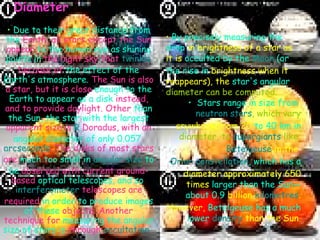
Diameter Due to their great distance from the  Earth, all stars except the Sun appear  to the human eye as shining points in  the night sky that  twinkle  because of  the effect of the Earth's atmosphere.  The Sun is also a star, but it is close  enough to the Earth to appear as a disk  instead, and to provide daylight. Other  than the Sun, the star with the largest  apparent size is  R  Doradus , with an  angular diameter of only 0.057  arcseconds . The disks of most stars are  much too small in  angular size  to be  observed with current ground-based  optical telescopes, and so  interferometer  telescopes are required  in order to produce images of these  objects. Another technique for  measuring the angular size of stars is  through  occultation .  By precisely measuring the drop  in brightness of a star as it is  occulted by the  Moon  (or the rise in  brightness when it reappears), the  star's angular  diameter can be computed. Stars range in size from  neutron stars , which vary  anywhere from 20  to 40 km in  diameter, to  supergiants  like   Betelgeuse  in the   Orion constellation , which has a  diameter approximately 650 times  larger than the Sun—about 0.9  billion  kilometres . However,  Betelgeuse has a much lower  density  than the Sun.
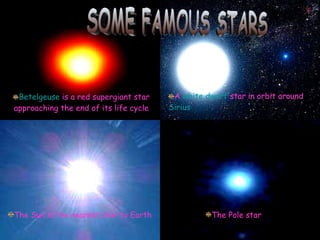
Betelgeuse  is a red supergiant star approaching the end of its life cycle A  white dwarf  star in orbit around  Sirius   The Sun is the nearest star to Earth The Pole star SOME FAMOUS STARS
GALAXIES A galaxy is a massive,  gravitationally bound   system that consists of  stars  and  stellar   remnants , an  interstellar medium  of  gas and  dust , and an important but poorly  understood component tentatively dubbed  dark matter . The name is from the Greek  root  galaxias  [γαλαξίας], meaning "milky,"  a reference to the  Milky Way  galaxy.   Typical galaxies range from  dwarfs  with  as few as   ten million stars up to giants  with one  trillion   stars,   all orbiting the galaxy's  center of   mass . Galaxies can also contain  many  multiple star systems ,  star  clusters , and various  interstellar  clouds . The  Sun  is one of the  stars in the  Milky Way  galaxy; the   Solar System  includes the Earth  and all the other objects that  orbit the Sun.
Historically, galaxies have been  categorized according to their  apparent shape (usually referred  to as their visual morphology). A  common form is the  elliptical  galaxy , [5]  which has an   ellipse -shaped light profile.  Spiral  galaxies  are disk-shaped  assemblages with dusty, curving  arms. Galaxies with irregular or unusual shapes  are known as  peculiar galaxies , and  typically result from disruption by the  gravitational pull of neighboring galaxies.  Such interactions between nearby galaxies,  which may ultimately result in galaxies  merging, may induce episodes of  significantly increased  star formation ,  producing what is called a  starburst galaxy .  Small galaxies that lack a coherent structure  could also be referred to as  irregular galaxies .
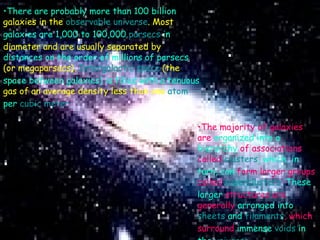
There are probably more than 100 billion   galaxies in the  observable universe . Most   galaxies are 1,000 to 100,000  parsecs  in   diameter and are usually separated by   distances on the order of millions of parsecs   (or megaparsecs).  Intergalactic space  (the   space between galaxies) is filled with a tenuous   gas of an average density less than one  atom   per  cubic meter .   The majority of galaxies are   organized into a hierarchy   of associations called   clusters , which, in turn, can   form larger groups called   superclusters . These larger   structures are generally   arranged into  sheets  and   filaments , which surround   immense  voids  in the   universe .
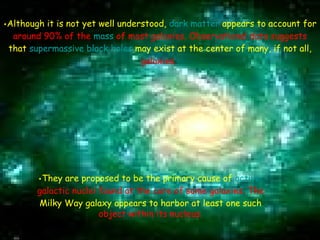
    Although it is not yet well understood,  dark matter  appears to account for   around 90% of the  mass  of most galaxies. Observational data suggests   that  supermassive black holes  may exist at the center of many, if not all,   galaxies.   They are proposed to be the primary cause of  active  galactic nuclei  found at the core of some galaxies. The  Milky Way galaxy appears to harbor at least one such  object within its nucleus.
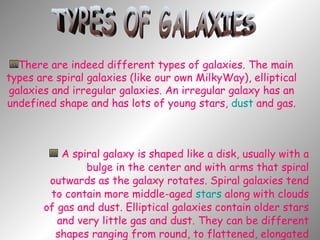
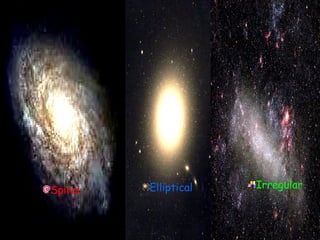
A spiral galaxy is shaped like a disk, usually with a bulge in the center and with arms that spiral outwards as the galaxy rotates. Spiral galaxies tend to contain more middle-aged  stars  along with clouds of gas and dust. Elliptical galaxies contain older stars and very little gas and dust. They can be different shapes ranging from round, to flattened, elongated spheres. TYPES OF GALAXIES There are indeed different types of galaxies. The main types are spiral galaxies (like our own MilkyWay), elliptical galaxies and irregular galaxies. An irregular galaxy has an undefined shape and has lots of young stars,  dust  and gas.
Irregular Spiral Elliptical
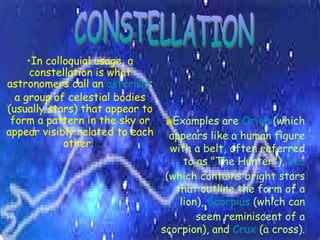
CONSTELLATION In colloquial usage, a constellation is what astronomers call an  asterism : a group of celestial bodies (usually stars) that appear to form a pattern in the sky or appear visibly related to each other.   Examples are  Orion  (which appears like a human figure with a belt, often referred to as "The Hunter"),  Leo  (which contains bright stars that outline the form of a lion),  Scorpius  (which can seem reminiscent of a scorpion), and  Crux  (a cross).
In astronomy, however, a  constellation is an area of the sky,  and contains all the stars and  other celestial objects within that  area. The  International  Astronomical Union  (IAU) divides  the sky into 88 official  constellations [1]  with exact  boundaries, so that every  direction or place in the sky is  defined by one constellation.   Most of these constellations are   centered on the traditional   constellations of Western culture.   Constellations were devised by ancient   people to be able to recognize stars in   the sky. The shapes of constellations   resemble objects familiar to those   people.
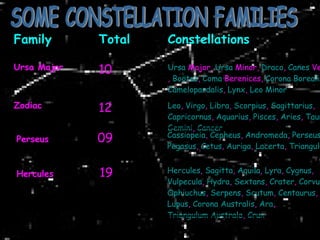
SOME CONSTELLATION FAMILIES Leo ,  Virgo ,  Libra ,  Scorpius ,  Sagittarius ,  Capricornus ,  Aquarius ,  Pisces ,  Aries ,  Taurus ,  Gemini ,  Cancer   12 Zodiac Ursa  Major ,  Ursa  Minor ,  Draco ,  Canes  Venatici ,  Boötes ,  Coma  Berenices ,  Corona Borealis ,  Camelopardalis ,  Lynx ,  Leo Minor   10 Ursa Major Constellations Total Family Hercules ,  Sagitta ,  Aquila ,  Lyra ,  Cygnus ,  Vulpecula ,  Hydra ,  Sextans ,  Crater ,  Corvus ,  Ophiuchus ,  Serpens ,  Scutum ,  Centaurus ,  Lupus ,  Corona Australis ,  Ara ,  Triangulum Australe ,  Crux   Hercules  19 Cassiopeia ,  Cepheus ,  Andromeda ,  Perseus ,  Pegasus ,  Cetus ,  Auriga ,  Lacerta ,  Triangulum   Perseus  09
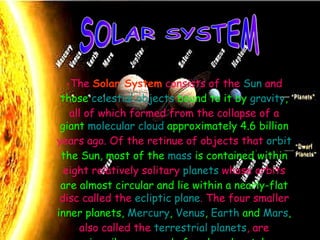
The  Solar System  consists of the  Sun  and  those  celestial objects  bound to it by  gravity ,  all of which   formed from the collapse of a  giant  molecular cloud  approximately 4.6 billion  years ago. Of the retinue of objects that  orbit   the Sun, most of the  mass  is contained within  eight relatively solitary  planets  whose orbits   are almost circular and lie within a nearly-flat  disc called the  ecliptic plane . The four smaller  inner planets,  Mercury ,  Venus ,  Earth  and  Mars ,  also called the  terrestrial planets , are  primarily composed of rock and metal.  SOLAR SYSTEM
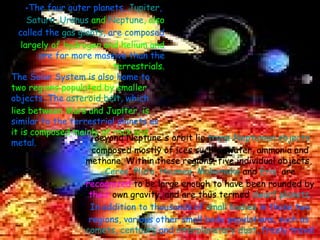
Beyond Neptune's orbit lie  trans-Neptunian objects  composed mostly of ices such as water, ammonia and methane. Within these regions, five individual objects,  Ceres ,  Pluto ,  Haumea ,  Makemake  and  Eris , are  recognized  to be large enough to have been rounded by  their  own gravity, and are thus termed  dwarf planets . In addition to thousands of  small bodies  in those two regions, various other small body populations, such as  comets ,  centaurs  and  interplanetary dust , freely travel between regions. The four outer planets,  Jupiter ,   Saturn ,  Uranus  and  Neptune , also  called the  gas giants , are composed  largely of hydrogen and helium and  are far more massive than the   terrestrials. The Solar System is also home to  two regions populated by smaller  objects. The  asteroid belt , which  lies between Mars and Jupiter, is  similar to the terrestrial planets as  it is composed   mainly of rock and  metal.
The  solar wind , a flow of  plasma  from the  Sun, creates a  bubble  in the  interstellar  medium  known as the  heliosphere , which  extends out to the edge of the scattered disc.  The hypothetical  Oort cloud , which acts as the  source for  long-period comets , may also exist  at a distance roughly a thousand times further  than  the heliosphere. Six of the  planets  and three of the  dwarf planets   are orbited by  natural satellites , [b]  usually termed  "moons" after Earth's  Moon . Each of the outer  planets is encircled by  planetary rings  of dust and  other particles.
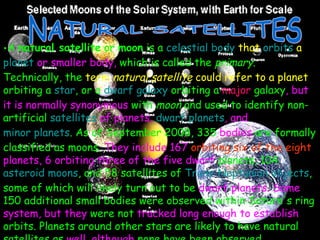
A  natural satellite  or  moon  is a  celestial body  that  orbits  a   planet  or smaller body,  which is called the  primary . Technically, the  term  natural satellite  could refer to a planet  orbiting a  star , or a  dwarf galaxy  orbiting a  major   galaxy , but it is normally synonymous  with  moon  and used to identify non-artificial  satellites  of planets,  dwarf planets , and   minor planets . As of September 2008, 335  bodies  are formally classified as moons.  They include 167  orbiting six of the eight   planets, 6 orbiting three of the five dwarf  planets, 104  asteroid moons , and 58 satellites of  Trans-Neptunian objects , some of which will likely turn out to be  dwarf planets. Some  150 additional small bodies were observed within Saturn's ring  system, but they  were not  tracked long enough to establish  orbits. Planets around other stars are likely to have natural satellites as  well, although  none have been observed. NATURAL SATELLITES
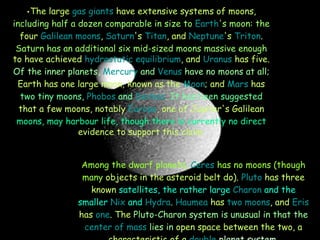
The large  gas giants  have extensive systems of moons,  including half a dozen comparable in size to  Earth 's moon: the  four  Galilean moons ,  Saturn 's  Titan , and  Neptune 's  Triton .  Saturn has an additional six mid-sized moons massive enough  to have achieved  hydrostatic equilibrium , and  Uranus  has five.  Of the inner planets,  Mercury  and  Venus  have no moons at all;  Earth has one large moon, known as the  Moon ; and  Mars  has  two tiny moons,  Phobos  and  Deimos . It has been suggested  that a few moons, notably  Europa , one of Jupiter's Galilean  moons, may harbour life, though there is currently no direct  evidence to support this claim. Among the dwarf planets,  Ceres  has no moons (though many  objects in the asteroid belt do).  Pluto  has three known  satellites, the rather large  Charon  and the smaller  Nix  and   Hydra .  Haumea  has  two moons , and  Eris  has  one . The  Pluto-Charon system is unusual in that the  center of mass  lies in  open space between the two, a characteristic of a  double  planet  system.
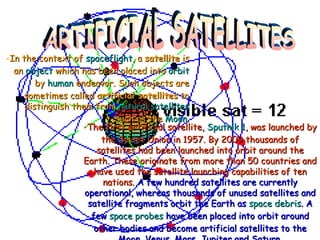
The first artificial satellite,  Sputnik 1 , was launched by the Soviet Union in 1957. By 2009 thousands of satellites had been launched into orbit around the Earth. These originate from more than 50 countries and have used the satellite launching capabilities of ten nations.  A few hundred satellites are currently operational, whereas thousands of unused satellites and satellite fragments orbit the Earth as  space debris . A few  space probes  have been placed into orbit around other bodies and become artificial satellites to the Moon, Venus, Mars, Jupiter and Saturn. ARTIFICIAL SATELLITES In the context of  spaceflight , a  satellite  is an  object  which has been placed into  orbit  by  human  endeavor. Such objects are sometimes called  artificial satellites  to distinguish them from  natural satellites  such as the  Moon .
Satellites are used for a large number of  purposes. Common types include military (spy)  and civilian Earth observation satellites,  communication satellites, navigation satellites,  weather satellites, and research satellites.  Space stations  and human  spacecraft  in orbit  are also satellites. Satellite orbits vary  greatly, depending on the purpose of the  satellite, and are classified in a number of  ways. Well-known (overlapping) classes include   low Earth orbit ,  polar orbit , and  geostationary  orbit . Satellites are usually semi-independent  computer controlled systems. Satellite  subsystems attend many tasks, such as  power generation, thermal control,  telemetry,  attitude control  and orbit  control.
National Aeronautics And Space Administration (NASA) American Institute for Astronautics and Aeronautics Space.com Smithsonian Air & Space National Space Society (NSS) Space Frontier Foundation (SFF) Space Studies Institute (SSI) Planetary Society Mars Society TsNIIMash Island One Society European Space Agency Italian Space Agency National Space Development Agency of Japan (NASDA)  British National Space Centre (BNSC)  FAA - Commercial Space Transportation  National Oceanic & Atmospheric Administration (NOAA) European  Organisation  for the Exploitation of Meteorological Satellites (EUMETSAT) The Austrian Space Agency Space Research Organization Netherlands (SRON) Norwegian Space Centre  SPACE ORGANIZATIONS
Committee on the Peaceful Uses of Outer Space (COPUOS) Indian Space Research  Organisation  (ISRO)  Russian Aviation and Space Agency (RSA)  French Space Agency - Centre National  d'Etudes   Spatiales  (CNES)  Brazilian National Institute for Space Research (INPE) Cooperative Research Centre for Satellite Systems (CRCSS) Swiss Space Office (SSO)  Indian National Remote Sensing Agency (NRSA) The Polish Space Research Centre  China National Space Administration (CNSA) Swedish National Space Board (SNSB) Asia-Pacific Satellite Communications Council (APSCC) Spanish Centre for the Development of Industrial Technology (CDTI)  Argentine Association for Space Technology  Space Enterprise Council Finnish National Technology Agency (TEKES) German National Aerospace Agency (DLR) Canadian Space Agency (CSA)
Space Research Organization Netherlands (SRON) Norwegian Space Centre  Committee on the Peaceful Uses of Outer Space (COPUOS) Indian Space Research  Organisation  (ISRO)  Russian Aviation and Space Agency (RSA)  French Space Agency - Centre National  d'Etudes   Spatiales  (CNES)  Brazilian National Institute for Space Research (INPE) Cooperative Research Centre for Satellite Systems (CRCSS) Swiss Space Office (SSO)  Indian National Remote Sensing Agency (NRSA) The Polish Space Research Centre  China National Space Administration (CNSA) Swedish National Space Board (SNSB) Asia-Pacific Satellite Communications Council (APSCC) Spanish Centre for the Development of Industrial Technology (CDTI)  Argentine Association for Space Technology  Space Enterprise Council Finnish National Technology Agency (TEKES) German National Aerospace Agency (DLR) Canadian Space Agency (CSA)
THANK YOU

Science project 3

  • 1.
    SCIENCE PROJECT SCIENCEPROJECT DONE BY : ASWIN SAMBHU.P.R CLASS : Vlll.B
  • 2.
    STARS AND THESOLAR SYSTEM
  • 3.
    STARS A star is a massive, luminous ball of plasma that is held together by gravity . The nearest star to Earth is the Sun , which is the source of most of the energy on Earth. Other stars are visible in the night sky, when they are not outshone by the Sun. Historically, the most prominent stars on the celestial sphere were grouped together into constellations , and the brightest stars gained proper names. Extensive catalogues of stars have been assembled by astronomers, which provide standardized star designations .
  • 4.
    For most ofits life, a star shines due to thermonuclear fusion in its core releasing energy that traverses the star's interior and then radiates into outer space . Almost all elements heavier than hydrogen and helium were created by fusion processes in stars. Astronomers can determine the mass , age, chemical composition and many other properties of a star by observing its spectrum , luminosity and motion through space. The total mass of a star is the principal determinant in its evolution and eventual fate. Other characteristics of a star are determined by its evolutionary history, including the diameter, rotation, movement and temperature. A plot of the temperature of many stars against their luminosities, known as a Hertzsprung-Russell diagram (H–R diagram), allows the age and evolutionary state of a star to be determined.
  • 5.
    A star beginsas a collapsing cloud of material composed primarily of hydrogen, along with helium and trace amounts of heavier elements. Once the stellar core is sufficiently dense, some of the hydrogen is steadily converted into helium through the process of nuclear fusion.The remainder of the star's interior carries energy away from the core through a combination of radiative and convective processes. The star's internal pressure prevents it from collapsing further under its own gravity. Once the hydrogen fuel at the core is exhausted, those stars having at least 0.4 times the mass of the Sun expand to become a red giant , in some cases fusing heavier elements at the core or in shells around the core.
  • 6.
    The star thenevolves into a degenerate form, recycling a portion of the matter into the interstellar environment, where it will form a new generation of stars with a higher proportion of heavy elements. Binary and multi-star systems consist of two or more stars that are gravitationally bound, and generally move around each other in stable orbits . When two such stars have a relatively close orbit, their gravitational interaction can have a significant impact on their evolution.Stars can form part of a much larger gravitationally bound structure, such as a cluster or a galaxy .
  • 7.
    Characteristics Almost everythingabout a star is determined by its initial mass, including essential characteristics such as luminosity and size, as well as the star's evolution, lifespan, and eventual fate. Age Most stars are between 1 billion and 10 billion years old. Some stars may even be close to 13.7 billion years old—the observed age of the universe . The oldest star yet discovered, HE 1523-0901 , is an estimated 13.2 billion years old. The more massive the star, the shorter its lifespan, primarily because massive stars have greater pressure on their cores, causing them to burn hydrogen more rapidly. The most massive stars last an average of about one million years, while stars of minimum mass (red dwarfs) burn their fuel very slowly and last tens to hundreds of billions of years.
  • 8.
    Chemical composition Whenstars form in the present Milky Way galaxy they are composed of about 71% hydrogen and 27% helium, as measured by mass, with a small fraction of heavier elements. Typically the portion of heavy elements is measured in terms of the iron content of the stellar atmosphere, as iron is a common element and its absorption lines are relatively easy to measure. Because the molecular clouds where stars form are steadily enriched by heavier elements from supernovae explosions, a measurement of the chemical composition of a star can be used to infer its age. The portion of heavier elements may also be an indicator of the likelihood that the star has a planetary system. The star with the lowest iron content ever measured is the dwarf HE1327-2326, with only 1/200,000th the iron content of the Sun. By contrast, the super- metal-rich star μ Leonis has nearly double the abundance of iron as the Sun, while the planet- bearing star 14 Herculis has nearly triple the iron.There also exist chemically peculiar stars that show unusual abundances of certain elements in their spectrum; especially chromium and rare earth elements .
  • 9.
    Diameter Due totheir great distance from the Earth, all stars except the Sun appear to the human eye as shining points in the night sky that twinkle because of the effect of the Earth's atmosphere. The Sun is also a star, but it is close enough to the Earth to appear as a disk instead, and to provide daylight. Other than the Sun, the star with the largest apparent size is R Doradus , with an angular diameter of only 0.057 arcseconds . The disks of most stars are much too small in angular size to be observed with current ground-based optical telescopes, and so interferometer telescopes are required in order to produce images of these objects. Another technique for measuring the angular size of stars is through occultation . By precisely measuring the drop in brightness of a star as it is occulted by the Moon (or the rise in brightness when it reappears), the star's angular diameter can be computed. Stars range in size from neutron stars , which vary anywhere from 20 to 40 km in diameter, to supergiants like Betelgeuse in the Orion constellation , which has a diameter approximately 650 times larger than the Sun—about 0.9 billion kilometres . However, Betelgeuse has a much lower density than the Sun.
  • 10.
    Betelgeuse isa red supergiant star approaching the end of its life cycle A white dwarf star in orbit around Sirius The Sun is the nearest star to Earth The Pole star SOME FAMOUS STARS
  • 11.
    GALAXIES A galaxyis a massive, gravitationally bound system that consists of stars and stellar remnants , an interstellar medium of gas and dust , and an important but poorly understood component tentatively dubbed dark matter . The name is from the Greek root galaxias [γαλαξίας], meaning "milky," a reference to the Milky Way galaxy. Typical galaxies range from dwarfs with as few as ten million stars up to giants with one trillion stars, all orbiting the galaxy's center of mass . Galaxies can also contain many multiple star systems , star clusters , and various interstellar clouds . The Sun is one of the stars in the Milky Way galaxy; the Solar System includes the Earth and all the other objects that orbit the Sun.
  • 12.
    Historically, galaxies havebeen categorized according to their apparent shape (usually referred to as their visual morphology). A common form is the elliptical galaxy , [5] which has an ellipse -shaped light profile. Spiral galaxies are disk-shaped assemblages with dusty, curving arms. Galaxies with irregular or unusual shapes are known as peculiar galaxies , and typically result from disruption by the gravitational pull of neighboring galaxies. Such interactions between nearby galaxies, which may ultimately result in galaxies merging, may induce episodes of significantly increased star formation , producing what is called a starburst galaxy . Small galaxies that lack a coherent structure could also be referred to as irregular galaxies .
  • 13.
    There are probablymore than 100 billion galaxies in the observable universe . Most galaxies are 1,000 to 100,000 parsecs in diameter and are usually separated by distances on the order of millions of parsecs (or megaparsecs). Intergalactic space (the space between galaxies) is filled with a tenuous gas of an average density less than one atom per cubic meter . The majority of galaxies are organized into a hierarchy of associations called clusters , which, in turn, can form larger groups called superclusters . These larger structures are generally arranged into sheets and filaments , which surround immense voids in the universe .
  • 14.
    Although it is not yet well understood, dark matter appears to account for around 90% of the mass of most galaxies. Observational data suggests that supermassive black holes may exist at the center of many, if not all, galaxies. They are proposed to be the primary cause of active galactic nuclei found at the core of some galaxies. The Milky Way galaxy appears to harbor at least one such object within its nucleus.
  • 15.
    A spiral galaxyis shaped like a disk, usually with a bulge in the center and with arms that spiral outwards as the galaxy rotates. Spiral galaxies tend to contain more middle-aged stars along with clouds of gas and dust. Elliptical galaxies contain older stars and very little gas and dust. They can be different shapes ranging from round, to flattened, elongated spheres. TYPES OF GALAXIES There are indeed different types of galaxies. The main types are spiral galaxies (like our own MilkyWay), elliptical galaxies and irregular galaxies. An irregular galaxy has an undefined shape and has lots of young stars, dust and gas.
  • 16.
  • 17.
    CONSTELLATION In colloquialusage, a constellation is what astronomers call an asterism : a group of celestial bodies (usually stars) that appear to form a pattern in the sky or appear visibly related to each other. Examples are Orion (which appears like a human figure with a belt, often referred to as "The Hunter"), Leo (which contains bright stars that outline the form of a lion), Scorpius (which can seem reminiscent of a scorpion), and Crux (a cross).
  • 18.
    In astronomy, however,a constellation is an area of the sky, and contains all the stars and other celestial objects within that area. The International Astronomical Union (IAU) divides the sky into 88 official constellations [1] with exact boundaries, so that every direction or place in the sky is defined by one constellation. Most of these constellations are centered on the traditional constellations of Western culture. Constellations were devised by ancient people to be able to recognize stars in the sky. The shapes of constellations resemble objects familiar to those people.
  • 19.
    SOME CONSTELLATION FAMILIESLeo , Virgo , Libra , Scorpius , Sagittarius , Capricornus , Aquarius , Pisces , Aries , Taurus , Gemini , Cancer 12 Zodiac Ursa Major , Ursa Minor , Draco , Canes Venatici , Boötes , Coma Berenices , Corona Borealis , Camelopardalis , Lynx , Leo Minor 10 Ursa Major Constellations Total Family Hercules , Sagitta , Aquila , Lyra , Cygnus , Vulpecula , Hydra , Sextans , Crater , Corvus , Ophiuchus , Serpens , Scutum , Centaurus , Lupus , Corona Australis , Ara , Triangulum Australe , Crux Hercules 19 Cassiopeia , Cepheus , Andromeda , Perseus , Pegasus , Cetus , Auriga , Lacerta , Triangulum Perseus 09
  • 20.
    The SolarSystem consists of the Sun and those celestial objects bound to it by gravity , all of which formed from the collapse of a giant molecular cloud approximately 4.6 billion years ago. Of the retinue of objects that orbit the Sun, most of the mass is contained within eight relatively solitary planets whose orbits are almost circular and lie within a nearly-flat disc called the ecliptic plane . The four smaller inner planets, Mercury , Venus , Earth and Mars , also called the terrestrial planets , are primarily composed of rock and metal. SOLAR SYSTEM
  • 21.
    Beyond Neptune's orbitlie trans-Neptunian objects composed mostly of ices such as water, ammonia and methane. Within these regions, five individual objects, Ceres , Pluto , Haumea , Makemake and Eris , are recognized to be large enough to have been rounded by their own gravity, and are thus termed dwarf planets . In addition to thousands of small bodies in those two regions, various other small body populations, such as comets , centaurs and interplanetary dust , freely travel between regions. The four outer planets, Jupiter , Saturn , Uranus and Neptune , also called the gas giants , are composed largely of hydrogen and helium and are far more massive than the terrestrials. The Solar System is also home to two regions populated by smaller objects. The asteroid belt , which lies between Mars and Jupiter, is similar to the terrestrial planets as it is composed mainly of rock and metal.
  • 22.
    The solarwind , a flow of plasma from the Sun, creates a bubble in the interstellar medium known as the heliosphere , which extends out to the edge of the scattered disc. The hypothetical Oort cloud , which acts as the source for long-period comets , may also exist at a distance roughly a thousand times further than the heliosphere. Six of the planets and three of the dwarf planets are orbited by natural satellites , [b] usually termed "moons" after Earth's Moon . Each of the outer planets is encircled by planetary rings of dust and other particles.
  • 23.
    A naturalsatellite or moon is a celestial body that orbits a planet or smaller body, which is called the primary . Technically, the term natural satellite could refer to a planet orbiting a star , or a dwarf galaxy orbiting a major galaxy , but it is normally synonymous with moon and used to identify non-artificial satellites of planets, dwarf planets , and minor planets . As of September 2008, 335 bodies are formally classified as moons. They include 167 orbiting six of the eight planets, 6 orbiting three of the five dwarf planets, 104 asteroid moons , and 58 satellites of Trans-Neptunian objects , some of which will likely turn out to be dwarf planets. Some 150 additional small bodies were observed within Saturn's ring system, but they were not tracked long enough to establish orbits. Planets around other stars are likely to have natural satellites as well, although none have been observed. NATURAL SATELLITES
  • 24.
    The large gas giants have extensive systems of moons, including half a dozen comparable in size to Earth 's moon: the four Galilean moons , Saturn 's Titan , and Neptune 's Triton . Saturn has an additional six mid-sized moons massive enough to have achieved hydrostatic equilibrium , and Uranus has five. Of the inner planets, Mercury and Venus have no moons at all; Earth has one large moon, known as the Moon ; and Mars has two tiny moons, Phobos and Deimos . It has been suggested that a few moons, notably Europa , one of Jupiter's Galilean moons, may harbour life, though there is currently no direct evidence to support this claim. Among the dwarf planets, Ceres has no moons (though many objects in the asteroid belt do). Pluto has three known satellites, the rather large Charon and the smaller Nix and Hydra . Haumea has two moons , and Eris has one . The Pluto-Charon system is unusual in that the center of mass lies in open space between the two, a characteristic of a double planet system.
  • 25.
    The first artificialsatellite, Sputnik 1 , was launched by the Soviet Union in 1957. By 2009 thousands of satellites had been launched into orbit around the Earth. These originate from more than 50 countries and have used the satellite launching capabilities of ten nations. A few hundred satellites are currently operational, whereas thousands of unused satellites and satellite fragments orbit the Earth as space debris . A few space probes have been placed into orbit around other bodies and become artificial satellites to the Moon, Venus, Mars, Jupiter and Saturn. ARTIFICIAL SATELLITES In the context of spaceflight , a satellite is an object which has been placed into orbit by human endeavor. Such objects are sometimes called artificial satellites to distinguish them from natural satellites such as the Moon .
  • 26.
    Satellites are usedfor a large number of purposes. Common types include military (spy) and civilian Earth observation satellites, communication satellites, navigation satellites, weather satellites, and research satellites. Space stations and human spacecraft in orbit are also satellites. Satellite orbits vary greatly, depending on the purpose of the satellite, and are classified in a number of ways. Well-known (overlapping) classes include low Earth orbit , polar orbit , and geostationary orbit . Satellites are usually semi-independent computer controlled systems. Satellite subsystems attend many tasks, such as power generation, thermal control, telemetry, attitude control and orbit control.
  • 27.
    National Aeronautics AndSpace Administration (NASA) American Institute for Astronautics and Aeronautics Space.com Smithsonian Air & Space National Space Society (NSS) Space Frontier Foundation (SFF) Space Studies Institute (SSI) Planetary Society Mars Society TsNIIMash Island One Society European Space Agency Italian Space Agency National Space Development Agency of Japan (NASDA) British National Space Centre (BNSC) FAA - Commercial Space Transportation National Oceanic & Atmospheric Administration (NOAA) European Organisation for the Exploitation of Meteorological Satellites (EUMETSAT) The Austrian Space Agency Space Research Organization Netherlands (SRON) Norwegian Space Centre SPACE ORGANIZATIONS
  • 28.
    Committee on thePeaceful Uses of Outer Space (COPUOS) Indian Space Research Organisation (ISRO) Russian Aviation and Space Agency (RSA) French Space Agency - Centre National d'Etudes Spatiales (CNES) Brazilian National Institute for Space Research (INPE) Cooperative Research Centre for Satellite Systems (CRCSS) Swiss Space Office (SSO) Indian National Remote Sensing Agency (NRSA) The Polish Space Research Centre China National Space Administration (CNSA) Swedish National Space Board (SNSB) Asia-Pacific Satellite Communications Council (APSCC) Spanish Centre for the Development of Industrial Technology (CDTI) Argentine Association for Space Technology Space Enterprise Council Finnish National Technology Agency (TEKES) German National Aerospace Agency (DLR) Canadian Space Agency (CSA)
  • 29.
    Space Research OrganizationNetherlands (SRON) Norwegian Space Centre Committee on the Peaceful Uses of Outer Space (COPUOS) Indian Space Research Organisation (ISRO) Russian Aviation and Space Agency (RSA) French Space Agency - Centre National d'Etudes Spatiales (CNES) Brazilian National Institute for Space Research (INPE) Cooperative Research Centre for Satellite Systems (CRCSS) Swiss Space Office (SSO) Indian National Remote Sensing Agency (NRSA) The Polish Space Research Centre China National Space Administration (CNSA) Swedish National Space Board (SNSB) Asia-Pacific Satellite Communications Council (APSCC) Spanish Centre for the Development of Industrial Technology (CDTI) Argentine Association for Space Technology Space Enterprise Council Finnish National Technology Agency (TEKES) German National Aerospace Agency (DLR) Canadian Space Agency (CSA)
  • 30.