Presenter: Anju Jose
NIS
AIIMS.
Evidence-based Practice: Knowledge,
Attitudes and Practice Among Nurses
in AIIMS.
Guide: Dr. Deepak Agrawal
Professor, Dept. Neuro surgery and Gamma-Knife
Chairman, Computerisation
AIIMS.
Introduction
• EBP- The conscientious, explicit and
judicious use of current best evidence in
making decisions about the care of
individual patients.
Background of the study
• There is a discrepancy between the amount of
research evidence that exists and the use of this
evidence within clinical health care practice.
• There is a need to improve quality of care and
patient safety by enhancing Nurses’ practice of
EBP.
Need for the study
 Evidence-based practice (EBP) has been
increasingly emphasized in nursing, but its
implementation is still sometimes met with
confusion and resistance.
 Therefore, identifying factors affecting its
implementation is crucial.
Review of literature
 Nurses had lower scores on knowledge and
skills and moderate scores on practice and
attitudes associated with EBP. (Koehn ML, Lehman K
2008)
Inadequate time and knowledge were the top
barriers to the implementation of research among
nurses. (Paramonczyk A 2005)
Problem statement
A Study To Assess Knowledge, Attitudes
And Practice regarding Evidence-based
Practice Among Nurses in AIIMS.
Objectives
1. To assess knowledge, attitudes and practice
regarding Evidence-based Practice among
nurses in AIIMS.
2. To find out associations between selected
demographic variables (academic qualification,
years of experience) and perceived EBP
practice, attitudes and knowledge.
Methodology
• Research approach: Quantitative
approach.
• Research design: Cross sectional survey.
• Setting: Selected wards in main AIIMS.
• Population: Nurses working in main AIIMS.
Sample & sampling technique
 Sample: Nurses working in selected areas of main
AIIMS and fulfilling the inclusion criteria.
 Sampling technique: Convenience sampling
technique.
• Inclusion criteria
 Nurses working in AIIMS and having clinical
experience of more than 1 year.
 Nurses who are willing to participate in the study.
• Sample size: 50
Tool: Evidence Based Practice
Questionnaire(EBPQ).
• Standardised and structured. Upton D. & Upton P. (2006)
• A 24-item, self-administered questionnaire.
• Gathers information and opinions on the use of EBP among
health professionals.
• 3 sub-scales: Practice of EBP, Attitudes towards EBP and
Knowledge of EBP.
• Reliability: Cronbach's alpha= 0.87.
Ethical considerations
• An informed written consent was obtained from
the subjects before data collection.
• Confidentiality of information and anonymity of
the subjects were maintained.
Method for data collection
• The subjects those fulfilling the inclusion criteria were
explained the purpose of the study.
• An informed written consent form was signed by the
subjects.
• Subjects filled Evidence Based Practice
Questionnaire(EBPQ).
• After the data collection, a thanks was given to subjects.
Analysis and
Interpretation
Methods of data analysis
• Data was analyzed using SPSS version-16.0
• Descriptive statistical methods
Mean
Standard Deviation
Frequency, Percentage
• Inferential statistical methods
chi-square test
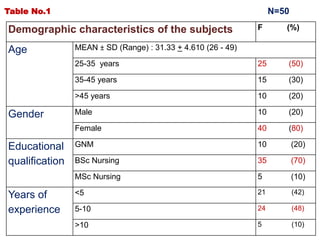
N=50
Demographic characteristics of the subjects F (%)
Age MEAN ± SD (Range) : 31.33 + 4.610 (26 - 49)
25-35 years 25 (50)
35-45 years 15 (30)
>45 years 10 (20)
Gender Male 10 (20)
Female 40 (80)
Educational
qualification
GNM 10 (20)
BSc Nursing 35 (70)
MSc Nursing 5 (10)
Years of
experience
<5 21 (42)
5-10 24 (48)
>10 5 (10)
Table No.1
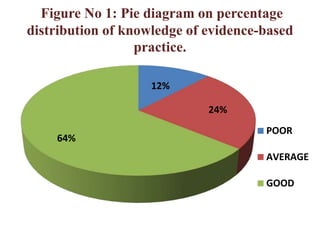
Figure No 1: Pie diagram on percentage
distribution of knowledge of evidence-based
practice.
12%
24%
64%
POOR
AVERAGE
GOOD
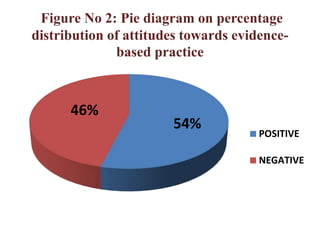
Figure No 2: Pie diagram on percentage
distribution of attitudes towards evidence-
based practice
54%
46%
POSITIVE
NEGATIVE
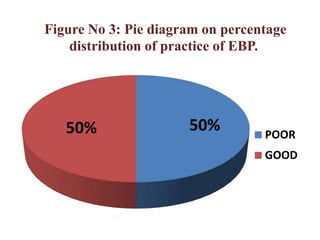
Figure No 3: Pie diagram on percentage
distribution of practice of EBP.
50%50% POOR
GOOD
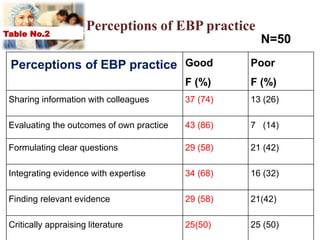
Perceptions of EBP practice
Perceptions of EBP practice Good
F (%)
Poor
F (%)
Sharing information with colleagues 37 (74) 13 (26)
Evaluating the outcomes of own practice 43 (86) 7 (14)
Formulating clear questions 29 (58) 21 (42)
Integrating evidence with expertise 34 (68) 16 (32)
Finding relevant evidence 29 (58) 21(42)
Critically appraising literature 25(50) 25 (50)
N=50
Table No.2
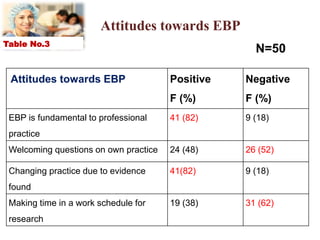
Attitudes towards EBP
Attitudes towards EBP Positive
F (%)
Negative
F (%)
EBP is fundamental to professional
practice
41 (82) 9 (18)
Welcoming questions on own practice 24 (48) 26 (52)
Changing practice due to evidence
found
41(82) 9 (18)
Making time in a work schedule for
research
19 (38) 31 (62)
N=50Table No.3
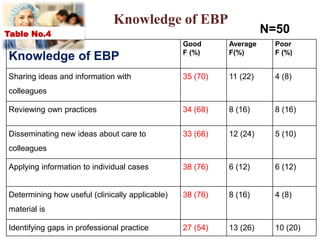
Knowledge of EBP

Knowledge of EBP
Good
F (%)
Average
F(%)
Poor
F (%)
Sharing ideas and information with
colleagues
35 (70) 11 (22) 4 (8)
Reviewing own practices 34 (68) 8 (16) 8 (16)
Disseminating new ideas about care to
colleagues
33 (66) 12 (24) 5 (10)
Applying information to individual cases 38 (76) 6 (12) 6 (12)
Determining how useful (clinically applicable)
material is
38 (76) 8 (16) 4 (8)
Identifying gaps in professional practice 27 (54) 13 (26) 10 (20)
N=50Table No.4
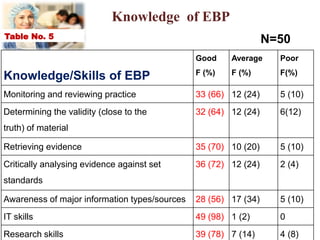
Knowledge of EBP
Knowledge/Skills of EBP
Good
F (%)
Average
F (%)
Poor
F(%)
Monitoring and reviewing practice 33 (66) 12 (24) 5 (10)
Determining the validity (close to the
truth) of material
32 (64) 12 (24) 6(12)
Retrieving evidence 35 (70) 10 (20) 5 (10)
Critically analysing evidence against set
standards
36 (72) 12 (24) 2 (4)
Awareness of major information types/sources 28 (56) 17 (34) 5 (10)
IT skills 49 (98) 1 (2) 0
Research skills 39 (78) 7 (14) 4 (8)
N=50Table No. 5
Objective-2
To find out associations between
selected demographic variables
(academic qualification, years of
experience) and perceived EBP
practice, attitudes and knowledge.
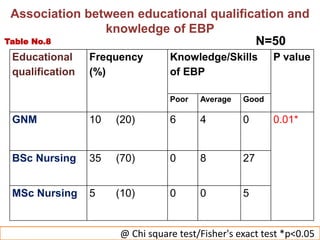
Educational
qualification
Frequency
(%)
Knowledge/Skills
of EBP
P value
Poor Average Good
GNM 10 (20) 6 4 0 0.01*
BSc Nursing 35 (70) 0 8 27
MSc Nursing 5 (10) 0 0 5
@ Chi square test/Fisher's exact test *p<0.05
Association between educational qualification and
knowledge of EBP
N=50Table No.8
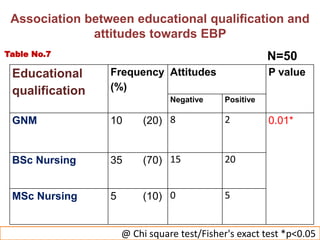
Educational
qualification
Frequency
(%)
Attitudes P value
Negative Positive
GNM 10 (20) 8 2 0.01*
BSc Nursing 35 (70) 15 20
MSc Nursing 5 (10) 0 5
@ Chi square test/Fisher's exact test *p<0.05
Association between educational qualification and
attitudes towards EBP
N=50Table No.7
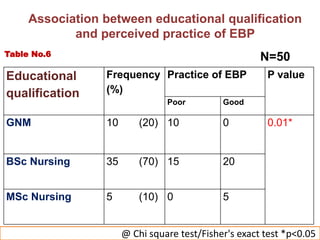
Educational
qualification
Frequency
(%)
Practice of EBP P value
Poor Good
GNM 10 (20) 10 0 0.01*
BSc Nursing 35 (70) 15 20
MSc Nursing 5 (10) 0 5
@ Chi square test/Fisher's exact test *p<0.05
Association between educational qualification
and perceived practice of EBP
N=50Table No.6
Years of
experience
Frequency (%) Perceived knowledge of
evidence-based practice
P
value
Poor Average Good
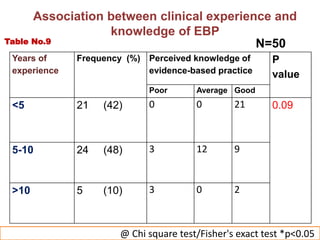
<5 21 (42) 0 0 21 0.09
5-10 24 (48) 3 12 9
>10 5 (10) 3 0 2
@ Chi square test/Fisher's exact test *p<0.05
Association between clinical experience and
knowledge of EBP
N=50Table No.9
Years of
experience
Frequency
(%)
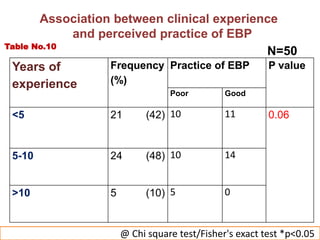
Practice of EBP P value
Poor Good
<5 21 (42) 10 11 0.06
5-10 24 (48) 10 14
>10 5 (10) 5 0
@ Chi square test/Fisher's exact test *p<0.05
Association between clinical experience
and perceived practice of EBP
N=50Table No.10
Years of
experience
Frequency
(%)
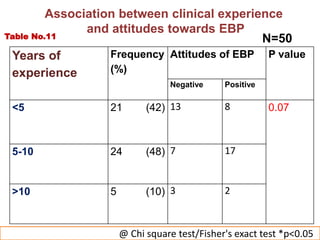
Attitudes of EBP P value
Negative Positive
<5 21 (42) 13 8 0.07
5-10 24 (48) 7 17
>10 5 (10) 3 2
@ Chi square test/Fisher's exact test *p<0.05
Association between clinical experience
and attitudes towards EBP
N=50Table No.11
Major findings and discussion
 More than half of the nurses had good knowledge (64%) and
positive attitude (54%) towards evidence based practice. Half
(50%) of the nurses reported frequent utilisation of evidence
based practice.
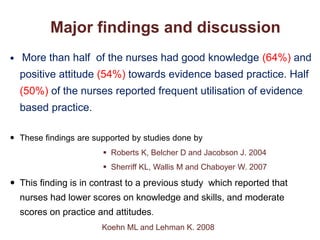
 These findings are supported by studies done by
 Roberts K, Belcher D and Jacobson J. 2004
 Sherriff KL, Wallis M and Chaboyer W. 2007
 This finding is in contrast to a previous study which reported that
nurses had lower scores on knowledge and skills, and moderate
scores on practice and attitudes.
Koehn ML and Lehman K. 2008
 The level of knowledge, attitude and practice of EBP
was proportionate to the educational qualification of the
nurses.
 This finding is supported by a previous study which
found that nurses with higher qualifications were better
able to benefit from EBP activities. Majid S, Foo S, Luyt
B, et al. 2011
Major findings and discussion
 No significant positive associations were found
between years of experience and knowledge,
practice and attitudes.
 This finding is in disagreement with another study
which found that nurses who had more years of
experience reported more frequent use of EBP
and positive attitudes towards EBP. Motamedi SH,
Seyednour R, Noorikhajavi M, Afghah S (2007)
Major findings and discussion
Conclusion
• Continuing education regarding EBP for nurses is crucial
in order to enhance nurses’ clinical practice, knowledge
and skills, and hospital management should take steps to
minimise the barriers to EBP implementation.
Evidence-based Practice: Knowledge, Attitudes and Practice Among Nurses in AIIMS.

Evidence-based Practice: Knowledge, Attitudes and Practice Among Nurses in AIIMS.

  • 1.
    Presenter: Anju Jose NIS AIIMS. Evidence-basedPractice: Knowledge, Attitudes and Practice Among Nurses in AIIMS. Guide: Dr. Deepak Agrawal Professor, Dept. Neuro surgery and Gamma-Knife Chairman, Computerisation AIIMS.
  • 2.
    Introduction • EBP- Theconscientious, explicit and judicious use of current best evidence in making decisions about the care of individual patients.
  • 3.
    Background of thestudy • There is a discrepancy between the amount of research evidence that exists and the use of this evidence within clinical health care practice. • There is a need to improve quality of care and patient safety by enhancing Nurses’ practice of EBP.
  • 4.
    Need for thestudy  Evidence-based practice (EBP) has been increasingly emphasized in nursing, but its implementation is still sometimes met with confusion and resistance.  Therefore, identifying factors affecting its implementation is crucial.
  • 5.
    Review of literature Nurses had lower scores on knowledge and skills and moderate scores on practice and attitudes associated with EBP. (Koehn ML, Lehman K 2008) Inadequate time and knowledge were the top barriers to the implementation of research among nurses. (Paramonczyk A 2005)
  • 6.
    Problem statement A StudyTo Assess Knowledge, Attitudes And Practice regarding Evidence-based Practice Among Nurses in AIIMS.
  • 7.
    Objectives 1. To assessknowledge, attitudes and practice regarding Evidence-based Practice among nurses in AIIMS. 2. To find out associations between selected demographic variables (academic qualification, years of experience) and perceived EBP practice, attitudes and knowledge.
  • 8.
    Methodology • Research approach:Quantitative approach. • Research design: Cross sectional survey. • Setting: Selected wards in main AIIMS. • Population: Nurses working in main AIIMS.
  • 9.
    Sample & samplingtechnique  Sample: Nurses working in selected areas of main AIIMS and fulfilling the inclusion criteria.  Sampling technique: Convenience sampling technique. • Inclusion criteria  Nurses working in AIIMS and having clinical experience of more than 1 year.  Nurses who are willing to participate in the study. • Sample size: 50
  • 10.
    Tool: Evidence BasedPractice Questionnaire(EBPQ). • Standardised and structured. Upton D. & Upton P. (2006) • A 24-item, self-administered questionnaire. • Gathers information and opinions on the use of EBP among health professionals. • 3 sub-scales: Practice of EBP, Attitudes towards EBP and Knowledge of EBP. • Reliability: Cronbach's alpha= 0.87.
  • 11.
    Ethical considerations • Aninformed written consent was obtained from the subjects before data collection. • Confidentiality of information and anonymity of the subjects were maintained.
  • 12.
    Method for datacollection • The subjects those fulfilling the inclusion criteria were explained the purpose of the study. • An informed written consent form was signed by the subjects. • Subjects filled Evidence Based Practice Questionnaire(EBPQ). • After the data collection, a thanks was given to subjects.
  • 13.
  • 14.
    Methods of dataanalysis • Data was analyzed using SPSS version-16.0 • Descriptive statistical methods Mean Standard Deviation Frequency, Percentage • Inferential statistical methods chi-square test
  • 15.
    N=50 Demographic characteristics ofthe subjects F (%) Age MEAN ± SD (Range) : 31.33 + 4.610 (26 - 49) 25-35 years 25 (50) 35-45 years 15 (30) >45 years 10 (20) Gender Male 10 (20) Female 40 (80) Educational qualification GNM 10 (20) BSc Nursing 35 (70) MSc Nursing 5 (10) Years of experience <5 21 (42) 5-10 24 (48) >10 5 (10) Table No.1
  • 16.
    Figure No 1:Pie diagram on percentage distribution of knowledge of evidence-based practice. 12% 24% 64% POOR AVERAGE GOOD
  • 17.
    Figure No 2:Pie diagram on percentage distribution of attitudes towards evidence- based practice 54% 46% POSITIVE NEGATIVE
  • 18.
    Figure No 3:Pie diagram on percentage distribution of practice of EBP. 50%50% POOR GOOD
  • 19.
    Perceptions of EBPpractice Perceptions of EBP practice Good F (%) Poor F (%) Sharing information with colleagues 37 (74) 13 (26) Evaluating the outcomes of own practice 43 (86) 7 (14) Formulating clear questions 29 (58) 21 (42) Integrating evidence with expertise 34 (68) 16 (32) Finding relevant evidence 29 (58) 21(42) Critically appraising literature 25(50) 25 (50) N=50 Table No.2
  • 20.
    Attitudes towards EBP Attitudestowards EBP Positive F (%) Negative F (%) EBP is fundamental to professional practice 41 (82) 9 (18) Welcoming questions on own practice 24 (48) 26 (52) Changing practice due to evidence found 41(82) 9 (18) Making time in a work schedule for research 19 (38) 31 (62) N=50Table No.3
  • 21.
    Knowledge of EBP Knowledgeof EBP Good F (%) Average F(%) Poor F (%) Sharing ideas and information with colleagues 35 (70) 11 (22) 4 (8) Reviewing own practices 34 (68) 8 (16) 8 (16) Disseminating new ideas about care to colleagues 33 (66) 12 (24) 5 (10) Applying information to individual cases 38 (76) 6 (12) 6 (12) Determining how useful (clinically applicable) material is 38 (76) 8 (16) 4 (8) Identifying gaps in professional practice 27 (54) 13 (26) 10 (20) N=50Table No.4
  • 22.
    Knowledge of EBP Knowledge/Skillsof EBP Good F (%) Average F (%) Poor F(%) Monitoring and reviewing practice 33 (66) 12 (24) 5 (10) Determining the validity (close to the truth) of material 32 (64) 12 (24) 6(12) Retrieving evidence 35 (70) 10 (20) 5 (10) Critically analysing evidence against set standards 36 (72) 12 (24) 2 (4) Awareness of major information types/sources 28 (56) 17 (34) 5 (10) IT skills 49 (98) 1 (2) 0 Research skills 39 (78) 7 (14) 4 (8) N=50Table No. 5
  • 23.
    Objective-2 To find outassociations between selected demographic variables (academic qualification, years of experience) and perceived EBP practice, attitudes and knowledge.
  • 24.
    Educational qualification Frequency (%) Knowledge/Skills of EBP P value PoorAverage Good GNM 10 (20) 6 4 0 0.01* BSc Nursing 35 (70) 0 8 27 MSc Nursing 5 (10) 0 0 5 @ Chi square test/Fisher's exact test *p<0.05 Association between educational qualification and knowledge of EBP N=50Table No.8
  • 25.
    Educational qualification Frequency (%) Attitudes P value NegativePositive GNM 10 (20) 8 2 0.01* BSc Nursing 35 (70) 15 20 MSc Nursing 5 (10) 0 5 @ Chi square test/Fisher's exact test *p<0.05 Association between educational qualification and attitudes towards EBP N=50Table No.7
  • 26.
    Educational qualification Frequency (%) Practice of EBPP value Poor Good GNM 10 (20) 10 0 0.01* BSc Nursing 35 (70) 15 20 MSc Nursing 5 (10) 0 5 @ Chi square test/Fisher's exact test *p<0.05 Association between educational qualification and perceived practice of EBP N=50Table No.6
  • 27.
    Years of experience Frequency (%)Perceived knowledge of evidence-based practice P value Poor Average Good <5 21 (42) 0 0 21 0.09 5-10 24 (48) 3 12 9 >10 5 (10) 3 0 2 @ Chi square test/Fisher's exact test *p<0.05 Association between clinical experience and knowledge of EBP N=50Table No.9
  • 28.
    Years of experience Frequency (%) Practice ofEBP P value Poor Good <5 21 (42) 10 11 0.06 5-10 24 (48) 10 14 >10 5 (10) 5 0 @ Chi square test/Fisher's exact test *p<0.05 Association between clinical experience and perceived practice of EBP N=50Table No.10
  • 29.
    Years of experience Frequency (%) Attitudes ofEBP P value Negative Positive <5 21 (42) 13 8 0.07 5-10 24 (48) 7 17 >10 5 (10) 3 2 @ Chi square test/Fisher's exact test *p<0.05 Association between clinical experience and attitudes towards EBP N=50Table No.11
  • 30.
    Major findings anddiscussion  More than half of the nurses had good knowledge (64%) and positive attitude (54%) towards evidence based practice. Half (50%) of the nurses reported frequent utilisation of evidence based practice.  These findings are supported by studies done by  Roberts K, Belcher D and Jacobson J. 2004  Sherriff KL, Wallis M and Chaboyer W. 2007  This finding is in contrast to a previous study which reported that nurses had lower scores on knowledge and skills, and moderate scores on practice and attitudes. Koehn ML and Lehman K. 2008


  • 31.
     The levelof knowledge, attitude and practice of EBP was proportionate to the educational qualification of the nurses.  This finding is supported by a previous study which found that nurses with higher qualifications were better able to benefit from EBP activities. Majid S, Foo S, Luyt B, et al. 2011 Major findings and discussion
  • 32.
     No significantpositive associations were found between years of experience and knowledge, practice and attitudes.  This finding is in disagreement with another study which found that nurses who had more years of experience reported more frequent use of EBP and positive attitudes towards EBP. Motamedi SH, Seyednour R, Noorikhajavi M, Afghah S (2007) Major findings and discussion
  • 33.
    Conclusion • Continuing educationregarding EBP for nurses is crucial in order to enhance nurses’ clinical practice, knowledge and skills, and hospital management should take steps to minimise the barriers to EBP implementation.

Editor's Notes

  • #6 Olsson M B, Hwang C P. Depression in mothers and fathers of children with intellectual disability. Journal of Intellectual Disability Research. 2001; 45: 535–543.