Population Health Management
Jan 24th 2019
PHM and the NHS Long Term Plan
• NHS and our partners will be moving to create Integrated Care Systems
(ICS) everywhere by April 2021.
• ICSs will deliver the ‘triple integration’ of primary and specialist care,
physical and mental health services, and health with social care.
• ICSs will help deliver these programmes as the NHS continues to move
from reactive care towards a model embodying active Population Health
Management.
• PHM solutions will be deployed to support ICSs to understand areas of
greatest health need and match NHS services to meet them.
• These PHM solutions will become increasingly more sophisticated...
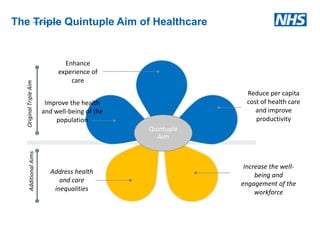
The Triple Quintuple Aim of Healthcare
Improve the health
and well-being of the
population
Reduce per capita
cost of health care
and improve
productivity
Increase the well-
being and
engagement of the
workforce
Enhance
experience of
care
Address health
and care
inequalities
Quintuple
Aim
OriginalTripleAimAdditionalAims
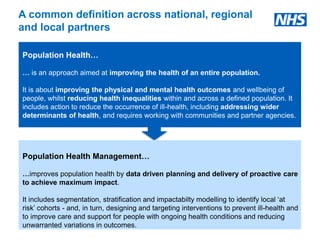
A common definition across national, regional
and local partners
Population Health…
… is an approach aimed at improving the health of an entire population.
It is about improving the physical and mental health outcomes and wellbeing of
people, whilst reducing health inequalities within and across a defined population. It
includes action to reduce the occurrence of ill-health, including addressing wider
determinants of health, and requires working with communities and partner agencies.
Population Health Management…
…improves population health by data driven planning and delivery of proactive care
to achieve maximum impact.
It includes segmentation, stratification and impactabilty modelling to identify local ‘at
risk’ cohorts - and, in turn, designing and targeting interventions to prevent ill-health and
to improve care and support for people with ongoing health conditions and reducing
unwarranted variations in outcomes.
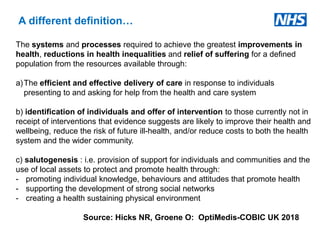
A different definition…
The systems and processes required to achieve the greatest improvements in
health, reductions in health inequalities and relief of suffering for a defined
population from the resources available through:
a)The efficient and effective delivery of care in response to individuals
presenting to and asking for help from the health and care system
b) identification of individuals and offer of intervention to those currently not in
receipt of interventions that evidence suggests are likely to improve their health and
wellbeing, reduce the risk of future ill-health, and/or reduce costs to both the health
system and the wider community.
c) salutogenesis : i.e. provision of support for individuals and communities and the
use of local assets to protect and promote health through:
- promoting individual knowledge, behaviours and attitudes that promote health
- supporting the development of strong social networks
- creating a health sustaining physical environment
Source: Hicks NR, Groene O: OptiMedis-COBIC UK 2018
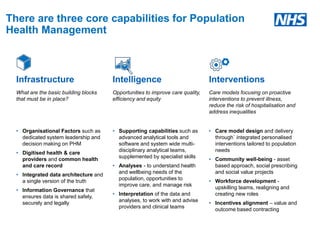
There are three core capabilities for Population
Health Management
What are the basic building blocks
that must be in place?
• Organisational Factors such as
dedicated system leadership and
decision making on PHM
• Digitised health & care
providers and common health
and care record
• Integrated data architecture and
a single version of the truth
• Information Governance that
ensures data is shared safely,
securely and legally
Opportunities to improve care quality,
efficiency and equity
• Supporting capabilities such as
advanced analytical tools and
software and system wide multi-
disciplinary analytical teams,
supplemented by specialist skills
• Analyses - to understand health
and wellbeing needs of the
population, opportunities to
improve care, and manage risk
• Interpretation of the data and
analyses, to work with and advise
providers and clinical teams
Care models focusing on proactive
interventions to prevent illness,
reduce the risk of hospitalisation and
address inequalities
• Care model design and delivery
through` integrated personalised
interventions tailored to population
needs
• Community well-being - asset
based approach, social prescribing
and social value projects
• Workforce development -
upskilling teams, realigning and
creating new roles
• Incentives alignment – value and
outcome based contracting
Infrastructure Intelligence Interventions
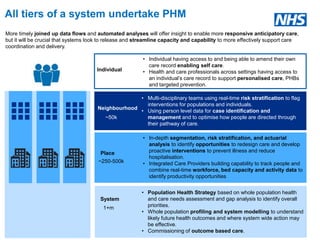
Neighbourhood
~50k
• Multi-disciplinary teams using real-time risk stratification to flag
interventions for populations and individuals.
• Using person level data for case identification and
management and to optimise how people are directed through
their pathway of care.
Place
~250-500k
• In-depth segmentation, risk stratification, and actuarial
analysis to identify opportunities to redesign care and develop
proactive interventions to prevent illness and reduce
hospitalisation.
• Integrated Care Providers building capability to track people and
combine real-time workforce, bed capacity and activity data to
identify productivity opportunities
System
1+m
• Population Health Strategy based on whole population health
and care needs assessment and gap analysis to identify overall
priorities.
• Whole population profiling and system modelling to understand
likely future health outcomes and where system wide action may
be effective.
• Commissioning of outcome based care.
Individual
• Individual having access to and being able to amend their own
care record enabling self care.
• Health and care professionals across settings having access to
an individual’s care record to support personalised care, PHBs
and targeted prevention.
All tiers of a system undertake PHM
More timely joined up data flows and automated analyses will offer insight to enable more responsive anticipatory care,
but it will be crucial that systems look to release and streamline capacity and capability to more effectively support care
coordination and delivery.
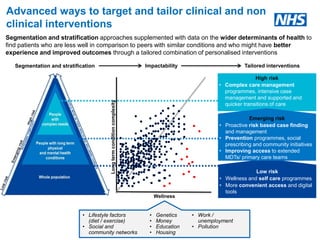
High risk
• Complex care management
programmes, intensive case
management and supported and
quicker transitions of care
Low risk
• Wellness and self care programmes
• More convenient access and digital
tools
Segmentation and stratification approaches supplemented with data on the wider determinants of health to
find patients who are less well in comparison to peers with similar conditions and who might have better
experience and improved outcomes through a tailored combination of personalised interventions
Segmentation and stratification Impactability Tailored interventions
Longtermconditioncomplexity
Wellness
• Lifestyle factors
(diet / exercise)
• Social and
community networks
• Genetics
• Money
• Education
• Housing
• Work /
unemployment
• Pollution
Advanced ways to target and tailor clinical and non
clinical interventions
Emerging risk
• Proactive risk based case finding
and management
• Prevention programmes, social
prescribing and community initiatives
• Improving access to extended
MDTs/ primary care teams
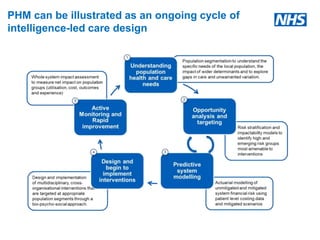
PHM can be illustrated as an ongoing cycle of
intelligence-led care design
Population Health Management Presentation

Population Health Management Presentation

  • 1.
  • 2.
    PHM and theNHS Long Term Plan • NHS and our partners will be moving to create Integrated Care Systems (ICS) everywhere by April 2021. • ICSs will deliver the ‘triple integration’ of primary and specialist care, physical and mental health services, and health with social care. • ICSs will help deliver these programmes as the NHS continues to move from reactive care towards a model embodying active Population Health Management. • PHM solutions will be deployed to support ICSs to understand areas of greatest health need and match NHS services to meet them. • These PHM solutions will become increasingly more sophisticated...
  • 3.
    The Triple QuintupleAim of Healthcare Improve the health and well-being of the population Reduce per capita cost of health care and improve productivity Increase the well- being and engagement of the workforce Enhance experience of care Address health and care inequalities Quintuple Aim OriginalTripleAimAdditionalAims
  • 4.
    A common definitionacross national, regional and local partners Population Health… … is an approach aimed at improving the health of an entire population. It is about improving the physical and mental health outcomes and wellbeing of people, whilst reducing health inequalities within and across a defined population. It includes action to reduce the occurrence of ill-health, including addressing wider determinants of health, and requires working with communities and partner agencies. Population Health Management… …improves population health by data driven planning and delivery of proactive care to achieve maximum impact. It includes segmentation, stratification and impactabilty modelling to identify local ‘at risk’ cohorts - and, in turn, designing and targeting interventions to prevent ill-health and to improve care and support for people with ongoing health conditions and reducing unwarranted variations in outcomes.
  • 5.
    A different definition… Thesystems and processes required to achieve the greatest improvements in health, reductions in health inequalities and relief of suffering for a defined population from the resources available through: a)The efficient and effective delivery of care in response to individuals presenting to and asking for help from the health and care system b) identification of individuals and offer of intervention to those currently not in receipt of interventions that evidence suggests are likely to improve their health and wellbeing, reduce the risk of future ill-health, and/or reduce costs to both the health system and the wider community. c) salutogenesis : i.e. provision of support for individuals and communities and the use of local assets to protect and promote health through: - promoting individual knowledge, behaviours and attitudes that promote health - supporting the development of strong social networks - creating a health sustaining physical environment Source: Hicks NR, Groene O: OptiMedis-COBIC UK 2018
  • 6.
    There are threecore capabilities for Population Health Management What are the basic building blocks that must be in place? • Organisational Factors such as dedicated system leadership and decision making on PHM • Digitised health & care providers and common health and care record • Integrated data architecture and a single version of the truth • Information Governance that ensures data is shared safely, securely and legally Opportunities to improve care quality, efficiency and equity • Supporting capabilities such as advanced analytical tools and software and system wide multi- disciplinary analytical teams, supplemented by specialist skills • Analyses - to understand health and wellbeing needs of the population, opportunities to improve care, and manage risk • Interpretation of the data and analyses, to work with and advise providers and clinical teams Care models focusing on proactive interventions to prevent illness, reduce the risk of hospitalisation and address inequalities • Care model design and delivery through` integrated personalised interventions tailored to population needs • Community well-being - asset based approach, social prescribing and social value projects • Workforce development - upskilling teams, realigning and creating new roles • Incentives alignment – value and outcome based contracting Infrastructure Intelligence Interventions
  • 7.
    Neighbourhood ~50k • Multi-disciplinary teamsusing real-time risk stratification to flag interventions for populations and individuals. • Using person level data for case identification and management and to optimise how people are directed through their pathway of care. Place ~250-500k • In-depth segmentation, risk stratification, and actuarial analysis to identify opportunities to redesign care and develop proactive interventions to prevent illness and reduce hospitalisation. • Integrated Care Providers building capability to track people and combine real-time workforce, bed capacity and activity data to identify productivity opportunities System 1+m • Population Health Strategy based on whole population health and care needs assessment and gap analysis to identify overall priorities. • Whole population profiling and system modelling to understand likely future health outcomes and where system wide action may be effective. • Commissioning of outcome based care. Individual • Individual having access to and being able to amend their own care record enabling self care. • Health and care professionals across settings having access to an individual’s care record to support personalised care, PHBs and targeted prevention. All tiers of a system undertake PHM More timely joined up data flows and automated analyses will offer insight to enable more responsive anticipatory care, but it will be crucial that systems look to release and streamline capacity and capability to more effectively support care coordination and delivery.
  • 8.
    High risk • Complexcare management programmes, intensive case management and supported and quicker transitions of care Low risk • Wellness and self care programmes • More convenient access and digital tools Segmentation and stratification approaches supplemented with data on the wider determinants of health to find patients who are less well in comparison to peers with similar conditions and who might have better experience and improved outcomes through a tailored combination of personalised interventions Segmentation and stratification Impactability Tailored interventions Longtermconditioncomplexity Wellness • Lifestyle factors (diet / exercise) • Social and community networks • Genetics • Money • Education • Housing • Work / unemployment • Pollution Advanced ways to target and tailor clinical and non clinical interventions Emerging risk • Proactive risk based case finding and management • Prevention programmes, social prescribing and community initiatives • Improving access to extended MDTs/ primary care teams
  • 9.
    PHM can beillustrated as an ongoing cycle of intelligence-led care design