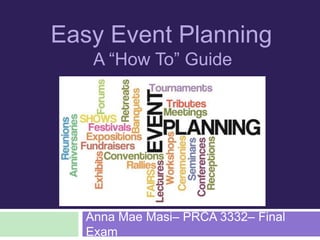
Easy Event Planning
A “How To” Guide
Anna Mae Masi– PRCA 3332– Final
Exam
First Things First!
 Here are a few essential questions to ask yourself or
your client before the planning begins:
- Should I hold an event?
- Do I have the money to hold the event I envision?
- What is the purpose of the event?
 Initial Planning Tips:
- Think in terms of “sense” not just dollars and cents
- Bring event planners and consultants in at the
appropriate time and you can save money in the end!
- Define the goals you’d like to achieve through the event
and be sure that all steps you take lead to the end result.
Budget
 During initial planning, lay
out your proposed budget
on a cost sheet in Excel
 Keep budget accurate
and up to date at all times
to prevent over spending
 Your event should be
reconciled as you go
forward– each time you
get new costs or make
adjustments/changes, you
r budget needs to be
updated so that there are
no surprises.
Organization and Timing is
Everything
 Function Sheet: the information guide that tells you how
you want your event to be handled
- It makes sure everything is in place… no surprises!
- One person needs to be in charge of preparing the
sheets, to control all the information coming in, and that
person must be the only one dealing with suppliers and
finalizing plans.
 Contact Sheets: list of all names, titles, company
names, addresses, telephone, fax and cell numbers, e-mail
addresses, and emergency information
- Used so that the creative director has all the numbers
in one central area and so that thank-you letters can be
written after the event is completed
Organization and Timing Cont.
 Decide on an appropriate
date:
- What’s going on around the
proposed time of your event?
Consider major
holidays, religious
observations, school
breaks, sporting events, ect.
- Consider the seasons
(November and December are
packed with holiday festivities…)
- Discuss climate!
Location and Site
 Site Selection: you are not limited to
hotels, convention centers, or restaurants–
think outside the box!
 You are limited only by your imagination and
your budget
 Location Requirements: investigate
availability and be specific!
- It is easier to release space and scale
down than to try and work with inadequate
space once you have signed the contract
Location and Site Cont.
 - Map out your location
requirements on a grid/chart–
Include:
- Move In
- Setup
- Rehearsal
- Teardown
- Move Out
Planes, Trains, and
Automobiles
 Transportation
Checklist:
- Access all event
transportation requirements
- Look at where
conventional and creative
transportation options are
appropriate
- Choose the
appropriate route
- Decide how group
departure and drop-off can be
made more convenient
Be Our Guest!
 Guest Arrival:
- Assess all guest
arrival transportation and
parking requirements
- Determine how many
entrances will need to be
covered
- Design arrival that is
welcoming and sets the
tone for the event ahead
Be Our Guest Cont.
 Guests: Keep and track all guest information organized
on one Excel spreadsheet -
(incl. full name, address, RSVP status, guest names, dietary
restrictions, etc.)
 Registration questions to consider:
Will guests be receiving…
- Programs?
- Floor/seating Plans?
- Information kits?
Will you need…
- Display easels for signs?
- Electrical outlets and/or extension chords?
- Extra tables and/or chairs?
Venue & Menu
 Venue/Room considerations:
- Width of the doors
- Ceiling height
- Sight lines
- What is on the floors, walls, and ceilings
 Space requirements:
- Cocktail Reception: 8 sq ft per person
- Cocktails w/ Food Stations: 12-15 sq ft per
person
- Seated Dinner: 20 sq ft per person
- Dance Floor: 20 sq ft per instrument for the
band
Venue & Menu Cont.
 Work with the caterers to come
up with a creative menu!
 Cardinal rule… do NOT run out
of food!
 Appetizers
• Array of choices, but limit to 8-
10 items
 Dinner
• If follows, 6-8 hors d’oevres
per person
• NO dinner, 18-30 pieces per
person
Extra Tips
 Always have a back-up plan for everything, especially
being able to communicate quickly with your invited
guests in case something goes really wrong.
 Stay in communication with your guests throughout
the process. Call them 2-3 days prior to the event to
confirm their attendance. After the event, send a note
or letter thanking them for coming. Bonus points if you
can include a picture of them at the event!
 Don’t be afraid to negotiate prices or get additional
quotes from other caterers, cor companies, florists
etc. Competition means savings!
Extra Tips
 Will you need microphones,
projectors, speakers, video
cameras, etc.? Make a list of
equipment needs and plan to
hire a professional AV tech to
set up all equipment.
 Last but not least…evaluate
your event! What worked?
What didn’t work? This will
help you plan and execute
future events
References
 http://www.northeastern.edu/events/downloads
/Top%20Ten%20Tips%20for%20Planning%20
an%20Event.pdf
 Event Planning (second addition) by Judy
Allen

Event Planning Guide

  • 1.
    Easy Event Planning A“How To” Guide Anna Mae Masi– PRCA 3332– Final Exam
  • 2.
    First Things First! Here are a few essential questions to ask yourself or your client before the planning begins: - Should I hold an event? - Do I have the money to hold the event I envision? - What is the purpose of the event?  Initial Planning Tips: - Think in terms of “sense” not just dollars and cents - Bring event planners and consultants in at the appropriate time and you can save money in the end! - Define the goals you’d like to achieve through the event and be sure that all steps you take lead to the end result.
  • 3.
    Budget  During initialplanning, lay out your proposed budget on a cost sheet in Excel  Keep budget accurate and up to date at all times to prevent over spending  Your event should be reconciled as you go forward– each time you get new costs or make adjustments/changes, you r budget needs to be updated so that there are no surprises.
  • 4.
    Organization and Timingis Everything  Function Sheet: the information guide that tells you how you want your event to be handled - It makes sure everything is in place… no surprises! - One person needs to be in charge of preparing the sheets, to control all the information coming in, and that person must be the only one dealing with suppliers and finalizing plans.  Contact Sheets: list of all names, titles, company names, addresses, telephone, fax and cell numbers, e-mail addresses, and emergency information - Used so that the creative director has all the numbers in one central area and so that thank-you letters can be written after the event is completed
  • 5.
    Organization and TimingCont.  Decide on an appropriate date: - What’s going on around the proposed time of your event? Consider major holidays, religious observations, school breaks, sporting events, ect. - Consider the seasons (November and December are packed with holiday festivities…) - Discuss climate!
  • 6.
    Location and Site Site Selection: you are not limited to hotels, convention centers, or restaurants– think outside the box!  You are limited only by your imagination and your budget  Location Requirements: investigate availability and be specific! - It is easier to release space and scale down than to try and work with inadequate space once you have signed the contract
  • 7.
    Location and SiteCont.  - Map out your location requirements on a grid/chart– Include: - Move In - Setup - Rehearsal - Teardown - Move Out
  • 8.
    Planes, Trains, and Automobiles Transportation Checklist: - Access all event transportation requirements - Look at where conventional and creative transportation options are appropriate - Choose the appropriate route - Decide how group departure and drop-off can be made more convenient
  • 9.
    Be Our Guest! Guest Arrival: - Assess all guest arrival transportation and parking requirements - Determine how many entrances will need to be covered - Design arrival that is welcoming and sets the tone for the event ahead
  • 10.
    Be Our GuestCont.  Guests: Keep and track all guest information organized on one Excel spreadsheet - (incl. full name, address, RSVP status, guest names, dietary restrictions, etc.)  Registration questions to consider: Will guests be receiving… - Programs? - Floor/seating Plans? - Information kits? Will you need… - Display easels for signs? - Electrical outlets and/or extension chords? - Extra tables and/or chairs?
  • 11.
    Venue & Menu Venue/Room considerations: - Width of the doors - Ceiling height - Sight lines - What is on the floors, walls, and ceilings  Space requirements: - Cocktail Reception: 8 sq ft per person - Cocktails w/ Food Stations: 12-15 sq ft per person - Seated Dinner: 20 sq ft per person - Dance Floor: 20 sq ft per instrument for the band
  • 12.
    Venue & MenuCont.  Work with the caterers to come up with a creative menu!  Cardinal rule… do NOT run out of food!  Appetizers • Array of choices, but limit to 8- 10 items  Dinner • If follows, 6-8 hors d’oevres per person • NO dinner, 18-30 pieces per person
  • 13.
    Extra Tips  Alwayshave a back-up plan for everything, especially being able to communicate quickly with your invited guests in case something goes really wrong.  Stay in communication with your guests throughout the process. Call them 2-3 days prior to the event to confirm their attendance. After the event, send a note or letter thanking them for coming. Bonus points if you can include a picture of them at the event!  Don’t be afraid to negotiate prices or get additional quotes from other caterers, cor companies, florists etc. Competition means savings!
  • 14.
    Extra Tips  Willyou need microphones, projectors, speakers, video cameras, etc.? Make a list of equipment needs and plan to hire a professional AV tech to set up all equipment.  Last but not least…evaluate your event! What worked? What didn’t work? This will help you plan and execute future events
  • 15.