Chapter 3 The Event Concept
HRTM 195 Events Management
Prepared by: Aireen Y. Clores
To Help With Your Audience
Satisfaction
• Try these tips:
– Research and Develop External Client
Relationships
– Pay attention to the smallest details. (People
Notice)
– Choose a direction to your event and attack with
passion
• The event could be:
– Educational, Energizing, Enlightening, or Engaging
– Look for different things to make your audience
standout
• E.I. Personalize and Customize as much as possible
Pre-event
11. Promotion
1. Proposal
2. Budget
3. Venue/ Site Selection and Design
4. Production Schedule
5. Speaker & Supplier Checklist
6. Sponsorship
7. F & B Menu
8. Guest list
9. Risk Management
10. Marketing
1. Executive Summary
2. Contents Sheet
- Major section headings + details of any attachments
3. Introduction
- Your approach
4. The Concept
- Description including broad outline timings for the actual show
- Include floor/ site plan to assist understanding (detailed plans
are
in the Planning section or as attachments)
- Include artist’s impressions if they add to understanding
5. Meeting the Requirements
- Answering specific questions or requirements posed by the client
6. The Budget
- Basis of calculation
- Income and expenditure
- Cash Flow
- Details of management fee structure and payment schedule
(the fully detailed budget and cash flow could be an attachment)
7. Organizational Structure for the Event
- Includes outline of major responsibilities
- Your company profile, references if applicable, as attachment
- Major contractor’s details may be required as well
8. Planning/ Logistics
- Outline to show you can do it, NOT so much detail that the
client
can take the plan and do it themselves.
- Risk Management plan is usually required
- Include other operational plans, such a Transport, ONLY IF THEY
ARE DIRECTLY APPLICALE TO WINNING THE BID
9. Other Plans (Marketing, sponsorship etc)
- ONLY include if they are part of the requirement, and then in
strategic rather than detailed form
10. Why Us?
- Your major selling point for this event
11. Conclusion
- A tidy summary of the major points which will sell the
proposal
12. Attachments
- Factual – Budget, floor plans, company profile, credentials
- Supporting – Details of the location, tour options, etc
Location, Location, Location
1 of the MOST IMPORTANT
THINGS to consider when
planning an event!!!
Guidelines for Selection
1.Availability
2.Size of the event
3.Layout and suitability
4.Stage, field of play or performance area
5.Transport and parking
6.Proximity to accommodation
7.Services available e.g. F&B
8.Technical support e.g. PA system, projector
9.Cost
Other Things to consider when
look at Location
• 4 main criteria:
– Proximity
• Where the location of the event is in relation to its
environment.
– Cost
• How much will the location cost $$$ (site cost
included)
– Size
• How much room do you need per person?
– Facilities
• What else are we working with?
Little Things Have a Big
Effect
• Make sure the event location matches the
event theme.
• Outline everything you have and need before
hand (Contracts)
– Helps with organization
• Indoor or Outdoor decision
• Type of safety hazards
– One way in one way out exits, etc.
• Will there be signs available to identify your
event
• So you’ve got your location down
so…what’s next…
KNOW YOUR
VENUE
Venue
• Make sure Staging, Audio, and Lightening is accessible at
your venue.
– Having no power is no fun
• Be weary of Space and Time guidelines in the contract.
• Keep in mind the feeling you want to convey in relation
to your venue.
• Know the smallest details
– Carpeted or Not
– Number of Columns in the room
– Possible isle paths for entrance and exits
– Event Design Angles
Transportation and Parking
• The event begins and ends with parking
and transportation.
– Transportation
• Make sure you take care of any special vehicles
needed to transport participants.
– Parking
• Get parking passes IN ADVANCE (if needed)
• Is there going to VIP parking
• Is the parking area will lit
• Will media have special parking
• Will sectional parking be avaliable.
THEME
• Things to consider
– Time of year
– Site
– Name & Logos
– Atmosphere
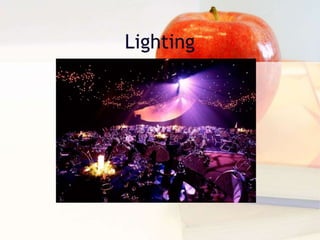
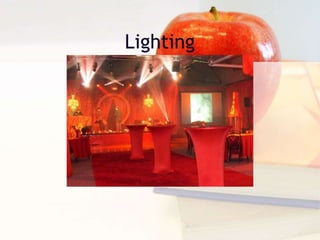
– Lighting
– Props
– Party Favors
Invitations/Promotional
Materials
• Save the date cards
– Themed reminders about the event
• Make sure your invitation set the mode
for the event
– It’s the first time your audience see’s or
hears about your event
• Determine whether the event be
– Invite only
– General Admission
#1 CARDINAL RULE
NEVER RUN OUT
OF FOOD
WARNING: This may cause a riot
• DECIDE IF THERE WILL BE FOOD AND
BEVERAGES AT YOUR EVENT.
Food And Beverages
• Most venues will work with you when it
comes to food in their venue.
• Make sure the food matches or adds to
your event.
• If alcohol is being served make
guidelines to ensure order.
• Make sure you are there for every step
of the food and beverage process.
SO HOW MUCH IS
THIS GOING TO
COST YOU
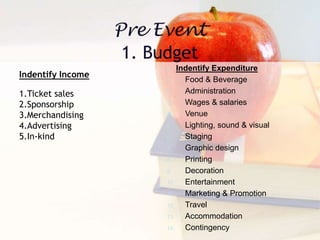
 Indentify Expenditure
1. Food & Beverage
2. Administration
3. Wages & salaries
4. Venue
5. Lighting, sound & visual
6. Staging
7. Graphic design
8. Printing
9. Decoration
10. Entertainment
11. Marketing & Promotion
12. Travel
13. Accommodation
14. Contingency
Indentify Income
1.Ticket sales
2.Sponsorship
3.Merchandising
4.Advertising
5.In-kind
Money
• Project a budget first
– Preliminary budget frame your event
vision
• NEVER MIX EVENT MONEY WITH YOUR
MONEY.
– If you don’t have the money make it work
with what you have.
Things to consider
• Budget
– How much are you going to spend.
• Kitchen space and location
• Number of guest
• Type of Event
• Will there be Appetizer/Courses served
• How will your food be served
– Self-service
– Catering help
Event Budget
• Things to consider when creating your
budget
– Expenses
• Focus of the Event
• Site Cost
• Refreshments/Food
• Programs
• Promotion materials
– Income
• Pre-sold/Day of tickets
• Vendor spaces
• Raffle tickets etc.
NOW THE MAIN EVENT
HELPFUL HINT: Show about one hour
before the first person or group is suppose
to be there just in cause
Event Day
Day of the Event Checklist
o Supplies Pick up
o Venue Set-up
o Prop pick-up
o Furniture Placement/Removal (if needed)
o Food Delivery (if needed)
o Place any outside and/or outside Promotional Materials
o Copies of any contracts or written correspondence
o Be prepared to handle any last minute adjustments
o Back up plans, surplus items, etc.
Now That Your Event Is Over
WHAT NEXT???
Post Event
 Evaluation
 Shutdown and Reporting
CLEAN UP
• Clean up begins once the last dish is cleared.
• At this time, you want to re-announce prize winners
to come pick up their prizes.
• Also announce the ending of the meal.
• Make sure to check every inch of the venue and
location while cleaning
• Generally you want your venue and location to look
like it did when you first arrived. (at least)
• Make sure all trash is taken to the negotiated areas
Closing the Event
• Make sure procedures for securing any
types of keys are made clear and
followed.
• The event manager should be the last
one to leave.
See Appendix 2 _ Site Inspection Checklist
Conduct a Site Inspection
Develop a checklist for Site Inspection:
1.Compatibility with event theme
2.Seating arrangement
3.Sight obstruction e.g. pillars
4.Storage areas
5.Entrances & exits including freight access
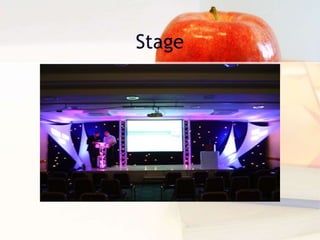
6.Stage area
7.Equipment available on site
8.Safety and security
9.Access time
10.Power
See Appendix 3 _ Layout Diagram
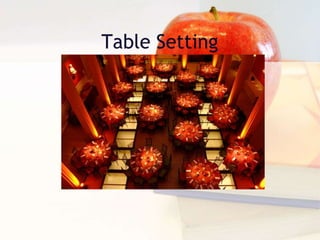
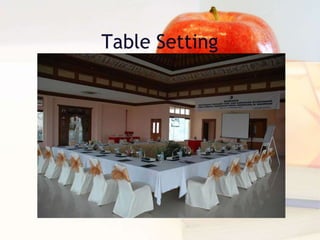
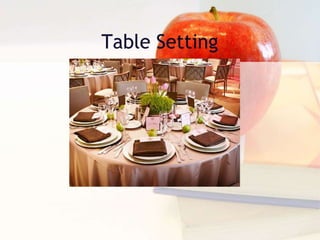
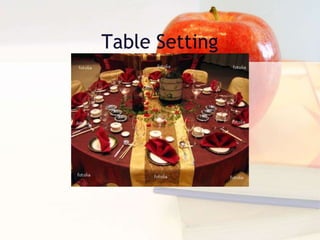
Layout Diagram
Prepare a Layout diagram on:
1.Stage
2.Seating and table arrangement
3.Registration area
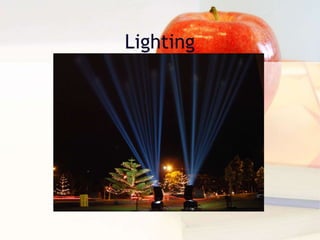
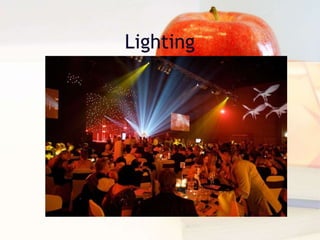
4.Equipment positions e.g. lighting, projectors
5.Decoration layout
6.F & B station
7.Signs
8.Entry and exit including staff position
See Appendix 4 _ Sample of Gantt Chart
See Appendix 5 _ Sample of Production Schedule
What is to happen
When will it happen
Where will it happen
Who is responsible
Gantt Charts/ Production Schedule
Event review meetings
- to check progress against the schedule
Status reports
– to check progress against schedule
Check lists
Direct observation
Speaker Checklist
1.Send invitation
2.Get writing confirmation
3.Biodata and photograph
4.Slide presentation
5.Accommodation & Transportation Arrangement
See Appendix 6 _ Sample of Supplier Checklist
Supplier Checklist
1.List of suppliers
2.List of requirements from every supplier
3.List of their roles and date to set up
4.i.e audio and visual – projector, notebook, PA
system, microphone, cable
5.i.e photography – how many photographer you
need, location of the photographer
Why should companies sponsor?
1.Gain access to target markets for promotional messages
2.Generate consumer awareness – used to introduce or build a brand
3.Positioning/repositioning of the existing service/ product
4.Exclusivity – to lock out their competitors
5.Demonstrate product attributes
Before seeking sponsorship, we should
decide whether:
1.Your stakeholders (members, participants) are likely to approve
of commercial sponsorship
2.Your event has rights/ benefits of value to a potential sponsor,
e.g. access to target markets
3.You have the human resources to sell and service sponsors, e.g.
a good sales person
4.There are businesses/ organizations that you would be advised
not to seek sponsorship from
Sponsorship Proposal
1.Overview of the event including mission/ goals, history,
location, current and past sponsors, program duration,
staff, past or anticipated level and predicted attendee
profile
2.Sponsorship package on offer and its cost. This might
range from naming rights or sole sponsorship to designated
sponsorship categories
3.Strategic fit between the event and the needs of the
organization
4.Duration of agreement, e.g. agreement for one year,
optional for 3 years renewal
5.Contact details
Identifying Sponsors
1.Who has sponsored the event recently?
2.Research the sponsors of similar competitor events – who is in the
market?
3.Examine what particular companies or products have a fit with your
event
Selling Sponsorships
1.Identify the decision maker in the company that you
are approaching
2.Try to obtain a personal interview to discuss the
sponsorship
3.Sell opportunities (access to target market, capacity to
meet with specific VIP’s)
4.Provide a benefit package (competitively priced) that
will meet some of their marketing needs
5.Be creative in the form that your sponsorship proposal
takes
6.Interact with potential sponsors in a professional way
Managing the relationship
1.Make sure that you keep in regular contact with your
sponsor – manage the relationship
2.Discuss and agree with your sponsor on clear objectives
and agreement
3.Reports achievements as part of negotiating for renewal of
the sponsorship
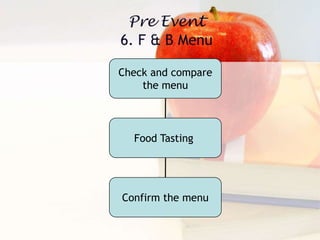
Check and compare
the menu
Food Tasting
Confirm the menu
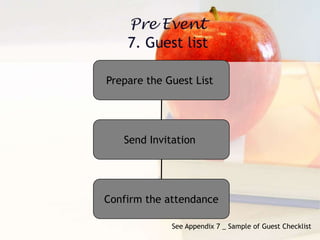
Prepare the Guest List
Send Invitation
Confirm the attendance
See Appendix 7 _ Sample of Guest Checklist
 Is a way of helping you to identify and resolve
the risks that could result in accidents, injury
or damage.
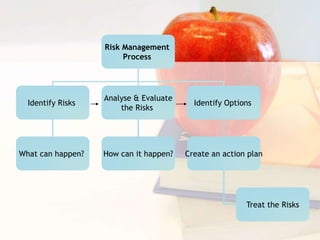
Risk Management
Process
Identify Risks
Analyse & Evaluate
the Risks
Identify Options
What can happen? How can it happen? Create an action plan
Treat the Risks
Event Marketing is a matching process in which
the event producer seeks to understand and
meet the needs of their audience
Is a planning for a promotion
Positioning
Identify target market
How attendees regard a specific event or other
events of a similar nature
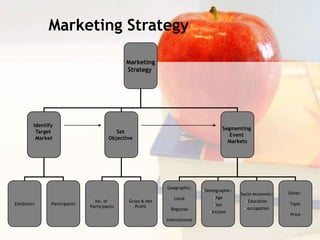
Marketing
Strategy
Identify
Target
Market
Set
Objective
Segmenting
Event
Markets
Exhibitors Participants
No. of
Participants
Gross & Net
Profit
Geographic:
Local
Regional
international
Demographic:
Age
Sex
income
Socio-economic:
Education
 occupation
Other:
Topic
Price
Marketing Strategy
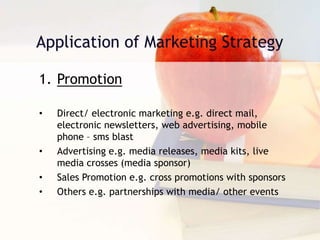
1. Promotion
• Direct/ electronic marketing e.g. direct mail,
electronic newsletters, web advertising, mobile
phone – sms blast
• Advertising e.g. media releases, media kits, live
media crosses (media sponsor)
• Sales Promotion e.g. cross promotions with sponsors
• Others e.g. partnerships with media/ other events
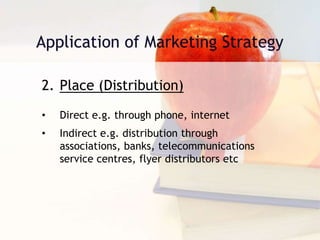
2. Place (Distribution)
• Direct e.g. through phone, internet
• Indirect e.g. distribution through
associations, banks, telecommunications
service centres, flyer distributors etc
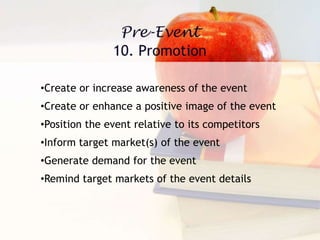
•Create or increase awareness of the event
•Create or enhance a positive image of the event
•Position the event relative to its competitors
•Inform target market(s) of the event
•Generate demand for the event
•Remind target markets of the event details
Promotion
Advertising Publicity Sales Promotion Direct Marketing Personal Selling
See Appendix 8 _ Sample of Running Sheet
Events mgt. chapter 3 sy 2013 14.ppt

Events mgt. chapter 3 sy 2013 14.ppt

  • 1.
    Chapter 3 TheEvent Concept HRTM 195 Events Management Prepared by: Aireen Y. Clores
  • 2.
    To Help WithYour Audience Satisfaction • Try these tips: – Research and Develop External Client Relationships – Pay attention to the smallest details. (People Notice) – Choose a direction to your event and attack with passion • The event could be: – Educational, Energizing, Enlightening, or Engaging – Look for different things to make your audience standout • E.I. Personalize and Customize as much as possible
  • 3.
    Pre-event 11. Promotion 1. Proposal 2.Budget 3. Venue/ Site Selection and Design 4. Production Schedule 5. Speaker & Supplier Checklist 6. Sponsorship 7. F & B Menu 8. Guest list 9. Risk Management 10. Marketing
  • 5.
    1. Executive Summary 2.Contents Sheet - Major section headings + details of any attachments 3. Introduction - Your approach 4. The Concept - Description including broad outline timings for the actual show - Include floor/ site plan to assist understanding (detailed plans are in the Planning section or as attachments) - Include artist’s impressions if they add to understanding
  • 6.
    5. Meeting theRequirements - Answering specific questions or requirements posed by the client 6. The Budget - Basis of calculation - Income and expenditure - Cash Flow - Details of management fee structure and payment schedule (the fully detailed budget and cash flow could be an attachment) 7. Organizational Structure for the Event - Includes outline of major responsibilities - Your company profile, references if applicable, as attachment - Major contractor’s details may be required as well
  • 7.
    8. Planning/ Logistics -Outline to show you can do it, NOT so much detail that the client can take the plan and do it themselves. - Risk Management plan is usually required - Include other operational plans, such a Transport, ONLY IF THEY ARE DIRECTLY APPLICALE TO WINNING THE BID 9. Other Plans (Marketing, sponsorship etc) - ONLY include if they are part of the requirement, and then in strategic rather than detailed form
  • 8.
    10. Why Us? -Your major selling point for this event 11. Conclusion - A tidy summary of the major points which will sell the proposal 12. Attachments - Factual – Budget, floor plans, company profile, credentials - Supporting – Details of the location, tour options, etc
  • 9.
    Location, Location, Location 1of the MOST IMPORTANT THINGS to consider when planning an event!!!
  • 10.
    Guidelines for Selection 1.Availability 2.Sizeof the event 3.Layout and suitability 4.Stage, field of play or performance area 5.Transport and parking 6.Proximity to accommodation 7.Services available e.g. F&B 8.Technical support e.g. PA system, projector 9.Cost
  • 11.
    Other Things toconsider when look at Location • 4 main criteria: – Proximity • Where the location of the event is in relation to its environment. – Cost • How much will the location cost $$$ (site cost included) – Size • How much room do you need per person? – Facilities • What else are we working with?
  • 12.
    Little Things Havea Big Effect • Make sure the event location matches the event theme. • Outline everything you have and need before hand (Contracts) – Helps with organization • Indoor or Outdoor decision • Type of safety hazards – One way in one way out exits, etc. • Will there be signs available to identify your event
  • 13.
    • So you’vegot your location down so…what’s next… KNOW YOUR VENUE
  • 14.
    Venue • Make sureStaging, Audio, and Lightening is accessible at your venue. – Having no power is no fun • Be weary of Space and Time guidelines in the contract. • Keep in mind the feeling you want to convey in relation to your venue. • Know the smallest details – Carpeted or Not – Number of Columns in the room – Possible isle paths for entrance and exits – Event Design Angles
  • 15.
    Transportation and Parking •The event begins and ends with parking and transportation. – Transportation • Make sure you take care of any special vehicles needed to transport participants. – Parking • Get parking passes IN ADVANCE (if needed) • Is there going to VIP parking • Is the parking area will lit • Will media have special parking • Will sectional parking be avaliable.
  • 16.
    THEME • Things toconsider – Time of year – Site – Name & Logos – Atmosphere – Lighting – Props – Party Favors
  • 17.
    Invitations/Promotional Materials • Save thedate cards – Themed reminders about the event • Make sure your invitation set the mode for the event – It’s the first time your audience see’s or hears about your event • Determine whether the event be – Invite only – General Admission
  • 18.
    #1 CARDINAL RULE NEVERRUN OUT OF FOOD WARNING: This may cause a riot
  • 19.
    • DECIDE IFTHERE WILL BE FOOD AND BEVERAGES AT YOUR EVENT.
  • 20.
    Food And Beverages •Most venues will work with you when it comes to food in their venue. • Make sure the food matches or adds to your event. • If alcohol is being served make guidelines to ensure order. • Make sure you are there for every step of the food and beverage process.
  • 21.
    SO HOW MUCHIS THIS GOING TO COST YOU
  • 22.
     Indentify Expenditure 1.Food & Beverage 2. Administration 3. Wages & salaries 4. Venue 5. Lighting, sound & visual 6. Staging 7. Graphic design 8. Printing 9. Decoration 10. Entertainment 11. Marketing & Promotion 12. Travel 13. Accommodation 14. Contingency Indentify Income 1.Ticket sales 2.Sponsorship 3.Merchandising 4.Advertising 5.In-kind
  • 23.
    Money • Project abudget first – Preliminary budget frame your event vision • NEVER MIX EVENT MONEY WITH YOUR MONEY. – If you don’t have the money make it work with what you have.
  • 24.
    Things to consider •Budget – How much are you going to spend. • Kitchen space and location • Number of guest • Type of Event • Will there be Appetizer/Courses served • How will your food be served – Self-service – Catering help
  • 25.
    Event Budget • Thingsto consider when creating your budget – Expenses • Focus of the Event • Site Cost • Refreshments/Food • Programs • Promotion materials – Income • Pre-sold/Day of tickets • Vendor spaces • Raffle tickets etc.
  • 26.
    NOW THE MAINEVENT HELPFUL HINT: Show about one hour before the first person or group is suppose to be there just in cause
  • 27.
  • 28.
    Day of theEvent Checklist o Supplies Pick up o Venue Set-up o Prop pick-up o Furniture Placement/Removal (if needed) o Food Delivery (if needed) o Place any outside and/or outside Promotional Materials o Copies of any contracts or written correspondence o Be prepared to handle any last minute adjustments o Back up plans, surplus items, etc.
  • 29.
    Now That YourEvent Is Over WHAT NEXT???
  • 30.
    Post Event  Evaluation Shutdown and Reporting
  • 31.
    CLEAN UP • Cleanup begins once the last dish is cleared. • At this time, you want to re-announce prize winners to come pick up their prizes. • Also announce the ending of the meal. • Make sure to check every inch of the venue and location while cleaning • Generally you want your venue and location to look like it did when you first arrived. (at least) • Make sure all trash is taken to the negotiated areas
  • 32.
    Closing the Event •Make sure procedures for securing any types of keys are made clear and followed. • The event manager should be the last one to leave.
  • 33.
    See Appendix 2_ Site Inspection Checklist Conduct a Site Inspection Develop a checklist for Site Inspection: 1.Compatibility with event theme 2.Seating arrangement 3.Sight obstruction e.g. pillars 4.Storage areas 5.Entrances & exits including freight access 6.Stage area 7.Equipment available on site 8.Safety and security 9.Access time 10.Power
  • 34.
    See Appendix 3_ Layout Diagram Layout Diagram Prepare a Layout diagram on: 1.Stage 2.Seating and table arrangement 3.Registration area 4.Equipment positions e.g. lighting, projectors 5.Decoration layout 6.F & B station 7.Signs 8.Entry and exit including staff position
  • 49.
    See Appendix 4_ Sample of Gantt Chart See Appendix 5 _ Sample of Production Schedule What is to happen When will it happen Where will it happen Who is responsible Gantt Charts/ Production Schedule
  • 50.
    Event review meetings -to check progress against the schedule Status reports – to check progress against schedule Check lists Direct observation
  • 51.
    Speaker Checklist 1.Send invitation 2.Getwriting confirmation 3.Biodata and photograph 4.Slide presentation 5.Accommodation & Transportation Arrangement
  • 52.
    See Appendix 6_ Sample of Supplier Checklist Supplier Checklist 1.List of suppliers 2.List of requirements from every supplier 3.List of their roles and date to set up 4.i.e audio and visual – projector, notebook, PA system, microphone, cable 5.i.e photography – how many photographer you need, location of the photographer
  • 53.
    Why should companiessponsor? 1.Gain access to target markets for promotional messages 2.Generate consumer awareness – used to introduce or build a brand 3.Positioning/repositioning of the existing service/ product 4.Exclusivity – to lock out their competitors 5.Demonstrate product attributes
  • 54.
    Before seeking sponsorship,we should decide whether: 1.Your stakeholders (members, participants) are likely to approve of commercial sponsorship 2.Your event has rights/ benefits of value to a potential sponsor, e.g. access to target markets 3.You have the human resources to sell and service sponsors, e.g. a good sales person 4.There are businesses/ organizations that you would be advised not to seek sponsorship from
  • 55.
    Sponsorship Proposal 1.Overview ofthe event including mission/ goals, history, location, current and past sponsors, program duration, staff, past or anticipated level and predicted attendee profile 2.Sponsorship package on offer and its cost. This might range from naming rights or sole sponsorship to designated sponsorship categories 3.Strategic fit between the event and the needs of the organization 4.Duration of agreement, e.g. agreement for one year, optional for 3 years renewal 5.Contact details
  • 56.
    Identifying Sponsors 1.Who hassponsored the event recently? 2.Research the sponsors of similar competitor events – who is in the market? 3.Examine what particular companies or products have a fit with your event
  • 57.
    Selling Sponsorships 1.Identify thedecision maker in the company that you are approaching 2.Try to obtain a personal interview to discuss the sponsorship 3.Sell opportunities (access to target market, capacity to meet with specific VIP’s) 4.Provide a benefit package (competitively priced) that will meet some of their marketing needs 5.Be creative in the form that your sponsorship proposal takes 6.Interact with potential sponsors in a professional way
  • 58.
    Managing the relationship 1.Makesure that you keep in regular contact with your sponsor – manage the relationship 2.Discuss and agree with your sponsor on clear objectives and agreement 3.Reports achievements as part of negotiating for renewal of the sponsorship
  • 59.
    Check and compare themenu Food Tasting Confirm the menu
  • 60.
    Prepare the GuestList Send Invitation Confirm the attendance See Appendix 7 _ Sample of Guest Checklist
  • 61.
     Is away of helping you to identify and resolve the risks that could result in accidents, injury or damage.
  • 62.
    Risk Management Process Identify Risks Analyse& Evaluate the Risks Identify Options What can happen? How can it happen? Create an action plan Treat the Risks
  • 63.
    Event Marketing isa matching process in which the event producer seeks to understand and meet the needs of their audience
  • 64.
    Is a planningfor a promotion Positioning Identify target market How attendees regard a specific event or other events of a similar nature
  • 65.
    Marketing Strategy Identify Target Market Set Objective Segmenting Event Markets Exhibitors Participants No. of Participants Gross& Net Profit Geographic: Local Regional international Demographic: Age Sex income Socio-economic: Education  occupation Other: Topic Price Marketing Strategy
  • 66.
    1. Promotion • Direct/electronic marketing e.g. direct mail, electronic newsletters, web advertising, mobile phone – sms blast • Advertising e.g. media releases, media kits, live media crosses (media sponsor) • Sales Promotion e.g. cross promotions with sponsors • Others e.g. partnerships with media/ other events
  • 67.
    2. Place (Distribution) •Direct e.g. through phone, internet • Indirect e.g. distribution through associations, banks, telecommunications service centres, flyer distributors etc
  • 68.
    •Create or increaseawareness of the event •Create or enhance a positive image of the event •Position the event relative to its competitors •Inform target market(s) of the event •Generate demand for the event •Remind target markets of the event details
  • 69.
    Promotion Advertising Publicity SalesPromotion Direct Marketing Personal Selling
  • 75.
    See Appendix 8_ Sample of Running Sheet