I N E V A P O R A T I O N P H Y S I C A L A N D C H E M I C A L
P R O P E R T I E S O F T H E S O L U T I O N B E I N G
C O N C E N T R A T E D
EVAPORATORS
Properties on which the evaporation
greatly depends
 Concentration of the liquid : by time liquid becomes concentrated .heat
transfer coefficient becomes adequately low so the circulation or the turbulence
must be there to prevent the coefficient becomes sufficiently low
 Solubility: by the variation in temperature effects the solubility of the
solution either .condensation of the liquid from cold liquid causes
crystallisation of the substance .effects the evaporation
 Temperature sensitivity of the material : some material degrade due to prolong
heating
 Foaming and frothing: foam and froth forms during boiling accompanies the
vapour coming out of the evaporator due to which entrainment loss occurs
 Pressure and temperature :B.P. of the solution is related to pressure of the
system. The higher the operating pressure of the evaporator the higher the
temp at boiling . By increase in the concentration temperature of boiling may
rise
 Scale deposition and material of construction : by these factors heat transfer
coefficient decreases causes the decrease in heat transfer.
Types of evaporators
1. Open kettle or pan
2. Horizontal type natural circular evaporation
3. Vertical type natural circulation evaporation
4. Long tube vertical type evaporator
5. Falling film type evaporator
6. Forced circulation type evaporator
7. Agitated film evaporator
8. Open pan solar evaporator
Open kettle or pan evaporator
 Cheap and simple
 Heat economy is poor
 Paddles and scrappers
are used for agitation
 Heat is supplied by
condensation of stream
Horizontal type natural circulation
evaporator
 Similar heating tubes such in
heat exchangers are used
 Vapour leaves the liquid
surface often goes through de
entrainment device such as
baffles are used to prevent
carryover of liq. Droplets
 relatively cheap then the other
higher evaporator devices
 Used for non viscous liquid
with heat transfer coefficient
(since circulation is poor )
 Liquids that do not deposit on
the surfaces
 Stream enters inside the tube
 Not used for foamy liquids
Vertical type natural circulation
evaporator
 Types are basket type(liquid
inside ) and standard
type(liquid outside )
 Velocity :1-3 fps
 Boiling increases de
 Boiling increases density
liquid rises in the tube by
natural circulation and flows
downward through a large
central open space or
downcomer
 Natural circulation increases
heat transfer coefficient
 Not for viscous liquid
 Also called as short tube
evaporator
long tube vertical type evaporator or
kestner evaporator
 Heat transfer on stream side is
very high as compare to
evaporating liquid side so high
liquid velocities are desirable
 Liquid run inside the tube
 Length of 12-20 ft.
 3-10 mm tubes
 Formation of vapours inside the
tube causing pumping action
which gives quite high liquid
velocities
 Not re circulated (contact time is
low )
 Can be adapt for foamy liquids
 Not for scaling and not for
liquids of high viscosity
Falling film type evaporator
 Liquid is fed from top and
flow down as a thin film
 Vapour liquid separation
usually takes place at the
bottom
 Used widely for
concentrating heat
sensitive materials such as
orange juice and other fruit
juice
 Holdup time is very small
(5-10)
 High heat transfer
coefficient (due to high
velocities )
Forced circulation type evaporator
 We use pump in film type
evaporator
 Increase heat transfer coefficient
 Useful for viscous fluid
 External heating provide more
ease to cleaning to tubes more
complicated piping is used
 For viscous we use positive
pumps and for colloidal we use
low power pumps
 Heating element is placed at the
lower level to avoid boiling on
heating surface .this reduces the
rate of deposition of solids
Agitated film evaporator
 Main resistance of the heat
transfer is on evaporator side
 Heat transfer coefficient and
turbulence is increased by
mechanical agitation of this
liquid film
 Modifying falling film evaporator
with a single large jacketed tube
containing internal agitator
 Used for viscous fluids ,high
sensitive materials like rubber,
latex, gelatine, antibiotics and
fruit
 Heat transfer coefficient
increases
 High cost
 Small capacity
Open pan solar evaporator
 Low scale evaporation
 Takes longer time
 Cheap
 Solar energy is used to
evaporate the water from
the solution
Method of operation of evaporation
 Single effect evaporator
 Forward feed multiple effect evaporator
 Backward feed multiple effect evaporator
 Parallel feed multiple effect evaporator
 Mixed feed multiple effect evaporator
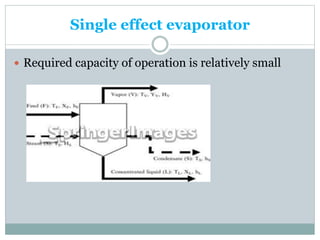
Single effect evaporator
 Required capacity of operation is relatively small
Forward feed multiple effect evaporator
 Feed should be near the B.P. of
the solution at the pressure in the
1st effect
 Previous unit vapour serves as a
heating medium for the next
effect
 Here latent of the vapour can be
reused and recovered again
 Uses when feed is hot or when
the concentration product might
be damaged at high temperature
 B.P decreases from effect to effect
 Pressure is 1 atm at 1st effect and
under vaccum in other effects
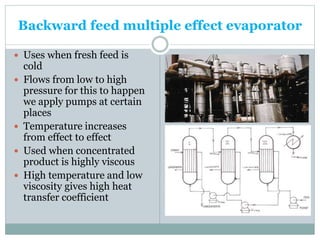
Backward feed multiple effect evaporator
 Uses when fresh feed is
cold
 Flows from low to high
pressure for this to happen
we apply pumps at certain
places
 Temperature increases
from effect to effect
 Used when concentrated
product is highly viscous
 High temperature and low
viscosity gives high heat
transfer coefficient
Parallel multiple effect evaporator
 Adding and withdrawal
of concentrated product
from each effect
 Feed almost saturated
and solid crystals are the
product
 Eg- evaporation of brine
to make salt
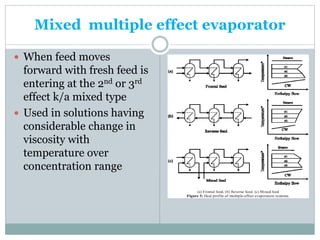
Mixed multiple effect evaporator
 When feed moves
forward with fresh feed is
entering at the 2nd or 3rd
effect k/a mixed type
 Used in solutions having
considerable change in
viscosity with
temperature over
concentration range
Effects of processing variables on
evaporator
 Effect of temperature : feed must be at temp greater or
equal to the b.p of the solution . Preheating the feed can
reduce the size of evaporator heat transfer area
 Effect of pressure : a pressure of 101.32 kpa is used in the
vapour space which gives the b.p of the feed .if the rise in
temperature increases .means large difference in
temperature is desirable heating surface area and the
cost of the evaporator decreases .if pressure decreases
under vaccum condenser and pump are used
 Effect of stream pressure :with increase in pressure of
the saturated stream difference in b.p of increases giving
small size and hence cost decreases
M A D E B Y : S H I K H A T H A P A
C O L L E G E N A M E : I N S T I T U T E O F T E C H N O L O G Y
G U R U G H A S I D A S C E N T R A L U N I V E R S I T Y
S T U D E N T O F C H E M I C A L E N G I N E E R I N G
S E M E S T E R : 5 T H
Thank you

Evaporators

  • 1.
    I N EV A P O R A T I O N P H Y S I C A L A N D C H E M I C A L P R O P E R T I E S O F T H E S O L U T I O N B E I N G C O N C E N T R A T E D EVAPORATORS
  • 2.
    Properties on whichthe evaporation greatly depends  Concentration of the liquid : by time liquid becomes concentrated .heat transfer coefficient becomes adequately low so the circulation or the turbulence must be there to prevent the coefficient becomes sufficiently low  Solubility: by the variation in temperature effects the solubility of the solution either .condensation of the liquid from cold liquid causes crystallisation of the substance .effects the evaporation  Temperature sensitivity of the material : some material degrade due to prolong heating  Foaming and frothing: foam and froth forms during boiling accompanies the vapour coming out of the evaporator due to which entrainment loss occurs  Pressure and temperature :B.P. of the solution is related to pressure of the system. The higher the operating pressure of the evaporator the higher the temp at boiling . By increase in the concentration temperature of boiling may rise  Scale deposition and material of construction : by these factors heat transfer coefficient decreases causes the decrease in heat transfer.
  • 3.
    Types of evaporators 1.Open kettle or pan 2. Horizontal type natural circular evaporation 3. Vertical type natural circulation evaporation 4. Long tube vertical type evaporator 5. Falling film type evaporator 6. Forced circulation type evaporator 7. Agitated film evaporator 8. Open pan solar evaporator
  • 4.
    Open kettle orpan evaporator  Cheap and simple  Heat economy is poor  Paddles and scrappers are used for agitation  Heat is supplied by condensation of stream
  • 5.
    Horizontal type naturalcirculation evaporator  Similar heating tubes such in heat exchangers are used  Vapour leaves the liquid surface often goes through de entrainment device such as baffles are used to prevent carryover of liq. Droplets  relatively cheap then the other higher evaporator devices  Used for non viscous liquid with heat transfer coefficient (since circulation is poor )  Liquids that do not deposit on the surfaces  Stream enters inside the tube  Not used for foamy liquids
  • 6.
    Vertical type naturalcirculation evaporator  Types are basket type(liquid inside ) and standard type(liquid outside )  Velocity :1-3 fps  Boiling increases de  Boiling increases density liquid rises in the tube by natural circulation and flows downward through a large central open space or downcomer  Natural circulation increases heat transfer coefficient  Not for viscous liquid  Also called as short tube evaporator
  • 7.
    long tube verticaltype evaporator or kestner evaporator  Heat transfer on stream side is very high as compare to evaporating liquid side so high liquid velocities are desirable  Liquid run inside the tube  Length of 12-20 ft.  3-10 mm tubes  Formation of vapours inside the tube causing pumping action which gives quite high liquid velocities  Not re circulated (contact time is low )  Can be adapt for foamy liquids  Not for scaling and not for liquids of high viscosity
  • 8.
    Falling film typeevaporator  Liquid is fed from top and flow down as a thin film  Vapour liquid separation usually takes place at the bottom  Used widely for concentrating heat sensitive materials such as orange juice and other fruit juice  Holdup time is very small (5-10)  High heat transfer coefficient (due to high velocities )
  • 9.
    Forced circulation typeevaporator  We use pump in film type evaporator  Increase heat transfer coefficient  Useful for viscous fluid  External heating provide more ease to cleaning to tubes more complicated piping is used  For viscous we use positive pumps and for colloidal we use low power pumps  Heating element is placed at the lower level to avoid boiling on heating surface .this reduces the rate of deposition of solids
  • 10.
    Agitated film evaporator Main resistance of the heat transfer is on evaporator side  Heat transfer coefficient and turbulence is increased by mechanical agitation of this liquid film  Modifying falling film evaporator with a single large jacketed tube containing internal agitator  Used for viscous fluids ,high sensitive materials like rubber, latex, gelatine, antibiotics and fruit  Heat transfer coefficient increases  High cost  Small capacity
  • 11.
    Open pan solarevaporator  Low scale evaporation  Takes longer time  Cheap  Solar energy is used to evaporate the water from the solution
  • 12.
    Method of operationof evaporation  Single effect evaporator  Forward feed multiple effect evaporator  Backward feed multiple effect evaporator  Parallel feed multiple effect evaporator  Mixed feed multiple effect evaporator
  • 13.
    Single effect evaporator Required capacity of operation is relatively small
  • 14.
    Forward feed multipleeffect evaporator  Feed should be near the B.P. of the solution at the pressure in the 1st effect  Previous unit vapour serves as a heating medium for the next effect  Here latent of the vapour can be reused and recovered again  Uses when feed is hot or when the concentration product might be damaged at high temperature  B.P decreases from effect to effect  Pressure is 1 atm at 1st effect and under vaccum in other effects
  • 15.
    Backward feed multipleeffect evaporator  Uses when fresh feed is cold  Flows from low to high pressure for this to happen we apply pumps at certain places  Temperature increases from effect to effect  Used when concentrated product is highly viscous  High temperature and low viscosity gives high heat transfer coefficient
  • 16.
    Parallel multiple effectevaporator  Adding and withdrawal of concentrated product from each effect  Feed almost saturated and solid crystals are the product  Eg- evaporation of brine to make salt
  • 17.
    Mixed multiple effectevaporator  When feed moves forward with fresh feed is entering at the 2nd or 3rd effect k/a mixed type  Used in solutions having considerable change in viscosity with temperature over concentration range
  • 18.
    Effects of processingvariables on evaporator  Effect of temperature : feed must be at temp greater or equal to the b.p of the solution . Preheating the feed can reduce the size of evaporator heat transfer area  Effect of pressure : a pressure of 101.32 kpa is used in the vapour space which gives the b.p of the feed .if the rise in temperature increases .means large difference in temperature is desirable heating surface area and the cost of the evaporator decreases .if pressure decreases under vaccum condenser and pump are used  Effect of stream pressure :with increase in pressure of the saturated stream difference in b.p of increases giving small size and hence cost decreases
  • 19.
    M A DE B Y : S H I K H A T H A P A C O L L E G E N A M E : I N S T I T U T E O F T E C H N O L O G Y G U R U G H A S I D A S C E N T R A L U N I V E R S I T Y S T U D E N T O F C H E M I C A L E N G I N E E R I N G S E M E S T E R : 5 T H Thank you