Evaluation Question 3
What have you learned from your
audience feedback?
We chose our film idea because other films with the same characteristics as ours have
succeeded, things such as action and thrillers with Hitmen involved etc. Knowing that similar
past films have done well told us that if we supported all the stereotypes from these other films
and mimicked all the styles it uses such as editing techniques, props and settings, our film could
also follow suit and succeed. As well as this, we knew that there was already quite a large
audience for our type of film.
How did you respond to the original brief with
the audience in mind?
Questionnaire Video link: https://www.youtube.com/watch?v=3jh8x2Q1AhY
After we had written the story for our film we wrote a questionnaire asking people who had
read it, what they thought of it. We asked questions like ‘Please state your name and age’ to
understand the gender and age of the people we are asking around college. ‘Did you
understand the story line?’ we asked this to find out if the story was too hard to follow, as we
would have to visualise this story in only five minutes. If people thought it was too confusing we
would have had to simplify it to make it more understandable. ‘What certificate would you say
this film is?’ if a lot of people thought from reading about our film that it would have an 18
certificate then we would have to reduce the amount of violence that would be added so that is
would stay as a 15 as that was what was planned for our film. ‘What genre would you class this
film as’ this was important to see if we had included enough of the themes of an action thriller
for it to be classed as such. Finally ‘Would you go and watch this film’ we asked this question
because, we could have had perfect answers for all the other questions but if the people don’t
want to watch it then they would all be wasted.
In filming and editing how did you ensure meaning would be apparent to the
audience? What creative decisions did you make in planning, rehearsing, filming and
editing that were influenced by your sense of the audience and how they might
interpret your finished film?
I used editing techniques that I know that audiences react well to, making our film enjoyable to
the audience. For example, if the audience have chosen to see an action film, then by mimicking
the same style of editing that these other action films do, the audience will enjoy our film more
because it has the same features as other films they enjoy. One similarity that I have carried
over into our film was the fight sequence, the iconic fast pace editing replicates that of an action
film.
For the thriller genre, I know that there are a lot of tense scenes, and the one thing that is key in
all of them, is the feature of sound. The sound is vitally important as it sets a tone that is meant
to leave the viewer on edge, and in need to know what will happen next. I tried to recreate this
in our film in the chase scene, when the Hitman is following Quincy I used some intense
mysterious music that I synced up to the changes in the shots. Meaning that as the beat
changes in the music, then the shot also changes (roughly every few seconds) I did this so that
the viewer can know when the next thing will happen (when the beat changes) making the
sense of anticipation for will happen next. The beat changes and shot changes also symbolises a
heart beat, which is good because these tense thriller style scenes are supposed to get the heart
racing.
How did the audience respond when you trialled aspects of your film? Are there a
variety of different possible interpretations of your film that will depend on the
cultural situation of the viewer?
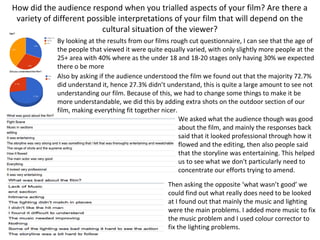
By looking at the results from our films rough cut questionnaire, I can see that the age of
the people that viewed it were quite equally varied, with only slightly more people at the
25+ area with 40% where as the under 18 and 18-20 stages only having 30% we expected
there o be more
Also by asking if the audience understood the film we found out that the majority 72.7%
did understand it, hence 27.3% didn’t understand, this is quite a large amount to see not
understanding our film. Because of this, we had to change some things to make it be
more understandable, we did this by adding extra shots on the outdoor section of our
film, making everything fit together nicer.
We asked what the audience though was good
about the film, and mainly the responses back
said that it looked professional through how it
flowed and the editing, then also people said
that the storyline was entertaining. This helped
us to see what we don't particularly need to
concentrate our efforts trying to amend.
Then asking the opposite ‘what wasn’t good’ we
could find out what really does need to be looked
at I found out that mainly the music and lighting
were the main problems. I added more music to fix
the music problem and I used colour corrector to
fix the lighting problems.
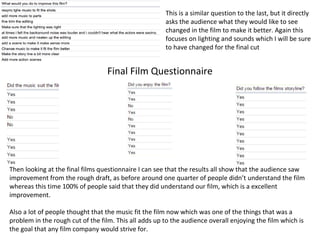
This is a similar question to the last, but it directly
asks the audience what they would like to see
changed in the film to make it better. Again this
focuses on lighting and sounds which I will be sure
to have changed for the final cut
Final Film Questionnaire
Then looking at the final films questionnaire I can see that the results all show that the audience saw
improvement from the rough draft, as before around one quarter of people didn’t understand the film
whereas this time 100% of people said that they did understand our film, which is a excellent
improvement.
Also a lot of people thought that the music fit the film now which was one of the things that was a
problem in the rough cut of the film. This all adds up to the audience overall enjoying the film which is
the goal that any film company would strive for.
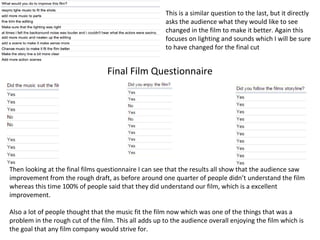
This is a similar question to the last, but it directly
asks the audience what they would like to see
changed in the film to make it better. Again this
focuses on lighting and sounds which I will be sure
to have changed for the final cut
Final Film Questionnaire
Then looking at the final films questionnaire I can see that the results all show that the audience saw
improvement from the rough draft, as before around one quarter of people didn’t understand the film
whereas this time 100% of people said that they did understand our film, which is a excellent
improvement.
Also a lot of people thought that the music fit the film now which was one of the things that was a
problem in the rough cut of the film. This all adds up to the audience overall enjoying the film which is
the goal that any film company would strive for.

Evaluation question Three

  • 1.
    Evaluation Question 3 Whathave you learned from your audience feedback?
  • 2.
    We chose ourfilm idea because other films with the same characteristics as ours have succeeded, things such as action and thrillers with Hitmen involved etc. Knowing that similar past films have done well told us that if we supported all the stereotypes from these other films and mimicked all the styles it uses such as editing techniques, props and settings, our film could also follow suit and succeed. As well as this, we knew that there was already quite a large audience for our type of film. How did you respond to the original brief with the audience in mind? Questionnaire Video link: https://www.youtube.com/watch?v=3jh8x2Q1AhY After we had written the story for our film we wrote a questionnaire asking people who had read it, what they thought of it. We asked questions like ‘Please state your name and age’ to understand the gender and age of the people we are asking around college. ‘Did you understand the story line?’ we asked this to find out if the story was too hard to follow, as we would have to visualise this story in only five minutes. If people thought it was too confusing we would have had to simplify it to make it more understandable. ‘What certificate would you say this film is?’ if a lot of people thought from reading about our film that it would have an 18 certificate then we would have to reduce the amount of violence that would be added so that is would stay as a 15 as that was what was planned for our film. ‘What genre would you class this film as’ this was important to see if we had included enough of the themes of an action thriller for it to be classed as such. Finally ‘Would you go and watch this film’ we asked this question because, we could have had perfect answers for all the other questions but if the people don’t want to watch it then they would all be wasted.
  • 3.
    In filming andediting how did you ensure meaning would be apparent to the audience? What creative decisions did you make in planning, rehearsing, filming and editing that were influenced by your sense of the audience and how they might interpret your finished film? I used editing techniques that I know that audiences react well to, making our film enjoyable to the audience. For example, if the audience have chosen to see an action film, then by mimicking the same style of editing that these other action films do, the audience will enjoy our film more because it has the same features as other films they enjoy. One similarity that I have carried over into our film was the fight sequence, the iconic fast pace editing replicates that of an action film. For the thriller genre, I know that there are a lot of tense scenes, and the one thing that is key in all of them, is the feature of sound. The sound is vitally important as it sets a tone that is meant to leave the viewer on edge, and in need to know what will happen next. I tried to recreate this in our film in the chase scene, when the Hitman is following Quincy I used some intense mysterious music that I synced up to the changes in the shots. Meaning that as the beat changes in the music, then the shot also changes (roughly every few seconds) I did this so that the viewer can know when the next thing will happen (when the beat changes) making the sense of anticipation for will happen next. The beat changes and shot changes also symbolises a heart beat, which is good because these tense thriller style scenes are supposed to get the heart racing.
  • 4.
    How did theaudience respond when you trialled aspects of your film? Are there a variety of different possible interpretations of your film that will depend on the cultural situation of the viewer? By looking at the results from our films rough cut questionnaire, I can see that the age of the people that viewed it were quite equally varied, with only slightly more people at the 25+ area with 40% where as the under 18 and 18-20 stages only having 30% we expected there o be more Also by asking if the audience understood the film we found out that the majority 72.7% did understand it, hence 27.3% didn’t understand, this is quite a large amount to see not understanding our film. Because of this, we had to change some things to make it be more understandable, we did this by adding extra shots on the outdoor section of our film, making everything fit together nicer. We asked what the audience though was good about the film, and mainly the responses back said that it looked professional through how it flowed and the editing, then also people said that the storyline was entertaining. This helped us to see what we don't particularly need to concentrate our efforts trying to amend. Then asking the opposite ‘what wasn’t good’ we could find out what really does need to be looked at I found out that mainly the music and lighting were the main problems. I added more music to fix the music problem and I used colour corrector to fix the lighting problems.
  • 5.
    This is asimilar question to the last, but it directly asks the audience what they would like to see changed in the film to make it better. Again this focuses on lighting and sounds which I will be sure to have changed for the final cut Final Film Questionnaire Then looking at the final films questionnaire I can see that the results all show that the audience saw improvement from the rough draft, as before around one quarter of people didn’t understand the film whereas this time 100% of people said that they did understand our film, which is a excellent improvement. Also a lot of people thought that the music fit the film now which was one of the things that was a problem in the rough cut of the film. This all adds up to the audience overall enjoying the film which is the goal that any film company would strive for.
  • 6.
    This is asimilar question to the last, but it directly asks the audience what they would like to see changed in the film to make it better. Again this focuses on lighting and sounds which I will be sure to have changed for the final cut Final Film Questionnaire Then looking at the final films questionnaire I can see that the results all show that the audience saw improvement from the rough draft, as before around one quarter of people didn’t understand the film whereas this time 100% of people said that they did understand our film, which is a excellent improvement. Also a lot of people thought that the music fit the film now which was one of the things that was a problem in the rough cut of the film. This all adds up to the audience overall enjoying the film which is the goal that any film company would strive for.