Curriculum Vitae
Workshop
Dr. Elena Gonzalez
November 1, 2013
CADI 308
Objectives
 Become familiarized with different formats and
contents of science curriculum vitae
 Determine the content sections you should include in
your curriculum vitae
 Decide what to include in each section of your
curriculum vitae
 Write each entry following language appropriate to a
curriculum vitae
 Select the best format that best meets your needs
CVs Versus Resumes
 University of Chapel Hill Writing Center
 CVs Versus Resumes
 Differences clearly defined
 See handout
Formats and Contents
 University of Puerto Rico - RISE Program
Presenter
 CV Margaret Colón
 University of Kent- Career and Employment
Services
 http://www.kent.ac.uk/careers/cv/sciencecv.htm
 California State University – Career Center
 http://campusapps2.fullerton.edu/career/students/jobSe
arch/Chapter5/SampleCV.aspx
Format, Style, and Content
 Taken from: Laura Malisheski - Office of Career Services at
Harvard University, February 2010
Refer to document entitled:
Just for Scientists: CV, Resume or Something in
Between?
Commonality
 What are some of the common features between the
CVs?
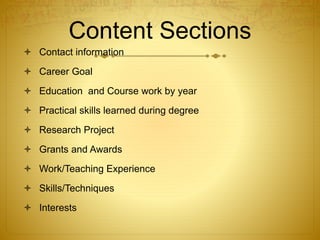
Content Sections
 Contact information
 Career Goal
 Education and Course work by year
 Practical skills learned during degree
 Research Project
 Grants and Awards
 Work/Teaching Experience
 Skills/Techniques
 Interests
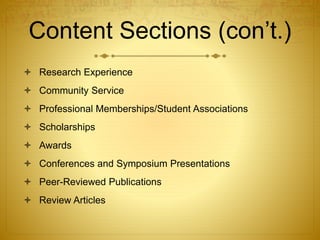
Content Sections (con’t.)
 Research Experience
 Community Service
 Professional Memberships/Student Associations
 Scholarships
 Awards
 Conferences and Symposium Presentations
 Peer-Reviewed Publications
 Review Articles
Your Content Areas
 Decide what sections you will include in your CV and their corresponding
order.
 Content Sections
1. __________________
2. __________________
3. __________________
4. __________________
5. __________________
6. __________________
7. __________________
Contact Information
 Name
 Address
 Email
 Telephones
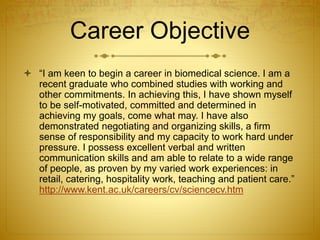
Career Objective
 “I am keen to begin a career in biomedical science. I am a
recent graduate who combined studies with working and
other commitments. In achieving this, I have shown myself
to be self-motivated, committed and determined in
achieving my goals, come what may. I have also
demonstrated negotiating and organizing skills, a firm
sense of responsibility and my capacity to work hard under
pressure. I possess excellent verbal and written
communication skills and am able to relate to a wide range
of people, as proven by my varied work experiences: in
retail, catering, hospitality work, teaching and patient care.”
http://www.kent.ac.uk/careers/cv/sciencecv.htm
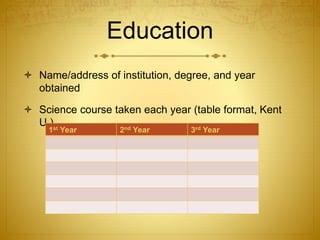
Education
 Name/address of institution, degree, and year
obtained
 Science course taken each year (table format, Kent
U.)
1st Year 2nd Year 3rd Year
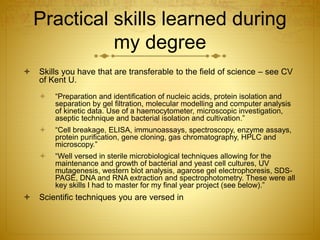
Practical skills learned during
my degree
 Skills you have that are transferable to the field of science – see CV
of Kent U.
 “Preparation and identification of nucleic acids, protein isolation and
separation by gel filtration, molecular modelling and computer analysis
of kinetic data. Use of a haemocytometer, microscopic investigation,
aseptic technique and bacterial isolation and cultivation.”
 “Cell breakage, ELISA, immunoassays, spectroscopy, enzyme assays,
protein purification, gene cloning, gas chromatography, HPLC and
microscopy.”
 “Well versed in sterile microbiological techniques allowing for the
maintenance and growth of bacterial and yeast cell cultures, UV
mutagenesis, western blot analysis, agarose gel electrophoresis, SDS-
PAGE, DNA and RNA extraction and spectrophotometry. These were all
key skills I had to master for my final year project (see below).”
 Scientific techniques you are versed in
Research Experience
 You will mention everything you have done in terms of
research
 Participation in RISE Program
 Summer Bridge experience
 First Semester Course
 Proposals
 Review Papers
Work Experience
 Company name, duties, and skills
Teaching Experience
 Tutor
Awards
 Any science related award obtained
 Travel award
 Poster presentation award
 Leadership awards
Conferences &
Symposiums
Community Service
 Things you have done to provide service to your
community
Professional Membership and
Student Associations
 Membership in associations related to your field of
science
 Membership in student associations and positions
held
 Provide name of association and years of membership
Presentations
 Include symposiums and conferences
 Provide names of presenters, title of presentation,
organization offering the event, date, and place
Publications
 Peer-review publications
 Review Papers
Appropriate Language
 Write information in sentence fragments
 Mostly use action verbs to introduces the fragment
Format
 The content is more important than the format
 Format should be uniform, formal, and clear
 From the examples of CVs you have seen today
select one and use it consistently

Curriculum vitae workshop fall2013

  • 1.
    Curriculum Vitae Workshop Dr. ElenaGonzalez November 1, 2013 CADI 308
  • 2.
    Objectives  Become familiarizedwith different formats and contents of science curriculum vitae  Determine the content sections you should include in your curriculum vitae  Decide what to include in each section of your curriculum vitae  Write each entry following language appropriate to a curriculum vitae  Select the best format that best meets your needs
  • 3.
    CVs Versus Resumes University of Chapel Hill Writing Center  CVs Versus Resumes  Differences clearly defined  See handout
  • 4.
    Formats and Contents University of Puerto Rico - RISE Program Presenter  CV Margaret Colón  University of Kent- Career and Employment Services  http://www.kent.ac.uk/careers/cv/sciencecv.htm  California State University – Career Center  http://campusapps2.fullerton.edu/career/students/jobSe arch/Chapter5/SampleCV.aspx
  • 5.
    Format, Style, andContent  Taken from: Laura Malisheski - Office of Career Services at Harvard University, February 2010 Refer to document entitled: Just for Scientists: CV, Resume or Something in Between?
  • 6.
    Commonality  What aresome of the common features between the CVs?
  • 7.
    Content Sections  Contactinformation  Career Goal  Education and Course work by year  Practical skills learned during degree  Research Project  Grants and Awards  Work/Teaching Experience  Skills/Techniques  Interests
  • 8.
    Content Sections (con’t.) Research Experience  Community Service  Professional Memberships/Student Associations  Scholarships  Awards  Conferences and Symposium Presentations  Peer-Reviewed Publications  Review Articles
  • 9.
    Your Content Areas Decide what sections you will include in your CV and their corresponding order.  Content Sections 1. __________________ 2. __________________ 3. __________________ 4. __________________ 5. __________________ 6. __________________ 7. __________________
  • 10.
    Contact Information  Name Address  Email  Telephones
  • 11.
    Career Objective  “Iam keen to begin a career in biomedical science. I am a recent graduate who combined studies with working and other commitments. In achieving this, I have shown myself to be self-motivated, committed and determined in achieving my goals, come what may. I have also demonstrated negotiating and organizing skills, a firm sense of responsibility and my capacity to work hard under pressure. I possess excellent verbal and written communication skills and am able to relate to a wide range of people, as proven by my varied work experiences: in retail, catering, hospitality work, teaching and patient care.” http://www.kent.ac.uk/careers/cv/sciencecv.htm
  • 12.
    Education  Name/address ofinstitution, degree, and year obtained  Science course taken each year (table format, Kent U.) 1st Year 2nd Year 3rd Year
  • 13.
    Practical skills learnedduring my degree  Skills you have that are transferable to the field of science – see CV of Kent U.  “Preparation and identification of nucleic acids, protein isolation and separation by gel filtration, molecular modelling and computer analysis of kinetic data. Use of a haemocytometer, microscopic investigation, aseptic technique and bacterial isolation and cultivation.”  “Cell breakage, ELISA, immunoassays, spectroscopy, enzyme assays, protein purification, gene cloning, gas chromatography, HPLC and microscopy.”  “Well versed in sterile microbiological techniques allowing for the maintenance and growth of bacterial and yeast cell cultures, UV mutagenesis, western blot analysis, agarose gel electrophoresis, SDS- PAGE, DNA and RNA extraction and spectrophotometry. These were all key skills I had to master for my final year project (see below).”  Scientific techniques you are versed in
  • 14.
    Research Experience  Youwill mention everything you have done in terms of research  Participation in RISE Program  Summer Bridge experience  First Semester Course  Proposals  Review Papers
  • 15.
    Work Experience  Companyname, duties, and skills
  • 16.
  • 17.
    Awards  Any sciencerelated award obtained  Travel award  Poster presentation award  Leadership awards
  • 18.
  • 19.
    Community Service  Thingsyou have done to provide service to your community
  • 20.
    Professional Membership and StudentAssociations  Membership in associations related to your field of science  Membership in student associations and positions held  Provide name of association and years of membership
  • 21.
    Presentations  Include symposiumsand conferences  Provide names of presenters, title of presentation, organization offering the event, date, and place
  • 22.
  • 23.
    Appropriate Language  Writeinformation in sentence fragments  Mostly use action verbs to introduces the fragment
  • 24.
    Format  The contentis more important than the format  Format should be uniform, formal, and clear  From the examples of CVs you have seen today select one and use it consistently