EVALUATION:
QUESTION 3
What have you learnt from audience feedback?
Audience Feedback
■ Firstly we asked our peers to give us some feedback on our blogs for improvements, we
had many improvements that would help us to achieve more.
■ To be able to analyse our work we sent out a survey for our audience and peers to
complete.This was because it enabled us to see what areas of our documentary we needed
to improve to make it is as good as possible.We sent out a questionnaire to many people by
using survey monkey as it was the easiest way to compare and analyse our results.
Peers Feedback
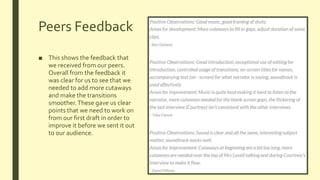
■ This shows the feedback that
we received from our peers.
Overall from the feedback it
was clear for us to see that we
needed to add more cutaways
and make the transitions
smoother.These gave us clear
points that we need to work on
from our first draft in order to
improve it before we sent it out
to our audience.
Question 1
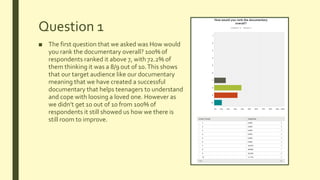
■ The first question that we asked was How would
you rank the documentary overall? 100% of
respondents ranked it above 7, with 72.2% of
them thinking it was a 8/9 out of 10.This shows
that our target audience like our documentary
meaning that we have created a successful
documentary that helps teenagers to understand
and cope with loosing a loved one. However as
we didn’t get 10 out of 10 from 100% of
respondents it still showed us how we there is
still room to improve.
Question 2
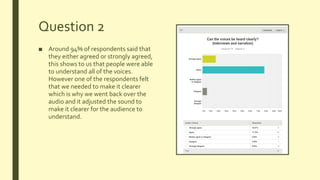
■ Around 94% of respondents said that
they either agreed or strongly agreed,
this shows to us that people were able
to understand all of the voices.
However one of the respondents felt
that we needed to make it clearer
which is why we went back over the
audio and it adjusted the sound to
make it clearer for the audience to
understand.
Question 3
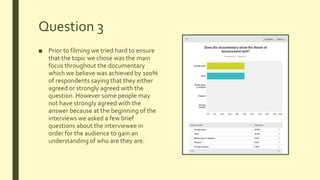
■ Prior to filming we tried hard to ensure
that the topic we chose was the main
focus throughout the documentary
which we believe was achieved by 100%
of respondents saying that they either
agreed or strongly agreed with the
question. However some people may
not have strongly agreed with the
answer because at the beginning of the
interviews we asked a few brief
questions about the interviewee in
order for the audience to gain an
understanding of who are they are.
Question 4
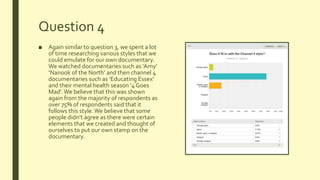
■ Again similar to question 3, we spent a lot
of time researching various styles that we
could emulate for our own documentary.
We watched documentaries such as ‘Amy’
‘Nanook of the North’ and then channel 4
documentaries such as ‘Educating Essex’
and their mental health season ‘4 Goes
Mad’.We believe that this was shown
again from the majority of respondents as
over 75% of respondents said that it
follows this style.We believe that some
people didn’t agree as there were certain
elements that we created and thought of
ourselves to put our own stamp on the
documentary.
Question 5
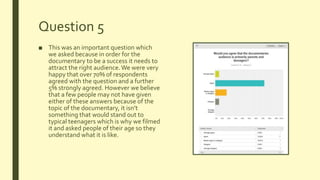
■ This was an important question which
we asked because in order for the
documentary to be a success it needs to
attract the right audience.We were very
happy that over 70% of respondents
agreed with the question and a further
5% strongly agreed. However we believe
that a few people may not have given
either of these answers because of the
topic of the documentary, it isn’t
something that would stand out to
typical teenagers which is why we filmed
it and asked people of their age so they
understand what it is like.
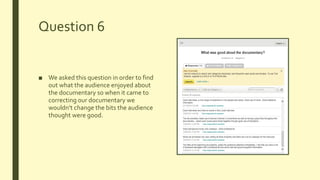
Question 6
■ We asked this question in order to find
out what the audience enjoyed about
the documentary so when it came to
correcting our documentary we
wouldn’t change the bits the audience
thought were good.
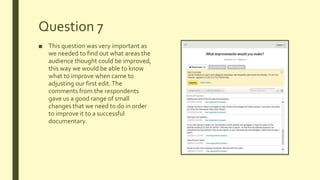
Question 7
■ This question was very important as
we needed to find out what areas the
audience thought could be improved,
this way we would be able to know
what to improve when came to
adjusting our first edit.The
comments from the respondents
gave us a good range of small
changes that we need to do in order
to improve it to a successful
documentary.
Advantages
■ From the peers feedback and questionnaire responses we found a lot of advantages
that came from them:
– It gave us a better understanding of what areas needed to be improved. For
example we found out that they felt the duration of some clips could be altered,
the transitions between shots could be smoother, also add extra cutaways to
break up the interview and also adjust the volume levels so that interviews and
voice over was clear.
– Secondly it meant that we were able to get the views and opinions from our
target audience. Gaining a better understanding of the audiences perception
enables us to know what areas to focus on.Also as the results were positive it
showed us the audience would likely watch the documentary.
Disadvantages/Limitations
■ However there were some limitations and disadvantages that we found from the
questionnaire and peer feedback which were:
– We only had limited time available to us to alter and change all of the points that
audience felt needed to be improved. As we had other commitments and
difficulties with the software it became increasingly difficult to make all of the
changes required in time.
– Secondly some of points that were raised weren’t feasible to be able to do, this
was because some of them required the interview to be re filmed because of the
audio quality of the interview.This was a problem for us but to fix we managed to
alter the audio on the software in order to make the interviews and voice overs
clearer for the audience.
What have we learned? How did we improve?
■ From the feedback there are various things that we have learnt from the feedback in order
for us to be able to improve which are:
■ Audio sound wasn’t loud/clear enough, in order for the interviews to be clearer we were able
to click on the layer which would then enable us to alter the audio accordingly. For some
points we needed to lower the background music and raise the audio layer of the top to be
louder, this way the audience would be able to hear the voice overs and interviews clearer.
■ Needed more cutaways to break up shots, in order for the documentary not to just look at
one interview throughout we needed to add more cutaways to fit in and break up the shots.
To do this we went round filming appropriate cutaways that we added in once we received
the feedback.
■ Duration of some clips were too long, to fix this we went back through the documentary
ourselves and became more critical on the length of each shot was. For example the
interview with the student support worker was to long and we often cut it down to ensure
the audience was able to equally see each interviewees opinion.
■ The transitions between shots needed to be smoother, again similar to previously, we went
back through the documentary and we were a lot more critical on the transitions and we
then changed them accordingly by either speeding them up or slowing them down.
■ Make the text clearer, again we went through our documentary and when we seen fault with
the text we changed it so that it was clearer for every member of the audience to see.
How has feedback shaped our views?
■ From receiving the feedback I believe that we overall become more critical of our
documentary and during the second edit were more aware of the finer details that
make a successful documentary such as the length of shots. In some cases they can be
just a split second to long which we began to notice during the second edit. Prior to
the feedback I think we were very happy with our documentary and after the feedback
from the questionnaire and our peers we realised that there was still room for
improvement but also that we had a good documentary that could be altered and
improved in order to become even better.

Evaluation question 3

  • 1.
    EVALUATION: QUESTION 3 What haveyou learnt from audience feedback?
  • 2.
    Audience Feedback ■ Firstlywe asked our peers to give us some feedback on our blogs for improvements, we had many improvements that would help us to achieve more. ■ To be able to analyse our work we sent out a survey for our audience and peers to complete.This was because it enabled us to see what areas of our documentary we needed to improve to make it is as good as possible.We sent out a questionnaire to many people by using survey monkey as it was the easiest way to compare and analyse our results.
  • 3.
    Peers Feedback ■ Thisshows the feedback that we received from our peers. Overall from the feedback it was clear for us to see that we needed to add more cutaways and make the transitions smoother.These gave us clear points that we need to work on from our first draft in order to improve it before we sent it out to our audience.
  • 4.
    Question 1 ■ Thefirst question that we asked was How would you rank the documentary overall? 100% of respondents ranked it above 7, with 72.2% of them thinking it was a 8/9 out of 10.This shows that our target audience like our documentary meaning that we have created a successful documentary that helps teenagers to understand and cope with loosing a loved one. However as we didn’t get 10 out of 10 from 100% of respondents it still showed us how we there is still room to improve.
  • 5.
    Question 2 ■ Around94% of respondents said that they either agreed or strongly agreed, this shows to us that people were able to understand all of the voices. However one of the respondents felt that we needed to make it clearer which is why we went back over the audio and it adjusted the sound to make it clearer for the audience to understand.
  • 6.
    Question 3 ■ Priorto filming we tried hard to ensure that the topic we chose was the main focus throughout the documentary which we believe was achieved by 100% of respondents saying that they either agreed or strongly agreed with the question. However some people may not have strongly agreed with the answer because at the beginning of the interviews we asked a few brief questions about the interviewee in order for the audience to gain an understanding of who are they are.
  • 7.
    Question 4 ■ Againsimilar to question 3, we spent a lot of time researching various styles that we could emulate for our own documentary. We watched documentaries such as ‘Amy’ ‘Nanook of the North’ and then channel 4 documentaries such as ‘Educating Essex’ and their mental health season ‘4 Goes Mad’.We believe that this was shown again from the majority of respondents as over 75% of respondents said that it follows this style.We believe that some people didn’t agree as there were certain elements that we created and thought of ourselves to put our own stamp on the documentary.
  • 8.
    Question 5 ■ Thiswas an important question which we asked because in order for the documentary to be a success it needs to attract the right audience.We were very happy that over 70% of respondents agreed with the question and a further 5% strongly agreed. However we believe that a few people may not have given either of these answers because of the topic of the documentary, it isn’t something that would stand out to typical teenagers which is why we filmed it and asked people of their age so they understand what it is like.
  • 9.
    Question 6 ■ Weasked this question in order to find out what the audience enjoyed about the documentary so when it came to correcting our documentary we wouldn’t change the bits the audience thought were good.
  • 10.
    Question 7 ■ Thisquestion was very important as we needed to find out what areas the audience thought could be improved, this way we would be able to know what to improve when came to adjusting our first edit.The comments from the respondents gave us a good range of small changes that we need to do in order to improve it to a successful documentary.
  • 11.
    Advantages ■ From thepeers feedback and questionnaire responses we found a lot of advantages that came from them: – It gave us a better understanding of what areas needed to be improved. For example we found out that they felt the duration of some clips could be altered, the transitions between shots could be smoother, also add extra cutaways to break up the interview and also adjust the volume levels so that interviews and voice over was clear. – Secondly it meant that we were able to get the views and opinions from our target audience. Gaining a better understanding of the audiences perception enables us to know what areas to focus on.Also as the results were positive it showed us the audience would likely watch the documentary.
  • 12.
    Disadvantages/Limitations ■ However therewere some limitations and disadvantages that we found from the questionnaire and peer feedback which were: – We only had limited time available to us to alter and change all of the points that audience felt needed to be improved. As we had other commitments and difficulties with the software it became increasingly difficult to make all of the changes required in time. – Secondly some of points that were raised weren’t feasible to be able to do, this was because some of them required the interview to be re filmed because of the audio quality of the interview.This was a problem for us but to fix we managed to alter the audio on the software in order to make the interviews and voice overs clearer for the audience.
  • 13.
    What have welearned? How did we improve? ■ From the feedback there are various things that we have learnt from the feedback in order for us to be able to improve which are: ■ Audio sound wasn’t loud/clear enough, in order for the interviews to be clearer we were able to click on the layer which would then enable us to alter the audio accordingly. For some points we needed to lower the background music and raise the audio layer of the top to be louder, this way the audience would be able to hear the voice overs and interviews clearer. ■ Needed more cutaways to break up shots, in order for the documentary not to just look at one interview throughout we needed to add more cutaways to fit in and break up the shots. To do this we went round filming appropriate cutaways that we added in once we received the feedback. ■ Duration of some clips were too long, to fix this we went back through the documentary ourselves and became more critical on the length of each shot was. For example the interview with the student support worker was to long and we often cut it down to ensure the audience was able to equally see each interviewees opinion. ■ The transitions between shots needed to be smoother, again similar to previously, we went back through the documentary and we were a lot more critical on the transitions and we then changed them accordingly by either speeding them up or slowing them down. ■ Make the text clearer, again we went through our documentary and when we seen fault with the text we changed it so that it was clearer for every member of the audience to see.
  • 14.
    How has feedbackshaped our views? ■ From receiving the feedback I believe that we overall become more critical of our documentary and during the second edit were more aware of the finer details that make a successful documentary such as the length of shots. In some cases they can be just a split second to long which we began to notice during the second edit. Prior to the feedback I think we were very happy with our documentary and after the feedback from the questionnaire and our peers we realised that there was still room for improvement but also that we had a good documentary that could be altered and improved in order to become even better.