Evaluating a Humanitarian Action
             Project
Why Evaluation
• To assess the quality of the project
• To see if it fits into the mandate of the
  organization
• To see if the needs and aspirations of the
  community is captured properly
• Value for money
• Make decisions: select, fine tune, reject
Key Indicators Used for Evaluation
•   Relevance
•   Effectiveness
•   Efficiency
•   Capacity and Support
•   Sustainability
•   Imp (whether all the documents required are in
    place)
The Project
• A Post Emergency Disaster Risk Reduction
  Project in Northern Sri Lanka
• Submitted to European Commission
  Humanitarian Aid and Civil Protection
• Duration: 12 Months
• Proposed Budget: Euros 128.806,00
• Financing Mechanism: 100% from ECHO
Relevance
• Appropriateness of the specific objective,
  pertinence of the action in regards to the real
  needs of the population
• Appropriateness of the action to the physical
  and political environment
• Link of the principal objective of the action
  with DG ECHO strategy
Project Context
• The project seems to be in line with local needs
  and aspirations of the community therefore it is
  highly relevant
• Installation of the early warning system could
  reduce the impact of disaster
• Weather conditions can lead to heavy rains,
  thunderstorms and floods
• N E Sri Lanka is also vulnerable to cyclone and
  tsunamis.
• The impact of civil war has further enhanced the
  vulnerability of the community
Efficiency
• Measuring outputs in relation to the inputs
• Alternative approaches to achieving the same
  output
• How economically resources were utilized:
  Human Resources, finance and time
Cost Efficiency
• Cost broken down by sector is rationally allocated
• Cost for transportation: further information
  needed on what kind of a vehicle will be used for
  transportation
• Time allocated for transportation seems a bit
  unrealistic: duration of the project 12 months –
  time for planning
• HR Cost: Expatriate: 33% of the budget
• Program cost V/s Program support cost = 60:40
Time Efficiency: realistic management
              schedule
• Three phases: establishment, capacity building
  & implementation
• Difference between M&E
Human Resources Efficiency
• Should reflect staff
  responsibility, support, development and well
  being
• The proposal does not state anything about
  the criteria and selection for team recruitment
Effectiveness
• Are the objectives effective compared to the
  problem statement?
• Do the results correspond with the aimed
  objectives?

Output, outcome and impact
Output
• Objectives are coherent with objectives of
  ICDM and their former projects
• No clear percentages in objectives: difficult to
  assess
  – F.e.: “participating communities are aware of their
    risk situation” and “participation of women is
    ensured”  what percentage of the participating
    communities and what percentage of the women?
• Objectives should be more specific
Outcome and Impact
• In general: the stated results (outcome) match
  the stated objectives
• However, one of the results implicates a raised
  awareness of Disaster Risk Reduction:
  – The area is already prone to natural disasters 
    are there not already existing coping mechanisms
    in use?
  – Not investigated by ICDM  could negatively
    effect the impact of the project
Capacity and Support
• Whether the organization has the internal and
  external means to successfully implement the
  proposal
• Whether the organization has the ability to
  critically assess its organizational capacity
• Whether it has the strategies and resources in
  place to improve the organizational capacity
Internal Organizational Capacity
• ICDM is well equipped and suitable for the
  project
• Coordination and capacity of HR is not clear
• It should consider adding training schemes for
  its team
Implementing Partner Capacity
• Seva Lanka fits the mandate of the project
• No point of contact has been mentioned
• No information about the HR of the partner
  organization
Evaluation Methods
• Method of evaluation proposed seems
  appropriate
• As per ECHO guidelines the focal person for
  evaluation needs to be mentioned
• No information on sharing the report with HQ.
• Sharing of the evaluative feedback with
  ALNAP, UN and other international knowledge
  based organizations
Sustainability as Reflected
• Involvement of community and other
  stakeholders in the project cycle
• Co-operation and coordination between
  different stakeholders
• Designing of the institutional mechanism
• Availability of the local skills and knowledge to
  maintain the systems
Involvement of the Community
• Enhances ownership
• Management of the project after phase out
• The Transfer of ownership should be a gradual
  process
• Whether built into Project Cycle
Organization Perception
• Presence of the organization
• Its image
• Interface between the organization and the
  community
• Program Mode V/s Project Mode
Coordination between Stakeholders
•   Linkages and leverages
•   Mobilizing resources
•   Sharing expertise
•   Comprehensive project
•   Community, Community Based Organizations,
    Government, Civil Society, UN Clusters and
    Donors
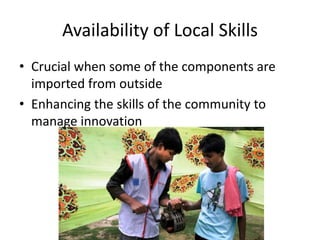
Availability of Local Skills
• Crucial when some of the components are
  imported from outside
• Enhancing the skills of the community to
  manage innovation
Proposal: Organizations Presence
• Pg 5 and Pg 13?
• Present since 2004 and long term relationship
  with the community
• Till date implemented six projects
• Local partnership with Seva Lanka
Proposal: Involvement of the
             community
• Pg 10, 19 and 35?
• Designing: through community consultation
  involving the most vulnerable
• Focuses on community contribution
• Participatory M&E
Proposal: Coordination Between
              Stakeholders
• Pg 39
• Formalization of the relationships with key
  stakeholders
• Robust mechanism for involving local level
  stakeholders
• Silent on coordination at national level:
  Disaster Management Bureau, Un Clusters,
  agencies providing relief
Proposal: Local skills
• Pg 31, 34, 35, 36
• Gives due emphasis on creating village level
  volunteer for S&R and FA
• EWS (imported): capacity building is reflected
• Task Force: One time capacity building during
  the program. After that? Mechanism for
  constant capacity enhancement
Recommendations
• More robust log frame based on SMART
• Ratio between program and operational cost
• Efforts should be made to develop a better linkage with
  national level institutions
• M&E framework
• Mechanisms are not yet in place to ensure sustainability of
  the capacity of the community.
• Mechanism to ensure engagement of the community after
  the closure of the project.
• Fine-tune capacity building strategies
• Knowledge sharing mechanism
• Conflict and DRR
Thank You

The team
Kiona Bolt
Silvi Hurkmans
Yaoliang Peng
Maike Benemma
Shakeb Nabi

Evaluating a Humanitarian Action Proposal

  • 1.
  • 2.
    Why Evaluation • Toassess the quality of the project • To see if it fits into the mandate of the organization • To see if the needs and aspirations of the community is captured properly • Value for money • Make decisions: select, fine tune, reject
  • 3.
    Key Indicators Usedfor Evaluation • Relevance • Effectiveness • Efficiency • Capacity and Support • Sustainability • Imp (whether all the documents required are in place)
  • 4.
    The Project • APost Emergency Disaster Risk Reduction Project in Northern Sri Lanka • Submitted to European Commission Humanitarian Aid and Civil Protection • Duration: 12 Months • Proposed Budget: Euros 128.806,00 • Financing Mechanism: 100% from ECHO
  • 5.
    Relevance • Appropriateness ofthe specific objective, pertinence of the action in regards to the real needs of the population • Appropriateness of the action to the physical and political environment • Link of the principal objective of the action with DG ECHO strategy
  • 6.
    Project Context • Theproject seems to be in line with local needs and aspirations of the community therefore it is highly relevant • Installation of the early warning system could reduce the impact of disaster • Weather conditions can lead to heavy rains, thunderstorms and floods • N E Sri Lanka is also vulnerable to cyclone and tsunamis. • The impact of civil war has further enhanced the vulnerability of the community
  • 7.
    Efficiency • Measuring outputsin relation to the inputs • Alternative approaches to achieving the same output • How economically resources were utilized: Human Resources, finance and time
  • 8.
    Cost Efficiency • Costbroken down by sector is rationally allocated • Cost for transportation: further information needed on what kind of a vehicle will be used for transportation • Time allocated for transportation seems a bit unrealistic: duration of the project 12 months – time for planning • HR Cost: Expatriate: 33% of the budget • Program cost V/s Program support cost = 60:40
  • 9.
    Time Efficiency: realisticmanagement schedule • Three phases: establishment, capacity building & implementation • Difference between M&E
  • 10.
    Human Resources Efficiency •Should reflect staff responsibility, support, development and well being • The proposal does not state anything about the criteria and selection for team recruitment
  • 11.
    Effectiveness • Are theobjectives effective compared to the problem statement? • Do the results correspond with the aimed objectives? Output, outcome and impact
  • 12.
    Output • Objectives arecoherent with objectives of ICDM and their former projects • No clear percentages in objectives: difficult to assess – F.e.: “participating communities are aware of their risk situation” and “participation of women is ensured”  what percentage of the participating communities and what percentage of the women? • Objectives should be more specific
  • 13.
    Outcome and Impact •In general: the stated results (outcome) match the stated objectives • However, one of the results implicates a raised awareness of Disaster Risk Reduction: – The area is already prone to natural disasters  are there not already existing coping mechanisms in use? – Not investigated by ICDM  could negatively effect the impact of the project
  • 14.
    Capacity and Support •Whether the organization has the internal and external means to successfully implement the proposal • Whether the organization has the ability to critically assess its organizational capacity • Whether it has the strategies and resources in place to improve the organizational capacity
  • 15.
    Internal Organizational Capacity •ICDM is well equipped and suitable for the project • Coordination and capacity of HR is not clear • It should consider adding training schemes for its team
  • 16.
    Implementing Partner Capacity •Seva Lanka fits the mandate of the project • No point of contact has been mentioned • No information about the HR of the partner organization
  • 17.
    Evaluation Methods • Methodof evaluation proposed seems appropriate • As per ECHO guidelines the focal person for evaluation needs to be mentioned • No information on sharing the report with HQ. • Sharing of the evaluative feedback with ALNAP, UN and other international knowledge based organizations
  • 18.
    Sustainability as Reflected •Involvement of community and other stakeholders in the project cycle • Co-operation and coordination between different stakeholders • Designing of the institutional mechanism • Availability of the local skills and knowledge to maintain the systems
  • 19.
    Involvement of theCommunity • Enhances ownership • Management of the project after phase out • The Transfer of ownership should be a gradual process • Whether built into Project Cycle
  • 20.
    Organization Perception • Presenceof the organization • Its image • Interface between the organization and the community • Program Mode V/s Project Mode
  • 21.
    Coordination between Stakeholders • Linkages and leverages • Mobilizing resources • Sharing expertise • Comprehensive project • Community, Community Based Organizations, Government, Civil Society, UN Clusters and Donors
  • 22.
    Availability of LocalSkills • Crucial when some of the components are imported from outside • Enhancing the skills of the community to manage innovation
  • 23.
    Proposal: Organizations Presence •Pg 5 and Pg 13? • Present since 2004 and long term relationship with the community • Till date implemented six projects • Local partnership with Seva Lanka
  • 24.
    Proposal: Involvement ofthe community • Pg 10, 19 and 35? • Designing: through community consultation involving the most vulnerable • Focuses on community contribution • Participatory M&E
  • 25.
    Proposal: Coordination Between Stakeholders • Pg 39 • Formalization of the relationships with key stakeholders • Robust mechanism for involving local level stakeholders • Silent on coordination at national level: Disaster Management Bureau, Un Clusters, agencies providing relief
  • 26.
    Proposal: Local skills •Pg 31, 34, 35, 36 • Gives due emphasis on creating village level volunteer for S&R and FA • EWS (imported): capacity building is reflected • Task Force: One time capacity building during the program. After that? Mechanism for constant capacity enhancement
  • 27.
    Recommendations • More robustlog frame based on SMART • Ratio between program and operational cost • Efforts should be made to develop a better linkage with national level institutions • M&E framework • Mechanisms are not yet in place to ensure sustainability of the capacity of the community. • Mechanism to ensure engagement of the community after the closure of the project. • Fine-tune capacity building strategies • Knowledge sharing mechanism • Conflict and DRR
  • 28.
    Thank You The team KionaBolt Silvi Hurkmans Yaoliang Peng Maike Benemma Shakeb Nabi