Sustainable Economic Development of the Sudurnes
                 region, Iceland

         Preparation of Project Proposals
                ‘The project fiche’


            JOSE MATEOS MORENO

             Ásbrú, 25 November 2011
Contents

1. Preparation of the project
   application form

2. Activity and resource planning


                       2
1. Project Design


Sustainable Economic                  3
Development of the Sudurnes
region, Iceland
Project Design: definition of a
Project

• Economically indivisible series of activities
  for a precise technical function
• Identified outputs and objectives
• Clearly defined beginning and end
• A programme is a heterogeneous group of
  measures and projects


                        4
Elements of project design

       • Why: the problem or need and wider objectives
       • What: activities, results and project purpose
       • How: internal and diagonal logic:

            -   Indicators for monitoring and evaluation
            -   Risk analysis and assumptions
            -   Preconditions
            -   Finance: costs and co-financing
            -   Implementation schedule


Sustainable Economic                      5
Development of the Sudurnes
region, Iceland
Project Design: Tasks
Responsibilities of Final Beneficiary:
• Designing of project proposals and submitting them
  to IBs

Responsibilities of Lead Ministry (Sectoral
  Offices):
• Compliance with the sectoral strategic documents
• Verifies technical quality of the project proposal
• Verifies if the project proposal meets the eligibility
  criteria for IPA measures
• Ensures the national financial contribution for the
  project
                             6
The project application procedure
should:
  • Promote high quality project preparation
  • Asess if EU principles are met (horizontal
    issues)
  • Check for availibility of all necessary
    documents (feasibility studies, EIA, permits
    etc)
  • Show main results of EIA and feasibility/CBA
    studies
  • The format (project fiche or application form) is
    a tool for uniform communication of relevant
    key project information

                           7
Elements of a project proposal
‘Project fiche’
1)         Basic information
2)         Objectives
3)         Description
4)         Institutional Framework
5)         Detailed Budget
6)         Implementation Arrangements
7)         Implementation Schedule
8)         Cross cutting issues
      1)      Equal Opportunity
      2)      Environment
9)         Rates of Return
10)        Investment Criteria
11)        Conditionality and Sequencing

Annexes: Logframe, implementation chart, contracting and disbursement
    schedule, list of preparation studies, laws, plans.

                                      8
Activities in Project Design


A. Information gathering for the problem
   analysis and the elements of project design
B. Deciding the scale and scope of the project
C. Assembling the project design elements
D. Filling in the project proposal (fiche)


                      9
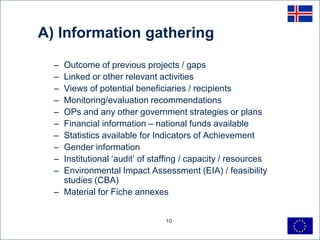
A) Information gathering
  – Outcome of previous projects / gaps
  – Linked or other relevant activities
  – Views of potential beneficiaries / recipients
  – Monitoring/evaluation recommendations
  – OPs and any other government strategies or plans
  – Financial information – national funds available
  – Statistics available for Indicators of Achievement
  – Gender information
  – Institutional ‘audit’ of staffing / capacity / resources
  – Environmental Impact Assessment (EIA) / feasibility
    studies (CBA)
  – Material for Fiche annexes


                                10
B) Deciding the scope and scale

Scope: type of activities to include should
  depend on:
- type of needs/problems
- cost/feasibility issues
- dependency of success on specific activities
Size (capacity) of the project should depend
  on:
- market demand/need for the services of the
  project (feasibility study)

                        11
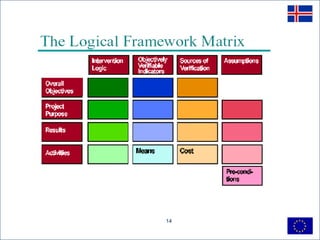
C) The project design elements and logframe

D) Filling in the project fiche


                        12
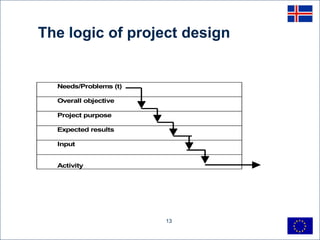
The logic of project design


  Needs/Problems (t)

  Overall objective

  Project purpose

  Expected results

  Input


  Activity


                       13
14
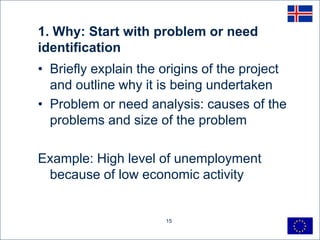
1. Why: Start with problem or need
identification
• Briefly explain the origins of the project
  and outline why it is being undertaken
• Problem or need analysis: causes of the
  problems and size of the problem

Example: High level of unemployment
 because of low economic activity


                      15
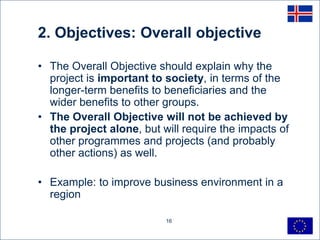
2. Objectives: Overall objective

• The Overall Objective should explain why the
  project is important to society, in terms of the
  longer-term benefits to beneficiaries and the
  wider benefits to other groups.
• The Overall Objective will not be achieved by
  the project alone, but will require the impacts of
  other programmes and projects (and probably
  other actions) as well.

• Example: to improve business environment in a
  region

                          16
2. Objectives: Project Purpose

The single central objective of the project in
  terms of sustainable benefits to be
  delivered to the project beneficiaries.


• Example: to improve business
  infrastructure for new start-ups.
• To improve tourist infrastructure in a
  region.

                        17
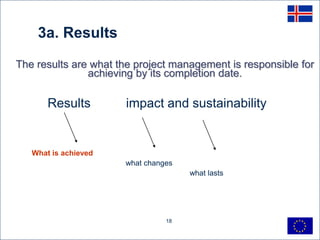
3a. Results
The results are what the project management is responsible for
               achieving by its completion date.

       Results        impact and sustainability


   What is achieved
                      what changes
                                     what lasts


                                18
3b. Activities

• The specific tasks to be undertaken during
  a project’s life to obtain results.

Activities should indicate:
• what the person or organisation
  responsible for the project should do.
• how the project’s goods and services will
  be delivered

                      19
3c. Indicators

Measurable indicators that will show whether or not
  objectives have been achieved at each level of the
  logframe hierarchy and at defined times

Indicators provide the basis for designing an
  appropriate monitoring (and evaluation) system

Sources of Verification: the means by which the
  indicators or milestones will be recorded and made
  available to project management or those
  evaluating project performance.


                          20
Risks & assumptions and
Pre-conditions
Risks: factors which could affect the progress or
  success of the project

In LFA: risks should always be expressed as
   assumptions

Risk analysis and risk management strategy for larger
  projects

Pre-conditions: constraints that have to be met
  before the project starts


                           21
4. Institutional Arrangements

• Institutional framework within which the project
  will operate.
• Identify any constraints or changes that can
  have impact on results
• Chain of command
• (a) who will be appointed as the "Engineer―
• (b) who will be the "Employer" — the institution
  responsible for providing the site and for
  paying the contractor
• (c) who will be or become "Owner" of the asset
  after project completion

                         22
5. Detailed Budget

• Budget: estimation of investment costs
• Clarify the cost estimation
• Maintenance costs are not covered by EU
  funds: make reservation in national budget
• Specify co-financing of national budget,
  municipalities, loans etc. (column funding
  source in resource schedule)


                      23
6. Implementation arrangements

• Implementing agency of the project
  (details)
• Contracting parties


                     24
7. Implementation schedule

  A) Start of tendering/call for proposals
  Give date, including when TORs and/or project
  specifications will be ready

  B) Start of project activity
  Expected date of commencement of first contract/grant scheme

  C) Project completion
  Expected date of last payment under last contract/grant


                                25
Annexes to Project Fiche
•       Logframe
•       Detailed implementation chart (year one at least)
•       Contracting and disbursement schedule, by quarter,
        for project duration
•       Studies
    –    All Projects: list of (pre-) feasibility studies, ex-ante
         evaluations, other preparatory work
    –    Investment Projects: exec. summaries of economic &
         financial studies, EIAs etc.
•        Reference list of relevant laws and regulations
•        Reference list of relevant strategic plans and studies
                                     26
2. Activity and resource schedules


                 27
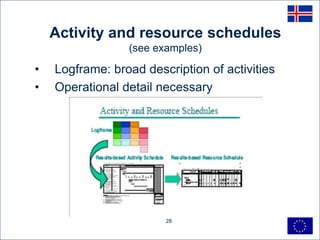
Activity and resource schedules
                 (see examples)

•   Logframe: broad description of activities
•   Operational detail necessary


                        28
Contracting and disbursement schedule

  • Show for project period contracting
    points
  • Show for project period expected
    payments in time


                       29
Conclusions

• Good project design starts with a sound
  problem analysis (problem tree) and make
  use of logframe
• Project design should be logical and have
  measurable objectives (logframe)
• The project fiche and logframe can help you
  to draft a good proposal


                      30

6 sept project fiche

  • 1.
    Sustainable Economic Developmentof the Sudurnes region, Iceland Preparation of Project Proposals ‘The project fiche’ JOSE MATEOS MORENO Ásbrú, 25 November 2011
  • 2.
    Contents 1. Preparation ofthe project application form 2. Activity and resource planning 2
  • 3.
    1. Project Design SustainableEconomic 3 Development of the Sudurnes region, Iceland
  • 4.
    Project Design: definitionof a Project • Economically indivisible series of activities for a precise technical function • Identified outputs and objectives • Clearly defined beginning and end • A programme is a heterogeneous group of measures and projects 4
  • 5.
    Elements of projectdesign • Why: the problem or need and wider objectives • What: activities, results and project purpose • How: internal and diagonal logic: - Indicators for monitoring and evaluation - Risk analysis and assumptions - Preconditions - Finance: costs and co-financing - Implementation schedule Sustainable Economic 5 Development of the Sudurnes region, Iceland
  • 6.
    Project Design: Tasks Responsibilitiesof Final Beneficiary: • Designing of project proposals and submitting them to IBs Responsibilities of Lead Ministry (Sectoral Offices): • Compliance with the sectoral strategic documents • Verifies technical quality of the project proposal • Verifies if the project proposal meets the eligibility criteria for IPA measures • Ensures the national financial contribution for the project 6
  • 7.
    The project applicationprocedure should: • Promote high quality project preparation • Asess if EU principles are met (horizontal issues) • Check for availibility of all necessary documents (feasibility studies, EIA, permits etc) • Show main results of EIA and feasibility/CBA studies • The format (project fiche or application form) is a tool for uniform communication of relevant key project information 7
  • 8.
    Elements of aproject proposal ‘Project fiche’ 1) Basic information 2) Objectives 3) Description 4) Institutional Framework 5) Detailed Budget 6) Implementation Arrangements 7) Implementation Schedule 8) Cross cutting issues 1) Equal Opportunity 2) Environment 9) Rates of Return 10) Investment Criteria 11) Conditionality and Sequencing Annexes: Logframe, implementation chart, contracting and disbursement schedule, list of preparation studies, laws, plans. 8
  • 9.
    Activities in ProjectDesign A. Information gathering for the problem analysis and the elements of project design B. Deciding the scale and scope of the project C. Assembling the project design elements D. Filling in the project proposal (fiche) 9
  • 10.
    A) Information gathering – Outcome of previous projects / gaps – Linked or other relevant activities – Views of potential beneficiaries / recipients – Monitoring/evaluation recommendations – OPs and any other government strategies or plans – Financial information – national funds available – Statistics available for Indicators of Achievement – Gender information – Institutional ‘audit’ of staffing / capacity / resources – Environmental Impact Assessment (EIA) / feasibility studies (CBA) – Material for Fiche annexes 10
  • 11.
    B) Deciding thescope and scale Scope: type of activities to include should depend on: - type of needs/problems - cost/feasibility issues - dependency of success on specific activities Size (capacity) of the project should depend on: - market demand/need for the services of the project (feasibility study) 11
  • 12.
    C) The projectdesign elements and logframe D) Filling in the project fiche 12
  • 13.
    The logic ofproject design Needs/Problems (t) Overall objective Project purpose Expected results Input Activity 13
  • 14.
  • 15.
    1. Why: Startwith problem or need identification • Briefly explain the origins of the project and outline why it is being undertaken • Problem or need analysis: causes of the problems and size of the problem Example: High level of unemployment because of low economic activity 15
  • 16.
    2. Objectives: Overallobjective • The Overall Objective should explain why the project is important to society, in terms of the longer-term benefits to beneficiaries and the wider benefits to other groups. • The Overall Objective will not be achieved by the project alone, but will require the impacts of other programmes and projects (and probably other actions) as well. • Example: to improve business environment in a region 16
  • 17.
    2. Objectives: ProjectPurpose The single central objective of the project in terms of sustainable benefits to be delivered to the project beneficiaries. • Example: to improve business infrastructure for new start-ups. • To improve tourist infrastructure in a region. 17
  • 18.
    3a. Results The resultsare what the project management is responsible for achieving by its completion date. Results impact and sustainability What is achieved what changes what lasts 18
  • 19.
    3b. Activities • Thespecific tasks to be undertaken during a project’s life to obtain results. Activities should indicate: • what the person or organisation responsible for the project should do. • how the project’s goods and services will be delivered 19
  • 20.
    3c. Indicators Measurable indicatorsthat will show whether or not objectives have been achieved at each level of the logframe hierarchy and at defined times Indicators provide the basis for designing an appropriate monitoring (and evaluation) system Sources of Verification: the means by which the indicators or milestones will be recorded and made available to project management or those evaluating project performance. 20
  • 21.
    Risks & assumptionsand Pre-conditions Risks: factors which could affect the progress or success of the project In LFA: risks should always be expressed as assumptions Risk analysis and risk management strategy for larger projects Pre-conditions: constraints that have to be met before the project starts 21
  • 22.
    4. Institutional Arrangements •Institutional framework within which the project will operate. • Identify any constraints or changes that can have impact on results • Chain of command • (a) who will be appointed as the "Engineer― • (b) who will be the "Employer" — the institution responsible for providing the site and for paying the contractor • (c) who will be or become "Owner" of the asset after project completion 22
  • 23.
    5. Detailed Budget •Budget: estimation of investment costs • Clarify the cost estimation • Maintenance costs are not covered by EU funds: make reservation in national budget • Specify co-financing of national budget, municipalities, loans etc. (column funding source in resource schedule) 23
  • 24.
    6. Implementation arrangements •Implementing agency of the project (details) • Contracting parties 24
  • 25.
    7. Implementation schedule A) Start of tendering/call for proposals Give date, including when TORs and/or project specifications will be ready B) Start of project activity Expected date of commencement of first contract/grant scheme C) Project completion Expected date of last payment under last contract/grant 25
  • 26.
    Annexes to ProjectFiche • Logframe • Detailed implementation chart (year one at least) • Contracting and disbursement schedule, by quarter, for project duration • Studies – All Projects: list of (pre-) feasibility studies, ex-ante evaluations, other preparatory work – Investment Projects: exec. summaries of economic & financial studies, EIAs etc. • Reference list of relevant laws and regulations • Reference list of relevant strategic plans and studies 26
  • 27.
    2. Activity andresource schedules 27
  • 28.
    Activity and resourceschedules (see examples) • Logframe: broad description of activities • Operational detail necessary 28
  • 29.
    Contracting and disbursementschedule • Show for project period contracting points • Show for project period expected payments in time 29
  • 30.
    Conclusions • Good projectdesign starts with a sound problem analysis (problem tree) and make use of logframe • Project design should be logical and have measurable objectives (logframe) • The project fiche and logframe can help you to draft a good proposal 30