Euthanasia and Physician-Assisted SuicideMedical Ethics OnlineEli Weber, InstructorSummer 2011
Lecture GoalsClarify the different types of euthanasia, as well as the specific ethical concerns associated with each.Consider some arguments for allowing patients the option of either active or passive euthanasia.Provide some responses and criticisms of these argumentsThink about whether the killing-letting die distinction is morally helpful.
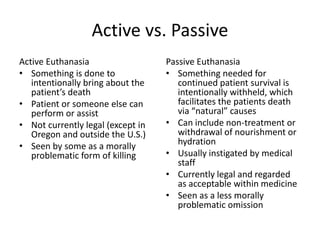
Active vs. PassiveActive EuthanasiaSomething is done to intentionally bring about the patient’s deathPatient or someone else can perform or assistNot currently legal (except in Oregon and outside the U.S.)Seen by some as a morally problematic form of killingPassive EuthanasiaSomething needed for continued patient survival is intentionally withheld, which facilitates the patients death via “natural” causesCan include non-treatment or withdrawal of nourishment or hydrationUsually instigated by medical staffCurrently legal and regarded as acceptable within medicineSeen as a less morally problematic omission
Voluntary vs. Involuntary vs. Nonvoluntary EuthanasiaVoluntary euthanasia-patient consents to either active or passive euthanasia, either directly or via an advanced directive or surrogate decision-makerInvoluntary euthanasia-patient explicitly expresses a desire to continue to live, but is subjected to either active or passive euthanasia anywayNonvoluntary euthanasia-it is unknown whether the patient consents to euthanasia
Ethically Speaking…Involuntary euthanasia of all kinds is regarded as deeply morally objectionableActive euthanasia is usually taken to be less morally problematic than passive euthanasiaThere are obvious cases where passive euthanasia seems morally worse than active euthanasiaNonvoluntary euthanasia is highly ethically controversialThe deep questions are whether euthanasia should ever be allowed, and if so, what kinds and under what conditions.
Arguments for Allowing Euthanasia:  Do Patients Have a Right to Die?A patient’s right to die is though to be grounded in a right of autonomy.Passive euthanasia can be construed as a right to refuse treatment if one wishes.-it’s not clear that this extends to a right to active euthanasiaCallahan:  Exercising this right requires the involvement of others, which makes a right to autonomy insufficient to justify it.
Arguments for Euthanasia:  Do Physicians Have an Obligation to Assist?Physicians are generally thought to be obligated to prevent patient suffering when they are able to do so.This seems to support an obligation to assist with not just passive, but active euthanasia.  Callahan:  The scope of a physician’s practice should be limited to treating suffering of a medical nature, not the more general “pain of existence” associated with terminal illness
Some Critical RepliesSlippery slope argument-allowing active euthanasia will open the door to increasingly permissive attitudes about when it is acceptable (or obligatory) for people to end their livesNo way of writing legislation that can adequately prevent abuses-Success of the Oregon plan tells against these arguments
Another critical replyKilling is morally worse than letting die-even if passive euthanasia is morally permissible, active euthanasia is not.This argument turns on there being a morally relevant difference between killing and letting die.So, is there a morally relevant difference here?
Smith and JonesSmith kills his nephew in order to get his inheritance, while Jones simply neglects to assist his nephew, who subsequently dies-Rachels claims that we think what Smith and Jones did is equally reprehensible, which demonstrates that there is no morally relevant difference between killing and letting dieNesbitt:  we think they are equally reprehensible because they were both prepared to do the same, equally reprehensible thing.
Smith and Jones, version 2Smith kills his nephew in order to get his inheritance, while Jones simply neglects to assist his nephew, who subsequently dies.  In this case, however, Jones was not prepared to kill his nephew had he not slipped and fell.-Nesbitt claims that in this case, we think Smith is morally worse than Jones.  This is because we think killing is morally worse than letting die.
The Bottom LineTerminally ill people who are fully competent, and who seem to genuinely desire to end their lives represents a serious problem for a society that grants patients a strong autonomy right.If we take this right seriously, opposition seems to turn on the success or failure of slippery slope concerns.  The evidence about these concerns is mixed.Even if killing makes one a morally worse person than letting die, it doesn’t follow that the actions themselves are morally unequal.

Euthanasia and physician assisted suicide

  • 1.
    Euthanasia and Physician-AssistedSuicideMedical Ethics OnlineEli Weber, InstructorSummer 2011
  • 2.
    Lecture GoalsClarify thedifferent types of euthanasia, as well as the specific ethical concerns associated with each.Consider some arguments for allowing patients the option of either active or passive euthanasia.Provide some responses and criticisms of these argumentsThink about whether the killing-letting die distinction is morally helpful.
  • 3.
    Active vs. PassiveActiveEuthanasiaSomething is done to intentionally bring about the patient’s deathPatient or someone else can perform or assistNot currently legal (except in Oregon and outside the U.S.)Seen by some as a morally problematic form of killingPassive EuthanasiaSomething needed for continued patient survival is intentionally withheld, which facilitates the patients death via “natural” causesCan include non-treatment or withdrawal of nourishment or hydrationUsually instigated by medical staffCurrently legal and regarded as acceptable within medicineSeen as a less morally problematic omission
  • 4.
    Voluntary vs. Involuntaryvs. Nonvoluntary EuthanasiaVoluntary euthanasia-patient consents to either active or passive euthanasia, either directly or via an advanced directive or surrogate decision-makerInvoluntary euthanasia-patient explicitly expresses a desire to continue to live, but is subjected to either active or passive euthanasia anywayNonvoluntary euthanasia-it is unknown whether the patient consents to euthanasia
  • 5.
    Ethically Speaking…Involuntary euthanasiaof all kinds is regarded as deeply morally objectionableActive euthanasia is usually taken to be less morally problematic than passive euthanasiaThere are obvious cases where passive euthanasia seems morally worse than active euthanasiaNonvoluntary euthanasia is highly ethically controversialThe deep questions are whether euthanasia should ever be allowed, and if so, what kinds and under what conditions.
  • 6.
    Arguments for AllowingEuthanasia: Do Patients Have a Right to Die?A patient’s right to die is though to be grounded in a right of autonomy.Passive euthanasia can be construed as a right to refuse treatment if one wishes.-it’s not clear that this extends to a right to active euthanasiaCallahan: Exercising this right requires the involvement of others, which makes a right to autonomy insufficient to justify it.
  • 7.
    Arguments for Euthanasia: Do Physicians Have an Obligation to Assist?Physicians are generally thought to be obligated to prevent patient suffering when they are able to do so.This seems to support an obligation to assist with not just passive, but active euthanasia. Callahan: The scope of a physician’s practice should be limited to treating suffering of a medical nature, not the more general “pain of existence” associated with terminal illness
  • 8.
    Some Critical RepliesSlipperyslope argument-allowing active euthanasia will open the door to increasingly permissive attitudes about when it is acceptable (or obligatory) for people to end their livesNo way of writing legislation that can adequately prevent abuses-Success of the Oregon plan tells against these arguments
  • 9.
    Another critical replyKillingis morally worse than letting die-even if passive euthanasia is morally permissible, active euthanasia is not.This argument turns on there being a morally relevant difference between killing and letting die.So, is there a morally relevant difference here?
  • 10.
    Smith and JonesSmithkills his nephew in order to get his inheritance, while Jones simply neglects to assist his nephew, who subsequently dies-Rachels claims that we think what Smith and Jones did is equally reprehensible, which demonstrates that there is no morally relevant difference between killing and letting dieNesbitt: we think they are equally reprehensible because they were both prepared to do the same, equally reprehensible thing.
  • 11.
    Smith and Jones,version 2Smith kills his nephew in order to get his inheritance, while Jones simply neglects to assist his nephew, who subsequently dies. In this case, however, Jones was not prepared to kill his nephew had he not slipped and fell.-Nesbitt claims that in this case, we think Smith is morally worse than Jones. This is because we think killing is morally worse than letting die.
  • 12.
    The Bottom LineTerminallyill people who are fully competent, and who seem to genuinely desire to end their lives represents a serious problem for a society that grants patients a strong autonomy right.If we take this right seriously, opposition seems to turn on the success or failure of slippery slope concerns. The evidence about these concerns is mixed.Even if killing makes one a morally worse person than letting die, it doesn’t follow that the actions themselves are morally unequal.