7. Dying &
Euthanasia:
Dr. Ayub Abdulkadir (Dr. Alto)
Medical Ethics
The Dying Process:
• Death is inevitable for everyone.
• Modern medicine has enabled people to live longer
and survive disease.
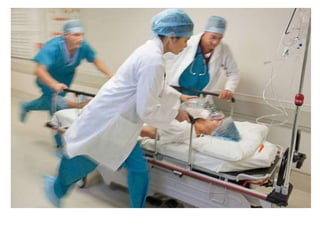
• Patients can now be kept alive by medical technology.
• Health care professionals have a duty to preserve life.
• Determination of death is important for many reasons
• Actual determination of death is critical due to organ
transplantation and life-support systems.
Karen Ann Quinlan Case
• April 15,1975: 21-year-old unconscious from a
prescription drug and alcohol overdose.
• Tracheotomy to help with breathing and
nasogastric tube for nourishment.
• Father appealed to have respirator discontinued.
• Respirator discontinued, but feeding tube
continued.
• Lived in coma for ten years without respirator, then
died.
Criteria for Death
• Assist in determination that death has
occurred
1. Loss of heartbeat.
2. Significant drop in body temperature.
3. Loss of body color.
4. Rigor mortis (stiffness).
• Symptoms may not appear until several
hours after death or not at all if life-support
equipment used.
*** Cardiac Death:
•Death in which heart has stopped
functioning
•Lack of pulse or breathing
•Considered a legal death
•Irreversible loss of all cardiac function
•Serious problem for organ transplants
*** Brain-Oriented Death
•Death occurs when there is irreversible
cessation of all brain function
•Most states accept this
definition of death
•Heart and lung functions can be
maintained by mechanical means after
brain function has stopped
Harvard Criteria for Definition
of Irreversible Coma
• Unreceptive and unresponsive with total
unawareness of externally applied and
painful stimuli.
• No spontaneous movements or breathing,
absence of response to pain, touch, sound,
or light.
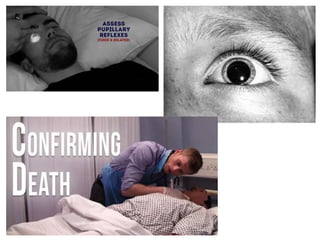
• No reflexes, with fixed dilated pupils, lack of
eye movement, and lack of deep tendon
reflexes.
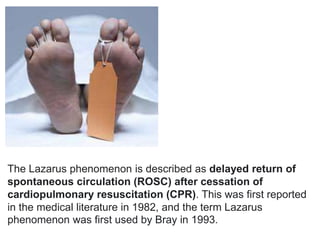
The Lazarus phenomenon is described as delayed return of
spontaneous circulation (ROSC) after cessation of
cardiopulmonary resuscitation (CPR). This was first reported
in the medical literature in 1982, and the term Lazarus
phenomenon was first used by Bray in 1993.
The Terri Schiavo Case
•Woman in a persistent vegetative state
•Husband sought to have her feeding
tube removed
•Tube was removed by court order
•Governor ordered tube to be reinserted
•Finally died after tube was removed
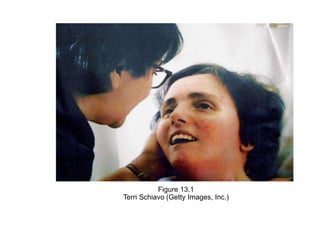
Figure 13.1
Terri Schiavo (Getty Images, Inc.)
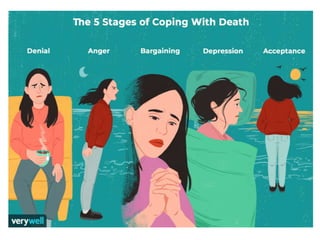
Stages of Dying:
•According to Dr. Elisabeth Kübler-Ross,
dying process is divided into five stages:
1. Denial
2. Anger
3. Bargaining
4. Depression
5. Acceptance
Choices in Life and Death
•Suicide is considered morally wrong and
illegal in most states.
•No state punishes people who attempt
suicide, but they may be placed in
psychiatric care if present danger to
themselves.
•Many religions condemn suicide and
euthanasia.
Euthanasia
Introduction:
• Euthanasia comes from the Greek words: Eu
(good) and Thanatosis (death) and it means "Good
Death, "Gentle and Easy Death." This word has come
to be used for "mercy killing.
• It is the act or practice of ending a life of a person
either by a lethal injection or suspension of medical
treatment.
• The word "euthanasia" was first used in a medical
context by Francis Bacon in the 17th century, to refer
to an easy, painless, happy death, during which it was
a "physician's responsibility to alleviate the 'physical
sufferings' of the body.
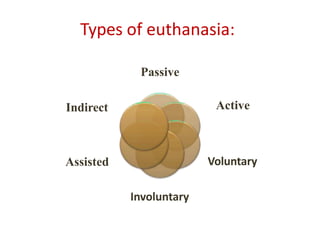
Types of euthanasia:
Passive
Active
Voluntary
Involuntary
Assisted
Indirect
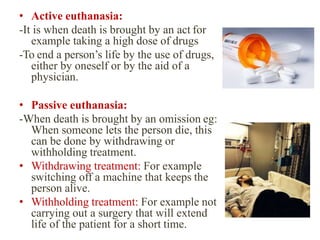
• Active euthanasia:
-It is when death is brought by an act for
example taking a high dose of drugs
-To end a person’s life by the use of drugs,
either by oneself or by the aid of a
physician.
• Passive euthanasia:
-When death is brought by an omission eg:
When someone lets the person die, this
can be done by withdrawing or
withholding treatment.
• Withdrawing treatment: For example
switching off a machine that keeps the
person alive.
• Withholding treatment: For example not
carrying out a surgery that will extend
life of the patient for a short time.
• Voluntary euthanasia is committed
with the willing or autonomous
cooperation of the subject. This
means that the subject is free from
direct or indirect pressure from
others.
• Non voluntary euthanasia occurs
when the patient is unconscious or
unable to make a meaningful choice
between living and dying, and an
appropriate person takes that
decision for him/her.
• This is usually called murder.
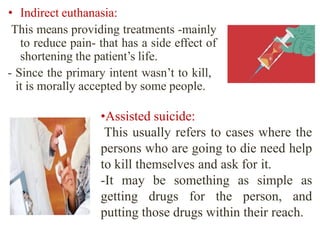
• Indirect euthanasia:
This means providing treatments -mainly
to reduce pain- that has a side effect of
shortening the patient’s life.
- Since the primary intent wasn’t to kill,
it is morally accepted by some people.
•Assisted suicide:
This usually refers to cases where the
persons who are going to die need help
to kill themselves and ask for it.
-It may be something as simple as
getting drugs for the person, and
putting those drugs within their reach.
History:
• It is believed that euthanasia started in ancient
Greece and Rome around the fifth century B.C.
• Some did this by abortions, and every now and
then performed a mercy killing even though
doctors were supposed to follow the
Hippocratic Oath:
• “I will give no deadly medicine to any one if asked,
nor suggest any such counsel”.
• During the Middle Ages, euthanasia was pretty
much out of the question. If one committed
suicide, the law in Europe was for the body to be
dragged through the streets or nailed to a barrel
and left to drift downriver.
• During the Seventeenth and Eighteenth centuries
euthanasia was a topic of discussion. However,
people continued to reject euthanasia and assisted
suicide.
• 1478-1535: Sir Thomas More is often quoted as
being the first prominent Christian to recommend
euthanasia in his book Utopia, where the Utopian
priests encourage euthanasia when a patient was
terminally ill and suffering pain
• 1828: The frist law against assisted killing, known
as anti-euthanasia was passed in new york.
• 1870: The use of morphine and analgesic
medications for assisting quick and painless death
was suggested.
• 1885: The American Medical Association strongly
denied the use of analgesic for euthanasia.
• 1994: Netherlands it is the first country where
euthanasia has been allowed.
• 2001: The euthanasia law was adopted in Belgium -
this law defines conditions for doctors to avoid penal
punishment.
• 2008: U.S. state of Washington legalizes assisted
suicide
Laws:
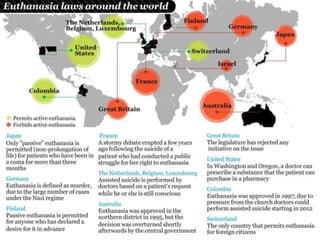
• In Europe, Euthanasia is only legal in the Netherlands
and Belgium, provided certain conditions are met.
• For example, the patient’s request must be voluntary
and well considered; the patient must be suffering
unbearable physical or mental suffering, with no
prospect of relief the patient must be informed about
their situation and prospects; at least one other,
independent, doctor must be consulted.
• In Belgium euthanasia is only allowed if the patient is
an adult.
• However, in the Netherlands euthanasia is allowed
for children aged between 12 and 16 years of age,
with the consent of their parents/guardians and for
individuals aged 16 years and over.
• Assisted suicide is legal in the Netherlands ,
Switzerland and the state of oregon in the US but
have certain conditions eg : the patient must be
considered competent and aware of their
situation.
• In Japan : Only " passive " euthanasia is permitted
for patients who have been in a Coma for more
than 3 months.
Religions:
• Those in favor of euthanasia argue that a civilized
society should allow people to die in dignity and
without pain.
• They add that as suicide is not a crime, euthanasia
should not be a crime.
• Most religions disapprove of euthanasia for a
number of reasons:
1. God has forbidden it ( that says 'you must not kill').
2. Human life is sacred.
3. Human beings are made in God's image.
4. God gives people life, so only God has the right to
take it away.
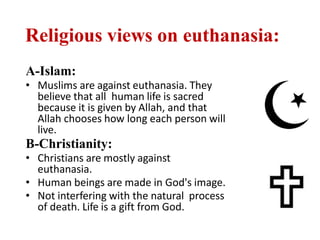
Religious views on euthanasia:
A-Islam:
• Muslims are against euthanasia. They
believe that all human life is sacred
because it is given by Allah, and that
Allah chooses how long each person will
live.
B-Christianity:
• Christians are mostly against
euthanasia.
• Human beings are made in God's image.
• Not interfering with the natural process
of death. Life is a gift from God.
Continue……………
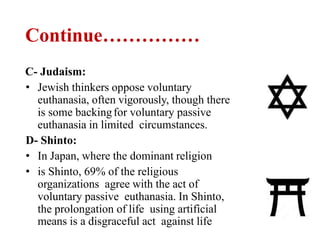
C- Judaism:
• Jewish thinkers oppose voluntary
euthanasia, often vigorously, though there
is some backingfor voluntary passive
euthanasia in limited circumstances.
D- Shinto:
• In Japan, where the dominant religion
• is Shinto, 69% of the religious
organizations agree with the act of
voluntary passive euthanasia. In Shinto,
the prolongation of life using artificial
means is a disgraceful act against life
Continue……………
E- Buddhism:
• An important value of Buddhism
teaching is compassion.
Compassion is used by some
Buddhists as a justification for
euthanasia because the person
suffering is relieved of pain.
• However, it is still immoral "to
embark on any course of action
whose aim is to destroy human
life, irrespective of the quality of
the individual's motive."

7. Dying & Euthanasia.pptx

  • 1.
    7. Dying & Euthanasia: Dr.Ayub Abdulkadir (Dr. Alto) Medical Ethics
  • 2.
    The Dying Process: •Death is inevitable for everyone. • Modern medicine has enabled people to live longer and survive disease. • Patients can now be kept alive by medical technology. • Health care professionals have a duty to preserve life. • Determination of death is important for many reasons • Actual determination of death is critical due to organ transplantation and life-support systems.
  • 4.
    Karen Ann QuinlanCase • April 15,1975: 21-year-old unconscious from a prescription drug and alcohol overdose. • Tracheotomy to help with breathing and nasogastric tube for nourishment. • Father appealed to have respirator discontinued. • Respirator discontinued, but feeding tube continued. • Lived in coma for ten years without respirator, then died.
  • 5.
    Criteria for Death •Assist in determination that death has occurred 1. Loss of heartbeat. 2. Significant drop in body temperature. 3. Loss of body color. 4. Rigor mortis (stiffness). • Symptoms may not appear until several hours after death or not at all if life-support equipment used.
  • 6.
    *** Cardiac Death: •Deathin which heart has stopped functioning •Lack of pulse or breathing •Considered a legal death •Irreversible loss of all cardiac function •Serious problem for organ transplants
  • 7.
    *** Brain-Oriented Death •Deathoccurs when there is irreversible cessation of all brain function •Most states accept this definition of death •Heart and lung functions can be maintained by mechanical means after brain function has stopped
  • 8.
    Harvard Criteria forDefinition of Irreversible Coma • Unreceptive and unresponsive with total unawareness of externally applied and painful stimuli. • No spontaneous movements or breathing, absence of response to pain, touch, sound, or light. • No reflexes, with fixed dilated pupils, lack of eye movement, and lack of deep tendon reflexes.
  • 10.
    The Lazarus phenomenonis described as delayed return of spontaneous circulation (ROSC) after cessation of cardiopulmonary resuscitation (CPR). This was first reported in the medical literature in 1982, and the term Lazarus phenomenon was first used by Bray in 1993.
  • 11.
    The Terri SchiavoCase •Woman in a persistent vegetative state •Husband sought to have her feeding tube removed •Tube was removed by court order •Governor ordered tube to be reinserted •Finally died after tube was removed
  • 12.
    Figure 13.1 Terri Schiavo(Getty Images, Inc.)
  • 13.
    Stages of Dying: •Accordingto Dr. Elisabeth Kübler-Ross, dying process is divided into five stages: 1. Denial 2. Anger 3. Bargaining 4. Depression 5. Acceptance
  • 15.
    Choices in Lifeand Death •Suicide is considered morally wrong and illegal in most states. •No state punishes people who attempt suicide, but they may be placed in psychiatric care if present danger to themselves. •Many religions condemn suicide and euthanasia.
  • 16.
  • 17.
    Introduction: • Euthanasia comesfrom the Greek words: Eu (good) and Thanatosis (death) and it means "Good Death, "Gentle and Easy Death." This word has come to be used for "mercy killing. • It is the act or practice of ending a life of a person either by a lethal injection or suspension of medical treatment. • The word "euthanasia" was first used in a medical context by Francis Bacon in the 17th century, to refer to an easy, painless, happy death, during which it was a "physician's responsibility to alleviate the 'physical sufferings' of the body.
  • 19.
  • 20.
    • Active euthanasia: -Itis when death is brought by an act for example taking a high dose of drugs -To end a person’s life by the use of drugs, either by oneself or by the aid of a physician. • Passive euthanasia: -When death is brought by an omission eg: When someone lets the person die, this can be done by withdrawing or withholding treatment. • Withdrawing treatment: For example switching off a machine that keeps the person alive. • Withholding treatment: For example not carrying out a surgery that will extend life of the patient for a short time.
  • 21.
    • Voluntary euthanasiais committed with the willing or autonomous cooperation of the subject. This means that the subject is free from direct or indirect pressure from others. • Non voluntary euthanasia occurs when the patient is unconscious or unable to make a meaningful choice between living and dying, and an appropriate person takes that decision for him/her. • This is usually called murder.
  • 22.
    • Indirect euthanasia: Thismeans providing treatments -mainly to reduce pain- that has a side effect of shortening the patient’s life. - Since the primary intent wasn’t to kill, it is morally accepted by some people. •Assisted suicide: This usually refers to cases where the persons who are going to die need help to kill themselves and ask for it. -It may be something as simple as getting drugs for the person, and putting those drugs within their reach.
  • 23.
    History: • It isbelieved that euthanasia started in ancient Greece and Rome around the fifth century B.C. • Some did this by abortions, and every now and then performed a mercy killing even though doctors were supposed to follow the Hippocratic Oath: • “I will give no deadly medicine to any one if asked, nor suggest any such counsel”.
  • 24.
    • During theMiddle Ages, euthanasia was pretty much out of the question. If one committed suicide, the law in Europe was for the body to be dragged through the streets or nailed to a barrel and left to drift downriver. • During the Seventeenth and Eighteenth centuries euthanasia was a topic of discussion. However, people continued to reject euthanasia and assisted suicide. • 1478-1535: Sir Thomas More is often quoted as being the first prominent Christian to recommend euthanasia in his book Utopia, where the Utopian priests encourage euthanasia when a patient was terminally ill and suffering pain
  • 25.
    • 1828: Thefrist law against assisted killing, known as anti-euthanasia was passed in new york. • 1870: The use of morphine and analgesic medications for assisting quick and painless death was suggested. • 1885: The American Medical Association strongly denied the use of analgesic for euthanasia. • 1994: Netherlands it is the first country where euthanasia has been allowed. • 2001: The euthanasia law was adopted in Belgium - this law defines conditions for doctors to avoid penal punishment. • 2008: U.S. state of Washington legalizes assisted suicide
  • 26.
    Laws: • In Europe,Euthanasia is only legal in the Netherlands and Belgium, provided certain conditions are met. • For example, the patient’s request must be voluntary and well considered; the patient must be suffering unbearable physical or mental suffering, with no prospect of relief the patient must be informed about their situation and prospects; at least one other, independent, doctor must be consulted. • In Belgium euthanasia is only allowed if the patient is an adult.
  • 27.
    • However, inthe Netherlands euthanasia is allowed for children aged between 12 and 16 years of age, with the consent of their parents/guardians and for individuals aged 16 years and over. • Assisted suicide is legal in the Netherlands , Switzerland and the state of oregon in the US but have certain conditions eg : the patient must be considered competent and aware of their situation. • In Japan : Only " passive " euthanasia is permitted for patients who have been in a Coma for more than 3 months.
  • 29.
    Religions: • Those infavor of euthanasia argue that a civilized society should allow people to die in dignity and without pain. • They add that as suicide is not a crime, euthanasia should not be a crime. • Most religions disapprove of euthanasia for a number of reasons: 1. God has forbidden it ( that says 'you must not kill'). 2. Human life is sacred. 3. Human beings are made in God's image. 4. God gives people life, so only God has the right to take it away.
  • 30.
    Religious views oneuthanasia: A-Islam: • Muslims are against euthanasia. They believe that all human life is sacred because it is given by Allah, and that Allah chooses how long each person will live. B-Christianity: • Christians are mostly against euthanasia. • Human beings are made in God's image. • Not interfering with the natural process of death. Life is a gift from God.
  • 31.
    Continue…………… C- Judaism: • Jewishthinkers oppose voluntary euthanasia, often vigorously, though there is some backingfor voluntary passive euthanasia in limited circumstances. D- Shinto: • In Japan, where the dominant religion • is Shinto, 69% of the religious organizations agree with the act of voluntary passive euthanasia. In Shinto, the prolongation of life using artificial means is a disgraceful act against life
  • 32.
    Continue…………… E- Buddhism: • Animportant value of Buddhism teaching is compassion. Compassion is used by some Buddhists as a justification for euthanasia because the person suffering is relieved of pain. • However, it is still immoral "to embark on any course of action whose aim is to destroy human life, irrespective of the quality of the individual's motive."