Lim 1


Qi Xun Lim

Mr Prinsloo

Secondary Technology

12 October 2012


                                            Euthanasia
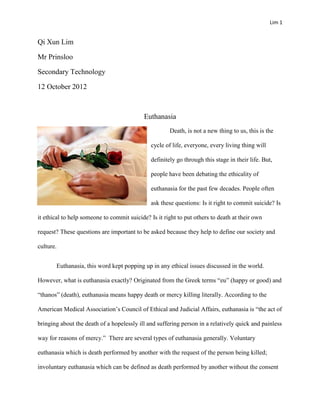
                                                      Death, is not a new thing to us, this is the

                                              cycle of life, everyone, every living thing will

                                              definitely go through this stage in their life. But,

                                              people have been debating the ethicality of

                                              euthanasia for the past few decades. People often

                                              ask these questions: Is it right to commit suicide? Is

it ethical to help someone to commit suicide? Is it right to put others to death at their own

request? These questions are important to be asked because they help to define our society and

culture.


       Euthanasia, this word kept popping up in any ethical issues discussed in the world.

However, what is euthanasia exactly? Originated from the Greek terms “eu” (happy or good) and

“thanos” (death), euthanasia means happy death or mercy killing literally. According to the

American Medical Association’s Council of Ethical and Judicial Affairs, euthanasia is “the act of

bringing about the death of a hopelessly ill and suffering person in a relatively quick and painless

way for reasons of mercy.” There are several types of euthanasia generally. Voluntary

euthanasia which is death performed by another with the request of the person being killed;

involuntary euthanasia which can be defined as death performed by another without the consent
Lim 2


of the person being killed. Active Euthanasia which is taking actions that lead to death, for

instance, fatal injection; and, passive euthanasia in which a physician allows a patient to die by

removing artificial life support systems.


       However, keep in mind that euthanasia is not the same as physician assisted death.

Euthanasia is the intentional killing of a person, voluntary or not; physician assisted death is a

practice in which the physician supplies the patients with the means to end his life, but the

physician does not carry out the action.


       Euthanasia is controversial in medical ethics and medical law. Debates about this topic

have been going on for the past few decades. In the debate, arguments against the acceptability

and legal feasibility of euthanasia can be found. One argument is about euthanasia is the same as

killing intentionally, and that killing people is wrong morally. And this should apply to medical

practitioners, physicians, as stated in the Hippocratic Oath, which explicitly states that “no

deadly medicine will be given to any one if asked, nor suggest any such counsel”, which can be

interpreted as any form of physician assisted death and euthanasia is not to be practiced by any

medical doctors. Euthanasia, if abused, can be used as an excuse to murder people. Doctors or

any physicians will not be sentenced to any crime if they claimed that they did not murder

someone but simply euthanize someone.

Another argument that is against euthanasia

is the potential for disagreement in how and

when to carry out euthanasia? In what state

of health should the patient be in order to

agree to be euthanized? If a patient is
Lim 3


mentally or physically incapable to agree, can the patient be freed from his or her suffering

through the use of euthanasia or any form of it? There are still a lot of question to be asked about

legalizing euthanasia globally.


       Although there are countless arguments against euthanasia, there are some arguments that

are in favor for the use of euthanasia especially in the medical field. Their argument mainly

based on the one’s “Right to Die”. The “right to die” is the ethical right for someone to commit

suicide or to undergo voluntary euthanasia or physician assisted death especially one who is

suffering extremely great mental or physical pain. Normally, patients that are in coma or have

                                                         suffered serious injuries will opt for

                                                         physician assisted death or active

                                                         euthanasia. Euthanasia and physician

                                                         assisted death is illegal in most countries

                                                         throughout the world, with a few

                                                         exception such as Netherlands where

physician will not be prosecuted for terminating a patient’s life, provided that the physicians

followed the established protocol and acts based on the patient’s request to be euthanized. People

should have the right to choose when and how they should die, especially when they are in an

unbearable pain. It can be assumed that, most human beings prefer and easy way to die, not to

endure all those pain or suffering, and also to die with dignity. Unfortunately, this does not

normally happen to most people, especially the elders, and the patients suffering from chronic

disease. For them, dying involves a long and miserable process, from mental stress to

degeneration of organs or the spread of cancer cells. Euthanasia provides them this gate-way to

be relieved and freed from all these pains and sufferings. In the medical law and medical ethic,
Lim 4


patient’s autonomy is everything. Patients have the right to decide whether they want to be

terminated or not. If no treatment is available or there is no improvement but the situation is

getting worse, a patient can choose whether they want to end the treatment or not, even after

knowing that by removing any treatments or any artificial life support system may lead to the

death of that patients. However, not every physician will agree to carry out this act because some

may still think that this is not ethical.


        As a conclusion, the debate about the ethicality of euthanasia will still continue because it

is impossible to come to a conclusion because people have different opinions on whether

terminating a person’s life, whether voluntary or involuntary morally right or wrong. There are

many aspects that need to be considered in deciding whether euthanasia is ethical or is it a crime

that has the same level of offense as murder.
Lim 5


Bibliography


"American Medical Association." June 1996. Opinion 2.21 Euthanasia. Document. 12 October 2012.
       <http://www.ama-assn.org/ama/pub/physician-resources/medical-ethics/code-medical-
       ethics/opinion221.page>.

Cauldwell, K. "The Right to Die? Ethical and Legal Issues Surrounding Euthanasia and Physician Assissted
       Death." 30 January 2007. Yahoo Voices. Document. 26 September 2012.
       <http://voices.yahoo.com/the-right-die-ethical-legal-issues-surrounding-177627.html>.

Cook, Michael. "Crisis Magazine." 7 July 2011. Reason Is the Enemy of Euthanasia Movement. PIcture. 17
       October 2012.

Larue, Gerals A. "Euthanasia: A Global Issue." 1999. North American Council for Humanism. Document.
        26 September 2012. <http://www.humanismtoday.org/vol13/larue.html>.

"NHS Choices." 1 August 2012. Euthanasia and Assissted Suicide. Document. 17 October 2012.

rsrevision.com. 2011. Picture. 17 October 2012.

Sr., Prof. Dr. Omar Hassan Kasule. "Euthanasia Ethic Legal Issue." n.d. Mission Islam. 28 September 2012.
         <http://www.missionislam.com/health/euthanasia.htm>.

Widdershoven, Guy A.M. "The Moral Basis of Euthanasia in the Netherlands." Beyond Autonomy and
       Beneficence (n.d.): 1-12. Document.

Zdenkowski, George. Human Rights and Euthanasia. Human Rights and Equal Opportunity Commission,
      Sydney. Sydney, 1996. Document.

Euthanasia

  • 1.
    Lim 1 Qi XunLim Mr Prinsloo Secondary Technology 12 October 2012 Euthanasia Death, is not a new thing to us, this is the cycle of life, everyone, every living thing will definitely go through this stage in their life. But, people have been debating the ethicality of euthanasia for the past few decades. People often ask these questions: Is it right to commit suicide? Is it ethical to help someone to commit suicide? Is it right to put others to death at their own request? These questions are important to be asked because they help to define our society and culture. Euthanasia, this word kept popping up in any ethical issues discussed in the world. However, what is euthanasia exactly? Originated from the Greek terms “eu” (happy or good) and “thanos” (death), euthanasia means happy death or mercy killing literally. According to the American Medical Association’s Council of Ethical and Judicial Affairs, euthanasia is “the act of bringing about the death of a hopelessly ill and suffering person in a relatively quick and painless way for reasons of mercy.” There are several types of euthanasia generally. Voluntary euthanasia which is death performed by another with the request of the person being killed; involuntary euthanasia which can be defined as death performed by another without the consent
  • 2.
    Lim 2 of theperson being killed. Active Euthanasia which is taking actions that lead to death, for instance, fatal injection; and, passive euthanasia in which a physician allows a patient to die by removing artificial life support systems. However, keep in mind that euthanasia is not the same as physician assisted death. Euthanasia is the intentional killing of a person, voluntary or not; physician assisted death is a practice in which the physician supplies the patients with the means to end his life, but the physician does not carry out the action. Euthanasia is controversial in medical ethics and medical law. Debates about this topic have been going on for the past few decades. In the debate, arguments against the acceptability and legal feasibility of euthanasia can be found. One argument is about euthanasia is the same as killing intentionally, and that killing people is wrong morally. And this should apply to medical practitioners, physicians, as stated in the Hippocratic Oath, which explicitly states that “no deadly medicine will be given to any one if asked, nor suggest any such counsel”, which can be interpreted as any form of physician assisted death and euthanasia is not to be practiced by any medical doctors. Euthanasia, if abused, can be used as an excuse to murder people. Doctors or any physicians will not be sentenced to any crime if they claimed that they did not murder someone but simply euthanize someone. Another argument that is against euthanasia is the potential for disagreement in how and when to carry out euthanasia? In what state of health should the patient be in order to agree to be euthanized? If a patient is
  • 3.
    Lim 3 mentally orphysically incapable to agree, can the patient be freed from his or her suffering through the use of euthanasia or any form of it? There are still a lot of question to be asked about legalizing euthanasia globally. Although there are countless arguments against euthanasia, there are some arguments that are in favor for the use of euthanasia especially in the medical field. Their argument mainly based on the one’s “Right to Die”. The “right to die” is the ethical right for someone to commit suicide or to undergo voluntary euthanasia or physician assisted death especially one who is suffering extremely great mental or physical pain. Normally, patients that are in coma or have suffered serious injuries will opt for physician assisted death or active euthanasia. Euthanasia and physician assisted death is illegal in most countries throughout the world, with a few exception such as Netherlands where physician will not be prosecuted for terminating a patient’s life, provided that the physicians followed the established protocol and acts based on the patient’s request to be euthanized. People should have the right to choose when and how they should die, especially when they are in an unbearable pain. It can be assumed that, most human beings prefer and easy way to die, not to endure all those pain or suffering, and also to die with dignity. Unfortunately, this does not normally happen to most people, especially the elders, and the patients suffering from chronic disease. For them, dying involves a long and miserable process, from mental stress to degeneration of organs or the spread of cancer cells. Euthanasia provides them this gate-way to be relieved and freed from all these pains and sufferings. In the medical law and medical ethic,
  • 4.
    Lim 4 patient’s autonomyis everything. Patients have the right to decide whether they want to be terminated or not. If no treatment is available or there is no improvement but the situation is getting worse, a patient can choose whether they want to end the treatment or not, even after knowing that by removing any treatments or any artificial life support system may lead to the death of that patients. However, not every physician will agree to carry out this act because some may still think that this is not ethical. As a conclusion, the debate about the ethicality of euthanasia will still continue because it is impossible to come to a conclusion because people have different opinions on whether terminating a person’s life, whether voluntary or involuntary morally right or wrong. There are many aspects that need to be considered in deciding whether euthanasia is ethical or is it a crime that has the same level of offense as murder.
  • 5.
    Lim 5 Bibliography "American MedicalAssociation." June 1996. Opinion 2.21 Euthanasia. Document. 12 October 2012. <http://www.ama-assn.org/ama/pub/physician-resources/medical-ethics/code-medical- ethics/opinion221.page>. Cauldwell, K. "The Right to Die? Ethical and Legal Issues Surrounding Euthanasia and Physician Assissted Death." 30 January 2007. Yahoo Voices. Document. 26 September 2012. <http://voices.yahoo.com/the-right-die-ethical-legal-issues-surrounding-177627.html>. Cook, Michael. "Crisis Magazine." 7 July 2011. Reason Is the Enemy of Euthanasia Movement. PIcture. 17 October 2012. Larue, Gerals A. "Euthanasia: A Global Issue." 1999. North American Council for Humanism. Document. 26 September 2012. <http://www.humanismtoday.org/vol13/larue.html>. "NHS Choices." 1 August 2012. Euthanasia and Assissted Suicide. Document. 17 October 2012. rsrevision.com. 2011. Picture. 17 October 2012. Sr., Prof. Dr. Omar Hassan Kasule. "Euthanasia Ethic Legal Issue." n.d. Mission Islam. 28 September 2012. <http://www.missionislam.com/health/euthanasia.htm>. Widdershoven, Guy A.M. "The Moral Basis of Euthanasia in the Netherlands." Beyond Autonomy and Beneficence (n.d.): 1-12. Document. Zdenkowski, George. Human Rights and Euthanasia. Human Rights and Equal Opportunity Commission, Sydney. Sydney, 1996. Document.