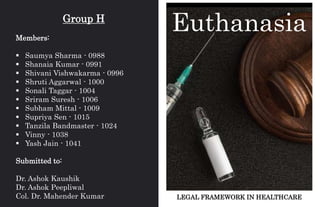
LEGAL FRAMEWORK IN HEALTHCARE
Euthanasia
Group H
Members:
 Saumya Sharma - 0988
 Shanaia Kumar - 0991
 Shivani Vishwakarma - 0996
 Shruti Aggarwal - 1000
 Sonali Taggar - 1004
 Sriram Suresh - 1006
 Subham Mittal - 1009
 Supriya Sen - 1015
 Tanzila Bandmaster - 1024
 Vinny - 1038
 Yash Jain - 1041
Submitted to:
Dr. Ashok Kaushik
Dr. Ashok Peepliwal
Col. Dr. Mahender Kumar
INTRODUCTION
2
3/17/2021
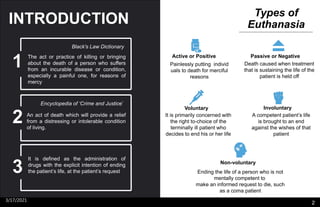
Types of
Euthanasia
2
3
Black's Law Dictionary
The act or practice of killing or bringing
about the death of a person who suffers
from an incurable disease or condition,
especially a painful one, for reasons of
mercy
Encyclopedia of ‘Crime and Justice’
An act of death which will provide a relief
from a distressing or intolerable condition
of living.
It is defined as the administration of
drugs with the explicit intention of ending
the patient’s life, at the patient’s request
Painlessly putting individ
uals to death for merciful
reasons
Active or Positive
Death caused when treatment
that is sustaining the life of the
patient is held off
Passive or Negative
It is primarily concerned with
the right to-choice of the
terminally ill patient who
decides to end his or her life
Voluntary Involuntary
A competent patient’s life
is brought to an end
against the wishes of that
patient
Non-voluntary
Ending the life of a person who is not
mentally competent to
make an informed request to die, such
as a coma patient
ETHICAL ISSUES
3
3/17/2021
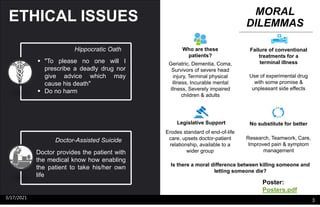
MORAL
DILEMMAS
2
Hippocratic Oath
 "To please no one will I
prescribe a deadly drug nor
give advice which may
cause his death"
 Do no harm
Doctor-Assisted Suicide
Doctor provides the patient with
the medical know how enabling
the patient to take his/her own
life
Is there a moral difference between killing someone and
letting someone die?
Geriatric, Dementia, Coma,
Survivors of severe head
injury, Terminal physical
illness, Incurable mental
illness, Severely impaired
children & adults
Who are these
patients?
Legislative Support
Erodes standard of end-of-life
care, upsets doctor-patient
relationship, available to a
wider group
No substitute for better
Research, Teamwork, Care,
Improved pain & symptom
management
Failure of conventional
treatments for a
terminal illness
Use of experimental drug
with some promise &
unpleasant side effects
Poster:
Posters.pdf
Aruna Shanbaug
Case
The Supreme Court specified 2 irreversible
conditions to permit passive Euthanasia
Law in 2011:
1. The brain dead for whom the ventilator
can be switched off
2. Those in Persistent Vegetative State
(PVS)
Aruna Ramchandra Shanbaug, a nurse, was
sexually assaulted by a ward boy, and went into
vegetative state in 1973 till her death in 2015 (42
years)
Writ petition was filed by Pinki Virani claiming that
her right to life guaranteed by the constitution has
been violated – it was rejected by the court after
medical examination
However, later in Aruna Shanbaug vs Union of
India, the Supreme Court in March 2011 held that
passive euthanasia could be allowed in exceptional
circumstances and under strict monitoring of the
apex court
4
3/17/2021
Chandrakant Narayanrao Tandale Case
81 years old
Chandrakant,
a permanent
resident of
Aurangabad
Admitted in
Kamalnayan Bajaj
Hospital, Aurangabad
for the treatment due
to enormous pain.
He was not able to
bear severe pain
Suffering from enormous
pain since June 2018, which
was neither operational nor
curable. Due to back disc
problem, he was bed-ridden
and required assistance for
moving from one place to
another place
Petitioner was mentally and
physically unable to face
severe pain. Hence, sought
permission from the Bombay
High Court to allow him to
have active euthanasia in
view of the Judgment of the
Hon'ble Supreme Court of
India
State/Respondent had
strongly opposed to allow
such prayer by filing
reply-affidavit.
It is the stand of the State
that active euthanasia is
not permissible in law
and if such exercise is
made, it would amount to
an offence
Hon'ble
Supreme Court
in case of
Common
Cause (Supra)
has only given
approval to
passive
euthanasia
PROMINENT CASES
Mr. Narayan and Mrs. Iravati
Lavate, 2018​
An elderly couple from Mumbai, wrote to
President’s office, seeking permission for
active euthanasia as they feared of falling
terminally ill and of not being able to
contribute to the society sought for permission
of mercy killing
Anamika Mishra, 2018​
A woman Shashi Mishra (59) and her 33-year-
old daughter Anamika Mishra, hailing from
Kanpur were suffering from muscular
dystrophy, with her father also losing life to
the disease, had written to the President
seeking permission for financial aid or passive
euthanasia due to poor financial condition
Dennis Kumar, Tamil Nadu, 2008
Dennis Kumar from Kanyakumari district
asked permission from the district collector
to grant euthanasia for his infant son who was
suffering from an unknown disease since
birth. Unable to bear the expenses for
his treatment or see his son’s suffering, Kumar
asked permission to give euthanasia, which
would relieve both his son and him of their
adversity
Jeet Narayan of Mirzapur in Uttar
Pradesh, 2008
Jeet Narayan pleaded for euthanasia for his
four sons to the president of India, Durgesh
(22), Sarvesh (18), Brijesh (13) and Sushil
(10) – all crippled and paralyzed below the
neck
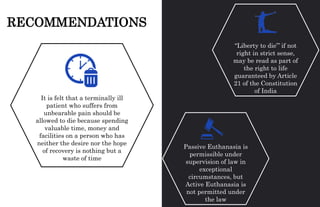
RECOMMENDATIONS
Passive Euthanasia is
permissible under
supervision of law in
exceptional
circumstances, but
Active Euthanasia is
not permitted under
the law
“Liberty to die”’ if not
right in strict sense,
may be read as part of
the right to life
guaranteed by Article
21 of the Constitution
of India
It is felt that a terminally ill
patient who suffers from
unbearable pain should be
allowed to die because spending
valuable time, money and
facilities on a person who has
neither the desire nor the hope
of recovery is nothing but a
waste of time
Passive Euthanasia is
permissible under supervision of
law in exceptional
circumstances, but Active
SOME SUGGESTIONS TO CHECK THE MISUSE
Circumstances in which it would be lawful for a
medical practitioner to cease/ authorize the
cessation of life-sustaining treatment of a
patient who has no spontaneous
respiratory and circulatory functions or
whose brainstem does not register any impulses.
Euthanasia request should come from a
patient suffering from unbearable
pain from an incurable condition; the
physician must follow certain ‘due
care’ criterion
The right of medical practitioner responsible for
the treatment of a terminally ill patient to increase
the dosage of medication, with the object of
relieving pain and distress, even if the secondary
effect of this may be to hasten the patient’s death
Termination of life should be in a medically
appropriate fashion. Practice of
administering an injection to render the
patient comatose, followed by a
second injection to stop the heart
A person who is going to die:
(i) Must completely understand what
will happen
(ii) Must know about all other
alternatives to the treatment
Explicit and repeated request by the patient which
leaves no reason for doubt concerning his desire to
die;
Mental and physical suffering of the patient must
be very severe with no prospect of relief
Pain, peace and happiness are subjective feelings, so the point at which one
experiences intolerable pain to end up life may be different from someone who has
more tolerance to pain
We can argue that could a death wish have
been a symptom of the psychiatric illness?
This is a poignant question since it will
be difficult to differentiate between a request
based on a genuine and consent form of
unbearable suffering and a request as
a symptom of a severe depression.
In cases of mental disorders, physician-assisted
Death might be justifiable, but only when applicants
are fully informed, and have access to adequate
treatment options and support in (psychic) suffering.
GROUP OPINION
The need for specific criteria and guidelines in assisted
suicide for mental conditions and some unexplained
shortcomings in the practice of psychiatric euthanasia
should be considered.
To sum up, doctors responsible for the end-of-life care are often placed in dilemma of ethics regarding
life and death. Euthanasia can put an end to the suffering of long-term ‘NO CURE’ illnesses, by death.
Medical science is progressing in India as in the rest of the world, and hence currently we are having devises
that can prolong life by artificial means.
This may indirectly prolong terminal suffering and may also prove to be very costly for the families of the
subject in question.
Hence, end-of-life issues are becoming major ethical considerations in the modern-day medical science
in India.
CONCLUSION
The proponents and the opponents of euthanasia
are as active in India as in the rest of the world.
However, the Indian legislature does not seem to
be sensitive to these.
The landmark Supreme Court judgment has provided a major boost to pro-euthanasia activists, though it
is a long way to go before it becomes a law in the parliament
Moreover, concerns for its misuse remain a major issue which ought to be addressed before it
becomes a law in our country.
Euthanasia seems to have raised ethical
concerns in the society. Some of the key
issues include ethical, practical
and religious issues.
However, euthanasia encompasses immense ambiguity because there is a total absence of homogeneity
in the societal perception.
THANK YOU
“ ना तीर को, ना तलवार को,
ना धर्म के पहरेदार को,
इन पीड़ित सााँसों पे ड़वरार् का अड़धकार है,
के वल र्ेरी इच्छा को |”

Euthanasia

  • 1.
    LEGAL FRAMEWORK INHEALTHCARE Euthanasia Group H Members:  Saumya Sharma - 0988  Shanaia Kumar - 0991  Shivani Vishwakarma - 0996  Shruti Aggarwal - 1000  Sonali Taggar - 1004  Sriram Suresh - 1006  Subham Mittal - 1009  Supriya Sen - 1015  Tanzila Bandmaster - 1024  Vinny - 1038  Yash Jain - 1041 Submitted to: Dr. Ashok Kaushik Dr. Ashok Peepliwal Col. Dr. Mahender Kumar
  • 2.
    INTRODUCTION 2 3/17/2021 Types of Euthanasia 2 3 Black's LawDictionary The act or practice of killing or bringing about the death of a person who suffers from an incurable disease or condition, especially a painful one, for reasons of mercy Encyclopedia of ‘Crime and Justice’ An act of death which will provide a relief from a distressing or intolerable condition of living. It is defined as the administration of drugs with the explicit intention of ending the patient’s life, at the patient’s request Painlessly putting individ uals to death for merciful reasons Active or Positive Death caused when treatment that is sustaining the life of the patient is held off Passive or Negative It is primarily concerned with the right to-choice of the terminally ill patient who decides to end his or her life Voluntary Involuntary A competent patient’s life is brought to an end against the wishes of that patient Non-voluntary Ending the life of a person who is not mentally competent to make an informed request to die, such as a coma patient
  • 3.
    ETHICAL ISSUES 3 3/17/2021 MORAL DILEMMAS 2 Hippocratic Oath "To please no one will I prescribe a deadly drug nor give advice which may cause his death"  Do no harm Doctor-Assisted Suicide Doctor provides the patient with the medical know how enabling the patient to take his/her own life Is there a moral difference between killing someone and letting someone die? Geriatric, Dementia, Coma, Survivors of severe head injury, Terminal physical illness, Incurable mental illness, Severely impaired children & adults Who are these patients? Legislative Support Erodes standard of end-of-life care, upsets doctor-patient relationship, available to a wider group No substitute for better Research, Teamwork, Care, Improved pain & symptom management Failure of conventional treatments for a terminal illness Use of experimental drug with some promise & unpleasant side effects Poster: Posters.pdf
  • 4.
    Aruna Shanbaug Case The SupremeCourt specified 2 irreversible conditions to permit passive Euthanasia Law in 2011: 1. The brain dead for whom the ventilator can be switched off 2. Those in Persistent Vegetative State (PVS) Aruna Ramchandra Shanbaug, a nurse, was sexually assaulted by a ward boy, and went into vegetative state in 1973 till her death in 2015 (42 years) Writ petition was filed by Pinki Virani claiming that her right to life guaranteed by the constitution has been violated – it was rejected by the court after medical examination However, later in Aruna Shanbaug vs Union of India, the Supreme Court in March 2011 held that passive euthanasia could be allowed in exceptional circumstances and under strict monitoring of the apex court 4 3/17/2021
  • 5.
    Chandrakant Narayanrao TandaleCase 81 years old Chandrakant, a permanent resident of Aurangabad Admitted in Kamalnayan Bajaj Hospital, Aurangabad for the treatment due to enormous pain. He was not able to bear severe pain Suffering from enormous pain since June 2018, which was neither operational nor curable. Due to back disc problem, he was bed-ridden and required assistance for moving from one place to another place Petitioner was mentally and physically unable to face severe pain. Hence, sought permission from the Bombay High Court to allow him to have active euthanasia in view of the Judgment of the Hon'ble Supreme Court of India State/Respondent had strongly opposed to allow such prayer by filing reply-affidavit. It is the stand of the State that active euthanasia is not permissible in law and if such exercise is made, it would amount to an offence Hon'ble Supreme Court in case of Common Cause (Supra) has only given approval to passive euthanasia
  • 6.
    PROMINENT CASES Mr. Narayanand Mrs. Iravati Lavate, 2018​ An elderly couple from Mumbai, wrote to President’s office, seeking permission for active euthanasia as they feared of falling terminally ill and of not being able to contribute to the society sought for permission of mercy killing Anamika Mishra, 2018​ A woman Shashi Mishra (59) and her 33-year- old daughter Anamika Mishra, hailing from Kanpur were suffering from muscular dystrophy, with her father also losing life to the disease, had written to the President seeking permission for financial aid or passive euthanasia due to poor financial condition Dennis Kumar, Tamil Nadu, 2008 Dennis Kumar from Kanyakumari district asked permission from the district collector to grant euthanasia for his infant son who was suffering from an unknown disease since birth. Unable to bear the expenses for his treatment or see his son’s suffering, Kumar asked permission to give euthanasia, which would relieve both his son and him of their adversity Jeet Narayan of Mirzapur in Uttar Pradesh, 2008 Jeet Narayan pleaded for euthanasia for his four sons to the president of India, Durgesh (22), Sarvesh (18), Brijesh (13) and Sushil (10) – all crippled and paralyzed below the neck
  • 7.
    RECOMMENDATIONS Passive Euthanasia is permissibleunder supervision of law in exceptional circumstances, but Active Euthanasia is not permitted under the law “Liberty to die”’ if not right in strict sense, may be read as part of the right to life guaranteed by Article 21 of the Constitution of India It is felt that a terminally ill patient who suffers from unbearable pain should be allowed to die because spending valuable time, money and facilities on a person who has neither the desire nor the hope of recovery is nothing but a waste of time Passive Euthanasia is permissible under supervision of law in exceptional circumstances, but Active
  • 8.
    SOME SUGGESTIONS TOCHECK THE MISUSE Circumstances in which it would be lawful for a medical practitioner to cease/ authorize the cessation of life-sustaining treatment of a patient who has no spontaneous respiratory and circulatory functions or whose brainstem does not register any impulses. Euthanasia request should come from a patient suffering from unbearable pain from an incurable condition; the physician must follow certain ‘due care’ criterion The right of medical practitioner responsible for the treatment of a terminally ill patient to increase the dosage of medication, with the object of relieving pain and distress, even if the secondary effect of this may be to hasten the patient’s death Termination of life should be in a medically appropriate fashion. Practice of administering an injection to render the patient comatose, followed by a second injection to stop the heart A person who is going to die: (i) Must completely understand what will happen (ii) Must know about all other alternatives to the treatment Explicit and repeated request by the patient which leaves no reason for doubt concerning his desire to die; Mental and physical suffering of the patient must be very severe with no prospect of relief
  • 9.
    Pain, peace andhappiness are subjective feelings, so the point at which one experiences intolerable pain to end up life may be different from someone who has more tolerance to pain We can argue that could a death wish have been a symptom of the psychiatric illness? This is a poignant question since it will be difficult to differentiate between a request based on a genuine and consent form of unbearable suffering and a request as a symptom of a severe depression. In cases of mental disorders, physician-assisted Death might be justifiable, but only when applicants are fully informed, and have access to adequate treatment options and support in (psychic) suffering. GROUP OPINION The need for specific criteria and guidelines in assisted suicide for mental conditions and some unexplained shortcomings in the practice of psychiatric euthanasia should be considered. To sum up, doctors responsible for the end-of-life care are often placed in dilemma of ethics regarding life and death. Euthanasia can put an end to the suffering of long-term ‘NO CURE’ illnesses, by death.
  • 10.
    Medical science isprogressing in India as in the rest of the world, and hence currently we are having devises that can prolong life by artificial means. This may indirectly prolong terminal suffering and may also prove to be very costly for the families of the subject in question. Hence, end-of-life issues are becoming major ethical considerations in the modern-day medical science in India. CONCLUSION The proponents and the opponents of euthanasia are as active in India as in the rest of the world. However, the Indian legislature does not seem to be sensitive to these. The landmark Supreme Court judgment has provided a major boost to pro-euthanasia activists, though it is a long way to go before it becomes a law in the parliament Moreover, concerns for its misuse remain a major issue which ought to be addressed before it becomes a law in our country. Euthanasia seems to have raised ethical concerns in the society. Some of the key issues include ethical, practical and religious issues. However, euthanasia encompasses immense ambiguity because there is a total absence of homogeneity in the societal perception.
  • 11.
    THANK YOU “ नातीर को, ना तलवार को, ना धर्म के पहरेदार को, इन पीड़ित सााँसों पे ड़वरार् का अड़धकार है, के वल र्ेरी इच्छा को |”