Marc García Carda 8(2)
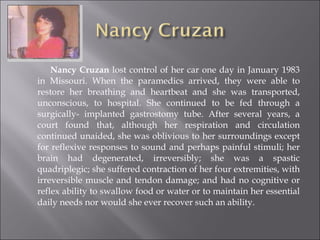
Nancy Cruzan  lost control of her car one day in January 1983 in Missouri. When the paramedics arrived, they were able to restore her breathing and heartbeat and she was transported, unconscious, to hospital. She continued to be fed through a surgically- implanted gastrostomy tube. After several years, a court found that, although her respiration and circulation continued unaided, she was oblivious to her surroundings except for reflexive responses to sound and perhaps painful stimuli; her brain had degenerated, irreversibly; she was a spastic quadriplegic; she suffered contraction of her four extremities, with irreversible muscle and tendon damage; and had no cognitive or reflex ability to swallow food or water or to maintain her essential daily needs nor would she ever recover such an ability.
Chantal Sebire
 
Voluntary euthanasia Non-voluntary euthanasia Involuntary euthanasia Passive euthanasia
Euthanasia made with the consent of the patient is called voluntary euthanasia. When the patient brings about his or her own death with the assistance of a physician, the term assisted suicide is often used instead.
Euthanasia conducted where the patient is unconscious is normally called non-voluntary euthanasia
Euthanasia conducted against the will of the patient is termed involuntary euthanasia. The patient refuses to take the treatment that could prevent him/her from dying.
Netherlands ( Green ), Oregon and Washington ( Yellow ), Belgium ( Red )
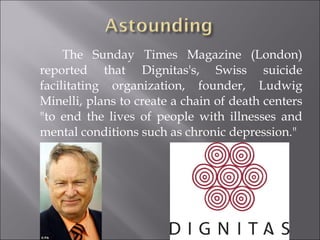
  The Sunday Times Magazine (London) reported that Dignitas's, Swiss suicide facilitating organization, founder, Ludwig Minelli, plans to create a chain of death centers "to end the lives of people with illnesses and mental conditions such as chronic depression."
It provides a way to relieve extreme pain  It provides a way of relief when a person's quality of life is low  Frees up medical funds to help other people
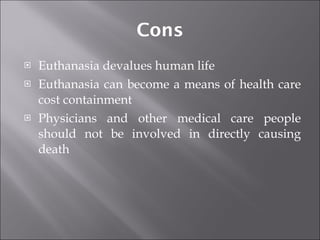
Cons Euthanasia devalues human life  Euthanasia can become a means of health care cost containment  Physicians and other medical care people should not be involved in directly causing death
Bibliography WWW: http://en.wikipedia.org/wiki/Euthanasia http://www.euthanasia.com/index.html http://www.euthanasia.com/euthanasiamap.html http://www.euthanasia.com/argumentsagainsteuthanasia.html http://www.euthanasia.com/reasonsforeuthanasia.html Magazine: The Sunday Times Magazine (London)

Euthanasia Powerpoint

  • 1.
  • 2.
    Nancy Cruzan lost control of her car one day in January 1983 in Missouri. When the paramedics arrived, they were able to restore her breathing and heartbeat and she was transported, unconscious, to hospital. She continued to be fed through a surgically- implanted gastrostomy tube. After several years, a court found that, although her respiration and circulation continued unaided, she was oblivious to her surroundings except for reflexive responses to sound and perhaps painful stimuli; her brain had degenerated, irreversibly; she was a spastic quadriplegic; she suffered contraction of her four extremities, with irreversible muscle and tendon damage; and had no cognitive or reflex ability to swallow food or water or to maintain her essential daily needs nor would she ever recover such an ability.
  • 3.
  • 4.
  • 5.
    Voluntary euthanasia Non-voluntaryeuthanasia Involuntary euthanasia Passive euthanasia
  • 6.
    Euthanasia made withthe consent of the patient is called voluntary euthanasia. When the patient brings about his or her own death with the assistance of a physician, the term assisted suicide is often used instead.
  • 7.
    Euthanasia conducted wherethe patient is unconscious is normally called non-voluntary euthanasia
  • 8.
    Euthanasia conducted againstthe will of the patient is termed involuntary euthanasia. The patient refuses to take the treatment that could prevent him/her from dying.
  • 9.
    Netherlands ( Green), Oregon and Washington ( Yellow ), Belgium ( Red )
  • 10.
    TheSunday Times Magazine (London) reported that Dignitas's, Swiss suicide facilitating organization, founder, Ludwig Minelli, plans to create a chain of death centers "to end the lives of people with illnesses and mental conditions such as chronic depression."
  • 11.
    It provides away to relieve extreme pain It provides a way of relief when a person's quality of life is low Frees up medical funds to help other people
  • 12.
    Cons Euthanasia devalueshuman life Euthanasia can become a means of health care cost containment Physicians and other medical care people should not be involved in directly causing death
  • 13.
    Bibliography WWW: http://en.wikipedia.org/wiki/Euthanasiahttp://www.euthanasia.com/index.html http://www.euthanasia.com/euthanasiamap.html http://www.euthanasia.com/argumentsagainsteuthanasia.html http://www.euthanasia.com/reasonsforeuthanasia.html Magazine: The Sunday Times Magazine (London)