EUTHANASIA
Under the Supervision of:
Dr: Hussein Sabit
Made By: Group.1
Outlines
Introduction History Legality
Religious
view
Our
Opinion
Conclusion
Definition
▪ Euthanasia is the practice of causing the
death of a patient for medical reasons, such as
an incurable disease associated with suffering
or unbearable pain.
▪ Simply, it is a quiet, painless death.
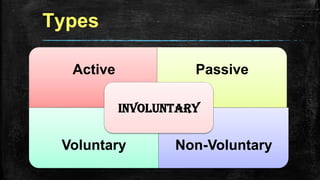
Types
Active Passive
Voluntary Non-Voluntary
Involuntary
❏ Euthanasia is categorized in different ways:
1. Active Euthanasia death is due to the
administration of a product.
2. passive, when the stop of care is initiated, and
only so-called comfort care is provided (analgesics
for pain, breathing comfort ...)
1. Voluntary euthanasia is when a patient take the
decision to end his life.
2. Non-voluntary euthanasia is when the patient is
not able to take a decision as he may be a child or in
deep comma so guardians take the decision.
3. Involuntary is when the death of a patient is
against his will, which is considered as a murder
Is it only for Medical Reasons ??
❏ Healthy 75 year-old UK
woman has killed herself at
a Swiss euthanasia clinic;
because she feared
developing a terminal
illness and being unable to
take her own life.
 Belgian doctors give healthy woman,
24, green light to die by euthanasia
because of “suicidal thoughts”.
Laura, 24, does not suffer from any
terminal disease or physical illness.
 She told doctors who assessed her
condition that 'life, that's not for me.
History
❏ Time & Place Of Birth
 The actions of easy death have been applied since
ancient ages.
• In ancient Greece, suicide of the patient who was
suffering extreme pain or having an incurable
illness was made easy, the physician was to give a
poisoned drink to him. Plato wrote: "Mentally and
physically ill persons should be left to death; they
do not have the right to live."
But…
● These actions were forbidden from time to time.
● In Mesopotamia, Assyrian physicians forbade
euthanasia.
● In ancient Rome, euthanasia was a crime and it was
regarded as murder.
● The first objection to euthanasia came from the
Hippocratic Oath which says: "I will not administer
poison to anyone when asked to do so, nor suggest
such a course."
15th - 17th Centuries
 Sir Thomas More (1478-1535) is often considered
the first Christian to recommend euthanasia in
his book Utopia, where the Utopian priests
encourage euthanasia when a patient was
terminally ill and suffering pain (but this could
only be done if the patient consented).
18th - 19th Centuries
 In Prussia (a former kingdom of Germany), 1st June
1794, a law was passed that reduced the punishment of
a person who killed the patient with an incurable
disease.
▪ The earliest American law explicitly to outlaw assisting
suicide was enacted in New York, Act of Dec. 10, 1828,
▪ In 1889, the German philosopher, Nietsche, said that
terminally ill patients are a burden to others and they
should not have the right to live in this world.
The 20th Century
 The efforts of legalization of euthanasia began in the
USA in the first years of the 20th century. The New
York State Medical Association recommended gentle
and easy death.
▪ Adolf Hitler admired the idea and encouraged it. In
1935,the German Nazi Party accepted euthanasia for
crippled children and "useless and unrehabilitive"
patients.
Into the Third Millennium
 In 2002 Belgium passed a similar law to the
Dutch, allowing both voluntary euthanasia and
physician-assisted suicide.
 Switzerland, once known for its spectacular
alpine landscape, the watches and chocolate, has
a new claim to fame as the World's death Mecca.
Physically and mentally patients have been lining
up for a one-way trip to Zurich.
Euthanasia raises a number
of Moral Dilemmas !!
Morality
 Is it ever right to end the life of a terminally ill
patient who is undergoing severe pain and
suffering?
 Is there a moral difference between killing
someone and letting them die?
 Does an individual who has no hope of recovery
have the right to decide how and when to end
his life?
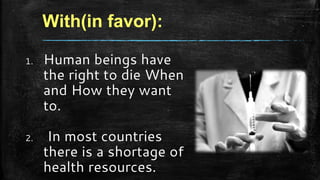
With(in favor):
1. Human beings have
the right to die When
and How they want
to.
2. In most countries
there is a shortage of
health resources.
Against(Opponent):
1- Secular objections:
 People also have
obligations to their friends
and family, to their doctors
and nurses, to society in
general.
 These obligations limit their
rights.
Cont.
We should also take account of our obligations
to society, and balance our individual right to
die against any bad consequences that it might
have for the community in general.
▪These bad consequences might be practical -
such as making involuntary euthanasia easier
and so putting patients at risk.
2- Shortage of Health Resources
 It would ultimately lead
to involuntary euthanasia:
(when the person who dies
wants to live but is killed
anyway. It is usually the
same thing as murder).
Legality
“Some rules are better than none”
 Places in the World Where Euthanasia
are Legal:
1. Belgium:
 The Belgian parliament legalised
euthanasia on 28 May 2002.
Cont.
2. Netherlands:
 In 2002, the Netherlands passed a law legalizing
euthanasia including physician-assisted suicide.
3. Luxembourg:
▪ The Luxembourg parliament passed a bill legalizing
euthanasia on 20 February 2008 in the first reading
with 30 of 59 votes in favour.
4. Four U.S. States:
1. Oregon( 1994 established the
Oregon Death with Dignity Act,
making Oregon the first U.S. state).
2. Washington(2008),
3. Vermont(May 20, 2013)
4. California(The law goes into effect
on January 1, 2016).
Legality
 Places in the World Where Euthanasia are
illegal:
▪ Australia, Canada, Colombia, Denmark,
Finland, France, United Kingdom, Turkey,
Israel.
Religious opinion
In Islam
 Islam categorically denied all forms of
suicide.
 Who gives life is God.
 Human life is sacred.
Christianity
 Christians are generally opposed to euthanasia.
 Christian denies murder motivated by
compassion.
 The Bible affirms that God bestows life and he
alone who can recoverable.
In Judaism
 Jewish opposition to euthanasia.
 Jewish law considers that human life is
sacred and say that it is wrong for one to
shorten human life.
Group Opinion
▪Everyone agrees on the idea of euthanasia in the
presence of two conditions:
▪The first one is that more than one doctor
acknowledges that person completely dead and there
is no hope
▪The second one because it consumes hospital
resources and the place might need someone else to
come back to life.
▪Euthanasia must be only for medical reasons not
psychological ones.
Conclusion
 Definition simply it’s a quit or painless death, it
is the practice of causing the death of a patient
for medical reasons, such as an incurable
disease associated with suffering or unbearable
pain.
 Euthanasia has many types such as voluntary,
non voluntary, involuntary, active and passive
euthanasia.
 Some countries don’t legalized
euthanasia(Canada, USA, Turkey, and
Norway).
 But Australia, Mexico, India and Netherlands
legalized euthanasia.
 In Islam, Christianity and Judaism, Euthanasia
is forbidden.
ConsPros
1. It can become a means
of health care cost
containment.
2. Physicians and
medical care people
should not be involved
in directly death.
3. Euthanasia devalues
human life.
1. It provides a way to
relieve extreme pain.
2. It provides a way of
relief when a person's
quality of life is low.
3. Frees up medical
funds to help other
people .
References:
1. http://www.medicalnewstoday.com/articles/1
82951.php
2. http://health.ccm.net/faq/3699-euthanasia-
definition
3. http://www.life.org.nz/euthanasia/abouteuth
anasia/history-euthanasia1/
4. http://euthanasia.com/
5. http://www.bbc.co.uk/ethics/euthanasia/
Thank you

Euthanasia

  • 1.
    EUTHANASIA Under the Supervisionof: Dr: Hussein Sabit Made By: Group.1
  • 2.
  • 3.
    Definition ▪ Euthanasia isthe practice of causing the death of a patient for medical reasons, such as an incurable disease associated with suffering or unbearable pain. ▪ Simply, it is a quiet, painless death.
  • 4.
  • 5.
    ❏ Euthanasia iscategorized in different ways: 1. Active Euthanasia death is due to the administration of a product. 2. passive, when the stop of care is initiated, and only so-called comfort care is provided (analgesics for pain, breathing comfort ...)
  • 6.
    1. Voluntary euthanasiais when a patient take the decision to end his life. 2. Non-voluntary euthanasia is when the patient is not able to take a decision as he may be a child or in deep comma so guardians take the decision. 3. Involuntary is when the death of a patient is against his will, which is considered as a murder
  • 7.
    Is it onlyfor Medical Reasons ??
  • 8.
    ❏ Healthy 75year-old UK woman has killed herself at a Swiss euthanasia clinic; because she feared developing a terminal illness and being unable to take her own life.
  • 9.
     Belgian doctorsgive healthy woman, 24, green light to die by euthanasia because of “suicidal thoughts”. Laura, 24, does not suffer from any terminal disease or physical illness.  She told doctors who assessed her condition that 'life, that's not for me.
  • 10.
  • 11.
    ❏ Time &Place Of Birth  The actions of easy death have been applied since ancient ages. • In ancient Greece, suicide of the patient who was suffering extreme pain or having an incurable illness was made easy, the physician was to give a poisoned drink to him. Plato wrote: "Mentally and physically ill persons should be left to death; they do not have the right to live."
  • 12.
    But… ● These actionswere forbidden from time to time. ● In Mesopotamia, Assyrian physicians forbade euthanasia. ● In ancient Rome, euthanasia was a crime and it was regarded as murder. ● The first objection to euthanasia came from the Hippocratic Oath which says: "I will not administer poison to anyone when asked to do so, nor suggest such a course."
  • 13.
    15th - 17thCenturies  Sir Thomas More (1478-1535) is often considered the first Christian to recommend euthanasia in his book Utopia, where the Utopian priests encourage euthanasia when a patient was terminally ill and suffering pain (but this could only be done if the patient consented).
  • 14.
    18th - 19thCenturies  In Prussia (a former kingdom of Germany), 1st June 1794, a law was passed that reduced the punishment of a person who killed the patient with an incurable disease. ▪ The earliest American law explicitly to outlaw assisting suicide was enacted in New York, Act of Dec. 10, 1828, ▪ In 1889, the German philosopher, Nietsche, said that terminally ill patients are a burden to others and they should not have the right to live in this world.
  • 15.
    The 20th Century The efforts of legalization of euthanasia began in the USA in the first years of the 20th century. The New York State Medical Association recommended gentle and easy death. ▪ Adolf Hitler admired the idea and encouraged it. In 1935,the German Nazi Party accepted euthanasia for crippled children and "useless and unrehabilitive" patients.
  • 16.
    Into the ThirdMillennium  In 2002 Belgium passed a similar law to the Dutch, allowing both voluntary euthanasia and physician-assisted suicide.  Switzerland, once known for its spectacular alpine landscape, the watches and chocolate, has a new claim to fame as the World's death Mecca. Physically and mentally patients have been lining up for a one-way trip to Zurich.
  • 17.
    Euthanasia raises anumber of Moral Dilemmas !!
  • 18.
    Morality  Is itever right to end the life of a terminally ill patient who is undergoing severe pain and suffering?  Is there a moral difference between killing someone and letting them die?  Does an individual who has no hope of recovery have the right to decide how and when to end his life?
  • 19.
    With(in favor): 1. Humanbeings have the right to die When and How they want to. 2. In most countries there is a shortage of health resources.
  • 20.
    Against(Opponent): 1- Secular objections: People also have obligations to their friends and family, to their doctors and nurses, to society in general.  These obligations limit their rights.
  • 21.
    Cont. We should alsotake account of our obligations to society, and balance our individual right to die against any bad consequences that it might have for the community in general. ▪These bad consequences might be practical - such as making involuntary euthanasia easier and so putting patients at risk.
  • 22.
    2- Shortage ofHealth Resources  It would ultimately lead to involuntary euthanasia: (when the person who dies wants to live but is killed anyway. It is usually the same thing as murder).
  • 23.
    Legality “Some rules arebetter than none”  Places in the World Where Euthanasia are Legal: 1. Belgium:  The Belgian parliament legalised euthanasia on 28 May 2002.
  • 24.
    Cont. 2. Netherlands:  In2002, the Netherlands passed a law legalizing euthanasia including physician-assisted suicide. 3. Luxembourg: ▪ The Luxembourg parliament passed a bill legalizing euthanasia on 20 February 2008 in the first reading with 30 of 59 votes in favour.
  • 25.
    4. Four U.S.States: 1. Oregon( 1994 established the Oregon Death with Dignity Act, making Oregon the first U.S. state). 2. Washington(2008), 3. Vermont(May 20, 2013) 4. California(The law goes into effect on January 1, 2016).
  • 26.
    Legality  Places inthe World Where Euthanasia are illegal: ▪ Australia, Canada, Colombia, Denmark, Finland, France, United Kingdom, Turkey, Israel.
  • 27.
  • 28.
    In Islam  Islamcategorically denied all forms of suicide.  Who gives life is God.  Human life is sacred.
  • 29.
    Christianity  Christians aregenerally opposed to euthanasia.  Christian denies murder motivated by compassion.  The Bible affirms that God bestows life and he alone who can recoverable.
  • 30.
    In Judaism  Jewishopposition to euthanasia.  Jewish law considers that human life is sacred and say that it is wrong for one to shorten human life.
  • 31.
    Group Opinion ▪Everyone agreeson the idea of euthanasia in the presence of two conditions: ▪The first one is that more than one doctor acknowledges that person completely dead and there is no hope ▪The second one because it consumes hospital resources and the place might need someone else to come back to life. ▪Euthanasia must be only for medical reasons not psychological ones.
  • 32.
    Conclusion  Definition simplyit’s a quit or painless death, it is the practice of causing the death of a patient for medical reasons, such as an incurable disease associated with suffering or unbearable pain.  Euthanasia has many types such as voluntary, non voluntary, involuntary, active and passive euthanasia.
  • 33.
     Some countriesdon’t legalized euthanasia(Canada, USA, Turkey, and Norway).  But Australia, Mexico, India and Netherlands legalized euthanasia.  In Islam, Christianity and Judaism, Euthanasia is forbidden.
  • 34.
    ConsPros 1. It canbecome a means of health care cost containment. 2. Physicians and medical care people should not be involved in directly death. 3. Euthanasia devalues human life. 1. It provides a way to relieve extreme pain. 2. It provides a way of relief when a person's quality of life is low. 3. Frees up medical funds to help other people .
  • 35.
    References: 1. http://www.medicalnewstoday.com/articles/1 82951.php 2. http://health.ccm.net/faq/3699-euthanasia- definition 3.http://www.life.org.nz/euthanasia/abouteuth anasia/history-euthanasia1/ 4. http://euthanasia.com/ 5. http://www.bbc.co.uk/ethics/euthanasia/
  • 36.