Euthanasia
Introduction
– There has been much talk about euthanasia, what it means and how it might
work. People have been told that the word means happy death, or death with
dignity: they have been told of active and passive euthanasia really involves,
party because of some difficulty with the subject and also because of the
intentional creation of confusion by those whose personal interests are best
served by this.
Definition
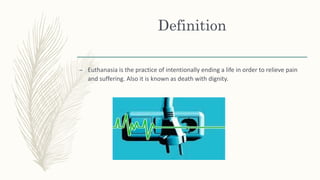
– Euthanasia is the practice of intentionally ending a life in order to relieve pain
and suffering. Also it is known as death with dignity.
Brief history of Euthanasia:
– In historical terms the issue of euthanasia has been around for as long as the
history of medicine. Certainly in ancient times it was quite common for doctors
to kill their patients with various poisonous preparations and this posed
enormous problems with regard to medical practice. It must have been most
awkward from the patient’s point of view if he did not know whether his doctor
was intending to cure him or kill him. The problem was recognized by a very
prominent Greek physician called Hippocrates was renowned teacher of
medicine and he made all his students take an oath which said among other
things.
– “That I will not give my patients any harmful thing even if they request it”
Brief history of Euthanasia:
– This was an enormous medical advance for it separated killing from medical
advance for it separated killing from medical practice, and progress in medicine
was now possible. The advantage of the oath, which eventually became known
as the Hippocratic Oath, quickly became evident and it became the norm for
medical practitioners of those times to take the Hippocratic Oath and the
practice has persisted for some 2,300 years until today.
Brief history of Euthanasia:
– Legal systems, religious philosophy, and medical ethical codes over many
centuries have held that euthanasia is unlawful, unethical and it has been
universally condemned.
– Historically it would appear that the issue of euthanasia did not become issue
of serious note again until relatively modern times when two Germans in 1920
published a book called “The Release of the Destruction of Life Devoid
Value”. The authors were Dr. Karl Binding, a lawyer, who was a Professor of Law
and Doctor of Philosophy and Dr. Alfred Hoche, who was a Doctor of Medicine
and a Psychiatrists.
Brief history of Euthanasia:
– The arguments that they used are just the same as those used today, namely,
that of compassion. They said it was barbarous that a person has to die from his
pain: that is permissible to shorten the act of dying and that people have a right
to death with dignity. They also included fro euthanasia children they described
as “useless idiots” but whom we would call mentally and physically retarded.
– Following the publication of the book in 1920 advocating the killing of worthless
people, there was a propaganda barrage directed against the traditional
compassionate nineteenth century attitudes towards the chronically ill and for
the adoption of this destructive point of view. That is, if a person was judged
better of death, then he should be killed. This propaganda campaign was done by
motion pictures books and even education of children in school of the economics
benefits of mercy killing.
Euthanasia classifications
– Euthanasia may be classified according to whether a person gives informed
consent into three types: voluntary, non-voluntary and involuntary. There is a
debate within the medical and bioethics literature about whether or not non-
voluntary killing of patients can be regarded as euthanasia, irrespective of
intent or the patient’s circumstances.
Euthanasia classifications
– Passive and active euthanasia: passive euthanasia entails the withholding of
common treatments, such as antibiotics. Active euthanasia entails the use of
lethal substances or forces, such as administering a lethal injection.
– Voluntary euthanasia- euthanasia conducted with the consent of the patient is
termed voluntary euthanasia.
– Non-voluntary euthanasia- euthanasia conducted where the consent of the
patient is unavailable is termed non-voluntary euthanasia.
– Involuntary euthanasia- euthanasia conducted against the will of the patient is
termed involuntary euthanasia.
Requirements of the doctor to
practice Euthanasia:
– You must be convinced that the patient’s request for euthanasia is voluntary
and well-considered
– You must be convinced that there is no possibly to improve that patient.
– Patients should be informed of their situation, prognosis and treatment options.
– You should discuss the situation with the customer and have concluded that
there is no other reasonable solution.
– You should discuses the case with another colleague that is not connected with
it.
Arguments in favor
Arguments based on rights:
– People have an explicit right to die.
– Death is a private matter and if there is no harm to others, the state and other people have
no right to interfere.
Practical arguments:
– It is possible to regulate euthanasia.
– Allowing people to die may free up scarce health resources.
Philosophical argument
– Euthanasia satisfies the criterion that moral rules must be universalisable.
Arguments Againts:
– Ethical arguments:
– Euthanasia weakens society’s respect for the sanctity of life.
– Accepting euthanasia accepts that some lives (those of the disabled or sick) are worth less than others.
– Euthanasia might not be a person’s best interests.
– Euthanasia affects other people’s rights, not just those of the patient.
Practical arguments:
– Allowing euthanasia will lead to less good care for the terminally ill.
– Euthanasia may become a cost-effective way to treat the terminally ill.
– Allowing euthanasia will discourage the search for new cures and treatments for the terminally ill.
– Euthanasia undermines the motivation to provide good care for the dying, and good pain relief.
Some countries and Euthanasia
– Legal Euthanasia:
– Vermont
– New Mexico
– United States ( Washington, Montana, Oregon)
– Holland
– Belgium
– Luxemborg
Illegal Euthanasia
– Puerto Rico
Arguments Against:
– Religious arguments:
– Euthanasia is against the word and will of God.
– Euthanasia weakens society’s respect for the sanctity of life.
– Suffering may have value.
– Voluntary euthanasia is the start of a slippery slope that leads to involuntary
euthanasia and the killing of people who are thought undesirable.
Law in Puerto Rico
– LAW NO. 160 OF NOVEMBER 2001
– To legally recognize the right of every adult person in full possession of his mental faculties,
to previously declare their will on regarding medical treatment in case of suffering a terminal
health condition and persistent vegetative state, their requirements, effects, conditions,
appoint a representative, and for other purposes.
The Patient’s will
– According to Miguel Angel Nuñez Paz (1999), the patient has the right to decide
in general, within the scope of their freedom, on whether or not to continue
treatment already begun or prevent future treatment, so their consent is
needed after receiving the information needed and therefore also it assists the
right to refuse.
Statistics
Conclusion
– Euthanasia is a controversial issue today. All individuals have different views on
this situation. Influencing factors such as ideology, economics, and politics.
Therefore, it is a social problem which we must pay close attention. It a should
ensure the rights and decision-making of the sick patients and their
consequences.
Bibliography
– http://www.lifeissues.net/writers/harri/nsw_01.euthautralia.html
– http://www.lawteacher.net/free-law-essays/medical-law/the-death-with-
dignity-act-medical-law-essay,php
– http://www.lawteacher.net/free-law-essays/medical-law/three-types-of-
euthanasia-voluntary-euthanasia-non-voluntary-involuntary-euthanasia-law-
medical-essay.php
– http://www.bbc.co.uk/ethics/euthanasia/against/against_1.shtml
– http://www.bbc.co.uk/ethics/euthanasia/infavour/infavour_1.shtml

Euthanasia

  • 1.
  • 2.
    Introduction – There hasbeen much talk about euthanasia, what it means and how it might work. People have been told that the word means happy death, or death with dignity: they have been told of active and passive euthanasia really involves, party because of some difficulty with the subject and also because of the intentional creation of confusion by those whose personal interests are best served by this.
  • 3.
    Definition – Euthanasia isthe practice of intentionally ending a life in order to relieve pain and suffering. Also it is known as death with dignity.
  • 4.
    Brief history ofEuthanasia: – In historical terms the issue of euthanasia has been around for as long as the history of medicine. Certainly in ancient times it was quite common for doctors to kill their patients with various poisonous preparations and this posed enormous problems with regard to medical practice. It must have been most awkward from the patient’s point of view if he did not know whether his doctor was intending to cure him or kill him. The problem was recognized by a very prominent Greek physician called Hippocrates was renowned teacher of medicine and he made all his students take an oath which said among other things. – “That I will not give my patients any harmful thing even if they request it”
  • 5.
    Brief history ofEuthanasia: – This was an enormous medical advance for it separated killing from medical advance for it separated killing from medical practice, and progress in medicine was now possible. The advantage of the oath, which eventually became known as the Hippocratic Oath, quickly became evident and it became the norm for medical practitioners of those times to take the Hippocratic Oath and the practice has persisted for some 2,300 years until today.
  • 6.
    Brief history ofEuthanasia: – Legal systems, religious philosophy, and medical ethical codes over many centuries have held that euthanasia is unlawful, unethical and it has been universally condemned. – Historically it would appear that the issue of euthanasia did not become issue of serious note again until relatively modern times when two Germans in 1920 published a book called “The Release of the Destruction of Life Devoid Value”. The authors were Dr. Karl Binding, a lawyer, who was a Professor of Law and Doctor of Philosophy and Dr. Alfred Hoche, who was a Doctor of Medicine and a Psychiatrists.
  • 7.
    Brief history ofEuthanasia: – The arguments that they used are just the same as those used today, namely, that of compassion. They said it was barbarous that a person has to die from his pain: that is permissible to shorten the act of dying and that people have a right to death with dignity. They also included fro euthanasia children they described as “useless idiots” but whom we would call mentally and physically retarded. – Following the publication of the book in 1920 advocating the killing of worthless people, there was a propaganda barrage directed against the traditional compassionate nineteenth century attitudes towards the chronically ill and for the adoption of this destructive point of view. That is, if a person was judged better of death, then he should be killed. This propaganda campaign was done by motion pictures books and even education of children in school of the economics benefits of mercy killing.
  • 8.
    Euthanasia classifications – Euthanasiamay be classified according to whether a person gives informed consent into three types: voluntary, non-voluntary and involuntary. There is a debate within the medical and bioethics literature about whether or not non- voluntary killing of patients can be regarded as euthanasia, irrespective of intent or the patient’s circumstances.
  • 9.
    Euthanasia classifications – Passiveand active euthanasia: passive euthanasia entails the withholding of common treatments, such as antibiotics. Active euthanasia entails the use of lethal substances or forces, such as administering a lethal injection. – Voluntary euthanasia- euthanasia conducted with the consent of the patient is termed voluntary euthanasia. – Non-voluntary euthanasia- euthanasia conducted where the consent of the patient is unavailable is termed non-voluntary euthanasia. – Involuntary euthanasia- euthanasia conducted against the will of the patient is termed involuntary euthanasia.
  • 10.
    Requirements of thedoctor to practice Euthanasia: – You must be convinced that the patient’s request for euthanasia is voluntary and well-considered – You must be convinced that there is no possibly to improve that patient. – Patients should be informed of their situation, prognosis and treatment options. – You should discuss the situation with the customer and have concluded that there is no other reasonable solution. – You should discuses the case with another colleague that is not connected with it.
  • 11.
    Arguments in favor Argumentsbased on rights: – People have an explicit right to die. – Death is a private matter and if there is no harm to others, the state and other people have no right to interfere. Practical arguments: – It is possible to regulate euthanasia. – Allowing people to die may free up scarce health resources.
  • 12.
    Philosophical argument – Euthanasiasatisfies the criterion that moral rules must be universalisable.
  • 13.
    Arguments Againts: – Ethicalarguments: – Euthanasia weakens society’s respect for the sanctity of life. – Accepting euthanasia accepts that some lives (those of the disabled or sick) are worth less than others. – Euthanasia might not be a person’s best interests. – Euthanasia affects other people’s rights, not just those of the patient. Practical arguments: – Allowing euthanasia will lead to less good care for the terminally ill. – Euthanasia may become a cost-effective way to treat the terminally ill. – Allowing euthanasia will discourage the search for new cures and treatments for the terminally ill. – Euthanasia undermines the motivation to provide good care for the dying, and good pain relief.
  • 14.
    Some countries andEuthanasia – Legal Euthanasia: – Vermont – New Mexico – United States ( Washington, Montana, Oregon) – Holland – Belgium – Luxemborg Illegal Euthanasia – Puerto Rico
  • 15.
    Arguments Against: – Religiousarguments: – Euthanasia is against the word and will of God. – Euthanasia weakens society’s respect for the sanctity of life. – Suffering may have value. – Voluntary euthanasia is the start of a slippery slope that leads to involuntary euthanasia and the killing of people who are thought undesirable.
  • 16.
    Law in PuertoRico – LAW NO. 160 OF NOVEMBER 2001 – To legally recognize the right of every adult person in full possession of his mental faculties, to previously declare their will on regarding medical treatment in case of suffering a terminal health condition and persistent vegetative state, their requirements, effects, conditions, appoint a representative, and for other purposes.
  • 17.
    The Patient’s will –According to Miguel Angel Nuñez Paz (1999), the patient has the right to decide in general, within the scope of their freedom, on whether or not to continue treatment already begun or prevent future treatment, so their consent is needed after receiving the information needed and therefore also it assists the right to refuse.
  • 18.
  • 19.
    Conclusion – Euthanasia isa controversial issue today. All individuals have different views on this situation. Influencing factors such as ideology, economics, and politics. Therefore, it is a social problem which we must pay close attention. It a should ensure the rights and decision-making of the sick patients and their consequences.
  • 20.
    Bibliography – http://www.lifeissues.net/writers/harri/nsw_01.euthautralia.html – http://www.lawteacher.net/free-law-essays/medical-law/the-death-with- dignity-act-medical-law-essay,php –http://www.lawteacher.net/free-law-essays/medical-law/three-types-of- euthanasia-voluntary-euthanasia-non-voluntary-involuntary-euthanasia-law- medical-essay.php – http://www.bbc.co.uk/ethics/euthanasia/against/against_1.shtml – http://www.bbc.co.uk/ethics/euthanasia/infavour/infavour_1.shtml