EUTHANASIA
A POWER POINT PRESENTAION BY    DEPARTMENT OF FORENSIC
  DR. SANGEETA CHOWDHRYY &     MEDICINE & TOXICOLGY, GMC,
       DR.SUNIL SHARMA                   JAMMU
EUTHANASIA

 The      term      Euthanasia
originated from the Greek
word for "good death." It
is defined as intentional
killing by act or omission, of a
dependent human being for
his or her alleged benefit. It
literally means mercy killing
or putting a person to
painless death especially in
case of incurable suffering or
when         life     becomes
purposeless as a result of
mental or physical handicap.
EUTHANASIA-TYPES

                             Passive Euthanasia: To end a person life by
                              not taking the necessary and ordinary
                              action to maintain life. This can be done
                              by withdrawing water, food, drugs,
                              medical or surgical procedures. There are
                              some medical actions which are often
                              described as passive euthanasia. These
 Active Euthanasia: When      acts include not commencing treatment
the death is intentionally    which would have not provided relief to
                              the patient, or withdrawing treatment that
caused. To end a person's     has been found to be ineffective, too
life by use of drugs,         burdensome, unwanted, or prescribing
                              high doses of pain killers that can
whether by oneself or with    endanger life of the patient.
the aid of a physician       Such actions are part of standard medical
                              practice. Since in these actions, there is no
                              intention to kill the person, some workers
                              do not consider it as euthanasia. Thus,
                              euthanasia is not there till there is
                              intention to kill.
EUTHANASIA-TYPES

Voluntary Euthanasia -       Physician-Assisted Suicide -
When a competent person       Suicide accomplished with
makes a voluntary and        the aid of a medical
enduring request to be       doctor        intentionally
helped to die.               providing a person with an
Involuntary Euthanasia -     overdose of prescription
To end a person's life       medication.
without their knowledge or   Assisted Suicide - Suicide
consent                      accomplished with the aid
                             of another person.
EUTHANASIA

The question of euthanasia
 arises on three occasions
 i.e. (1) at the beginning of
 life—at birth
(2) at the end of life –
 terminal stage
(3) when a person is
 severely impaired as a
 result of brain damage –
 unforeseen mishap.
OBJECTIVES OF LIFE
The main purpose of life is
to be happy, to make
others happy if possible, to
grow old gracefully and die
with dignity. The main
duty of the doctor is to
relieve pain and suffering
even if the measures he
takes may incidentally
shorten life.
AT BIRTH

The problem arise in the case of a
physically or mentally handicap
infant. Since the infant is not able to
make his own decisions; the matters
rests with the parents or doctors,
aided or confused by the law of land.
The decision should be based on the
quality of life the child can expect
and its consequent impact on the
parents, society, and the resources of
the State. The blessings of early
painless death can be balanced
against the purposeless life, the
probable suffering of the child, and
its consequent impacts. In addition,
the care of the child after death of
parents also needs consideration.
TERMINAL STAGE
The conscious dying patient
 can make his own decision.
 The refusal to consent to any
 treatment whatsoever always
 rests with the patient. There
 is no moral obligation on the
 doctor to preserve life at any
 cost and if, in the course of
 good terminal care, the use of
 drugs actually hastens death
 it would not amount to crime
 or malpractice because the
 ensuring death would be the
 result of natural causes.
UNFORESEEN MISHAP
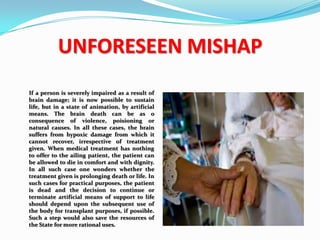
If a person is severely impaired as a result of
brain damage; it is now possible to sustain
life, but in a state of animation, by artificial
means. The brain death can be as o
consequence of violence, poisioning or
natural causes. In all these cases, the brain
suffers from hypoxic damage from which it
cannot recover, irrespective of treatment
given. When medical treatment has nothing
to offer to the ailing patient, the patient can
be allowed to die in comfort and with dignity.
In all such case one wonders whether the
treatment given is prolonging death or life. In
such cases for practical purposes, the patient
is dead and the decision to continue or
terminate artificial means of support to life
should depend upon the subsequent use of
the body for transplant purposes, if possible.
Such a step would also save the resources of
the State for more rational uses.
REASONS OF EUTHANASIA

Unbearable Pain:        It is
a major argument in favour
of euthanasia. In terminal
cases    of   cancer,     an
individual may suffer from
unbearable pain even with
the use of pain killers. But
with the use of new drugs
and treatment, much of
pain can be significantly
reduced.
REASONS OF EUTHANASIA

Right to Commit
Suicide: Most workers
who support the doctrine
of euthanasia believe that
every person should have
the right to commit
suicide. But, if logically
thought about, in this case
there is no right of suicide
as the act is done by
another person and thus
amounts to murder.
REASONS OF EUTHANASIA

 Should a Person be
forced to Stay Alive?
An argument forwarded that
whether     vegetative    life
should be allowed to be kept
on perpetual basis even
against the wishes of the
patient. It is cruel and
inhumane. But now law is
clear in such cases. Law does
not ask doctors to keep
death away forever in these
cases.
REASONS AGAINST EUTHANASIA

The following reasons are
cited against euthanasia’s:
Definition of “Terminally
Ill” is Not Conclusive: The
term “terminally ill” is
subjective and there can be
gross misuse in selection
of patients. It is also found
that some terminally ill
patients live for years or
months together.
REASONS AGAINST EUTHANASIA

Misuse by Hospitals to
Reduce Healthcare Cost:
Some hospitals may have
patients, on whom they
have to spend a lot of
money as they may be
admitted in intensive care
units for years, may be
declared as terminally ill
and may be considered for
euthanasia.
REASONS AGAINST EUTHANASIA


Importance and Value of
Life would be reduced in
the Eyes of People.
EUTHANASIA AND ASSISTED
            SUICIDE
Nowadays, concept of assisted suicide
has also developed. The difference
between euthanasia and assisted
suicide lies in who performs the last act
to cause death. In euthanasia, it is other
person who performs the last act which
causes death. For example, when a
doctor gives a lethal injection, it is
called euthanasia. But in assisted
suicide, it is the person who himself
performs the last act which causes
death. For example, patient himself
injects or drinks the poison provided by
the doctor for causing death. It is also
called as physician assisted suicide.
MEDICO-LEGAL SIGNIFICANCE


 Euthanasia in any form is not allowed in
 India. It is a punishable offence under      PUNISHABLE
 Indian Penal Code and person who does
 it may be prosecuted under the sections       OFFENCE
 of murder, assisting suicide, etc.          UNDER INDIAN
In some countries, however, it is legal.      PENAL CODE
 Netherlands, Belgium, Oregon in the
 United States,        Norway, Sweden,
 Finland,     Luxembourg,         Albania,
 Holland, Switzerland and Thailand are
 the only places in the world where laws
 permit euthanasia or assisted suicide.
 Some      countries     like    Australia
 introduced it for some time but seeing
 its misuse, it was later repealed.
 Worldwide opinion is that it should not
 be made legal as it can be grossly
 abused.

Euthanasia

  • 1.
    EUTHANASIA A POWER POINTPRESENTAION BY DEPARTMENT OF FORENSIC DR. SANGEETA CHOWDHRYY & MEDICINE & TOXICOLGY, GMC, DR.SUNIL SHARMA JAMMU
  • 2.
    EUTHANASIA The term Euthanasia originated from the Greek word for "good death." It is defined as intentional killing by act or omission, of a dependent human being for his or her alleged benefit. It literally means mercy killing or putting a person to painless death especially in case of incurable suffering or when life becomes purposeless as a result of mental or physical handicap.
  • 3.
    EUTHANASIA-TYPES Passive Euthanasia: To end a person life by not taking the necessary and ordinary action to maintain life. This can be done by withdrawing water, food, drugs, medical or surgical procedures. There are some medical actions which are often described as passive euthanasia. These Active Euthanasia: When acts include not commencing treatment the death is intentionally which would have not provided relief to the patient, or withdrawing treatment that caused. To end a person's has been found to be ineffective, too life by use of drugs, burdensome, unwanted, or prescribing high doses of pain killers that can whether by oneself or with endanger life of the patient. the aid of a physician Such actions are part of standard medical practice. Since in these actions, there is no intention to kill the person, some workers do not consider it as euthanasia. Thus, euthanasia is not there till there is intention to kill.
  • 4.
    EUTHANASIA-TYPES Voluntary Euthanasia - Physician-Assisted Suicide - When a competent person Suicide accomplished with makes a voluntary and the aid of a medical enduring request to be doctor intentionally helped to die. providing a person with an Involuntary Euthanasia - overdose of prescription To end a person's life medication. without their knowledge or Assisted Suicide - Suicide consent accomplished with the aid of another person.
  • 5.
    EUTHANASIA The question ofeuthanasia arises on three occasions i.e. (1) at the beginning of life—at birth (2) at the end of life – terminal stage (3) when a person is severely impaired as a result of brain damage – unforeseen mishap.
  • 6.
    OBJECTIVES OF LIFE Themain purpose of life is to be happy, to make others happy if possible, to grow old gracefully and die with dignity. The main duty of the doctor is to relieve pain and suffering even if the measures he takes may incidentally shorten life.
  • 7.
    AT BIRTH The problemarise in the case of a physically or mentally handicap infant. Since the infant is not able to make his own decisions; the matters rests with the parents or doctors, aided or confused by the law of land. The decision should be based on the quality of life the child can expect and its consequent impact on the parents, society, and the resources of the State. The blessings of early painless death can be balanced against the purposeless life, the probable suffering of the child, and its consequent impacts. In addition, the care of the child after death of parents also needs consideration.
  • 8.
    TERMINAL STAGE The consciousdying patient can make his own decision. The refusal to consent to any treatment whatsoever always rests with the patient. There is no moral obligation on the doctor to preserve life at any cost and if, in the course of good terminal care, the use of drugs actually hastens death it would not amount to crime or malpractice because the ensuring death would be the result of natural causes.
  • 9.
    UNFORESEEN MISHAP If aperson is severely impaired as a result of brain damage; it is now possible to sustain life, but in a state of animation, by artificial means. The brain death can be as o consequence of violence, poisioning or natural causes. In all these cases, the brain suffers from hypoxic damage from which it cannot recover, irrespective of treatment given. When medical treatment has nothing to offer to the ailing patient, the patient can be allowed to die in comfort and with dignity. In all such case one wonders whether the treatment given is prolonging death or life. In such cases for practical purposes, the patient is dead and the decision to continue or terminate artificial means of support to life should depend upon the subsequent use of the body for transplant purposes, if possible. Such a step would also save the resources of the State for more rational uses.
  • 10.
    REASONS OF EUTHANASIA UnbearablePain: It is a major argument in favour of euthanasia. In terminal cases of cancer, an individual may suffer from unbearable pain even with the use of pain killers. But with the use of new drugs and treatment, much of pain can be significantly reduced.
  • 11.
    REASONS OF EUTHANASIA Rightto Commit Suicide: Most workers who support the doctrine of euthanasia believe that every person should have the right to commit suicide. But, if logically thought about, in this case there is no right of suicide as the act is done by another person and thus amounts to murder.
  • 12.
    REASONS OF EUTHANASIA Should a Person be forced to Stay Alive? An argument forwarded that whether vegetative life should be allowed to be kept on perpetual basis even against the wishes of the patient. It is cruel and inhumane. But now law is clear in such cases. Law does not ask doctors to keep death away forever in these cases.
  • 13.
    REASONS AGAINST EUTHANASIA Thefollowing reasons are cited against euthanasia’s: Definition of “Terminally Ill” is Not Conclusive: The term “terminally ill” is subjective and there can be gross misuse in selection of patients. It is also found that some terminally ill patients live for years or months together.
  • 14.
    REASONS AGAINST EUTHANASIA Misuseby Hospitals to Reduce Healthcare Cost: Some hospitals may have patients, on whom they have to spend a lot of money as they may be admitted in intensive care units for years, may be declared as terminally ill and may be considered for euthanasia.
  • 15.
    REASONS AGAINST EUTHANASIA Importanceand Value of Life would be reduced in the Eyes of People.
  • 16.
    EUTHANASIA AND ASSISTED SUICIDE Nowadays, concept of assisted suicide has also developed. The difference between euthanasia and assisted suicide lies in who performs the last act to cause death. In euthanasia, it is other person who performs the last act which causes death. For example, when a doctor gives a lethal injection, it is called euthanasia. But in assisted suicide, it is the person who himself performs the last act which causes death. For example, patient himself injects or drinks the poison provided by the doctor for causing death. It is also called as physician assisted suicide.
  • 17.
    MEDICO-LEGAL SIGNIFICANCE Euthanasiain any form is not allowed in India. It is a punishable offence under PUNISHABLE Indian Penal Code and person who does it may be prosecuted under the sections OFFENCE of murder, assisting suicide, etc. UNDER INDIAN In some countries, however, it is legal. PENAL CODE Netherlands, Belgium, Oregon in the United States, Norway, Sweden, Finland, Luxembourg, Albania, Holland, Switzerland and Thailand are the only places in the world where laws permit euthanasia or assisted suicide. Some countries like Australia introduced it for some time but seeing its misuse, it was later repealed. Worldwide opinion is that it should not be made legal as it can be grossly abused.