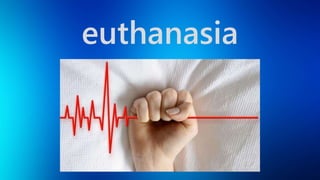
euthanasia
Outlines
• Introduction
• History
• Laws
• Religions
• Cases
• Conclusion
Introduction
• Euthanasia comes from the Greek words: Eu (good) and
• Thanatosis (death) and it means "Good Death, "Gentle and
• Easy Death." This word has come to be used for "mercy killing.
• It is the act or practice of ending a life of a person either by a
lethal injection or suspension of medical treatment.
• The word "euthanasia" was first used in a medical context by
Francis Bacon in the 17th century, to refer to an easy, painless,
happy death, during which it was a "physician's responsibility to
alleviate the 'physical sufferings' of the body
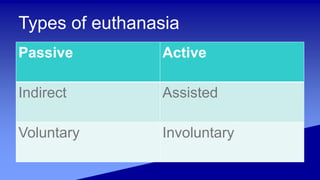
Types of euthanasia
Passive Active
Indirect Assisted
Voluntary Involuntary
• Active euthanasia
It is when death is brought by an
act for example taking a high
dose of drugs
To end a person’s life by the use
of drugs, either by oneself or by
the aid of a physician.
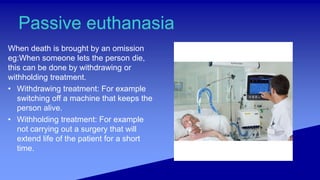
Passive euthanasia
When death is brought by an omission
eg:When someone lets the person die,
this can be done by withdrawing or
withholding treatment.
• Withdrawing treatment: For example
switching off a machine that keeps the
person alive.
• Withholding treatment: For example
not carrying out a surgery that will
extend life of the patient for a short
time.
Voluntary euthanasia
Voluntary euthanasia is
committed with the willing or
autonomous cooperation of
the subject, this means that
the subject is free from
direct or indirect pressure
from others.
Non voluntary euthanasia
Non voluntary euthanasia occurs
when the patient is unconscious or
unable to make a meaningful choice
between living and dying, and an
appropriate person takes that
decision for him/her.
• This is usually called murder, but it
is possible to imagine cases where
the killing would count as a favor
for the patient.
Indirect euthanasia
This means providing treatments
-mainly to reduce pain- that has
a side effect of shortening the
patient’s life.
- Since the primary intent wasn’t
to kill, it is morally accepted by
some people.
Assisted suicide
This usually refers to cases
where the persons who are
going to die need help
to kill themselves and ask for it.
-It may be something as simple
as getting drugs for the person,
and putting those drugs within
their reach.
History
-It is believed that euthanasia started in ancient Greece and rome
around the fifth century B.C.
-Some did this by abortions, and every now and then performed a
mercy killing even though doctors were supposed to follow the
Hippocratic Oath:
“I will give no deadly medicine to any one if asked, nor suggest any
such counsel”.
• During the Middle Ages, euthanasia was pretty much out of the
question. If one committed suicide, the law in Europe was for the
body to be dragged through the streets or nailed to a barrel and left
to drift downriver.
• During the Seventeenth and Eighteenth centuries euthanasia
was a topic of discussion. However, people continued to reject
euthanasia and assisted suicide.
• 1478-1535: Sir Thomas More is often quoted as being the first
prominent Christian to recommend euthanasia in his book Utopia,
where the Utopian priests encourage euthanasia when a patient
was
terminally ill and suffering pain
1828: The frist law against assisted killing, known as anti-euthanasia
was passed in new york.
1870: The use of morphine and analgesic medications for assisting
quick and painless death was suggested.
1885: The American Medical Association strongly denied the use of
analgesic for euthanasia.
1994: Netherlands it is the first country where euthanasia has been
allowed.
2001: The euthanasia law was adopted in Belgium -this law defines
conditions for doctors to avoid penal punishment.
2008: U.S. state of Washington legalizes assisted suicide
Laws
Religions
Those in favor of euthanasia argue that a civilized society should
allow people to die in dignity and without pain.
They add that as suicide is not a crime, euthanasia should not be a
crime.
Most religions disapprove of euthanasia for a number of
reasons:
1- God has forbidden it ( that says 'you must not kill').
2- Human life is sacred.
3- human beings are made in God's image.
4- God gives people life, so only God has the right to
take it away
Religious views on euthanasia
• A-Islam:Muslims are against euthanasia. They believe that all
human life is sacred because it is given by Allah, and that Allah chooses how
long each person will live. IMANA (the Islamic Medical Association of America )
say that turning off life support for deemed to be in a persistent vegetative state
is permissible. This is because they consider all mechanical life support
procedures as temporary measures.
B-Christianity:Christians are mostly against euthanasia. The arguments are
usually based on the beliefs that life is given by God, and that human beings
are made in God's image. Some churches also emphasize the importance of
not interfering with the natural process of death. Life is a gift from God
Christianity requires us to respect every human being.
C- Judaism:Jewish medical ethics have become divided,
over euthanasia and end of life treatment since the 1970s.
Generally, Jewish thinkers oppose voluntary euthanasia,
often vigorously, though there is some backing for voluntary
passive euthanasia in limited circumstances.
D- Shinto: In Japan, where the dominant religion is Shinto,
69% of the religious organizations agree with the act of
voluntary passive euthanasia. In Shinto, the prolongation of
life using artificial means is a disgraceful act
against life
E- Buddhism: An important value of Buddhism teaching is
compassion. Compassion is used by some Buddhists as a
justification for euthanasia because the person suffering is
relieved of pain.
However, it is still immoral "to embark on any course of
action whose aim is to destroy human life, irrespective of
the quality of the individual's motive."
Cases
The Aruna Shanbaug case which changed euthanasia
laws in India
A landmark verdict
The Supreme Court on March 9 ruled that individuals had a right to die with
dignity, allowing passive euthanasia with guidelines. The need to change
euthanasia laws was triggered by the famous Aruna Shanbaug case. The top
court in 2011 had recognised passive euthanasia in Aruna Shanbaug case by
which it had permitted withdrawal of life-sustaining treatment from patients not
in a position to make an informed decision.
The attack
Aruna Ramchandra Shanbaug was a nurse in the King Edwards Memorial
Hospital in Mumbai. In November 1973, she was assaulted by ward boy,
Sohanlal Bhartha Valmiki, of the same hospital while changing her clothes in
the hospital basement. Valmiki strangulated Shanbaug with a dog chain around
her neck.
Living in a coma
The attack cut off oxygen supply from her brain leaving her blind, deaf,
paralysed and in a vegetative state for the next 42 years.
From the day of the assault till the day she died on May 18, 2015, Aruna could
only survive on mashed food. She could not move her hands or legs, could not
talk or perform the basic functions of a human being.
What happened to Valmiki
In 1974, Valmiki was charged with attempted murder and for robbing Aruna's
earrings, but not for rape. The police did not take into account that she was
sodomized. A trial court sentenced Valmiki seven years imprisonment. This was
reduced to six years because he had already served a year in lock up. Valmiki
walked out of jail in 1980 and still claims he did not rape Shanbaug.
Facing opposition
The Supreme Court accepted the petition and constituted a medical board to
report back on Aruna's health and medical condition. The medical board,
comprising three eminent doctors, reported that the patient was not brain dead
and responded to some situations in her own way. They felt that there was no
need for euthanasia in the case.
The staff at KEM Hospital and the Bombay Municipal Corporation filed their
counter-petitions in the case, opposing euthanasia for Aruna. The nurses at
KEM Hospital were quite happy to look after the patient and they had been
doing that for years before petitioner Pinky Virani emerged on the scene.
Finally at peace
On May 18, 2015, Shanbaug then 66, died of severe pneumonia. She was on
ventilator support in KEM's acute care unit.
The End

Euthanasia

  • 1.
  • 2.
    Outlines • Introduction • History •Laws • Religions • Cases • Conclusion
  • 3.
    Introduction • Euthanasia comesfrom the Greek words: Eu (good) and • Thanatosis (death) and it means "Good Death, "Gentle and • Easy Death." This word has come to be used for "mercy killing. • It is the act or practice of ending a life of a person either by a lethal injection or suspension of medical treatment. • The word "euthanasia" was first used in a medical context by Francis Bacon in the 17th century, to refer to an easy, painless, happy death, during which it was a "physician's responsibility to alleviate the 'physical sufferings' of the body
  • 4.
    Types of euthanasia PassiveActive Indirect Assisted Voluntary Involuntary
  • 5.
    • Active euthanasia Itis when death is brought by an act for example taking a high dose of drugs To end a person’s life by the use of drugs, either by oneself or by the aid of a physician.
  • 6.
    Passive euthanasia When deathis brought by an omission eg:When someone lets the person die, this can be done by withdrawing or withholding treatment. • Withdrawing treatment: For example switching off a machine that keeps the person alive. • Withholding treatment: For example not carrying out a surgery that will extend life of the patient for a short time.
  • 7.
    Voluntary euthanasia Voluntary euthanasiais committed with the willing or autonomous cooperation of the subject, this means that the subject is free from direct or indirect pressure from others.
  • 8.
    Non voluntary euthanasia Nonvoluntary euthanasia occurs when the patient is unconscious or unable to make a meaningful choice between living and dying, and an appropriate person takes that decision for him/her. • This is usually called murder, but it is possible to imagine cases where the killing would count as a favor for the patient.
  • 9.
    Indirect euthanasia This meansproviding treatments -mainly to reduce pain- that has a side effect of shortening the patient’s life. - Since the primary intent wasn’t to kill, it is morally accepted by some people.
  • 10.
    Assisted suicide This usuallyrefers to cases where the persons who are going to die need help to kill themselves and ask for it. -It may be something as simple as getting drugs for the person, and putting those drugs within their reach.
  • 11.
    History -It is believedthat euthanasia started in ancient Greece and rome around the fifth century B.C. -Some did this by abortions, and every now and then performed a mercy killing even though doctors were supposed to follow the Hippocratic Oath: “I will give no deadly medicine to any one if asked, nor suggest any such counsel”.
  • 12.
    • During theMiddle Ages, euthanasia was pretty much out of the question. If one committed suicide, the law in Europe was for the body to be dragged through the streets or nailed to a barrel and left to drift downriver. • During the Seventeenth and Eighteenth centuries euthanasia was a topic of discussion. However, people continued to reject euthanasia and assisted suicide. • 1478-1535: Sir Thomas More is often quoted as being the first prominent Christian to recommend euthanasia in his book Utopia, where the Utopian priests encourage euthanasia when a patient was terminally ill and suffering pain
  • 13.
    1828: The fristlaw against assisted killing, known as anti-euthanasia was passed in new york. 1870: The use of morphine and analgesic medications for assisting quick and painless death was suggested. 1885: The American Medical Association strongly denied the use of analgesic for euthanasia. 1994: Netherlands it is the first country where euthanasia has been allowed. 2001: The euthanasia law was adopted in Belgium -this law defines conditions for doctors to avoid penal punishment. 2008: U.S. state of Washington legalizes assisted suicide
  • 14.
  • 16.
  • 17.
    Those in favorof euthanasia argue that a civilized society should allow people to die in dignity and without pain. They add that as suicide is not a crime, euthanasia should not be a crime. Most religions disapprove of euthanasia for a number of reasons: 1- God has forbidden it ( that says 'you must not kill'). 2- Human life is sacred. 3- human beings are made in God's image. 4- God gives people life, so only God has the right to take it away
  • 18.
    Religious views oneuthanasia • A-Islam:Muslims are against euthanasia. They believe that all human life is sacred because it is given by Allah, and that Allah chooses how long each person will live. IMANA (the Islamic Medical Association of America ) say that turning off life support for deemed to be in a persistent vegetative state is permissible. This is because they consider all mechanical life support procedures as temporary measures. B-Christianity:Christians are mostly against euthanasia. The arguments are usually based on the beliefs that life is given by God, and that human beings are made in God's image. Some churches also emphasize the importance of not interfering with the natural process of death. Life is a gift from God Christianity requires us to respect every human being.
  • 19.
    C- Judaism:Jewish medicalethics have become divided, over euthanasia and end of life treatment since the 1970s. Generally, Jewish thinkers oppose voluntary euthanasia, often vigorously, though there is some backing for voluntary passive euthanasia in limited circumstances. D- Shinto: In Japan, where the dominant religion is Shinto, 69% of the religious organizations agree with the act of voluntary passive euthanasia. In Shinto, the prolongation of life using artificial means is a disgraceful act against life
  • 20.
    E- Buddhism: Animportant value of Buddhism teaching is compassion. Compassion is used by some Buddhists as a justification for euthanasia because the person suffering is relieved of pain. However, it is still immoral "to embark on any course of action whose aim is to destroy human life, irrespective of the quality of the individual's motive."
  • 21.
    Cases The Aruna Shanbaugcase which changed euthanasia laws in India
  • 22.
    A landmark verdict TheSupreme Court on March 9 ruled that individuals had a right to die with dignity, allowing passive euthanasia with guidelines. The need to change euthanasia laws was triggered by the famous Aruna Shanbaug case. The top court in 2011 had recognised passive euthanasia in Aruna Shanbaug case by which it had permitted withdrawal of life-sustaining treatment from patients not in a position to make an informed decision. The attack Aruna Ramchandra Shanbaug was a nurse in the King Edwards Memorial Hospital in Mumbai. In November 1973, she was assaulted by ward boy, Sohanlal Bhartha Valmiki, of the same hospital while changing her clothes in the hospital basement. Valmiki strangulated Shanbaug with a dog chain around her neck.
  • 23.
    Living in acoma The attack cut off oxygen supply from her brain leaving her blind, deaf, paralysed and in a vegetative state for the next 42 years. From the day of the assault till the day she died on May 18, 2015, Aruna could only survive on mashed food. She could not move her hands or legs, could not talk or perform the basic functions of a human being. What happened to Valmiki In 1974, Valmiki was charged with attempted murder and for robbing Aruna's earrings, but not for rape. The police did not take into account that she was sodomized. A trial court sentenced Valmiki seven years imprisonment. This was reduced to six years because he had already served a year in lock up. Valmiki walked out of jail in 1980 and still claims he did not rape Shanbaug.
  • 24.
    Facing opposition The SupremeCourt accepted the petition and constituted a medical board to report back on Aruna's health and medical condition. The medical board, comprising three eminent doctors, reported that the patient was not brain dead and responded to some situations in her own way. They felt that there was no need for euthanasia in the case. The staff at KEM Hospital and the Bombay Municipal Corporation filed their counter-petitions in the case, opposing euthanasia for Aruna. The nurses at KEM Hospital were quite happy to look after the patient and they had been doing that for years before petitioner Pinky Virani emerged on the scene. Finally at peace On May 18, 2015, Shanbaug then 66, died of severe pneumonia. She was on ventilator support in KEM's acute care unit.
  • 25.