euthanasia
Contents
• Definition of euthanasia
• Types of euthanasia
• Law on euthanasia
• Acceptance of euthanasia in Malaysia
• Islamic Perspective
INTRODUCTION
DEFINITION & TYPES
What is euthanasia ?
εὐθανασία ( euthanatos )
εὐ/eu : good or well
Θανασία : death
Euthanasia or mercy killing is the practice of intentionally ending a life in
order to relieve pain and suffering.
or
Assisted suicide
Francis Bacon ( 17th Century ) – easy, painless and happy death
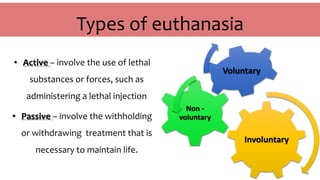
Types of euthanasia
• Active – involve the use of lethal
substances or forces, such as
administering a lethal injection
• Passive – involve the withholding
or withdrawing treatment that is
necessary to maintain life.
Involuntary
Non -
voluntary
Voluntary
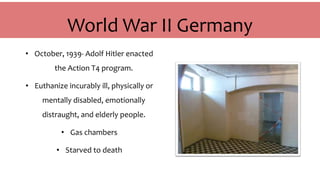
World War II Germany
• October, 1939- Adolf Hitler enacted
the Action T4 program.
• Euthanize incurably ill, physically or
mentally disabled, emotionally
distraught, and elderly people.
• Gas chambers
• Starved to death
LAWS
OF
EUTHANASIA
Canada
Canada
Euthanasia is not yet legal in Canada but
it will be by June 2016.
Netherlands
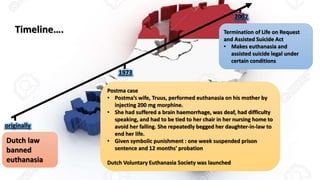
originally
Dutch law
banned
euthanasia
2002
Termination of Life on Request
and Assisted Suicide Act
• Makes euthanasia and
assisted suicide legal under
certain conditions
1973
Postma case
• Postma’s wife, Truus, performed euthanasia on his mother by
injecting 200 mg morphine.
• She had suffered a brain haemorrhage, was deaf, had difficulty
speaking, and had to be tied to her chair in her nursing home to
avoid her falling. She repeatedly begged her daughter-in-law to
end her life.
• Given symbolic punishment : one week suspended prison
sentence and 12 months' probation
Dutch Voluntary Euthanasia Society was launched
Timeline….
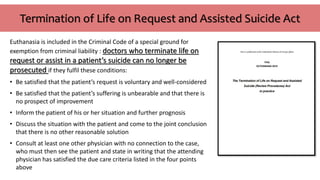
Termination of Life on Request and Assisted Suicide Act
Euthanasia is included in the Criminal Code of a special ground for
exemption from criminal liability : doctors who terminate life on
request or assist in a patient’s suicide can no longer be
prosecuted if they fulfil these conditions:
• Be satisfied that the patient’s request is voluntary and well-considered
• Be satisfied that the patient’s suffering is unbearable and that there is
no prospect of improvement
• Inform the patient of his or her situation and further prognosis
• Discuss the situation with the patient and come to the joint conclusion
that there is no other reasonable solution
• Consult at least one other physician with no connection to the case,
who must then see the patient and state in writing that the attending
physician has satisfied the due care criteria listed in the four points
above
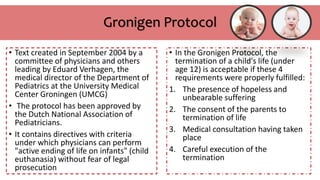
Gronigen Protocol
• Text created in September 2004 by a
committee of physicians and others
leading by Eduard Verhagen, the
medical director of the Department of
Pediatrics at the University Medical
Center Groningen (UMCG)
• The protocol has been approved by
the Dutch National Association of
Pediatricians.
• It contains directives with criteria
under which physicians can perform
"active ending of life on infants" (child
euthanasia) without fear of legal
prosecution
• In the Gronigen Protocol, the
termination of a child's life (under
age 12) is acceptable if these 4
requirements were properly fulfilled:
1. The presence of hopeless and
unbearable suffering
2. The consent of the parents to
termination of life
3. Medical consultation having taken
place
4. Careful execution of the
termination
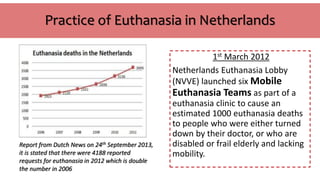
Practice of Euthanasia in Netherlands
1st March 2012
Netherlands Euthanasia Lobby
(NVVE) launched six Mobile
Euthanasia Teams as part of a
euthanasia clinic to cause an
estimated 1000 euthanasia deaths
to people who were either turned
down by their doctor, or who are
disabled or frail elderly and lacking
mobility.
Report from Dutch News on 24th September 2013,
it is stated that there were 4188 reported
requests for euthanasia in 2012 which is double
the number in 2006
Australia
• Illegal in Australia
• Although the public supports legalizing Euthanasia ,
Australian governments continue to resist legalizing
euthanasia or assisted suicide.
• Opponents of legalization: “Once we take the significant
step of allowing doctors to ‘kill’ patients in narrowly defined
circumstances, there will be pressure to increase the range
of circumstances with amending legislation. And it’s easier
to amend existing legislation than enact it in the first place
• Proponents of legalization: Generally respond by claiming
there is no evidence of either concern being realized in
places where euthanasia is lawful
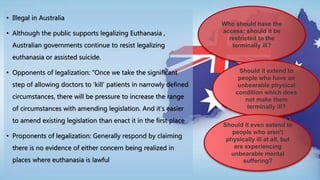
Who should have the
access: should it be
restricted to the
terminally ill?
Should it extend to
people who have an
unbearable physical
condition which does
not make them
terminally ill?
Should it even extend to
people who aren’t
physically ill at all, but
are experiencing
unbearable mental
suffering?
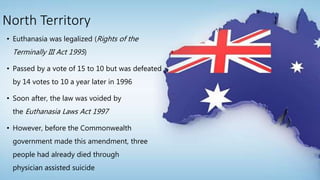
North Territory
• Euthanasia was legalized (Rights of the
Terminally III Act 1995)
• Passed by a vote of 15 to 10 but was defeated
by 14 votes to 10 a year later in 1996
• Soon after, the law was voided by
the Euthanasia Laws Act 1997
• However, before the Commonwealth
government made this amendment, three
people had already died through
physician assisted suicide
Japan
• Known as anraku-shi, means “peaceful death
• No acts or official laws regarding the status of
euthanasia based on Japanese Penal Code in
The Constitution of Japan
• The Supreme Court has never ruled on the
matter; two local court cases that happened
back in 1962 and 1995 → frameworks and
conditions for Japan’s euthanasia policy
• One can legally end patient’s life as long as
the conditions are fulfilled
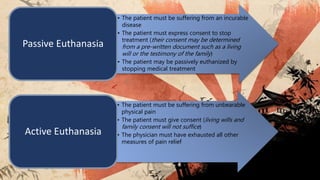
• The patient must be suffering from an incurable
disease
• The patient must express consent to stop
treatment (their consent may be determined
from a pre-written document such as a living
will or the testimony of the family)
• The patient may be passively euthanized by
stopping medical treatment
Passive Euthanasia
• The patient must be suffering from unbearable
physical pain
• The patient must give consent (living wills and
family consent will not suffice)
• The physician must have exhausted all other
measures of pain relief
Active Euthanasia
DEATH OF DIGNITY
• Concept emerged in 1970s but become a hot
topic recently
• Increment in aging & childless Japanese society
lead to the government starting to reflect on
legalizing it; a practice meant to cut medical
costs of patients in a vegetative state
• Defined as : The act of letting a terminally ill or a
patient in a persistent vegetative state die by
withdrawing life-sustaining treatment on request
in the form of a living will
ACCEPTANCE OF EUTHANASIA
AMONG MALAYSIANS
Main purpose: To
focus on public
awareness and
thoughts of
euthanasia in
Malaysia.
ACCEPTANCE OF EUTHANASIA AMONG MALAYSIANS
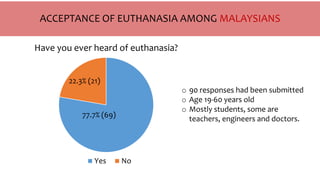
Have you ever heard of euthanasia?
Yes No
77.7% (69)
22.3% (21)
o 90 responses had been submitted
o Age 19-60 years old
o Mostly students, some are
teachers, engineers and doctors.
ACCEPTANCE OF EUTHANASIA AMONG MALAYSIANS
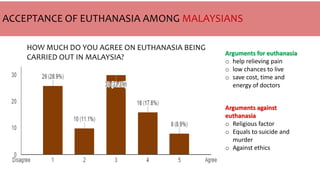
HOW MUCH DO YOU AGREE ON EUTHANASIA BEING
CARRIED OUT IN MALAYSIA?
Arguments for euthanasia
o help relieving pain
o low chances to live
o save cost, time and
energy of doctors
Arguments against
euthanasia
o Religious factor
o Equals to suicide and
murder
o Against ethics
EUTHANASIA
BASED ON
ISLAMIC PERSPECTIVES
EUTHANASIA AND SUICIDE IN ISLAM
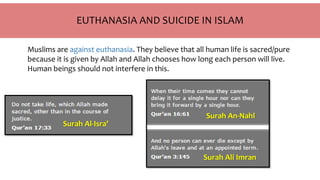
Muslims are against euthanasia. They believe that all human life is sacred/pure
because it is given by Allah and Allah chooses how long each person will live.
Human beings should not interfere in this.
Surah Al-Isra’
Surah Ali Imran
Surah An-Nahl
EUTHANASIA IN ISLAM
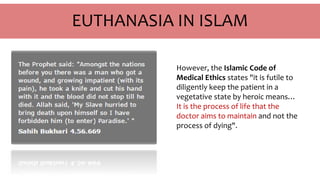
However, the Islamic Code of
Medical Ethics states "it is futile to
diligently keep the patient in a
vegetative state by heroic means…
It is the process of life that the
doctor aims to maintain and not the
process of dying".
CONCLUSION
Suffering and pain are
parts of our life. The
lesson in endurance when
patient was in pain is to
be thankful in times of
health and patient in
times of sickness.

Euthanasia Slide Presentation ..

  • 1.
  • 2.
    Contents • Definition ofeuthanasia • Types of euthanasia • Law on euthanasia • Acceptance of euthanasia in Malaysia • Islamic Perspective
  • 3.
  • 4.
    What is euthanasia? εὐθανασία ( euthanatos ) εὐ/eu : good or well Θανασία : death Euthanasia or mercy killing is the practice of intentionally ending a life in order to relieve pain and suffering. or Assisted suicide Francis Bacon ( 17th Century ) – easy, painless and happy death
  • 5.
    Types of euthanasia •Active – involve the use of lethal substances or forces, such as administering a lethal injection • Passive – involve the withholding or withdrawing treatment that is necessary to maintain life. Involuntary Non - voluntary Voluntary
  • 6.
    World War IIGermany • October, 1939- Adolf Hitler enacted the Action T4 program. • Euthanize incurably ill, physically or mentally disabled, emotionally distraught, and elderly people. • Gas chambers • Starved to death
  • 7.
  • 8.
  • 9.
    Canada Euthanasia is notyet legal in Canada but it will be by June 2016.
  • 10.
  • 11.
    originally Dutch law banned euthanasia 2002 Termination ofLife on Request and Assisted Suicide Act • Makes euthanasia and assisted suicide legal under certain conditions 1973 Postma case • Postma’s wife, Truus, performed euthanasia on his mother by injecting 200 mg morphine. • She had suffered a brain haemorrhage, was deaf, had difficulty speaking, and had to be tied to her chair in her nursing home to avoid her falling. She repeatedly begged her daughter-in-law to end her life. • Given symbolic punishment : one week suspended prison sentence and 12 months' probation Dutch Voluntary Euthanasia Society was launched Timeline….
  • 12.
    Termination of Lifeon Request and Assisted Suicide Act Euthanasia is included in the Criminal Code of a special ground for exemption from criminal liability : doctors who terminate life on request or assist in a patient’s suicide can no longer be prosecuted if they fulfil these conditions: • Be satisfied that the patient’s request is voluntary and well-considered • Be satisfied that the patient’s suffering is unbearable and that there is no prospect of improvement • Inform the patient of his or her situation and further prognosis • Discuss the situation with the patient and come to the joint conclusion that there is no other reasonable solution • Consult at least one other physician with no connection to the case, who must then see the patient and state in writing that the attending physician has satisfied the due care criteria listed in the four points above
  • 13.
    Gronigen Protocol • Textcreated in September 2004 by a committee of physicians and others leading by Eduard Verhagen, the medical director of the Department of Pediatrics at the University Medical Center Groningen (UMCG) • The protocol has been approved by the Dutch National Association of Pediatricians. • It contains directives with criteria under which physicians can perform "active ending of life on infants" (child euthanasia) without fear of legal prosecution • In the Gronigen Protocol, the termination of a child's life (under age 12) is acceptable if these 4 requirements were properly fulfilled: 1. The presence of hopeless and unbearable suffering 2. The consent of the parents to termination of life 3. Medical consultation having taken place 4. Careful execution of the termination
  • 14.
    Practice of Euthanasiain Netherlands 1st March 2012 Netherlands Euthanasia Lobby (NVVE) launched six Mobile Euthanasia Teams as part of a euthanasia clinic to cause an estimated 1000 euthanasia deaths to people who were either turned down by their doctor, or who are disabled or frail elderly and lacking mobility. Report from Dutch News on 24th September 2013, it is stated that there were 4188 reported requests for euthanasia in 2012 which is double the number in 2006
  • 16.
  • 17.
    • Illegal inAustralia • Although the public supports legalizing Euthanasia , Australian governments continue to resist legalizing euthanasia or assisted suicide. • Opponents of legalization: “Once we take the significant step of allowing doctors to ‘kill’ patients in narrowly defined circumstances, there will be pressure to increase the range of circumstances with amending legislation. And it’s easier to amend existing legislation than enact it in the first place • Proponents of legalization: Generally respond by claiming there is no evidence of either concern being realized in places where euthanasia is lawful Who should have the access: should it be restricted to the terminally ill? Should it extend to people who have an unbearable physical condition which does not make them terminally ill? Should it even extend to people who aren’t physically ill at all, but are experiencing unbearable mental suffering?
  • 18.
    North Territory • Euthanasiawas legalized (Rights of the Terminally III Act 1995) • Passed by a vote of 15 to 10 but was defeated by 14 votes to 10 a year later in 1996 • Soon after, the law was voided by the Euthanasia Laws Act 1997 • However, before the Commonwealth government made this amendment, three people had already died through physician assisted suicide
  • 19.
  • 20.
    • Known asanraku-shi, means “peaceful death • No acts or official laws regarding the status of euthanasia based on Japanese Penal Code in The Constitution of Japan • The Supreme Court has never ruled on the matter; two local court cases that happened back in 1962 and 1995 → frameworks and conditions for Japan’s euthanasia policy • One can legally end patient’s life as long as the conditions are fulfilled
  • 21.
    • The patientmust be suffering from an incurable disease • The patient must express consent to stop treatment (their consent may be determined from a pre-written document such as a living will or the testimony of the family) • The patient may be passively euthanized by stopping medical treatment Passive Euthanasia • The patient must be suffering from unbearable physical pain • The patient must give consent (living wills and family consent will not suffice) • The physician must have exhausted all other measures of pain relief Active Euthanasia
  • 22.
    DEATH OF DIGNITY •Concept emerged in 1970s but become a hot topic recently • Increment in aging & childless Japanese society lead to the government starting to reflect on legalizing it; a practice meant to cut medical costs of patients in a vegetative state • Defined as : The act of letting a terminally ill or a patient in a persistent vegetative state die by withdrawing life-sustaining treatment on request in the form of a living will
  • 23.
  • 24.
    Main purpose: To focuson public awareness and thoughts of euthanasia in Malaysia.
  • 25.
    ACCEPTANCE OF EUTHANASIAAMONG MALAYSIANS Have you ever heard of euthanasia? Yes No 77.7% (69) 22.3% (21) o 90 responses had been submitted o Age 19-60 years old o Mostly students, some are teachers, engineers and doctors.
  • 26.
    ACCEPTANCE OF EUTHANASIAAMONG MALAYSIANS HOW MUCH DO YOU AGREE ON EUTHANASIA BEING CARRIED OUT IN MALAYSIA? Arguments for euthanasia o help relieving pain o low chances to live o save cost, time and energy of doctors Arguments against euthanasia o Religious factor o Equals to suicide and murder o Against ethics
  • 27.
  • 28.
    EUTHANASIA AND SUICIDEIN ISLAM Muslims are against euthanasia. They believe that all human life is sacred/pure because it is given by Allah and Allah chooses how long each person will live. Human beings should not interfere in this. Surah Al-Isra’ Surah Ali Imran Surah An-Nahl
  • 29.
    EUTHANASIA IN ISLAM However,the Islamic Code of Medical Ethics states "it is futile to diligently keep the patient in a vegetative state by heroic means… It is the process of life that the doctor aims to maintain and not the process of dying".
  • 30.
    CONCLUSION Suffering and painare parts of our life. The lesson in endurance when patient was in pain is to be thankful in times of health and patient in times of sickness.