

Dr John Moffat
Richard Price Building, Room F49
Email: J.D.Moffat@swansea.ac.uk
Office Hours: Tuesday & Friday, 1:30-2:30pm
Learning Outcomes
 Students should be able to answer the following
questions:
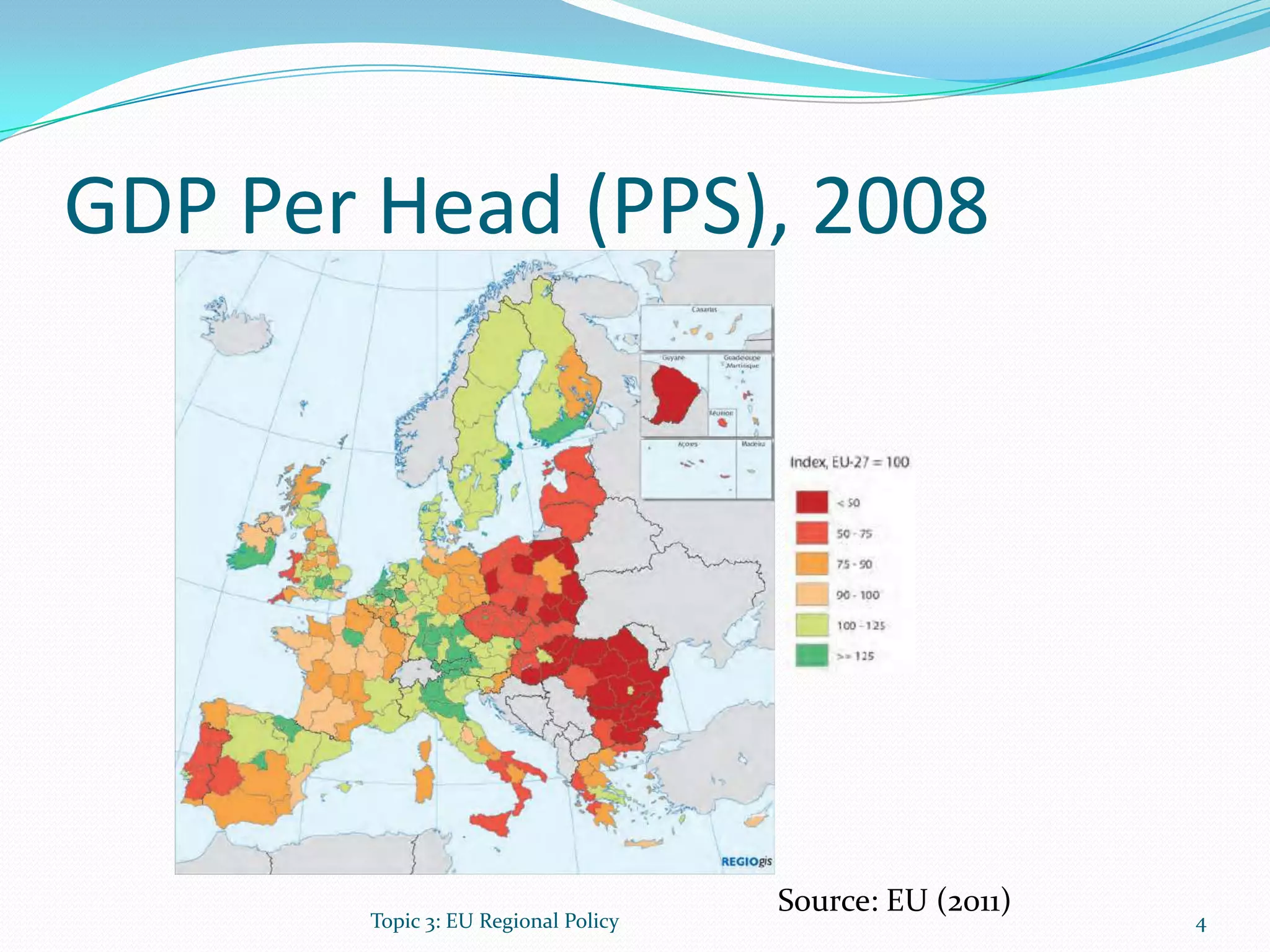
 Describe current disparities in economic performance
across the EU
 Is there a case for an EU-wide regional policy
superimposed upon a set of ‘national’ regional policies?
 What are the current objectives and instruments of EU
regional policy?
 Has EU regional policy had an impact?
2Topic 3: EU Regional Policy
Readings
 Armstrong & Taylor, chapter 11 (note that some parts of this are
rather outdated)
 Armstrong, H. (2011), ‘Regional Policy’ in El-Agraa, A, The
European Union: Economics and Policies, 9th ed. Cambridge:
Cambridge University Press
 EU (2011), The urban and regional dimension of Europe 2020:
Seventh progress report on economic, social and territorial
cohesion, Available from:
http://ec.europa.eu/regional_policy/sources/docoffic/official/re
ports/interim7/interim7_en.pdf
 Gripaios, P., Bishop, P., Hart, T. & McVittie, E. (2008), ‘Analysing
the impact of Objective 1 funding in Europe: a review,’
Environment and Planning, Available from:
http://www.envplan.com/abstract.cgi?id=c64m
3Topic 3: EU Regional Policy
GDP Per Head (PPS), 2008
Source: EU (2011)
4Topic 3: EU Regional Policy
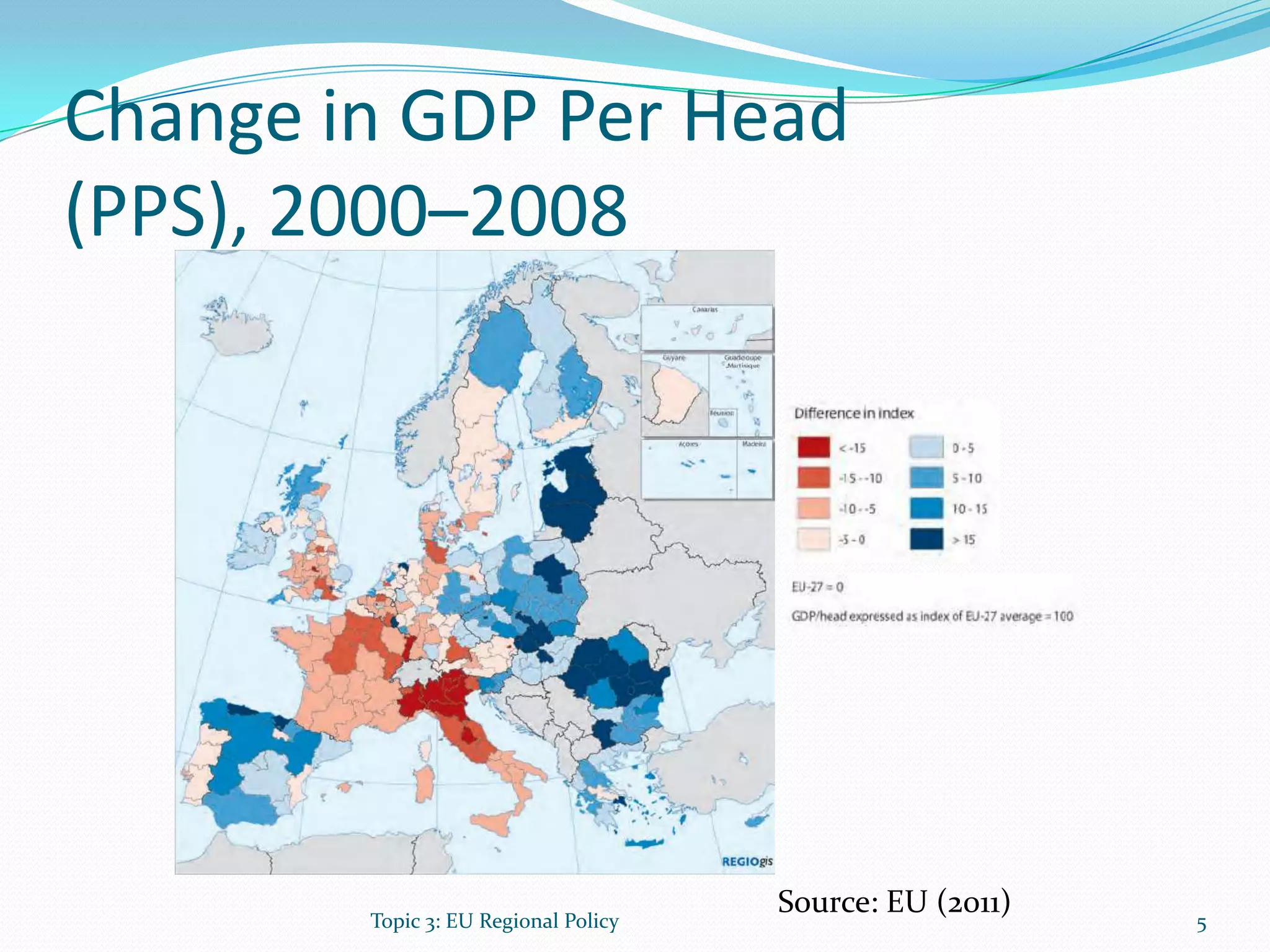
Change in GDP Per Head
(PPS), 2000–2008
Topic 3: EU Regional Policy 5
Source: EU (2011)
Unemployment Rates, 2010
Source: EU (2011) 6Topic 3: EU Regional Policy
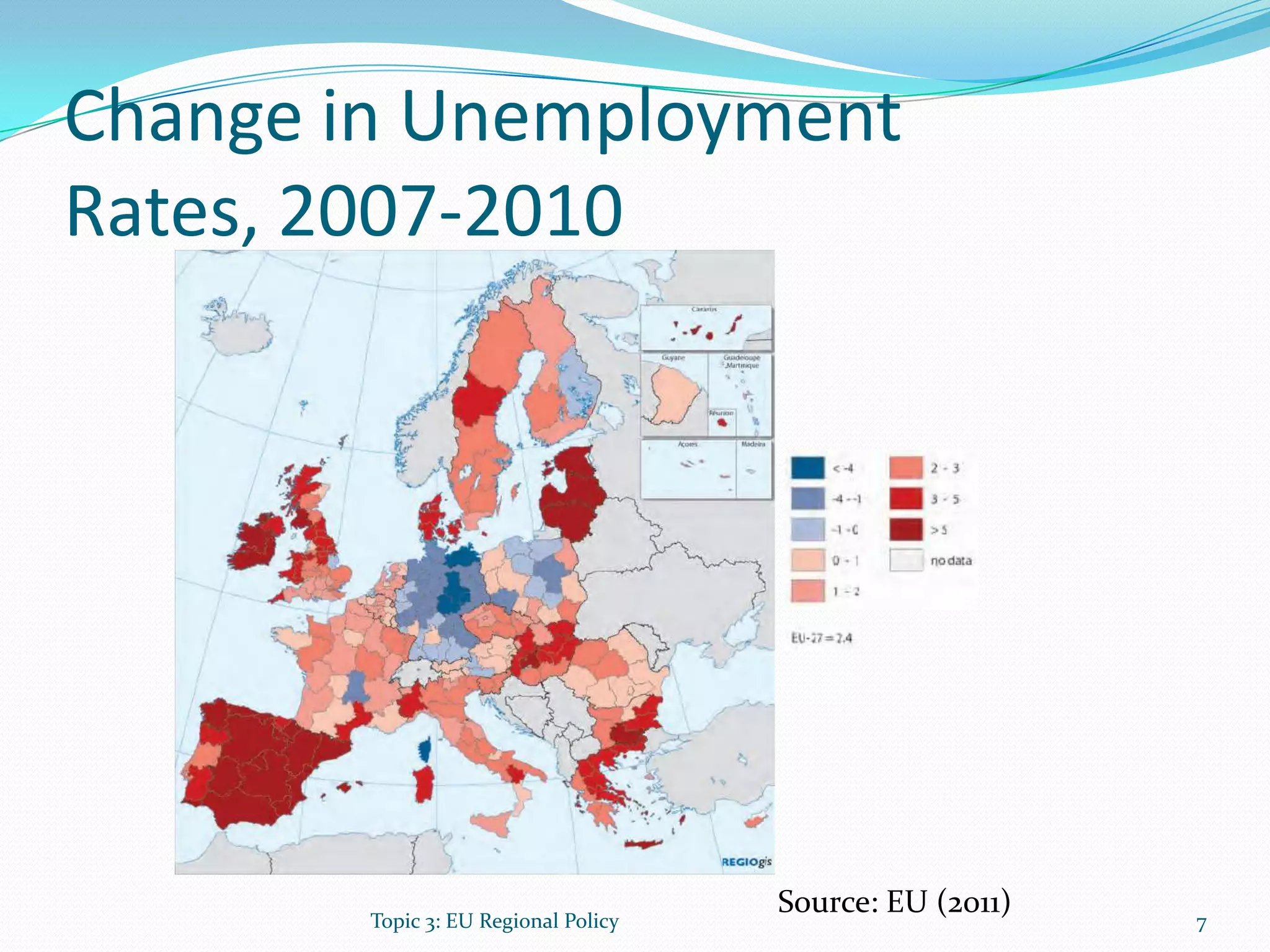
Change in Unemployment
Rates, 2007-2010
Topic 3: EU Regional Policy 7
Source: EU (2011)
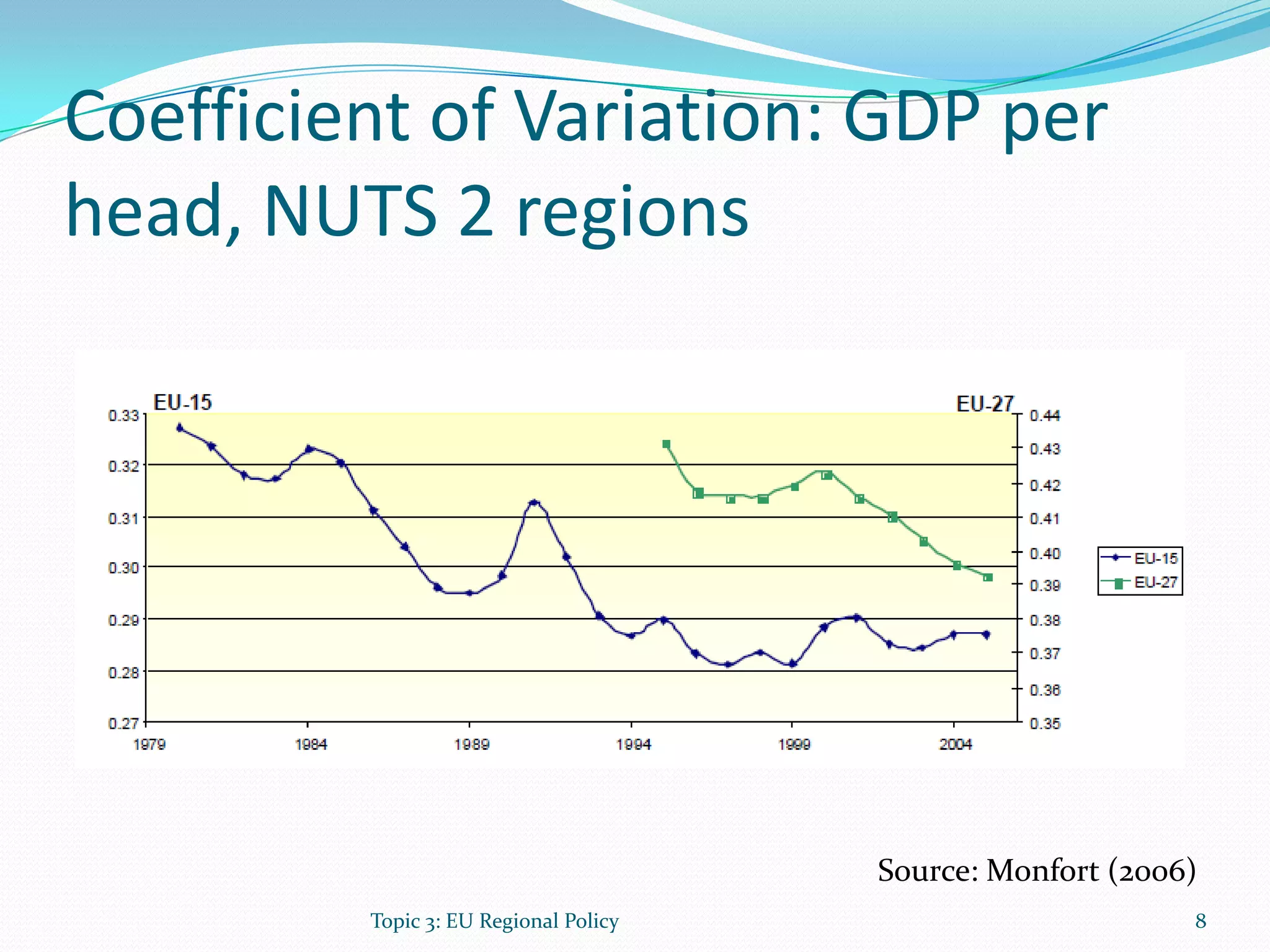
Coefficient of Variation: GDP per
head, NUTS 2 regions
Topic 3: EU Regional Policy 8
Source: Monfort (2006)
EU Regional Policy
 According to Armstrong (2011) there are five main
arguments for an EU regional policy:
 The vested interest argument
 The financial targeting argument
 The coordination argument
 The effects of EU integration argument
 The effects of other EU policies argument
9Topic 3: EU Regional Policy
The Vested Interest Argument
 The economic well-being of citizens in one member state is
dependent on the prosperity of other member states
 This is because greater prosperity in other members states
will lead to:
 Greater demand from other regions
 Reduced congestion
 A more controversial argument in favour of a regional
policy is that individuals in a given member state benefit if
other regions are prospering because this helps the
‘European project’ of greater economic integration
10Topic 3: EU Regional Policy
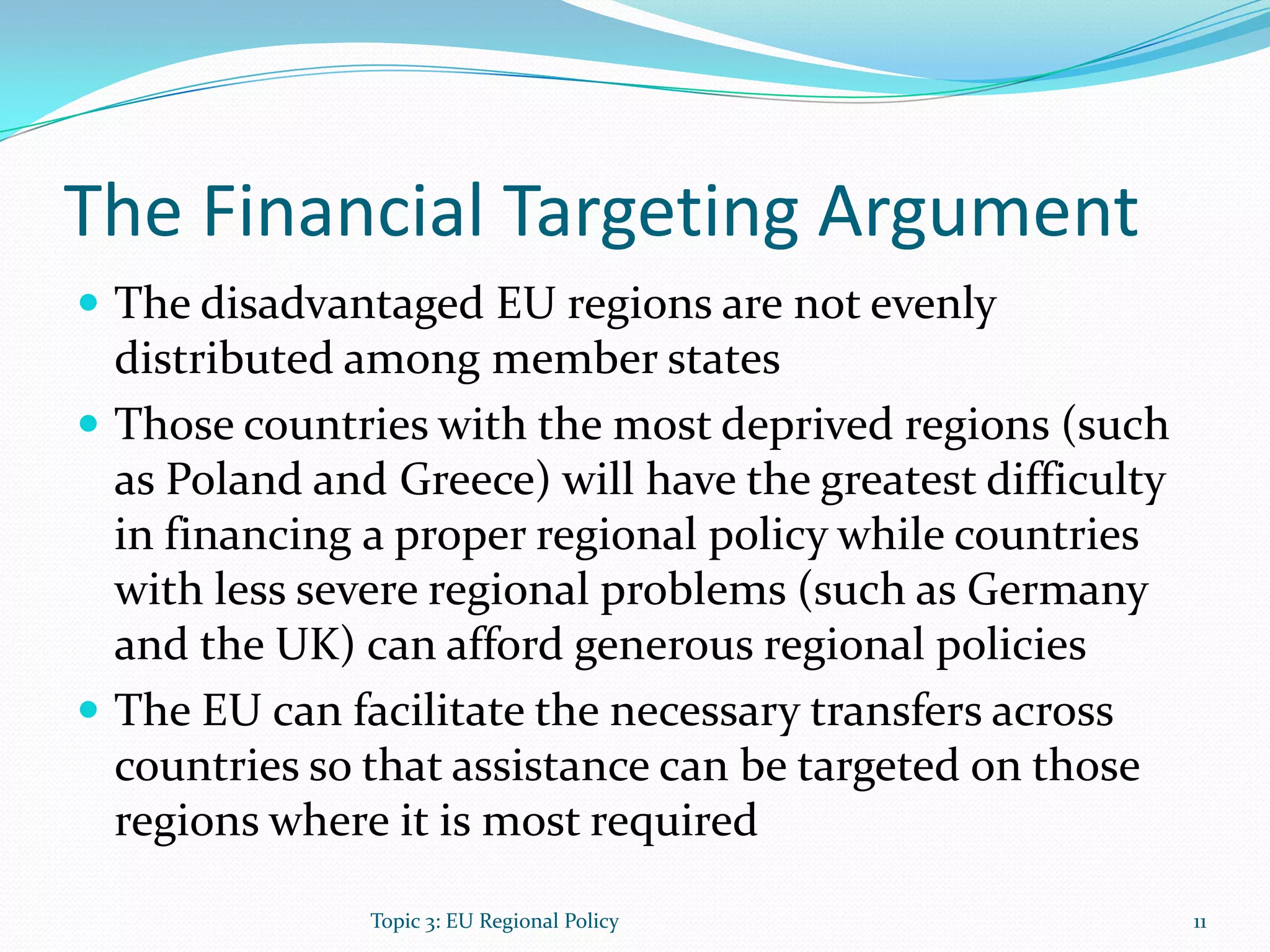
The Financial Targeting Argument
 The disadvantaged EU regions are not evenly
distributed among member states
 Those countries with the most deprived regions (such
as Poland and Greece) will have the greatest difficulty
in financing a proper regional policy while countries
with less severe regional problems (such as Germany
and the UK) can afford generous regional policies
 The EU can facilitate the necessary transfers across
countries so that assistance can be targeted on those
regions where it is most required
11Topic 3: EU Regional Policy
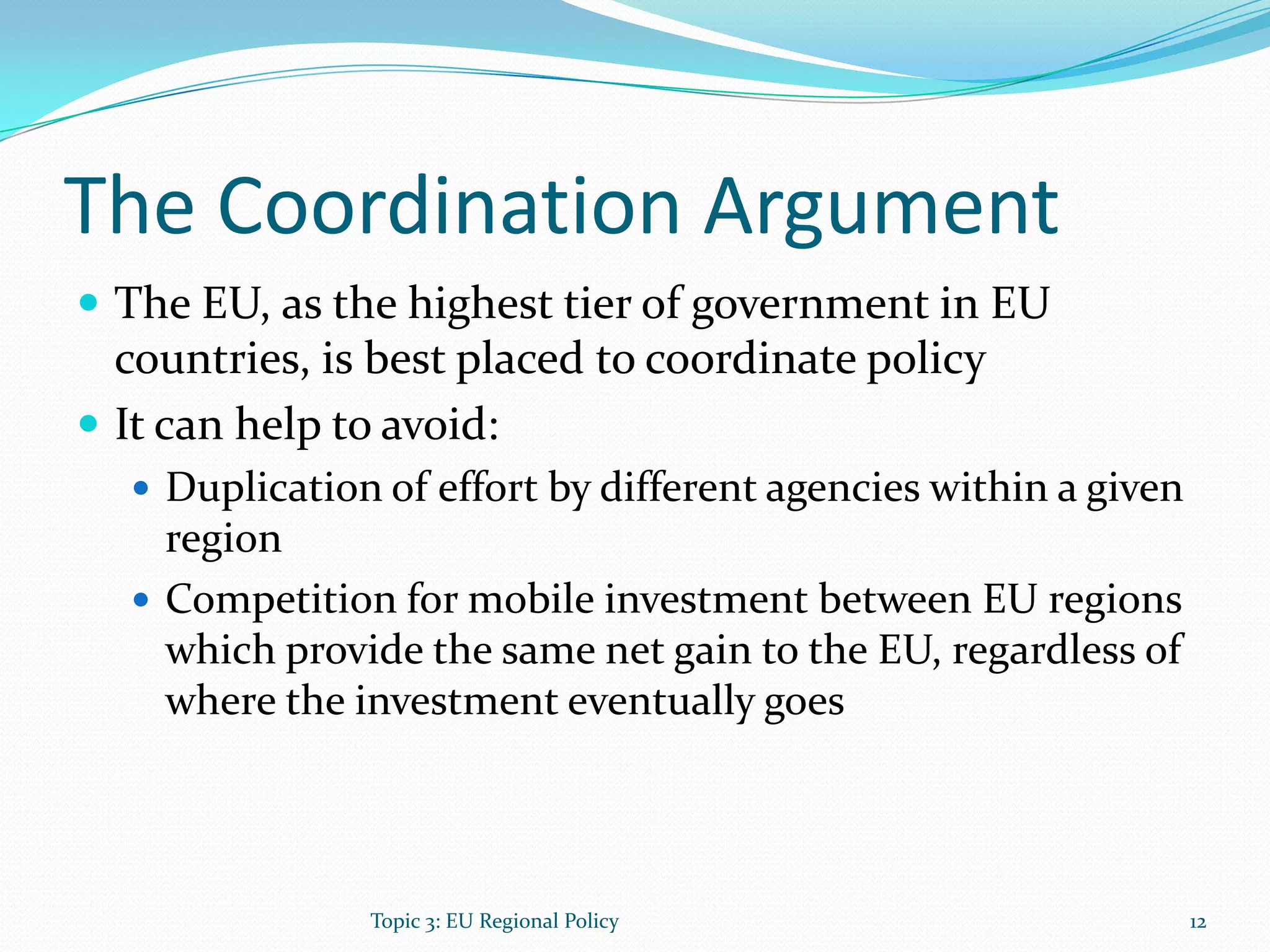
The Coordination Argument
 The EU, as the highest tier of government in EU
countries, is best placed to coordinate policy
 It can help to avoid:
 Duplication of effort by different agencies within a given
region
 Competition for mobile investment between EU regions
which provide the same net gain to the EU, regardless of
where the investment eventually goes
12Topic 3: EU Regional Policy
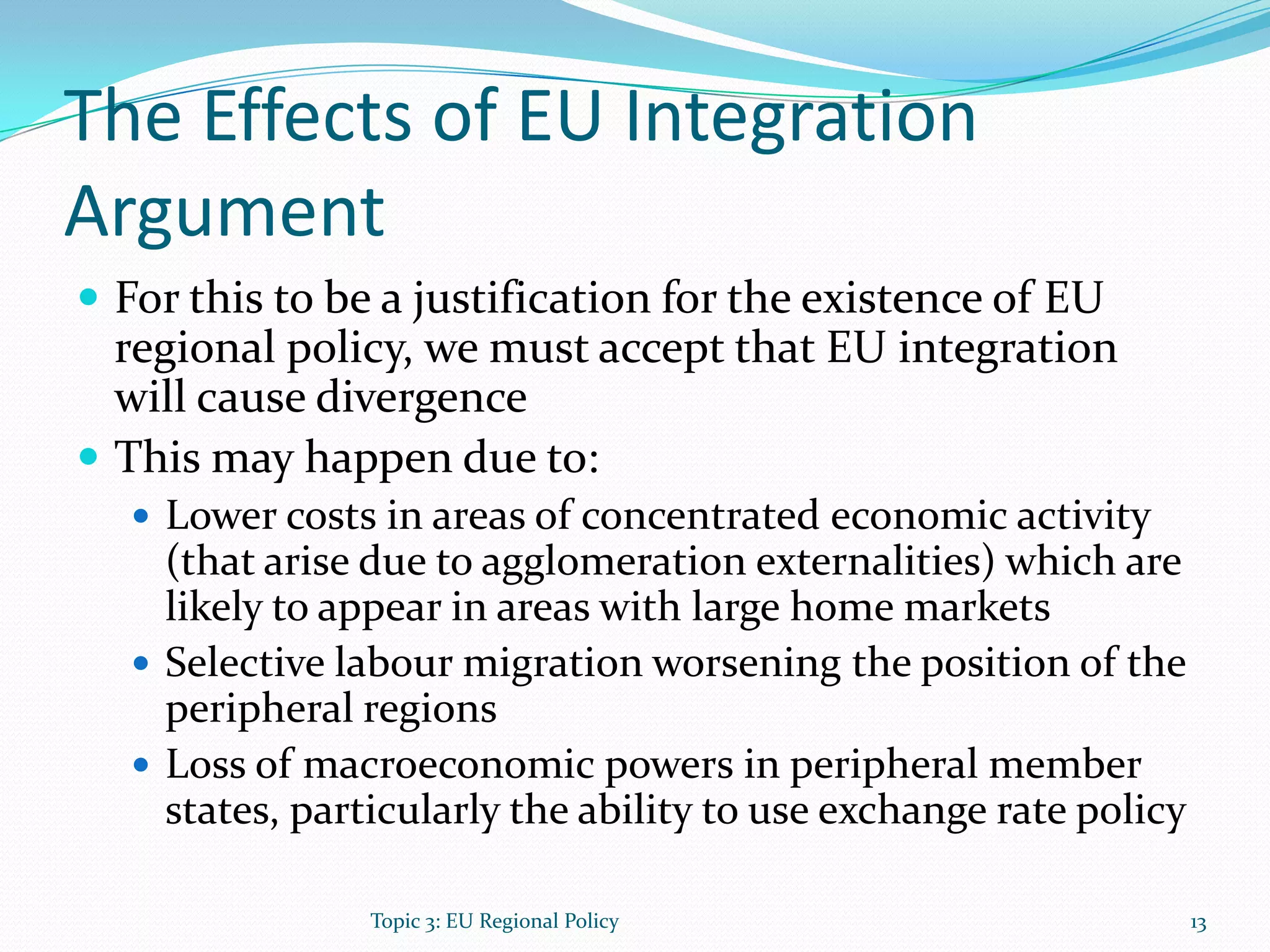
The Effects of EU Integration
Argument
 For this to be a justification for the existence of EU
regional policy, we must accept that EU integration
will cause divergence
 This may happen due to:
 Lower costs in areas of concentrated economic activity
(that arise due to agglomeration externalities) which are
likely to appear in areas with large home markets
 Selective labour migration worsening the position of the
peripheral regions
 Loss of macroeconomic powers in peripheral member
states, particularly the ability to use exchange rate policy
13Topic 3: EU Regional Policy
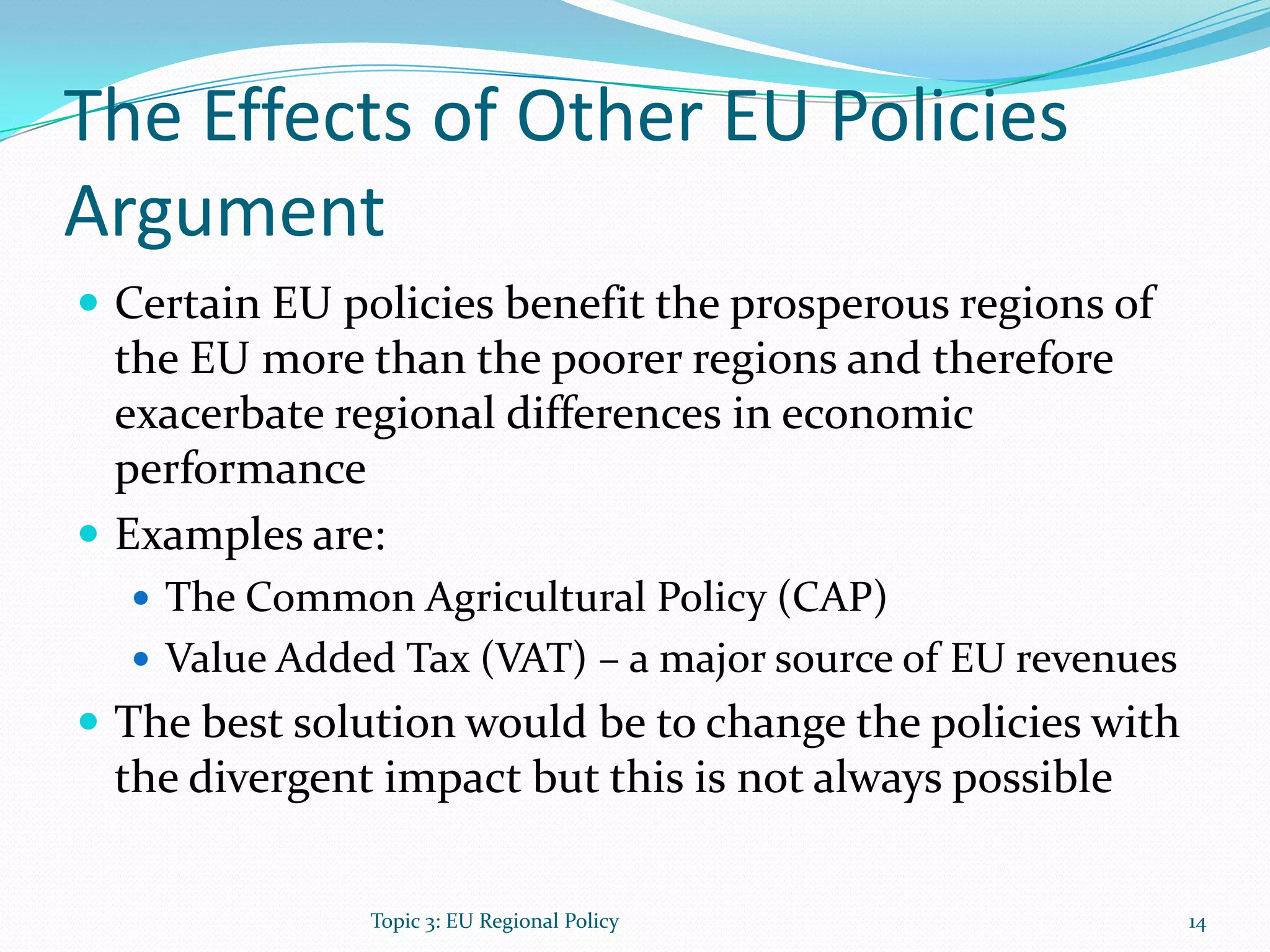
The Effects of Other EU Policies
Argument
 Certain EU policies benefit the prosperous regions of
the EU more than the poorer regions and therefore
exacerbate regional differences in economic
performance
 Examples are:
 The Common Agricultural Policy (CAP)
 Value Added Tax (VAT) – a major source of EU revenues
 The best solution would be to change the policies with
the divergent impact but this is not always possible
14Topic 3: EU Regional Policy
Centralisation Versus
Decentralisation of Regional Policy
 But none of these arguments imply that EU regional
policy should wholly replace UK regional policy
 This is because decentralised regional policy has
certain benefits. For instance, it allows:
 Local knowledge and experience to be used in the
design of policies
 Diversification and experimentation in policy
 Greater accountability in regional policy
Topic 3: EU Regional Policy 15
History of EU Regional Policy
 The Treaty of Rome (1958) stated that:
‘(Member states of the) European Economic Community are
anxious to ensure their harmonious development by reducing
the differences existing between the various regions and the
backwardness of the less favoured regions’
 The Directorate-General for Regional Policy of the
European Commission was established in 1968
 The UK joined the European Economic Community in 1973
 EU regional policy began in earnest in 1975 with the
creation of the European Regional Development Fund
(ERDF)
16Topic 3: EU Regional Policy
History of EU Regional Policy
 Initially, EU regional policy did similar things to
regional policy in member countries so, in the UK, it
mostly provided capital subsidies in the same way as
the RSA scheme (see last lecture)
 EU regional policy was fundamentally reformed in
1989 and, since then, money has been spent not on a
project-by-project basis but on ‘programmes of
assistance’
 The accession of 10 relatively poor countries in 2004
led to a large increase in expenditure on regional
policy
17Topic 3: EU Regional Policy
Organisation of EU Regional Policy
 Currently, EU regional
(or cohesion) policy has
three objectives and
three funds with which
to achieve these
objectives
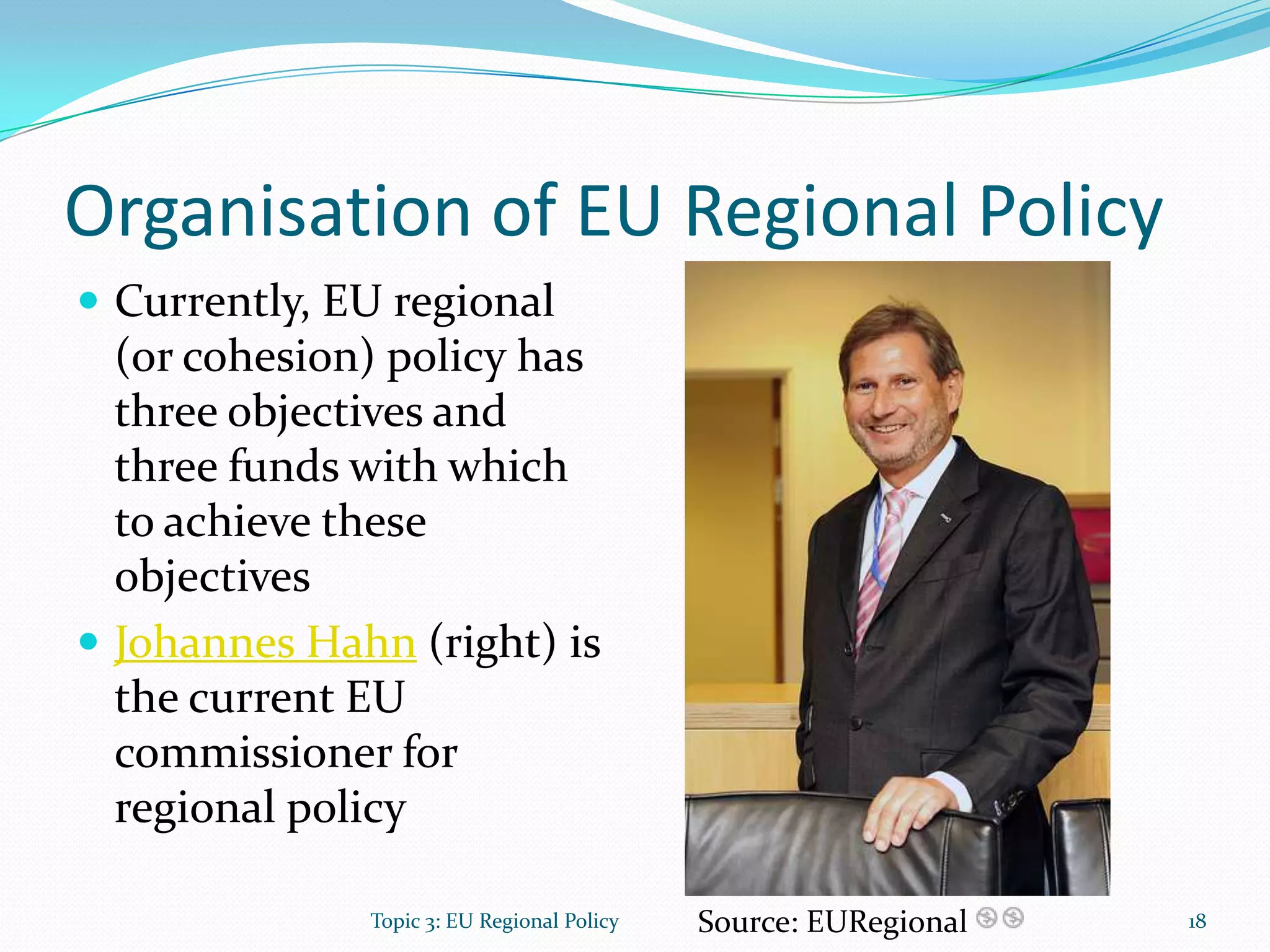
 Johannes Hahn (right) is
the current EU
commissioner for
regional policy
Source: EURegional 18Topic 3: EU Regional Policy
EU Regional Policy Principles
 Concentration
 Of resources - on the poorest regions
 Of effort - on the knowledge economy in 2007-13
 Of spending - by the end of the second year after their allocation
 Programming
 Cohesion policy funds multi-annual, multi-project, multi-partner
programmes on the basis of an Operational Programme Document
 Partnership
 Each programme is developed through a collective process
involving authorities at European, regional and local level, social
partners and organisations from civil society
 Additionality
 Financing from the European structural funds may not replace
national spending by a member country
Topic 3: EU Regional Policy 19
EU Regional Policy Objectives
 Convergence – solidarity
among nations
 Regional
Competitiveness and
Employment
 European territorial
cooperation
 The pie chart shows the
amount of money (€
billion) allocated to each
objective for 2007-2013
283.3
55
8.7
Convergence
Regional Competitiveness & Employment
European Territorial Cooperation
20Topic 3: EU Regional Policy
Source: EU (2011)
EU Regional Aid Map
Source: EU (2011)
21Topic 3: EU Regional Policy
Cohesion Policy Spending (2007-
2013) by Country (€ million)
Source: EU(2012) 22Topic 3: EU Regional Policy
Austria, 1,461 Belgium, 2,258 Bulgaria, 6,853
Cyprus, 640
Czech Republic, 26,692
Germany, 26,340
Denmark, 613
Estonia, 3,456
Spain, 35,217
Finland, 1,716
France, 14,319
Greece, 20,420
Hungary, 25,307
Ireland, 901
Italy, 28,812
Lithuania, 6,885Luxembourg, 65
Latvia, 4,620
Malta, 855
Netherlands, 1,907
Poland, 67,284
Portugal, 21,511
Romania, 19,668
Sweden, 1,891 Slovenia, 4,205
Slovakia, 11,588
United Kingdom, 10,613
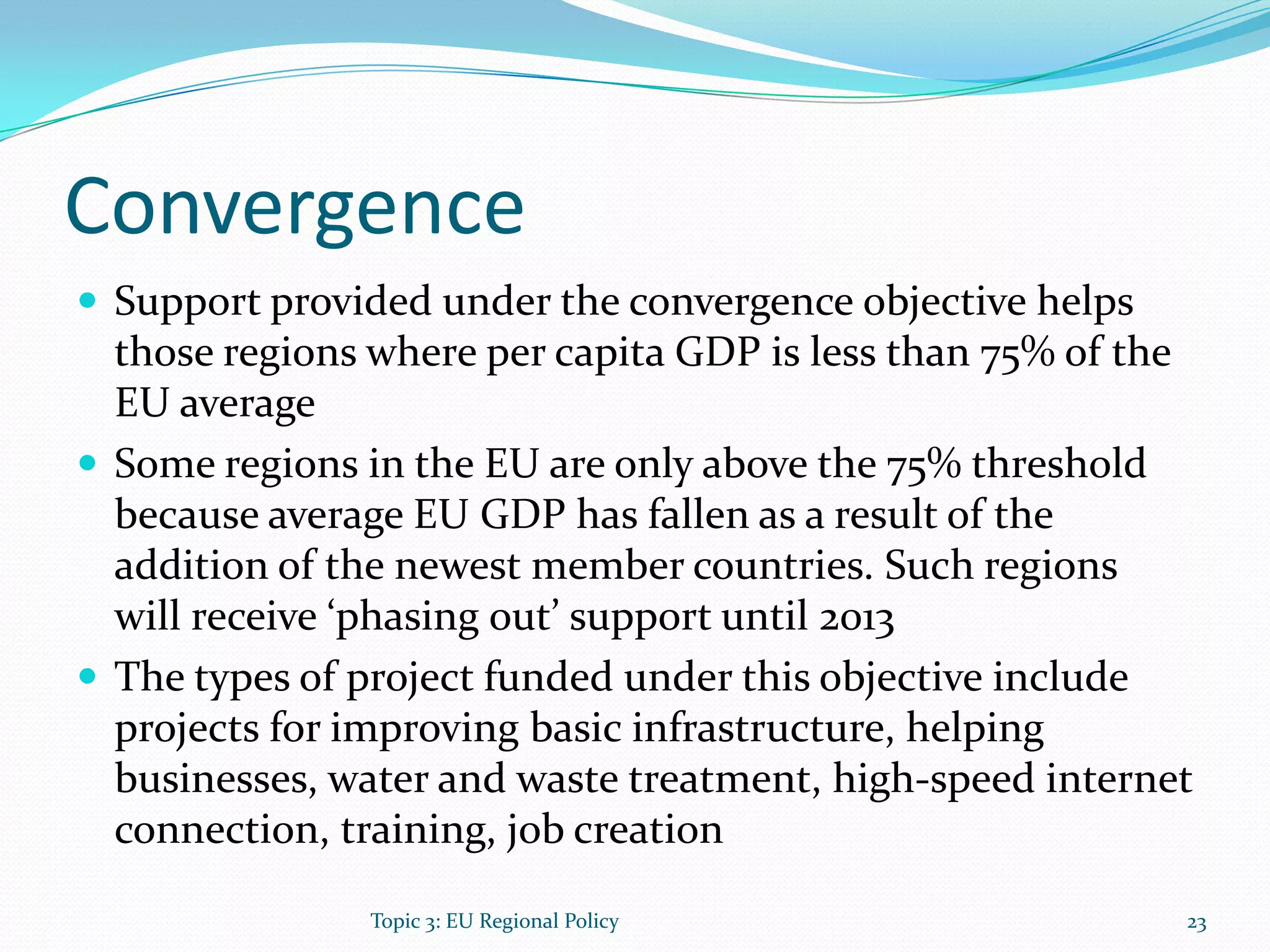
Convergence
 Support provided under the convergence objective helps
those regions where per capita GDP is less than 75% of the
EU average
 Some regions in the EU are only above the 75% threshold
because average EU GDP has fallen as a result of the
addition of the newest member countries. Such regions
will receive ‘phasing out’ support until 2013
 The types of project funded under this objective include
projects for improving basic infrastructure, helping
businesses, water and waste treatment, high-speed internet
connection, training, job creation
23Topic 3: EU Regional Policy
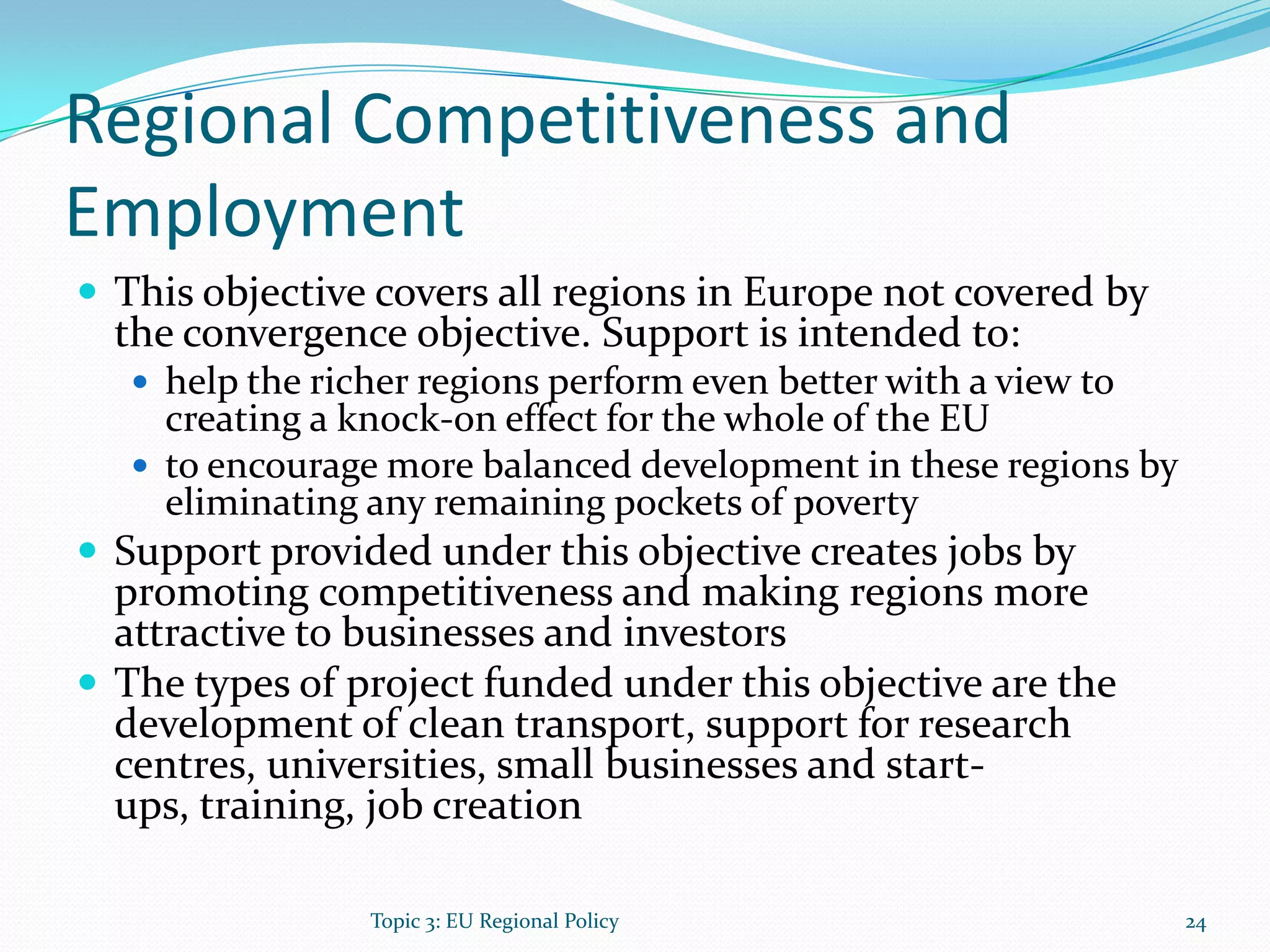
Regional Competitiveness and
Employment
 This objective covers all regions in Europe not covered by
the convergence objective. Support is intended to:
 help the richer regions perform even better with a view to
creating a knock-on effect for the whole of the EU
 to encourage more balanced development in these regions by
eliminating any remaining pockets of poverty
 Support provided under this objective creates jobs by
promoting competitiveness and making regions more
attractive to businesses and investors
 The types of project funded under this objective are the
development of clean transport, support for research
centres, universities, small businesses and start-
ups, training, job creation
24Topic 3: EU Regional Policy
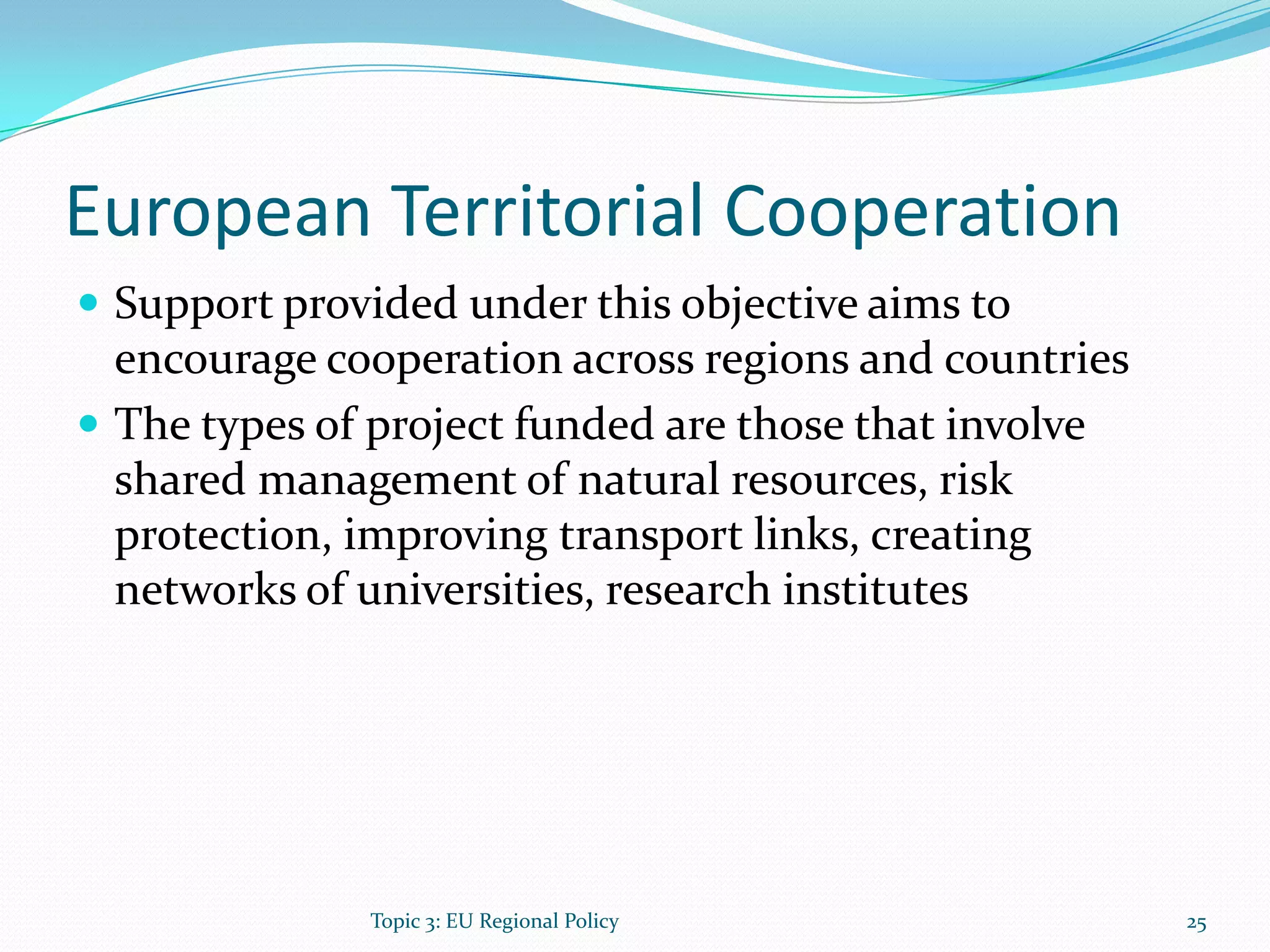
European Territorial Cooperation
 Support provided under this objective aims to
encourage cooperation across regions and countries
 The types of project funded are those that involve
shared management of natural resources, risk
protection, improving transport links, creating
networks of universities, research institutes
25Topic 3: EU Regional Policy
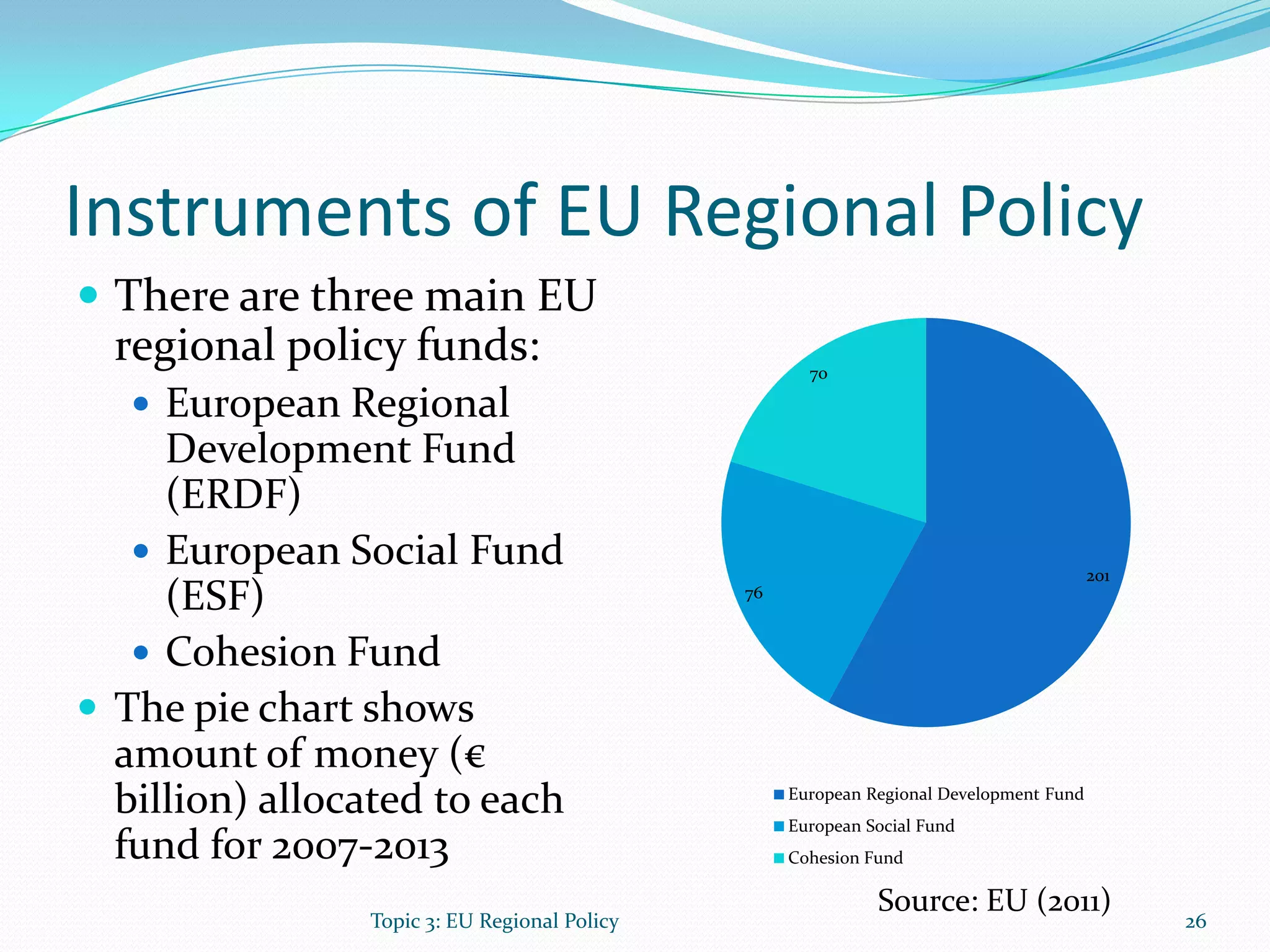
Instruments of EU Regional Policy
 There are three main EU
regional policy funds:
 European Regional
Development Fund
(ERDF)
 European Social Fund
(ESF)
 Cohesion Fund
 The pie chart shows
amount of money (€
billion) allocated to each
fund for 2007-2013
201
76
70
European Regional Development Fund
European Social Fund
Cohesion Fund
26Topic 3: EU Regional Policy
Source: EU (2011)
Instruments of EU Regional Policy
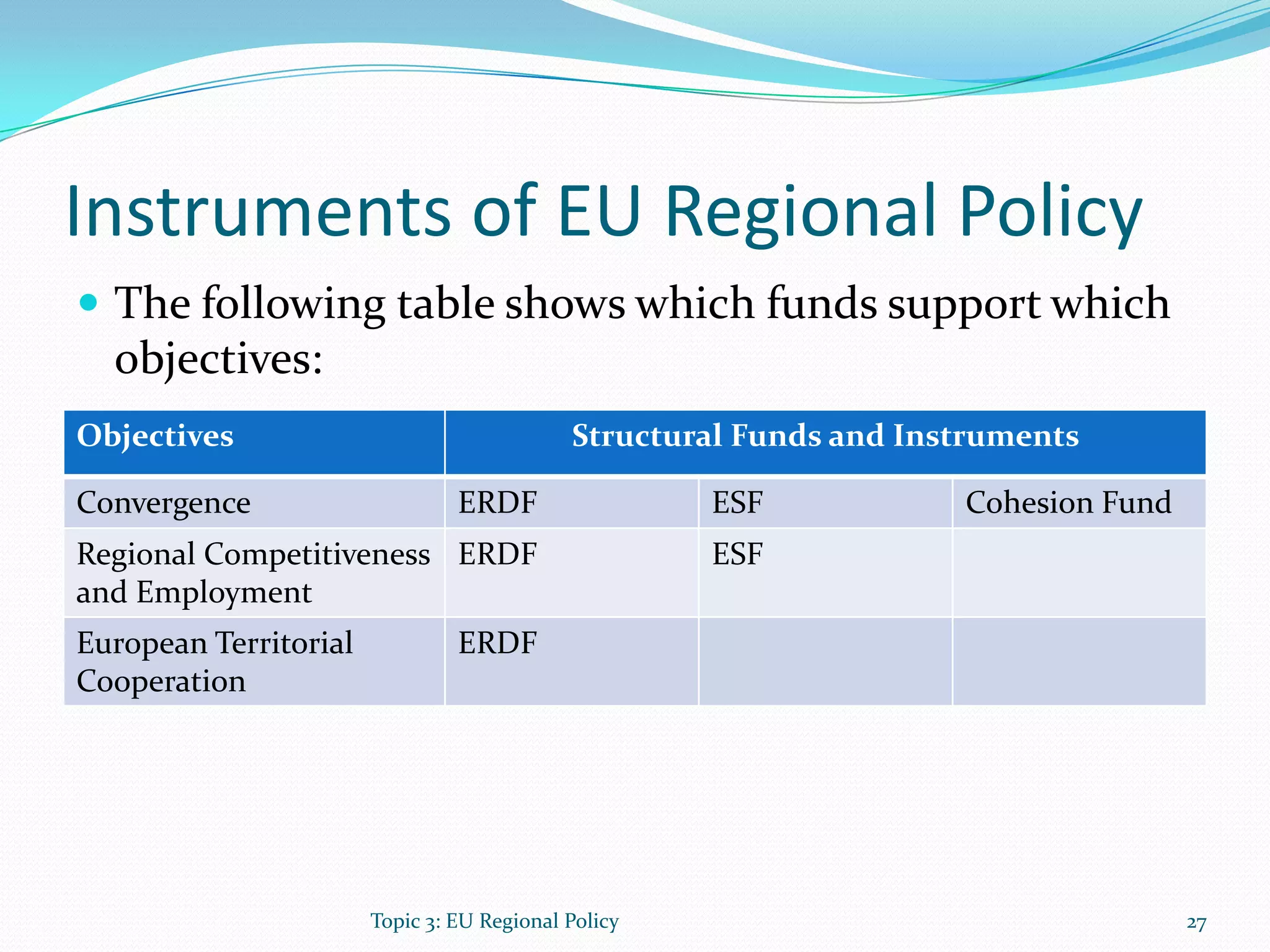
 The following table shows which funds support which
objectives:
Topic 3: EU Regional Policy 27
Objectives Structural Funds and Instruments
Convergence ERDF ESF Cohesion Fund
Regional Competitiveness
and Employment
ERDF ESF
European Territorial
Cooperation
ERDF
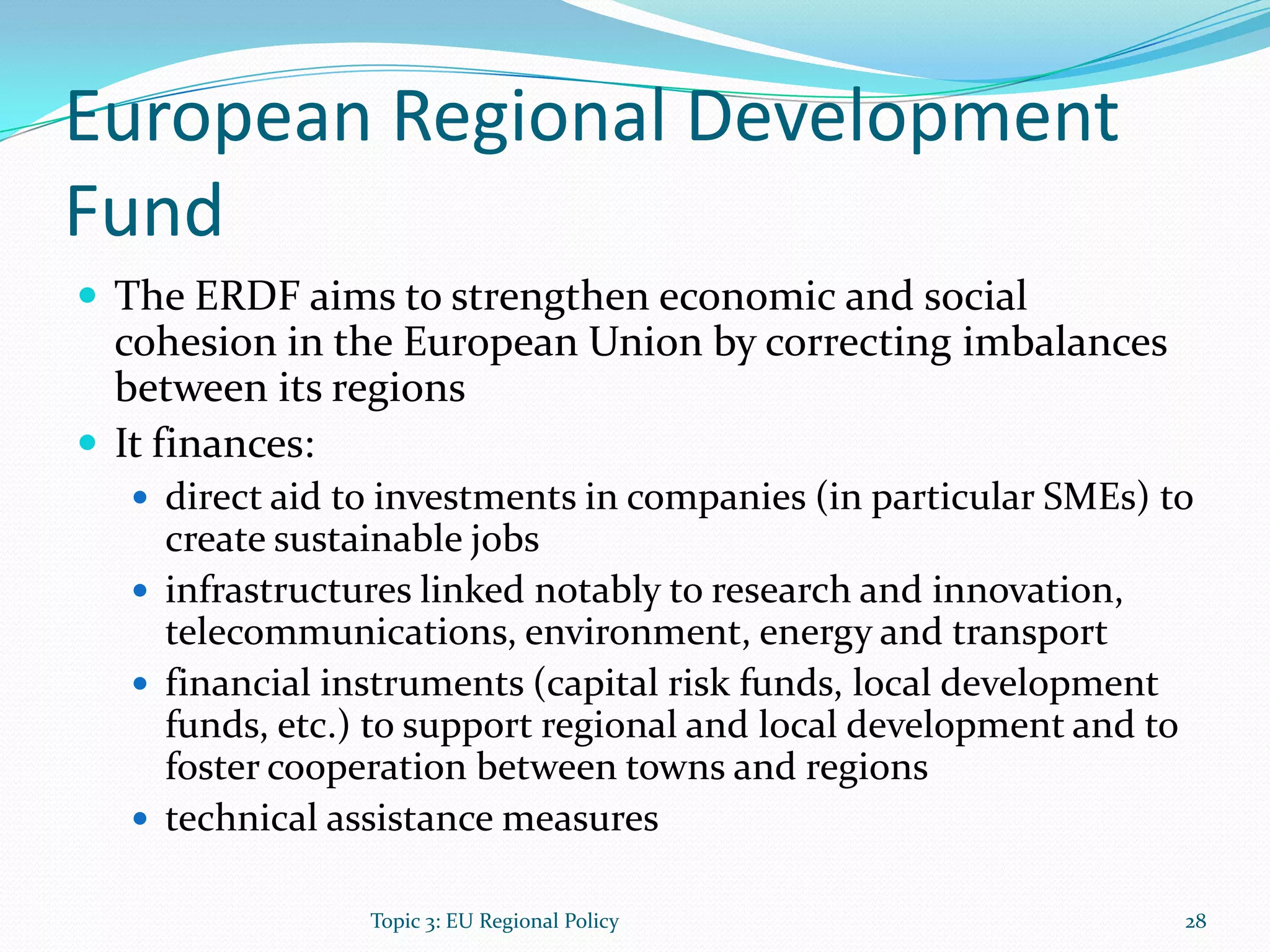
European Regional Development
Fund
 The ERDF aims to strengthen economic and social
cohesion in the European Union by correcting imbalances
between its regions
 It finances:
 direct aid to investments in companies (in particular SMEs) to
create sustainable jobs
 infrastructures linked notably to research and innovation,
telecommunications, environment, energy and transport
 financial instruments (capital risk funds, local development
funds, etc.) to support regional and local development and to
foster cooperation between towns and regions
 technical assistance measures
28Topic 3: EU Regional Policy
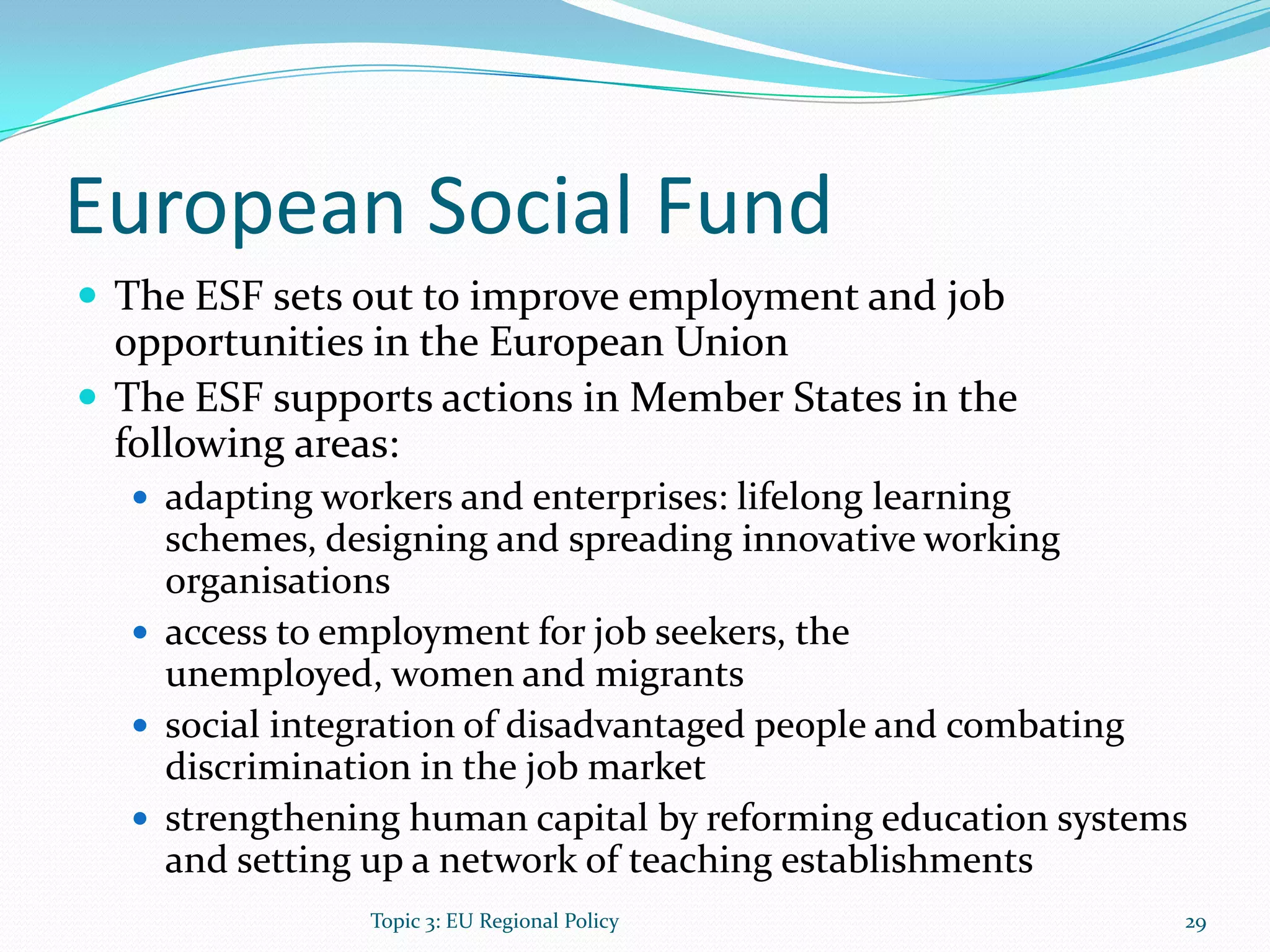
European Social Fund
 The ESF sets out to improve employment and job
opportunities in the European Union
 The ESF supports actions in Member States in the
following areas:
 adapting workers and enterprises: lifelong learning
schemes, designing and spreading innovative working
organisations
 access to employment for job seekers, the
unemployed, women and migrants
 social integration of disadvantaged people and combating
discrimination in the job market
 strengthening human capital by reforming education systems
and setting up a network of teaching establishments
29Topic 3: EU Regional Policy
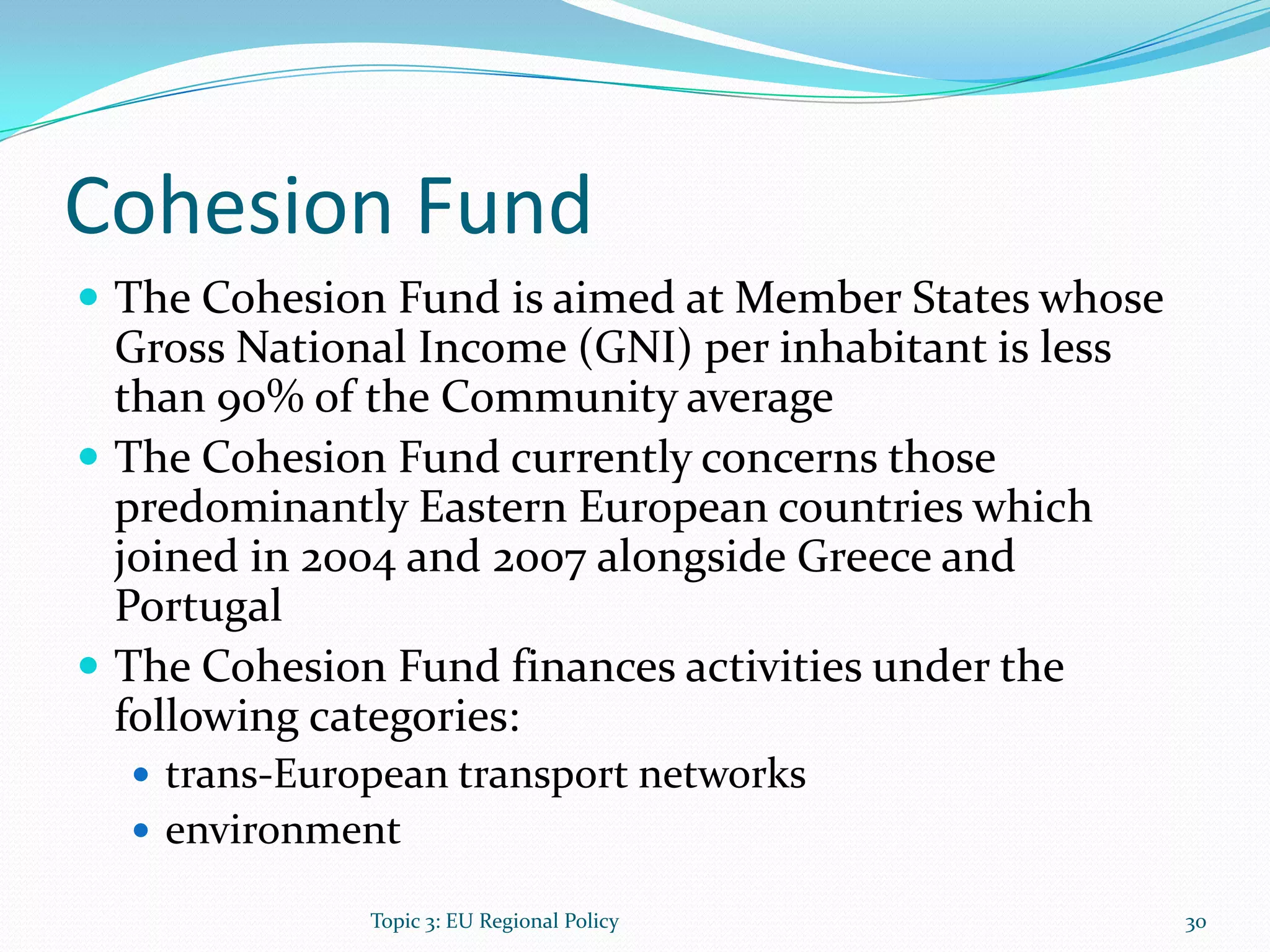
Cohesion Fund
 The Cohesion Fund is aimed at Member States whose
Gross National Income (GNI) per inhabitant is less
than 90% of the Community average
 The Cohesion Fund currently concerns those
predominantly Eastern European countries which
joined in 2004 and 2007 alongside Greece and
Portugal
 The Cohesion Fund finances activities under the
following categories:
 trans-European transport networks
 environment
30Topic 3: EU Regional Policy
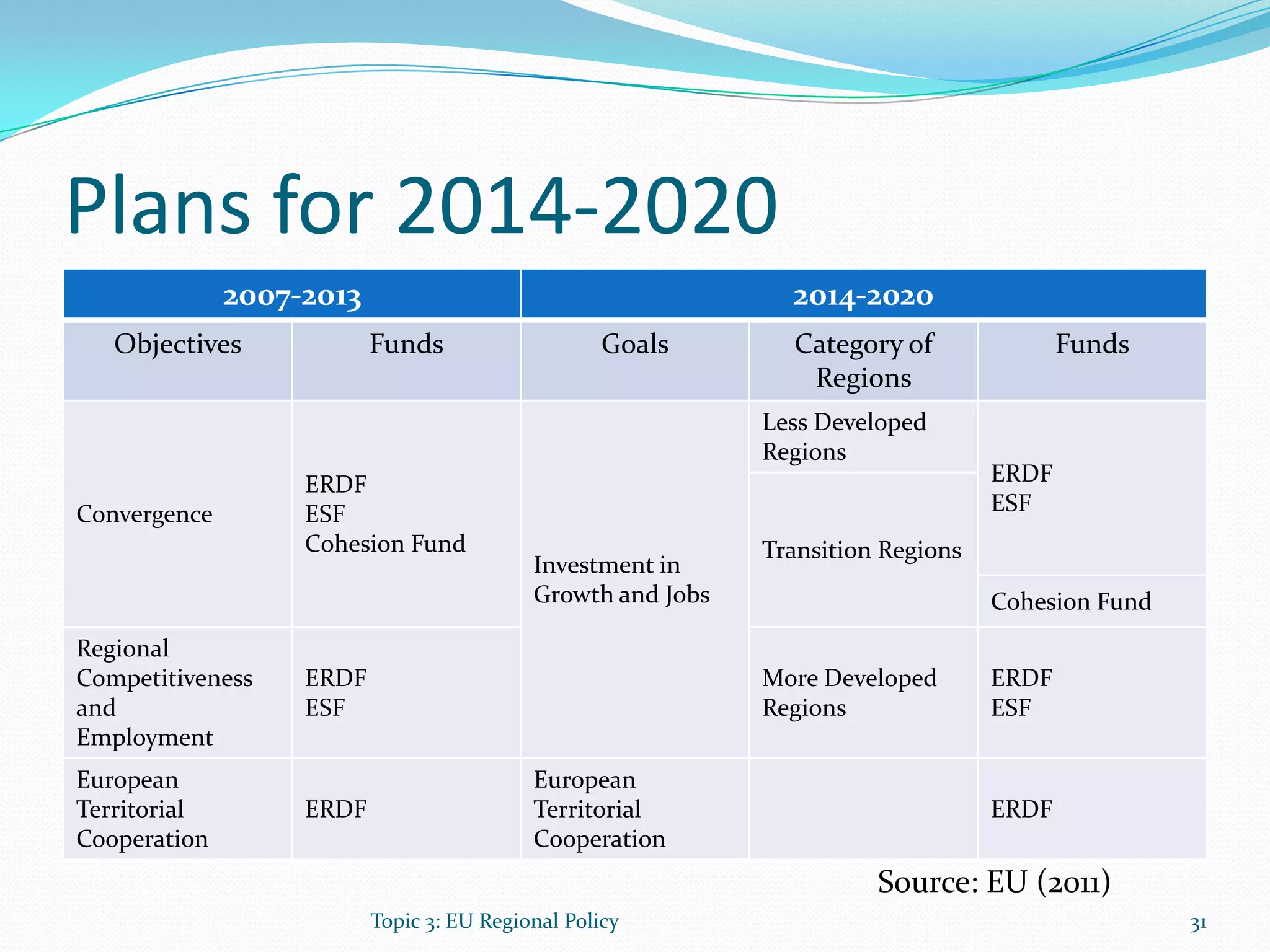
Plans for 2014-2020
2007-2013 2014-2020
Objectives Funds Goals Category of
Regions
Funds
Convergence
ERDF
ESF
Cohesion Fund
Investment in
Growth and Jobs
Less Developed
Regions
ERDF
ESF
Transition Regions
Cohesion Fund
Regional
Competitiveness
and
Employment
ERDF
ESF
More Developed
Regions
ERDF
ESF
European
Territorial
Cooperation
ERDF
European
Territorial
Cooperation
ERDF
Topic 3: EU Regional Policy 31
Source: EU (2011)
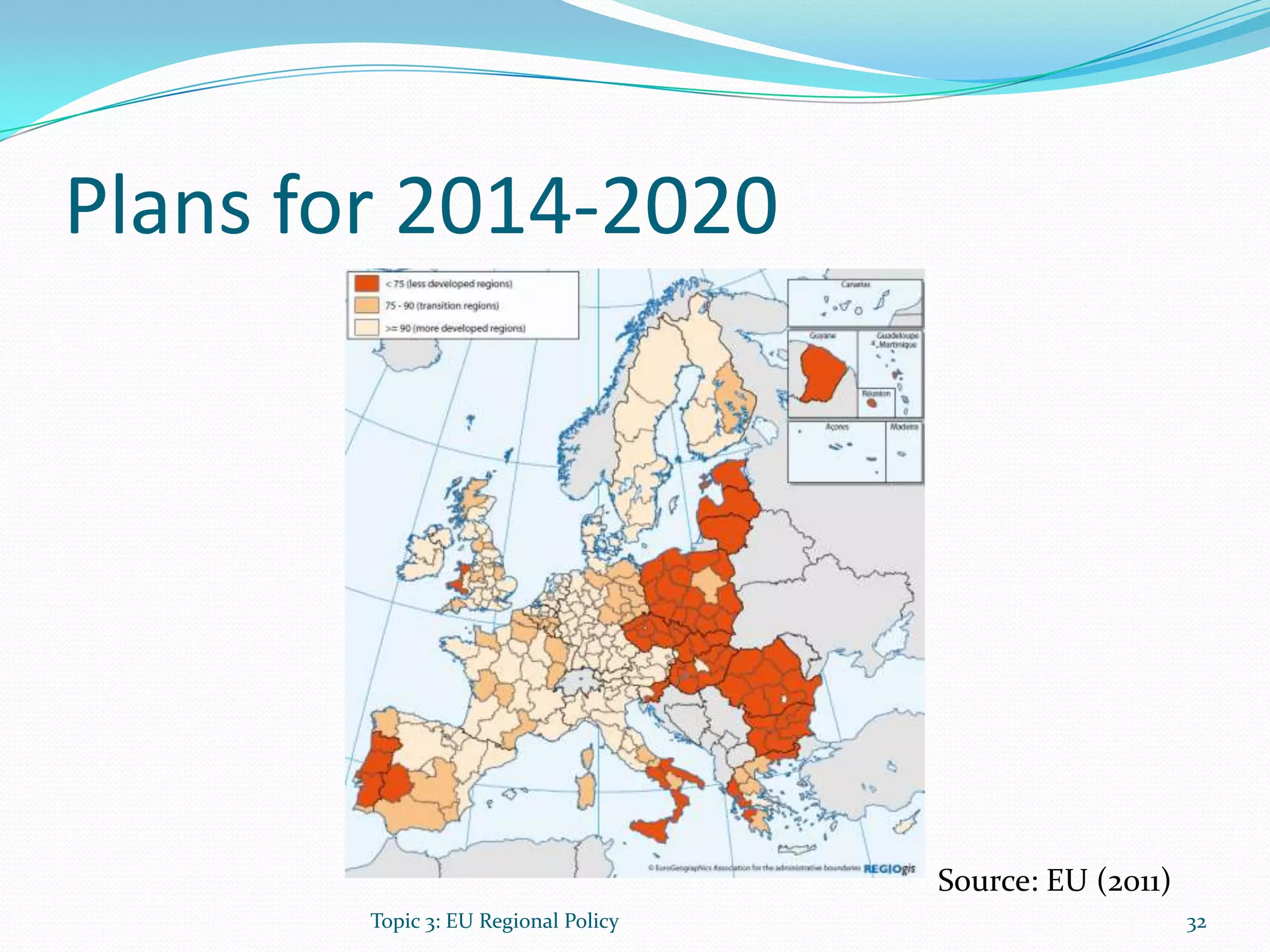
Plans for 2014-2020
Topic 3: EU Regional Policy 32
Source: EU (2011)
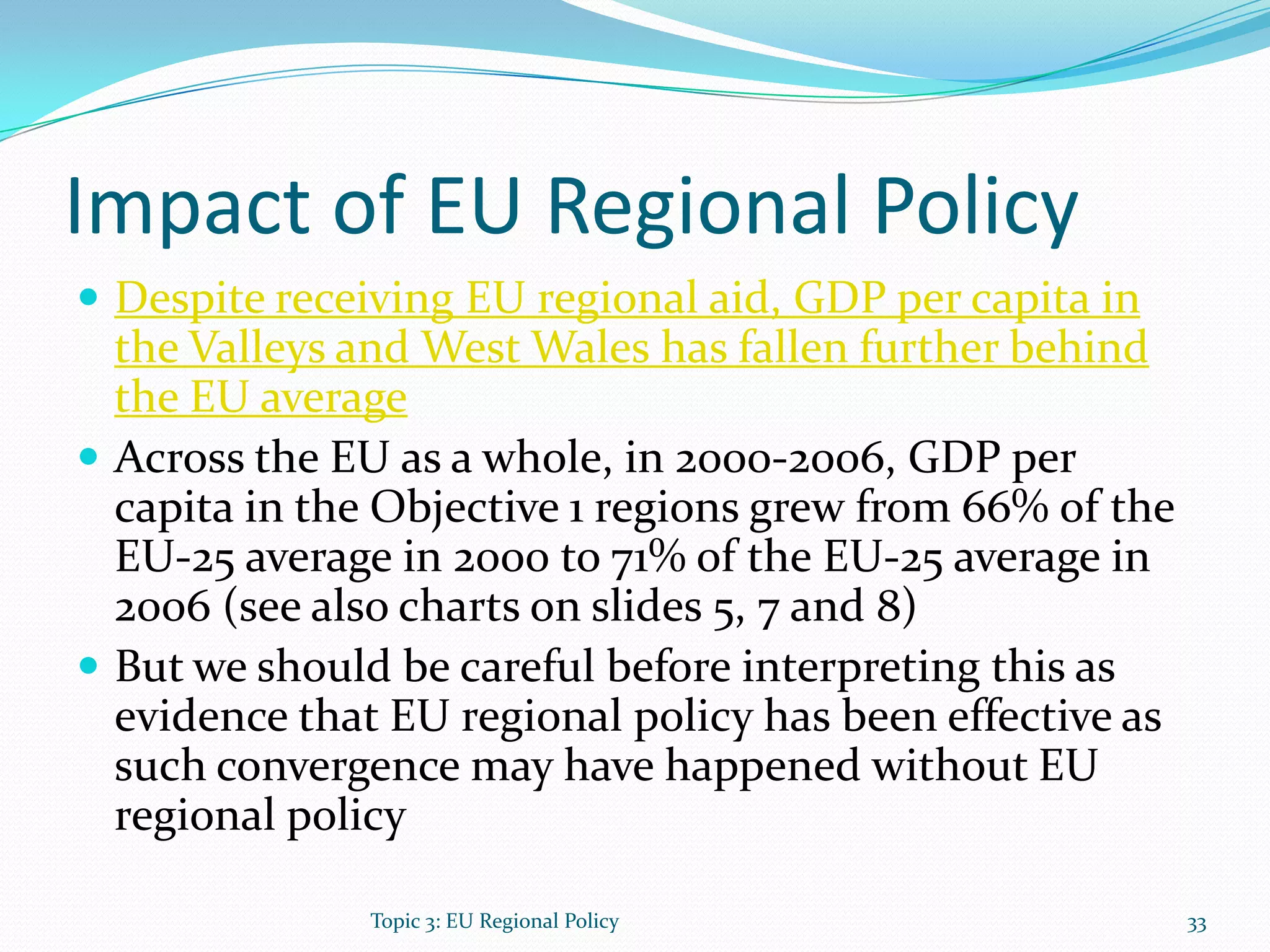
Impact of EU Regional Policy
 Despite receiving EU regional aid, GDP per capita in
the Valleys and West Wales has fallen further behind
the EU average
 Across the EU as a whole, in 2000-2006, GDP per
capita in the Objective 1 regions grew from 66% of the
EU-25 average in 2000 to 71% of the EU-25 average in
2006 (see also charts on slides 5, 7 and 8)
 But we should be careful before interpreting this as
evidence that EU regional policy has been effective as
such convergence may have happened without EU
regional policy
Topic 3: EU Regional Policy 33
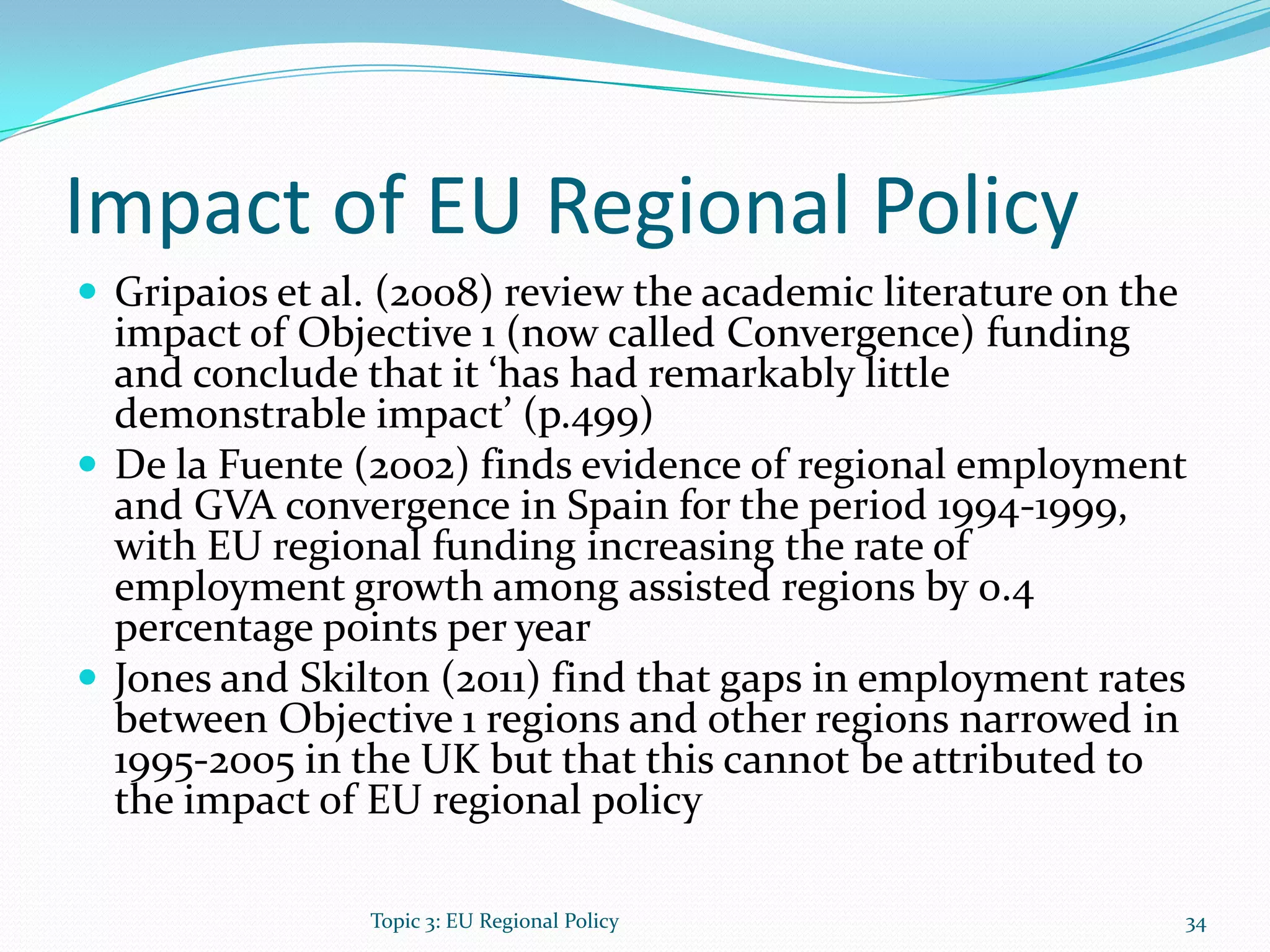
Impact of EU Regional Policy
 Gripaios et al. (2008) review the academic literature on the
impact of Objective 1 (now called Convergence) funding
and conclude that it ‘has had remarkably little
demonstrable impact’ (p.499)
 De la Fuente (2002) finds evidence of regional employment
and GVA convergence in Spain for the period 1994-1999,
with EU regional funding increasing the rate of
employment growth among assisted regions by 0.4
percentage points per year
 Jones and Skilton (2011) find that gaps in employment rates
between Objective 1 regions and other regions narrowed in
1995-2005 in the UK but that this cannot be attributed to
the impact of EU regional policy
Topic 3: EU Regional Policy 34
Summary
 There are very large disparities in economic
performance across the EU
 There is a case for EU regional policy in addition to
regional policy at the national level
 Current EU regional policy has three objectives
(convergence, regional competitiveness and
employment and European territorial cooperation)
and three funds to achieve these objectives (ERDF, ESF
and the Cohesion fund)
 On balance, the empirical evidence suggests that EU
regional policy has not had a significant impact
35Topic 3: EU Regional Policy
Next topic:
DEVOLUTION
36Topic 3: EU Regional Policy

3 eu regional policy

  • 1.
    Dr John Moffat RichardPrice Building, Room F49 Email: J.D.Moffat@swansea.ac.uk Office Hours: Tuesday & Friday, 1:30-2:30pm
  • 2.
    Learning Outcomes  Studentsshould be able to answer the following questions:  Describe current disparities in economic performance across the EU  Is there a case for an EU-wide regional policy superimposed upon a set of ‘national’ regional policies?  What are the current objectives and instruments of EU regional policy?  Has EU regional policy had an impact? 2Topic 3: EU Regional Policy
  • 3.
    Readings  Armstrong &Taylor, chapter 11 (note that some parts of this are rather outdated)  Armstrong, H. (2011), ‘Regional Policy’ in El-Agraa, A, The European Union: Economics and Policies, 9th ed. Cambridge: Cambridge University Press  EU (2011), The urban and regional dimension of Europe 2020: Seventh progress report on economic, social and territorial cohesion, Available from: http://ec.europa.eu/regional_policy/sources/docoffic/official/re ports/interim7/interim7_en.pdf  Gripaios, P., Bishop, P., Hart, T. & McVittie, E. (2008), ‘Analysing the impact of Objective 1 funding in Europe: a review,’ Environment and Planning, Available from: http://www.envplan.com/abstract.cgi?id=c64m 3Topic 3: EU Regional Policy
  • 4.
    GDP Per Head(PPS), 2008 Source: EU (2011) 4Topic 3: EU Regional Policy
  • 5.
    Change in GDPPer Head (PPS), 2000–2008 Topic 3: EU Regional Policy 5 Source: EU (2011)
  • 6.
    Unemployment Rates, 2010 Source:EU (2011) 6Topic 3: EU Regional Policy
  • 7.
    Change in Unemployment Rates,2007-2010 Topic 3: EU Regional Policy 7 Source: EU (2011)
  • 8.
    Coefficient of Variation:GDP per head, NUTS 2 regions Topic 3: EU Regional Policy 8 Source: Monfort (2006)
  • 9.
    EU Regional Policy According to Armstrong (2011) there are five main arguments for an EU regional policy:  The vested interest argument  The financial targeting argument  The coordination argument  The effects of EU integration argument  The effects of other EU policies argument 9Topic 3: EU Regional Policy
  • 10.
    The Vested InterestArgument  The economic well-being of citizens in one member state is dependent on the prosperity of other member states  This is because greater prosperity in other members states will lead to:  Greater demand from other regions  Reduced congestion  A more controversial argument in favour of a regional policy is that individuals in a given member state benefit if other regions are prospering because this helps the ‘European project’ of greater economic integration 10Topic 3: EU Regional Policy
  • 11.
    The Financial TargetingArgument  The disadvantaged EU regions are not evenly distributed among member states  Those countries with the most deprived regions (such as Poland and Greece) will have the greatest difficulty in financing a proper regional policy while countries with less severe regional problems (such as Germany and the UK) can afford generous regional policies  The EU can facilitate the necessary transfers across countries so that assistance can be targeted on those regions where it is most required 11Topic 3: EU Regional Policy
  • 12.
    The Coordination Argument The EU, as the highest tier of government in EU countries, is best placed to coordinate policy  It can help to avoid:  Duplication of effort by different agencies within a given region  Competition for mobile investment between EU regions which provide the same net gain to the EU, regardless of where the investment eventually goes 12Topic 3: EU Regional Policy
  • 13.
    The Effects ofEU Integration Argument  For this to be a justification for the existence of EU regional policy, we must accept that EU integration will cause divergence  This may happen due to:  Lower costs in areas of concentrated economic activity (that arise due to agglomeration externalities) which are likely to appear in areas with large home markets  Selective labour migration worsening the position of the peripheral regions  Loss of macroeconomic powers in peripheral member states, particularly the ability to use exchange rate policy 13Topic 3: EU Regional Policy
  • 14.
    The Effects ofOther EU Policies Argument  Certain EU policies benefit the prosperous regions of the EU more than the poorer regions and therefore exacerbate regional differences in economic performance  Examples are:  The Common Agricultural Policy (CAP)  Value Added Tax (VAT) – a major source of EU revenues  The best solution would be to change the policies with the divergent impact but this is not always possible 14Topic 3: EU Regional Policy
  • 15.
    Centralisation Versus Decentralisation ofRegional Policy  But none of these arguments imply that EU regional policy should wholly replace UK regional policy  This is because decentralised regional policy has certain benefits. For instance, it allows:  Local knowledge and experience to be used in the design of policies  Diversification and experimentation in policy  Greater accountability in regional policy Topic 3: EU Regional Policy 15
  • 16.
    History of EURegional Policy  The Treaty of Rome (1958) stated that: ‘(Member states of the) European Economic Community are anxious to ensure their harmonious development by reducing the differences existing between the various regions and the backwardness of the less favoured regions’  The Directorate-General for Regional Policy of the European Commission was established in 1968  The UK joined the European Economic Community in 1973  EU regional policy began in earnest in 1975 with the creation of the European Regional Development Fund (ERDF) 16Topic 3: EU Regional Policy
  • 17.
    History of EURegional Policy  Initially, EU regional policy did similar things to regional policy in member countries so, in the UK, it mostly provided capital subsidies in the same way as the RSA scheme (see last lecture)  EU regional policy was fundamentally reformed in 1989 and, since then, money has been spent not on a project-by-project basis but on ‘programmes of assistance’  The accession of 10 relatively poor countries in 2004 led to a large increase in expenditure on regional policy 17Topic 3: EU Regional Policy
  • 18.
    Organisation of EURegional Policy  Currently, EU regional (or cohesion) policy has three objectives and three funds with which to achieve these objectives  Johannes Hahn (right) is the current EU commissioner for regional policy Source: EURegional 18Topic 3: EU Regional Policy
  • 19.
    EU Regional PolicyPrinciples  Concentration  Of resources - on the poorest regions  Of effort - on the knowledge economy in 2007-13  Of spending - by the end of the second year after their allocation  Programming  Cohesion policy funds multi-annual, multi-project, multi-partner programmes on the basis of an Operational Programme Document  Partnership  Each programme is developed through a collective process involving authorities at European, regional and local level, social partners and organisations from civil society  Additionality  Financing from the European structural funds may not replace national spending by a member country Topic 3: EU Regional Policy 19
  • 20.
    EU Regional PolicyObjectives  Convergence – solidarity among nations  Regional Competitiveness and Employment  European territorial cooperation  The pie chart shows the amount of money (€ billion) allocated to each objective for 2007-2013 283.3 55 8.7 Convergence Regional Competitiveness & Employment European Territorial Cooperation 20Topic 3: EU Regional Policy Source: EU (2011)
  • 21.
    EU Regional AidMap Source: EU (2011) 21Topic 3: EU Regional Policy
  • 22.
    Cohesion Policy Spending(2007- 2013) by Country (€ million) Source: EU(2012) 22Topic 3: EU Regional Policy Austria, 1,461 Belgium, 2,258 Bulgaria, 6,853 Cyprus, 640 Czech Republic, 26,692 Germany, 26,340 Denmark, 613 Estonia, 3,456 Spain, 35,217 Finland, 1,716 France, 14,319 Greece, 20,420 Hungary, 25,307 Ireland, 901 Italy, 28,812 Lithuania, 6,885Luxembourg, 65 Latvia, 4,620 Malta, 855 Netherlands, 1,907 Poland, 67,284 Portugal, 21,511 Romania, 19,668 Sweden, 1,891 Slovenia, 4,205 Slovakia, 11,588 United Kingdom, 10,613
  • 23.
    Convergence  Support providedunder the convergence objective helps those regions where per capita GDP is less than 75% of the EU average  Some regions in the EU are only above the 75% threshold because average EU GDP has fallen as a result of the addition of the newest member countries. Such regions will receive ‘phasing out’ support until 2013  The types of project funded under this objective include projects for improving basic infrastructure, helping businesses, water and waste treatment, high-speed internet connection, training, job creation 23Topic 3: EU Regional Policy
  • 24.
    Regional Competitiveness and Employment This objective covers all regions in Europe not covered by the convergence objective. Support is intended to:  help the richer regions perform even better with a view to creating a knock-on effect for the whole of the EU  to encourage more balanced development in these regions by eliminating any remaining pockets of poverty  Support provided under this objective creates jobs by promoting competitiveness and making regions more attractive to businesses and investors  The types of project funded under this objective are the development of clean transport, support for research centres, universities, small businesses and start- ups, training, job creation 24Topic 3: EU Regional Policy
  • 25.
    European Territorial Cooperation Support provided under this objective aims to encourage cooperation across regions and countries  The types of project funded are those that involve shared management of natural resources, risk protection, improving transport links, creating networks of universities, research institutes 25Topic 3: EU Regional Policy
  • 26.
    Instruments of EURegional Policy  There are three main EU regional policy funds:  European Regional Development Fund (ERDF)  European Social Fund (ESF)  Cohesion Fund  The pie chart shows amount of money (€ billion) allocated to each fund for 2007-2013 201 76 70 European Regional Development Fund European Social Fund Cohesion Fund 26Topic 3: EU Regional Policy Source: EU (2011)
  • 27.
    Instruments of EURegional Policy  The following table shows which funds support which objectives: Topic 3: EU Regional Policy 27 Objectives Structural Funds and Instruments Convergence ERDF ESF Cohesion Fund Regional Competitiveness and Employment ERDF ESF European Territorial Cooperation ERDF
  • 28.
    European Regional Development Fund The ERDF aims to strengthen economic and social cohesion in the European Union by correcting imbalances between its regions  It finances:  direct aid to investments in companies (in particular SMEs) to create sustainable jobs  infrastructures linked notably to research and innovation, telecommunications, environment, energy and transport  financial instruments (capital risk funds, local development funds, etc.) to support regional and local development and to foster cooperation between towns and regions  technical assistance measures 28Topic 3: EU Regional Policy
  • 29.
    European Social Fund The ESF sets out to improve employment and job opportunities in the European Union  The ESF supports actions in Member States in the following areas:  adapting workers and enterprises: lifelong learning schemes, designing and spreading innovative working organisations  access to employment for job seekers, the unemployed, women and migrants  social integration of disadvantaged people and combating discrimination in the job market  strengthening human capital by reforming education systems and setting up a network of teaching establishments 29Topic 3: EU Regional Policy
  • 30.
    Cohesion Fund  TheCohesion Fund is aimed at Member States whose Gross National Income (GNI) per inhabitant is less than 90% of the Community average  The Cohesion Fund currently concerns those predominantly Eastern European countries which joined in 2004 and 2007 alongside Greece and Portugal  The Cohesion Fund finances activities under the following categories:  trans-European transport networks  environment 30Topic 3: EU Regional Policy
  • 31.
    Plans for 2014-2020 2007-20132014-2020 Objectives Funds Goals Category of Regions Funds Convergence ERDF ESF Cohesion Fund Investment in Growth and Jobs Less Developed Regions ERDF ESF Transition Regions Cohesion Fund Regional Competitiveness and Employment ERDF ESF More Developed Regions ERDF ESF European Territorial Cooperation ERDF European Territorial Cooperation ERDF Topic 3: EU Regional Policy 31 Source: EU (2011)
  • 32.
    Plans for 2014-2020 Topic3: EU Regional Policy 32 Source: EU (2011)
  • 33.
    Impact of EURegional Policy  Despite receiving EU regional aid, GDP per capita in the Valleys and West Wales has fallen further behind the EU average  Across the EU as a whole, in 2000-2006, GDP per capita in the Objective 1 regions grew from 66% of the EU-25 average in 2000 to 71% of the EU-25 average in 2006 (see also charts on slides 5, 7 and 8)  But we should be careful before interpreting this as evidence that EU regional policy has been effective as such convergence may have happened without EU regional policy Topic 3: EU Regional Policy 33
  • 34.
    Impact of EURegional Policy  Gripaios et al. (2008) review the academic literature on the impact of Objective 1 (now called Convergence) funding and conclude that it ‘has had remarkably little demonstrable impact’ (p.499)  De la Fuente (2002) finds evidence of regional employment and GVA convergence in Spain for the period 1994-1999, with EU regional funding increasing the rate of employment growth among assisted regions by 0.4 percentage points per year  Jones and Skilton (2011) find that gaps in employment rates between Objective 1 regions and other regions narrowed in 1995-2005 in the UK but that this cannot be attributed to the impact of EU regional policy Topic 3: EU Regional Policy 34
  • 35.
    Summary  There arevery large disparities in economic performance across the EU  There is a case for EU regional policy in addition to regional policy at the national level  Current EU regional policy has three objectives (convergence, regional competitiveness and employment and European territorial cooperation) and three funds to achieve these objectives (ERDF, ESF and the Cohesion fund)  On balance, the empirical evidence suggests that EU regional policy has not had a significant impact 35Topic 3: EU Regional Policy
  • 36.