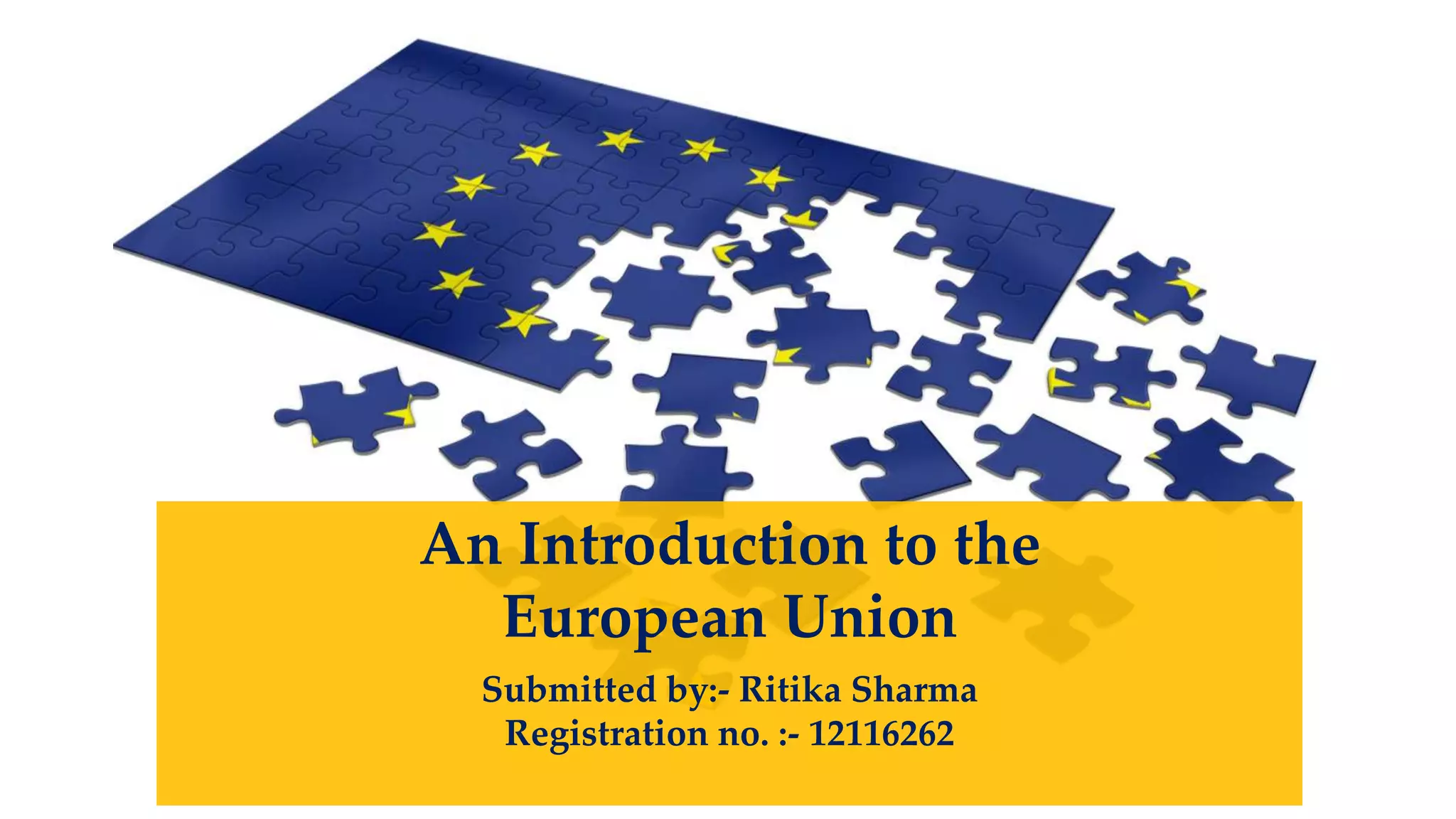
An Introduction to the
European Union
Submitted by:- Ritika Sharma
Registration no. :- 12116262
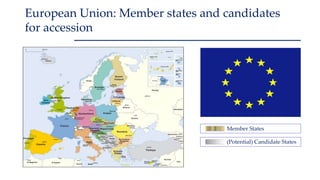
Member States
(Potential) Candidate States
European Union: Member states and candidates
for accession
 Origins of European integration: Integration initiatives launched in Western
Europe in aftermath of World War II; period marked by political and
economic reconstruction, beginning of Cold War
 Institutional foundations of today‘s European Union: Three Communities
created in 1950s: European Coal and Steel Community (ECSC), European
Atomic Energy Community (Euratom) and European Economic Community
(EEC), with six member states
 Three trajectories of development: (1) Accession of more member states
(“widening”); (2) transfer of more powers and decision-making autonomy to
European institutions (“deepening”); (3) growing complexity of multiple,
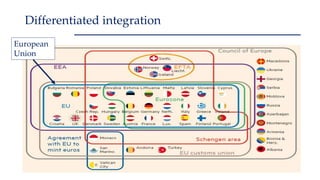
overlapping regional arrangements (“differentiated integration”)
History of European integration
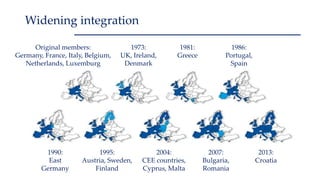
Original members:
Germany, France, Italy, Belgium,
Netherlands, Luxemburg
1973:
UK, Ireland,
Denmark
1981:
Greece
1986:
Portugal,
Spain
1990:
East
Germany
1995:
Austria, Sweden,
Finland
2004:
CEE countries,
Cyprus, Malta
2007:
Bulgaria,
Romania
2013:
Croatia
Widening integration
 1963/64: Court of Justice strengthens Community law against member states
 1985: Single European Act abolishes member-state veto in many policy areas,
strengthens European Parliament
 1991: Maastricht Treaty creates European Union; lay groundwork for Euro;
pushes integration beyond economics (foreign policy, home affairs)
 1997/2000: Amsterdam and Nice Treaties reform EU institutions prior to
enlargement; incorporate Schengen agreement into EU treaties
 2007: Lisbon Treaty simplifies institutional structure, gives EU unified legal
personality  in force since 2009
 Since 2010: Succession of crises (Eurozone crisis, refugee crisis, Brexit) and
rise of Euroscepticism
Deepening integration
Differentiated integration
European
Union
EU governance: Core characteristics
More than an international organization, less than a state:
EU is combination of intergovernmentalism (member-state control) and
supranationalism (pan-European mandate)
Multilevel governance:
EU makes binding laws in wide range of areas, but mainly framework laws
specified by member states; member states charged with policy implementation
Precarious legitimacy:
More democratic mechanisms than in any other international organizations, but
limited citizen interest/participation and increasing Euroscepticism
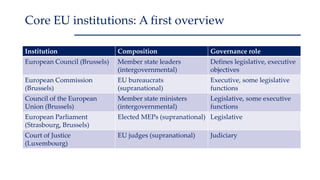
Institution Composition Governance role
European Council (Brussels) Member state leaders
(intergovernmental)
Defines legislative, executive
objectives
European Commission
(Brussels)
EU bureaucrats
(supranational)
Executive, some legislative
functions
Council of the European
Union (Brussels)
Member state ministers
(intergovernmental)
Legislative, some executive
functions
European Parliament
(Strasbourg, Brussels)
Elected MEPs (supranational) Legislative
Court of Justice
(Luxembourg)
EU judges (supranational) Judiciary
Core EU institutions: A first overview
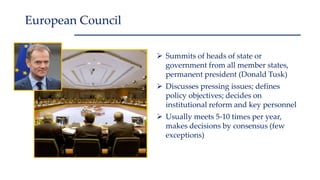
 Summits of heads of state or
government from all member states,
permanent president (Donald Tusk)
 Discusses pressing issues; defines
policy objectives; decides on
institutional reform and key personnel
 Usually meets 5-10 times per year,
makes decisions by consensus (few
exceptions)
European Council
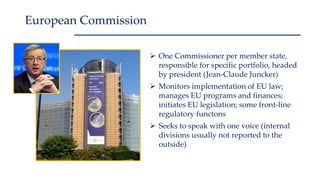
 One Commissioner per member state,
responsible for specific portfolio, headed
by president (Jean-Claude Juncker)
 Monitors implementation of EU law;
manages EU programs and finances;
initiates EU legislation; some front-line
regulatory functons
 Seeks to speak with one voice (internal
divisions usually not reported to the
outside)
European Commission
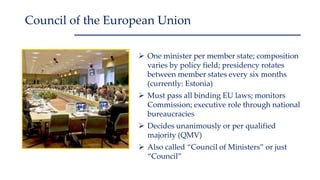
 One minister per member state; composition
varies by policy field; presidency rotates
between member states every six months
(currently: Estonia)
 Must pass all binding EU laws; monitors
Commission; executive role through national
bureaucracies
 Decides unanimously or per qualified
majority (QMV)
 Also called “Council of Ministers” or just
“Council”
Council of the European Union
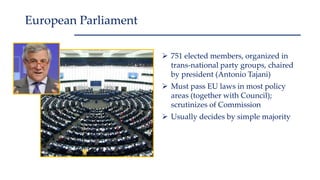
 751 elected members, organized in
trans-national party groups, chaired
by president (Antonio Tajani)
 Must pass EU laws in most policy
areas (together with Council);
scrutinizes of Commission
 Usually decides by simple majority
European Parliament
 European People‘s Party (Christian Democrats) (EPP)
 Progressive Alliance of Socialists and Democrats in the European Parliament
(S&D)
 European Conservatives and Reformists (ECR)
 Alliance of Liberals and Democrats for Europe (ALDE)
 European United Left – Nordic Green Left (GUE/NGL)
 Greens / European Free Alliance (Greens/EFA)
 Europe of Freedom and Direct Democracy (EFDD)
 Europe of Nations and Freedom (ENF)
Party Groups in the European Parliament
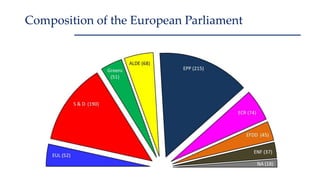
Composition of the European Parliament
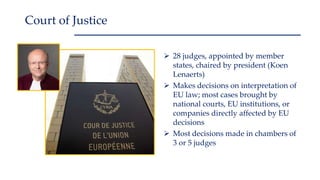
 28 judges, appointed by member
states, chaired by president (Koen
Lenaerts)
 Makes decisions on interpretation of
EU law; most cases brought by
national courts, EU institutions, or
companies directly affected by EU
decisions
 Most decisions made in chambers of
3 or 5 judges
Court of Justice
Thank you

EU-History-and-Institution.pptx

  • 1.
    An Introduction tothe European Union Submitted by:- Ritika Sharma Registration no. :- 12116262
  • 2.
    Member States (Potential) CandidateStates European Union: Member states and candidates for accession
  • 3.
     Origins ofEuropean integration: Integration initiatives launched in Western Europe in aftermath of World War II; period marked by political and economic reconstruction, beginning of Cold War  Institutional foundations of today‘s European Union: Three Communities created in 1950s: European Coal and Steel Community (ECSC), European Atomic Energy Community (Euratom) and European Economic Community (EEC), with six member states  Three trajectories of development: (1) Accession of more member states (“widening”); (2) transfer of more powers and decision-making autonomy to European institutions (“deepening”); (3) growing complexity of multiple, overlapping regional arrangements (“differentiated integration”) History of European integration
  • 4.
    Original members: Germany, France,Italy, Belgium, Netherlands, Luxemburg 1973: UK, Ireland, Denmark 1981: Greece 1986: Portugal, Spain 1990: East Germany 1995: Austria, Sweden, Finland 2004: CEE countries, Cyprus, Malta 2007: Bulgaria, Romania 2013: Croatia Widening integration
  • 5.
     1963/64: Courtof Justice strengthens Community law against member states  1985: Single European Act abolishes member-state veto in many policy areas, strengthens European Parliament  1991: Maastricht Treaty creates European Union; lay groundwork for Euro; pushes integration beyond economics (foreign policy, home affairs)  1997/2000: Amsterdam and Nice Treaties reform EU institutions prior to enlargement; incorporate Schengen agreement into EU treaties  2007: Lisbon Treaty simplifies institutional structure, gives EU unified legal personality  in force since 2009  Since 2010: Succession of crises (Eurozone crisis, refugee crisis, Brexit) and rise of Euroscepticism Deepening integration
  • 6.
  • 7.
    EU governance: Corecharacteristics More than an international organization, less than a state: EU is combination of intergovernmentalism (member-state control) and supranationalism (pan-European mandate) Multilevel governance: EU makes binding laws in wide range of areas, but mainly framework laws specified by member states; member states charged with policy implementation Precarious legitimacy: More democratic mechanisms than in any other international organizations, but limited citizen interest/participation and increasing Euroscepticism
  • 8.
    Institution Composition Governancerole European Council (Brussels) Member state leaders (intergovernmental) Defines legislative, executive objectives European Commission (Brussels) EU bureaucrats (supranational) Executive, some legislative functions Council of the European Union (Brussels) Member state ministers (intergovernmental) Legislative, some executive functions European Parliament (Strasbourg, Brussels) Elected MEPs (supranational) Legislative Court of Justice (Luxembourg) EU judges (supranational) Judiciary Core EU institutions: A first overview
  • 9.
     Summits ofheads of state or government from all member states, permanent president (Donald Tusk)  Discusses pressing issues; defines policy objectives; decides on institutional reform and key personnel  Usually meets 5-10 times per year, makes decisions by consensus (few exceptions) European Council
  • 10.
     One Commissionerper member state, responsible for specific portfolio, headed by president (Jean-Claude Juncker)  Monitors implementation of EU law; manages EU programs and finances; initiates EU legislation; some front-line regulatory functons  Seeks to speak with one voice (internal divisions usually not reported to the outside) European Commission
  • 11.
     One ministerper member state; composition varies by policy field; presidency rotates between member states every six months (currently: Estonia)  Must pass all binding EU laws; monitors Commission; executive role through national bureaucracies  Decides unanimously or per qualified majority (QMV)  Also called “Council of Ministers” or just “Council” Council of the European Union
  • 12.
     751 electedmembers, organized in trans-national party groups, chaired by president (Antonio Tajani)  Must pass EU laws in most policy areas (together with Council); scrutinizes of Commission  Usually decides by simple majority European Parliament
  • 13.
     European People‘sParty (Christian Democrats) (EPP)  Progressive Alliance of Socialists and Democrats in the European Parliament (S&D)  European Conservatives and Reformists (ECR)  Alliance of Liberals and Democrats for Europe (ALDE)  European United Left – Nordic Green Left (GUE/NGL)  Greens / European Free Alliance (Greens/EFA)  Europe of Freedom and Direct Democracy (EFDD)  Europe of Nations and Freedom (ENF) Party Groups in the European Parliament
  • 14.
    Composition of theEuropean Parliament
  • 15.
     28 judges,appointed by member states, chaired by president (Koen Lenaerts)  Makes decisions on interpretation of EU law; most cases brought by national courts, EU institutions, or companies directly affected by EU decisions  Most decisions made in chambers of 3 or 5 judges Court of Justice
  • 16.