Presentation 2023
Anand R S
Sreyas M P
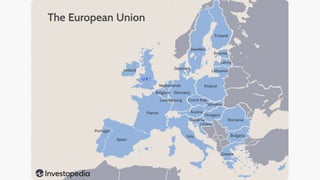
The European Union (EU) is a political and economic union of 27 European
countries that have come together to promote economic cooperation, political
stability, and shared values among its member states. It is one of the most
significant and ambitious regional integration projects in the world
Introduction
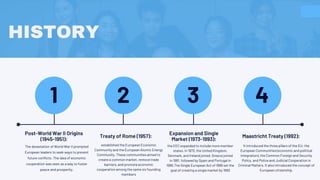
HISTORY
established the European Economic
Community and the European Atomic Energy
Community. These communities aimed to
create a common market, remove trade
barriers, and promote economic
cooperation among the same six founding
members
the EEC expanded to include more member
states. In 1973, the United Kingdom,
Denmark, and Ireland joined. Greece joined
in 1981, followed by Spain and Portugal in
1986.The Single European Act of 1986 set the
goal of creating a single market by 1993
It introduced the three pillars of the EU: the
European Communities (economic and political
integration), the Common Foreign and Security
Policy, and Police and Judicial Cooperation in
Criminal Matters. It also introduced the concept of
European citizenship.
Post-World War II Origins
(1945-1951):
Expansion and Single
Market (1973-1993):
Treaty of Rome (1957): Maastricht Treaty (1992):
1 2 3 4
The devastation of World War II prompted
European leaders to seek ways to prevent
future conflicts. The idea of economic
cooperation was seen as a way to foster
peace and prosperity.
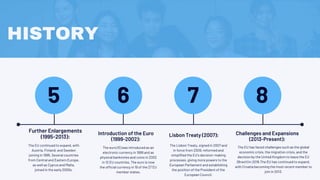
HISTORY
The EU continued to expand, with
Austria, Finland, and Sweden
joining in 1995. Several countries
from Central and Eastern Europe,
as well as Cyprus and Malta,
joined in the early 2000s.
The euro (€) was introduced as an
electronic currency in 1999 and as
physical banknotes and coins in 2002
in 12 EU countries. The euro is now
the official currency in 19 of the 27 EU
member states.
The Lisbon Treaty, signed in 2007 and
in force from 2009, reformed and
simplified the EU's decision-making
processes, giving more powers to the
European Parliament and establishing
the position of the President of the
European Council.
The EU has faced challenges such as the global
economic crisis, the migration crisis, and the
decision by the United Kingdom to leave the EU
(Brexit) in 2016.The EU has continued to expand,
with Croatia becoming the most recent member to
join in 2013.
Further Enlargements
(1995-2013): Lisbon Treaty (2007):
Introduction of the Euro
(1999-2002):
Challenges and Expansions
(2013-Present):
5 6 7 8
EU
INSTITUTIONS
EUROPEAN COMMISSION
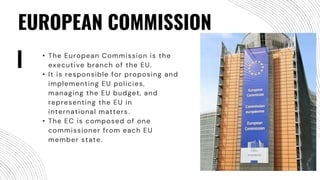
• The European Commission is the
executive branch of the EU.
• It is responsible for proposing and
implementing EU policies,
managing the EU budget, and
representing the EU in
international matters.
• The EC is composed of one
commissioner from each EU
member state.
EUROPEAN
PARLIAMENT
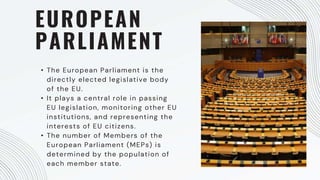
• The European Parliament is the
directly elected legislative body
of the EU.
• It plays a central role in passing
EU legislation, monitoring other EU
institutions, and representing the
interests of EU citizens.
• The number of Members of the
European Parliament (MEPs) is
determined by the population of
each member state.
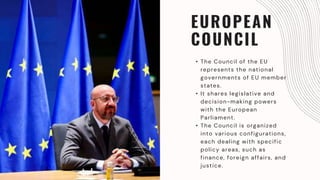
EUROPEAN
COUNCIL
• The Council of the EU
represents the national
governments of EU member
states.
• It shares legislative and
decision-making powers
with the European
Parliament.
• The Council is organized
into various configurations,
each dealing with specific
policy areas, such as
finance, foreign affairs, and
justice.
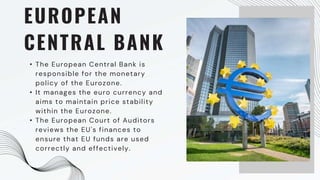
EUROPEAN
CENTRAL BANK
• The European Central Bank is
responsible for the monetary
policy of the Eurozone.
• It manages the euro currency and
aims to maintain price stability
within the Eurozone.
• The European Court of Auditors
reviews the EU's finances to
ensure that EU funds are used
correctly and effectively.
EUROPEAN ECONOMIC
AND SOCIAL
COMMITTEE
• The EESC provides a forum for
representatives of various
economic and social interest
groups to give their views on EU
policies.
• The Committee of the Regions
represents local and regional
authorities within the EU, ensuring
that their interests are taken into
account in EU decision-making.
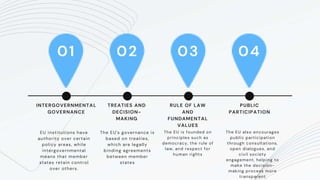
EU
GOVERNANCE
EU institutions have
authority over certain
policy areas, while
intergovernmental
means that member
states retain control
over others.
01
INTERGOVERNMENTAL
GOVERNANCE
02 03 04
The EU's governance is
based on treaties,
which are legally
binding agreements
between member
states
TREATIES AND
DECISION-
MAKING
The EU is founded on
principles such as
democracy, the rule of
law, and respect for
human rights
RULE OF LAW
AND
FUNDAMENTAL
VALUES
The EU also encourages
public participation
through consultations,
open dialogues, and
civil society
engagement, helping to
make the decision-
making process more
transparent
PUBLIC
PARTICIPATION
EU
POLICY AND
INITATIVES
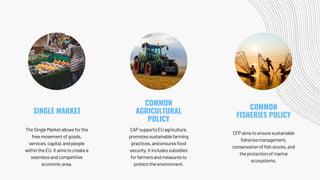
TheSingleMarketallowsforthe
freemovementofgoods,
services,capital,andpeople
withintheEU.Itaimstocreatea
seamlessandcompetitive
economicarea.
CAPsupportsEUagriculture,
promotessustainablefarming
practices,andensuresfood
security.Itincludessubsidies
forfarmersandmeasuresto
protecttheenvironment.
CFPaimstoensuresustainable
fisheriesmanagement,
conservationoffishstocks,and
theprotectionofmarine
ecosystems.
SINGLE MARKET
COMMON
AGRICULTURAL
POLICY
COMMON
FISHERIES POLICY
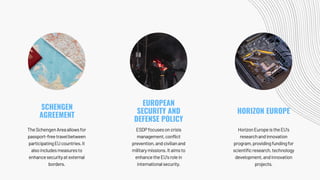
TheSchengenAreaallowsfor
passport-freetravelbetween
participatingEUcountries.It
alsoincludesmeasuresto
enhancesecurityatexternal
borders.
ESDPfocusesoncrisis
management,conflict
prevention,andcivilianand
militarymissions.Itaimsto
enhancetheEU'srolein
internationalsecurity.
HorizonEuropeistheEU's
researchandinnovation
program,providingfundingfor
scientificresearch,technology
development,andinnovation
projects.
SCHENGEN
AGREEMENT
EUROPEAN
SECURITY AND
DEFENSE POLICY
HORIZON EUROPE
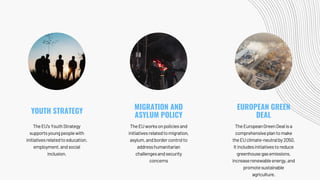
TheEU'sYouthStrategy
supportsyoungpeoplewith
initiativesrelatedtoeducation,
employment,andsocial
inclusion.
TheEUworksonpoliciesand
initiativesrelatedtomigration,
asylum,andbordercontrolto
addresshumanitarian
challengesandsecurity
concerns
TheEuropeanGreenDealisa
comprehensiveplantomake
theEUclimate-neutralby2050.
Itincludesinitiativestoreduce
greenhousegasemissions,
increaserenewableenergy,and
promotesustainable
agriculture.
YOUTH STRATEGY
MIGRATION AND
ASYLUM POLICY
EUROPEAN GREEN
DEAL
Challenges and
Criticisms
Faced by EU
The United Kingdom's decision to leave the EU (Brexit) in
2020 was a significant challenge. It raised questions
about the EU's future and its relationships with non-
member states.
Brexit
The EU has faced challenges related to the management
of migration flows, with debates on issues like border
control, the distribution of refugees among member
states, and the conditions in migrant camps.
Migration and Asylum
Economic disparities exist among EU member states,
leading to tensions. Some countries argue that they bear
a disproportionate burden or that EU policies favor
wealthier states.
Economic Disparities
Economic crises, such as the 2008 financial crisis and
the eurozone crisis, have tested the EU's ability to
coordinate economic policies and maintain stability.
Economic Challenges
Critics argue that the EU has not gone far enough in
addressing environmental and climate issues, despite
initiatives like the European Green Deal.
Environmental and Climate Concerns
The EU faces the challenge of balancing the interests of
Eurozone countries with those outside the euro, and
ensuring the stability of the single currency.
Managing the Eurozone
Several member states have faced criticism for
potential breaches of the rule of law and democratic
values, leading to tensions within the EU and calls for
enforcement mechanisms.
Rule of Law
Some member states have seen the rise of nationalist
and populist movements, challenging the principles of
unity and cooperation within the EU.
Nationalism
THANK
YOU

EUROPEAN UNION.pptx