Introduction:
 An international organization is an organization with an international
membership, scope, or presence.
 An international organization is “a body that promotes voluntary cooperation
and coordination between or among its members.
Types of International Organizations
1) International Non-Governmental
Organizations
 Non-governmental organizations
(NGO) whose operate independently.
 Internationally non-profit
organizations
 Not affiliated with governments
 Nevertheless play an important role in
international politics
Examples:
 Indian Red Cross
 Amnesty international
 Save the Children
2) International Governmental
Organizations
 An IGO is an organization composed
primarily of sovereign states, or of other
intergovernmental organizations.
 IGOs form when governments make an
agreement or band together.
Examples:
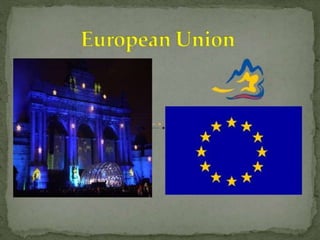
 European Union (EU)
 United Nations (UN)
 World Trade Organization (WTO)
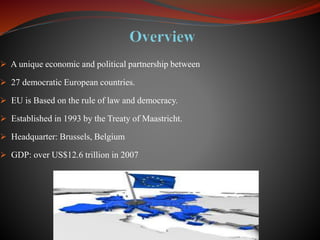
 A unique economic and political partnership between
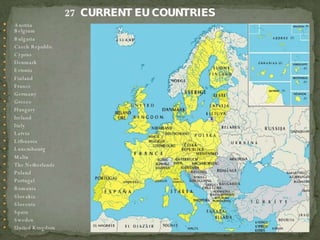
 27 democratic European countries.
 EU is Based on the rule of law and democracy.
 Established in 1993 by the Treaty of Maastricht.
 Headquarter: Brussels, Belgium
 GDP: over US$12.6 trillion in 2007
Aim/Purpose:
 Establish European Citizenship.
 Ensure freedom, security and justice.
 Promote economic and social progress.
 Assert Europe’s role in the world.
Structure of EU:
 European Parliament
 Council of European Union
 European Commission
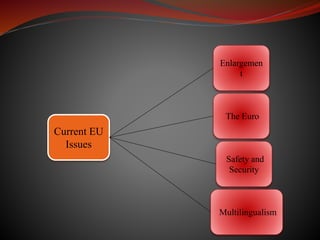
Current EU
Issues
The Euro
Multilingualism
Safety and
Security
Enlargemen
t
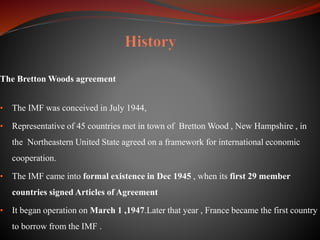
The Bretton Woods agreement
• The IMF was conceived in July 1944,
• Representative of 45 countries met in town of Bretton Wood , New Hampshire , in
the Northeastern United State agreed on a framework for international economic
cooperation.
• The IMF came into formal existence in Dec 1945 , when its first 29 member
countries signed Articles of Agreement
• It began operation on March 1 ,1947.Later that year , France became the first country
to borrow from the IMF .
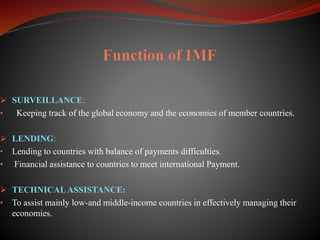
 SURVEILLANCE:
• Keeping track of the global economy and the economies of member countries.
 LENDING:
• Lending to countries with balance of payments difficulties.
• Financial assistance to countries to meet international Payment.
 TECHNICALASSISTANCE:
• To assist mainly low-and middle-income countries in effectively managing their
economies.
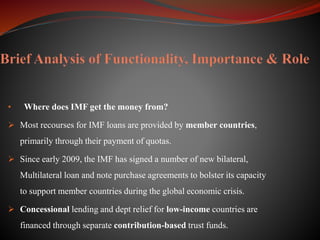
• Where does IMF get the money from?
 Most recourses for IMF loans are provided by member countries,
primarily through their payment of quotas.
 Since early 2009, the IMF has signed a number of new bilateral,
Multilateral loan and note purchase agreements to bolster its capacity
to support member countries during the global economic crisis.
 Concessional lending and dept relief for low-income countries are
financed through separate contribution-based trust funds.
“Bailout” conditionality's on Pakistan
• IMF approved US$7.6 billlion loan to Pakistan in 2008
• Conditionality's included-
 Eliminating all Government subsidies .
 Slashing government spending
 Raising Taxes
• Impact
 GDP Declined from 7.4%to 4.2% in 2008-09.
Economists claim that conditionality's (economic performance targets established as a
precondition for IMF loans)retard social.
 Problem Of Goverence
• IMF is driven by collective will of G-7 countries
• It is dominated not merely by wealth , industrialized nations , but also by commercial
and financial interest of these nations.
 Capital Market Liberalization
• IMF pressures countries that petition for IMF loans to open their markets to outside
capital investment.
• Investors invest huge sums in a country only to pull those investment at a moment’s
notice , causing acute economic crisis.
• Destabilzes the economy.
Introduction
 WTO is a global international organization dealing with the rules of trade between
nations.
 WTO work moves around WTO agreements, negotiated and signed by the bulk of the
world’s trading nations and ratified in their parliaments.
Purpose:
 Help producers of goods and services, exporters, and importers to conduct their
business
 Trade flows smoothly and deals with dispute over trade issues.
 It gives consumers more choices and a broader range of qualities to choose from.
 Based on rules and has nothing to do with power of nation.
 Exists a forum to handle crisis.
It provide a forum for negotiation and for settling disputes.
It oversees the implementation, administration and operation of the covered
agreements.
WTO shall administrate Trade Policy Review Mechanism
OPELAutomobile company
 Adam Opel AG is a German automobile manufacturer
headquartered in Rüsselsheim, Hesse, Germany, and a
subsidiary of General Motors Company.
 Founder: Adam Opel
 Founded: January 21, 1862,Rüsselsheim, Germany
What Is UNO???
 The United Nations (UN) is an intergovernmental
organization established to promote international co-
operation.
 Replacement for the ineffective League of Nations, the
organization was created following the Second World War
to prevent another such conflict.
 Officially it came into existence on
24October 1945.
The Purposes Of United Nations
Following are the purposes of UN:
 To maintain international peace & security.
 To develop friendly relations with nations.
 To corporate in solving international social, economic &
cultural problems.
 To promote respect for human rights & fundamental
freedoms.
 To protect earth & environment.
Principles of United Nations
 It is based on sovereign equality of all its members.
 All members are to fulfill in faith their charter obligations.
 They are to settle their international disputes by peace.
 They are to refrain from threat or use of force against other
state.
 They are to give United Nations every assistance in every
action it takes in accordance with charter.
UN Languages & Membership
UN languages:
Six official languages are recognized by UN:
1:Chinese 2:English 3:French
4:Russian 5: Spanish 6: Arabic
UN Membership:
Its membership is open to all peace loving
nations which accept obligations of its charter&
are able ad willing to fulfill these obligations.
Jurisdiction:
 The official power to make legal decisions and judgments.
 The territory over which authority is exercised
(All islands to the northwest are his jurisdiction.)
Intellectual property:
 Intangible property that is the result of creativity, such as patents, copyrights, etc.
Taxes and securities
Internet-specific issues

International organization presenttion

  • 2.
    Introduction:  An internationalorganization is an organization with an international membership, scope, or presence.  An international organization is “a body that promotes voluntary cooperation and coordination between or among its members.
  • 3.
    Types of InternationalOrganizations 1) International Non-Governmental Organizations  Non-governmental organizations (NGO) whose operate independently.  Internationally non-profit organizations  Not affiliated with governments  Nevertheless play an important role in international politics Examples:  Indian Red Cross  Amnesty international  Save the Children
  • 4.
    2) International Governmental Organizations An IGO is an organization composed primarily of sovereign states, or of other intergovernmental organizations.  IGOs form when governments make an agreement or band together. Examples:  European Union (EU)  United Nations (UN)  World Trade Organization (WTO)
  • 6.
     A uniqueeconomic and political partnership between  27 democratic European countries.  EU is Based on the rule of law and democracy.  Established in 1993 by the Treaty of Maastricht.  Headquarter: Brussels, Belgium  GDP: over US$12.6 trillion in 2007
  • 8.
    Aim/Purpose:  Establish EuropeanCitizenship.  Ensure freedom, security and justice.  Promote economic and social progress.  Assert Europe’s role in the world. Structure of EU:  European Parliament  Council of European Union  European Commission
  • 9.
  • 11.
    The Bretton Woodsagreement • The IMF was conceived in July 1944, • Representative of 45 countries met in town of Bretton Wood , New Hampshire , in the Northeastern United State agreed on a framework for international economic cooperation. • The IMF came into formal existence in Dec 1945 , when its first 29 member countries signed Articles of Agreement • It began operation on March 1 ,1947.Later that year , France became the first country to borrow from the IMF .
  • 12.
     SURVEILLANCE: • Keepingtrack of the global economy and the economies of member countries.  LENDING: • Lending to countries with balance of payments difficulties. • Financial assistance to countries to meet international Payment.  TECHNICALASSISTANCE: • To assist mainly low-and middle-income countries in effectively managing their economies.
  • 13.
    • Where doesIMF get the money from?  Most recourses for IMF loans are provided by member countries, primarily through their payment of quotas.  Since early 2009, the IMF has signed a number of new bilateral, Multilateral loan and note purchase agreements to bolster its capacity to support member countries during the global economic crisis.  Concessional lending and dept relief for low-income countries are financed through separate contribution-based trust funds.
  • 14.
    “Bailout” conditionality's onPakistan • IMF approved US$7.6 billlion loan to Pakistan in 2008 • Conditionality's included-  Eliminating all Government subsidies .  Slashing government spending  Raising Taxes • Impact  GDP Declined from 7.4%to 4.2% in 2008-09. Economists claim that conditionality's (economic performance targets established as a precondition for IMF loans)retard social.
  • 15.
     Problem OfGoverence • IMF is driven by collective will of G-7 countries • It is dominated not merely by wealth , industrialized nations , but also by commercial and financial interest of these nations.  Capital Market Liberalization • IMF pressures countries that petition for IMF loans to open their markets to outside capital investment. • Investors invest huge sums in a country only to pull those investment at a moment’s notice , causing acute economic crisis. • Destabilzes the economy.
  • 17.
    Introduction  WTO isa global international organization dealing with the rules of trade between nations.  WTO work moves around WTO agreements, negotiated and signed by the bulk of the world’s trading nations and ratified in their parliaments. Purpose:  Help producers of goods and services, exporters, and importers to conduct their business
  • 18.
     Trade flowssmoothly and deals with dispute over trade issues.  It gives consumers more choices and a broader range of qualities to choose from.  Based on rules and has nothing to do with power of nation.  Exists a forum to handle crisis.
  • 19.
    It provide aforum for negotiation and for settling disputes. It oversees the implementation, administration and operation of the covered agreements. WTO shall administrate Trade Policy Review Mechanism
  • 25.
    OPELAutomobile company  AdamOpel AG is a German automobile manufacturer headquartered in Rüsselsheim, Hesse, Germany, and a subsidiary of General Motors Company.  Founder: Adam Opel  Founded: January 21, 1862,Rüsselsheim, Germany
  • 31.
    What Is UNO??? The United Nations (UN) is an intergovernmental organization established to promote international co- operation.  Replacement for the ineffective League of Nations, the organization was created following the Second World War to prevent another such conflict.  Officially it came into existence on 24October 1945.
  • 32.
    The Purposes OfUnited Nations Following are the purposes of UN:  To maintain international peace & security.  To develop friendly relations with nations.  To corporate in solving international social, economic & cultural problems.  To promote respect for human rights & fundamental freedoms.  To protect earth & environment.
  • 33.
    Principles of UnitedNations  It is based on sovereign equality of all its members.  All members are to fulfill in faith their charter obligations.  They are to settle their international disputes by peace.  They are to refrain from threat or use of force against other state.  They are to give United Nations every assistance in every action it takes in accordance with charter.
  • 34.
    UN Languages &Membership UN languages: Six official languages are recognized by UN: 1:Chinese 2:English 3:French 4:Russian 5: Spanish 6: Arabic UN Membership: Its membership is open to all peace loving nations which accept obligations of its charter& are able ad willing to fulfill these obligations.
  • 35.
    Jurisdiction:  The officialpower to make legal decisions and judgments.  The territory over which authority is exercised (All islands to the northwest are his jurisdiction.) Intellectual property:  Intangible property that is the result of creativity, such as patents, copyrights, etc. Taxes and securities Internet-specific issues