Power Point Presentation
V. MURUGAN,
Assistant Professor of History,
Vivekananda College,
Tiruvedakam West,
Madurai District,
Tamil Nadu.
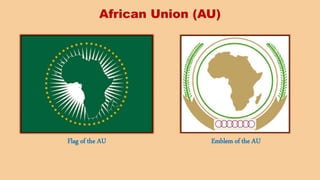
African Union (AU)
Flag of the AU Emblem of the AU
Introduction
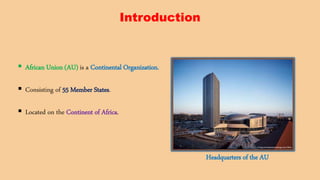
 African Union (AU) is a Continental Organization.
 Consisting of 55 Member States.
 Located on the Continent of Africa.
Headquarters of the AU
History
 The historical foundations of the African Union originated in the First Congress of Independence
African States, held in Accra, Ghana from 15 to 22 April 1958.
 Subsequent attempts to unite Africa, including the Organisation of African Unity (OAU) was
established on 25 May 1963.
 The African Economic Community was established in 1981.
 The idea of creating the AU was revived in the mid-1990s under the leadership of Libyan head of
state Muammar al-Gaddafi.
 The heads of state and government of the OAU issued the Sirte Declaration (named after Sirte, in
Libya) on 9 September 1999.
 It called for the establishment of an African Union.
 The bloc was founded on 26 May 2001 in Addis Ababa, Ethiopia.
 It was launched on 9 July 2002 in Durban, South Africa.
Objectives of the AU
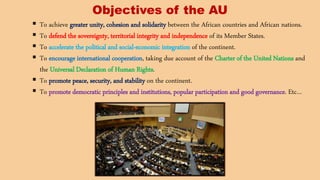
 To achieve greater unity, cohesion and solidarity between the African countries and African nations.
 To defend the sovereignty, territorial integrity and independence of its Member States.
 To accelerate the political and social-economic integration of the continent.
 To encourage international cooperation, taking due account of the Charter of the United Nations and
the Universal Declaration of Human Rights.
 To promote peace, security, and stability on the continent.
 To promote democratic principles and institutions, popular participation and good governance. Etc…
Organizations of the AU
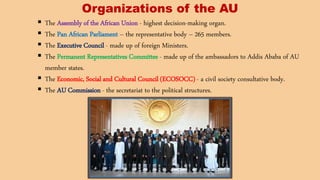
 The Assembly of the African Union - highest decision-making organ.
 The Pan African Parliament – the representative body – 265 members.
 The Executive Council - made up of foreign Ministers.
 The Permanent Representatives Committee - made up of the ambassadors to Addis Ababa of AU
member states.
 The Economic, Social and Cultural Council (ECOSOCC) - a civil society consultative body.
 The AU Commission - the secretariat to the political structures.
Conclusion
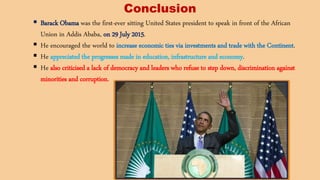
 Barack Obama was the first-ever sitting United States president to speak in front of the African
Union in Addis Ababa, on 29 July 2015.
 He encouraged the world to increase economic ties via investments and trade with the Continent.
 He appreciated the progresses made in education, infrastructure and economy.
 He also criticised a lack of democracy and leaders who refuse to step down, discrimination against
minorities and corruption.
African union

African union

  • 1.
    Power Point Presentation V.MURUGAN, Assistant Professor of History, Vivekananda College, Tiruvedakam West, Madurai District, Tamil Nadu.
  • 2.
    African Union (AU) Flagof the AU Emblem of the AU
  • 3.
    Introduction  African Union(AU) is a Continental Organization.  Consisting of 55 Member States.  Located on the Continent of Africa. Headquarters of the AU
  • 4.
    History  The historicalfoundations of the African Union originated in the First Congress of Independence African States, held in Accra, Ghana from 15 to 22 April 1958.  Subsequent attempts to unite Africa, including the Organisation of African Unity (OAU) was established on 25 May 1963.  The African Economic Community was established in 1981.  The idea of creating the AU was revived in the mid-1990s under the leadership of Libyan head of state Muammar al-Gaddafi.  The heads of state and government of the OAU issued the Sirte Declaration (named after Sirte, in Libya) on 9 September 1999.  It called for the establishment of an African Union.  The bloc was founded on 26 May 2001 in Addis Ababa, Ethiopia.  It was launched on 9 July 2002 in Durban, South Africa.
  • 5.
    Objectives of theAU  To achieve greater unity, cohesion and solidarity between the African countries and African nations.  To defend the sovereignty, territorial integrity and independence of its Member States.  To accelerate the political and social-economic integration of the continent.  To encourage international cooperation, taking due account of the Charter of the United Nations and the Universal Declaration of Human Rights.  To promote peace, security, and stability on the continent.  To promote democratic principles and institutions, popular participation and good governance. Etc…
  • 6.
    Organizations of theAU  The Assembly of the African Union - highest decision-making organ.  The Pan African Parliament – the representative body – 265 members.  The Executive Council - made up of foreign Ministers.  The Permanent Representatives Committee - made up of the ambassadors to Addis Ababa of AU member states.  The Economic, Social and Cultural Council (ECOSOCC) - a civil society consultative body.  The AU Commission - the secretariat to the political structures.
  • 7.
    Conclusion  Barack Obamawas the first-ever sitting United States president to speak in front of the African Union in Addis Ababa, on 29 July 2015.  He encouraged the world to increase economic ties via investments and trade with the Continent.  He appreciated the progresses made in education, infrastructure and economy.  He also criticised a lack of democracy and leaders who refuse to step down, discrimination against minorities and corruption.