BHAGVADGITA AND MANAGEMENT   SK Giridhar Organisational Expert Motivational Speaker & Trainer
Sri Bhagwadgita has been straight from the Lord Sri Krishna and the recipient directly was Sri Arjuna and by ways of association Dhrutarashtra and Sanjaya.
One has to visit Sri Bhagwadgita like a morning walk on the Seashores which looks infinite; dip the self and a fingers and feet on its shores and it shall be only rare on earth who shall dive into it totally to travel the length, width, distances and dimensions of Sri Bhagwadgita. That is the longest journey perhaps of the Self.
We  perhaps can read a Sloka or a word from a sloka and if we have meditated on the word quite comprehensively and also conceptualized and seeded that concept on the soil of inner soul; then perhaps sprouting knowledge one can write in these columns.
Sloka 1 and Chapter 1. Said and stated Dhruthrashtra to Sanjaya.  In management aspects: at least self and someone else is required. There has to be a dialogue and communications: asking and knowing are two key aspects of the management.  The address to Sanjaya is what the elder must do a respected junior. There is a DharmaBhoomi: the field, the boundaries, the limits of operations; where there are individuals, groups for defined objectives; there is a Kurukshetra; Kshetra ; means the objects of a subject; normally management is done to correct the deficiencies; to control the good parts; and ensure continual improvements in the system; management is done to bring back the system to intended accuracies, precisions and specifications.  In sloka 1, there is a word Yuddh- war. This word should not be taken straight as War as the contemporarily it suggests. Life is a war: wherein we are pouring our energies to make things happen and shape as per the intended desires. And there is a curiosity. Each one is filled with curiosity. Top management and we. What happened; who did; what has been achieved. So in Sloka 1, curiosity takes birth:
Hey Sanjaya: curiosity 1. what has been done by my sons and sons of Pandu: Curiosity two and three. In sloka 1 : there are three curiosities. Curiosity 4 : Participants having intended desires for war.
Any management process commences from: Curiosity: What to do this year; this month; today; what has been achieved; and that sort of role is played by almost everyone on the hierarchy of organizational structure.
The word vairaagya does not mean renouncing and living and hiding the self in the forest. Vairaagya means a state in which a person neither has raaga nor dwesha: nor attachment nor detachment. In most simplified manner; vairaagya means a person wearing the shoes of NON-ATTACHMENT and now he walks anywhere in the world and society; he is not getting indulged or he is not having any asakti; since he is now wearing the shoes of non-attachment. A person having vairaagya does give the best quality as his fundamental nature.
An effective work culture is about vigorous and arduous efforts in pursuit of given or chosen tasks. Sri Krishna elaborates on two types of work culture – "daivi sampat" or divine work culture and "asuri sampat" or demonic work culture. Daivi work culture ‐ involves fearlessness, purity, self‐control, sacrifice, straightforwardness, self denial, calmness, absence of fault‐finding, absence of greed, gentleness, modesty, absence of envy and pride.
Asuri work culture ‐ involves egoism, delusion, personal desires, improper performance, work not oriented towards service. Mere work ethic is not enough. The hardened criminal exhibits an excellent work ethic. What is needed is a work ethic conditioned by ethics in work. It is in this light that the counsel, "yogah karmasu kausalam" should be understood. "Kausalam" means skill or technique of work which is an indispensable component of a work ethic. “Yogah" is defined in the Gita itself as "samatvam yogah uchyate" meaning an unchanging equipoise of mind (detachment.)  Acting with an equable mind is Yoga.
By making the equable mind the bed‐rock of all actions, the Gita evolved the goal of unification of work ethic with ethics in work, for without ethical process no mind can attain equipoise. The guru,Adi Sankara Charya (born circa  800 AD), says that the skill necessary in the performance of one's duty is that of maintaining an evenness of mind in face of success and failure. The calm mind in the face of failure will lead to deeper introspection and see clearly where the process went wrong so that corrective steps could be taken to avoid shortcomings in future.
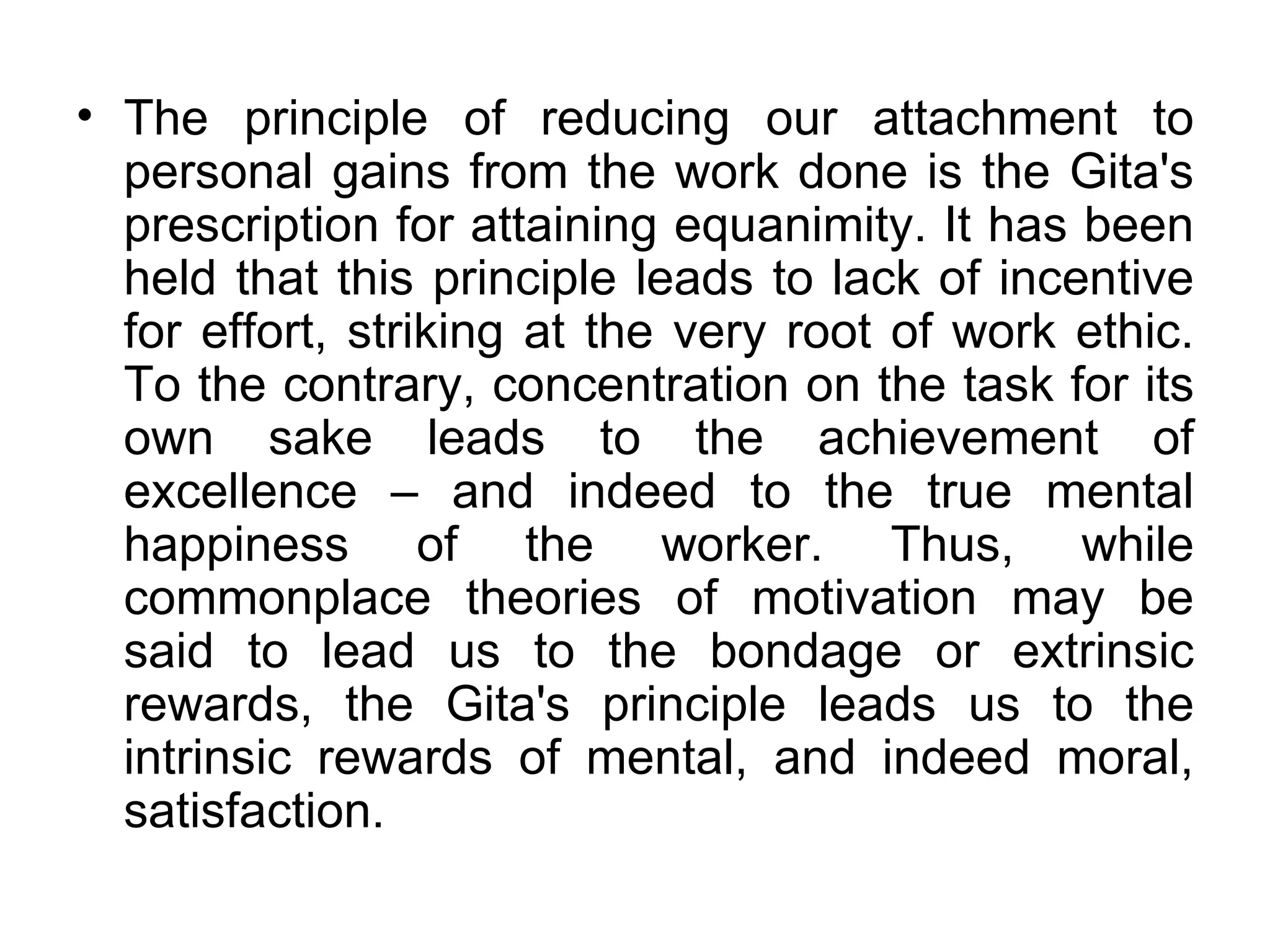
The principle of reducing our attachment to personal gains from the work done is the Gita's prescription for attaining equanimity. It has been held that this principle leads to lack of incentive for effort, striking at the very root of work ethic. To the contrary, concentration on the task for its own sake leads to the achievement of excellence – and indeed to the true mental happiness of the worker. Thus, while commonplace theories of motivation may be said to lead us to the bondage or extrinsic rewards, the Gita's principle leads us to the intrinsic rewards of mental, and indeed moral, satisfaction.
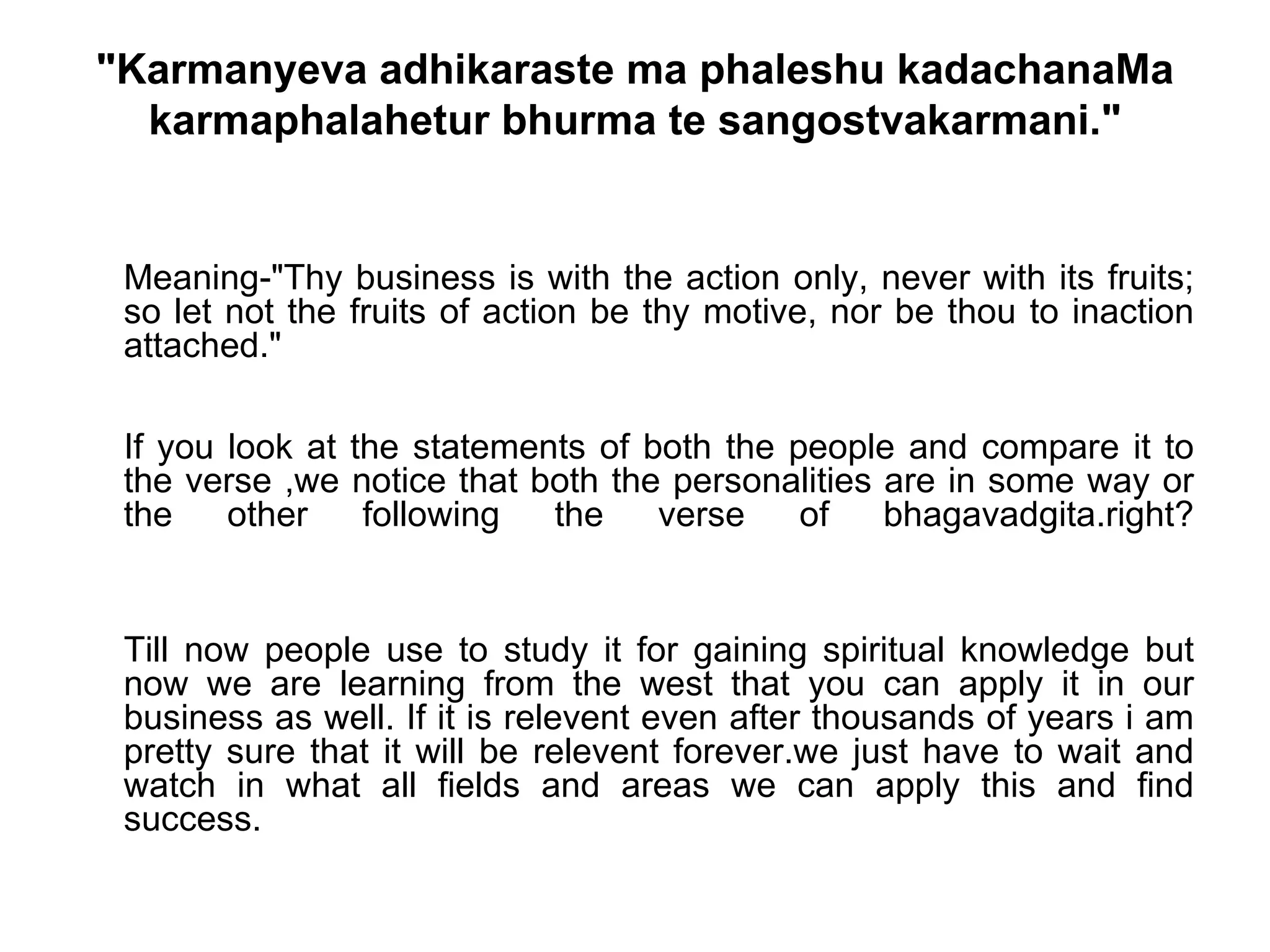
"Karmanyeva adhikaraste ma phaleshu kadachanaMa karmaphalahetur bhurma te sangostvakarmani." Meaning-"Thy business is with the action only, never with its fruits; so let not the fruits of action be thy motive, nor be thou to inaction attached." If you look at the statements of both the people and compare it to the verse ,we notice that both the personalities are in some way or the other following the verse of bhagavadgita.right? Till now people use to study it for gaining spiritual knowledge but now we are learning from the west that you can apply it in our business as well. If it is relevent even after thousands of years i am pretty sure that it will be relevent forever.we just have to wait and watch in what all fields and areas we can apply this and find success.
“ Whatever the excellent and best ones do, the commoners follow,” says Sri Krishna in the Gita. The visionary leader must be a missionary, extremely practical, intensively dynamic and capable of translating dreams into reality. This dynamism and strength of a true leader flows from an inspired and spontaneous motivation to help others. “I am the strength of those who are devoid of personal desire and attachment.  O Arjuna, I am the legitimate desire in those, who are not opposed to righteousness,” says  Sri Krishna in the 10th Chapter of the Gita.
[email_address] +91 9720 3938 34

Bhagvadgita And Management

  • 1.
    BHAGVADGITA AND MANAGEMENT SK Giridhar Organisational Expert Motivational Speaker & Trainer
  • 2.
    Sri Bhagwadgita hasbeen straight from the Lord Sri Krishna and the recipient directly was Sri Arjuna and by ways of association Dhrutarashtra and Sanjaya.
  • 3.
    One has tovisit Sri Bhagwadgita like a morning walk on the Seashores which looks infinite; dip the self and a fingers and feet on its shores and it shall be only rare on earth who shall dive into it totally to travel the length, width, distances and dimensions of Sri Bhagwadgita. That is the longest journey perhaps of the Self.
  • 4.
    We perhapscan read a Sloka or a word from a sloka and if we have meditated on the word quite comprehensively and also conceptualized and seeded that concept on the soil of inner soul; then perhaps sprouting knowledge one can write in these columns.
  • 5.
    Sloka 1 andChapter 1. Said and stated Dhruthrashtra to Sanjaya. In management aspects: at least self and someone else is required. There has to be a dialogue and communications: asking and knowing are two key aspects of the management. The address to Sanjaya is what the elder must do a respected junior. There is a DharmaBhoomi: the field, the boundaries, the limits of operations; where there are individuals, groups for defined objectives; there is a Kurukshetra; Kshetra ; means the objects of a subject; normally management is done to correct the deficiencies; to control the good parts; and ensure continual improvements in the system; management is done to bring back the system to intended accuracies, precisions and specifications. In sloka 1, there is a word Yuddh- war. This word should not be taken straight as War as the contemporarily it suggests. Life is a war: wherein we are pouring our energies to make things happen and shape as per the intended desires. And there is a curiosity. Each one is filled with curiosity. Top management and we. What happened; who did; what has been achieved. So in Sloka 1, curiosity takes birth:
  • 6.
    Hey Sanjaya: curiosity1. what has been done by my sons and sons of Pandu: Curiosity two and three. In sloka 1 : there are three curiosities. Curiosity 4 : Participants having intended desires for war.
  • 7.
    Any management processcommences from: Curiosity: What to do this year; this month; today; what has been achieved; and that sort of role is played by almost everyone on the hierarchy of organizational structure.
  • 8.
    The word vairaagyadoes not mean renouncing and living and hiding the self in the forest. Vairaagya means a state in which a person neither has raaga nor dwesha: nor attachment nor detachment. In most simplified manner; vairaagya means a person wearing the shoes of NON-ATTACHMENT and now he walks anywhere in the world and society; he is not getting indulged or he is not having any asakti; since he is now wearing the shoes of non-attachment. A person having vairaagya does give the best quality as his fundamental nature.
  • 9.
    An effective workculture is about vigorous and arduous efforts in pursuit of given or chosen tasks. Sri Krishna elaborates on two types of work culture – "daivi sampat" or divine work culture and "asuri sampat" or demonic work culture. Daivi work culture ‐ involves fearlessness, purity, self‐control, sacrifice, straightforwardness, self denial, calmness, absence of fault‐finding, absence of greed, gentleness, modesty, absence of envy and pride.
  • 10.
    Asuri work culture‐ involves egoism, delusion, personal desires, improper performance, work not oriented towards service. Mere work ethic is not enough. The hardened criminal exhibits an excellent work ethic. What is needed is a work ethic conditioned by ethics in work. It is in this light that the counsel, "yogah karmasu kausalam" should be understood. "Kausalam" means skill or technique of work which is an indispensable component of a work ethic. “Yogah" is defined in the Gita itself as "samatvam yogah uchyate" meaning an unchanging equipoise of mind (detachment.) Acting with an equable mind is Yoga.
  • 11.
    By making theequable mind the bed‐rock of all actions, the Gita evolved the goal of unification of work ethic with ethics in work, for without ethical process no mind can attain equipoise. The guru,Adi Sankara Charya (born circa 800 AD), says that the skill necessary in the performance of one's duty is that of maintaining an evenness of mind in face of success and failure. The calm mind in the face of failure will lead to deeper introspection and see clearly where the process went wrong so that corrective steps could be taken to avoid shortcomings in future.
  • 12.
    The principle ofreducing our attachment to personal gains from the work done is the Gita's prescription for attaining equanimity. It has been held that this principle leads to lack of incentive for effort, striking at the very root of work ethic. To the contrary, concentration on the task for its own sake leads to the achievement of excellence – and indeed to the true mental happiness of the worker. Thus, while commonplace theories of motivation may be said to lead us to the bondage or extrinsic rewards, the Gita's principle leads us to the intrinsic rewards of mental, and indeed moral, satisfaction.
  • 13.
    "Karmanyeva adhikaraste maphaleshu kadachanaMa karmaphalahetur bhurma te sangostvakarmani." Meaning-"Thy business is with the action only, never with its fruits; so let not the fruits of action be thy motive, nor be thou to inaction attached." If you look at the statements of both the people and compare it to the verse ,we notice that both the personalities are in some way or the other following the verse of bhagavadgita.right? Till now people use to study it for gaining spiritual knowledge but now we are learning from the west that you can apply it in our business as well. If it is relevent even after thousands of years i am pretty sure that it will be relevent forever.we just have to wait and watch in what all fields and areas we can apply this and find success.
  • 14.
    “ Whatever theexcellent and best ones do, the commoners follow,” says Sri Krishna in the Gita. The visionary leader must be a missionary, extremely practical, intensively dynamic and capable of translating dreams into reality. This dynamism and strength of a true leader flows from an inspired and spontaneous motivation to help others. “I am the strength of those who are devoid of personal desire and attachment. O Arjuna, I am the legitimate desire in those, who are not opposed to righteousness,” says Sri Krishna in the 10th Chapter of the Gita.
  • 15.