Bhagavad-Gita
Management
Lessons
Himanshu kumar
A1802008700
Introduction
 The "Bhagavad-Gita" is a doctrine of
universal truth. Its message is universal,
sublime, and non-sectarian although it is a
part of the scriptural trinity of Sanaatan
Dharm, commonly known as Hinduism
 The message of Bhagavad-Gita came to
humanity due to Arjun's unwillingness to
do his duty as a warrior, because fighting
involved destruction and killing
Management Learning
 LEADERSHIP
 MOTIVATION
 WORKCOMMITMENT
 DEVELOPINGHUMANRESOURCES
 MANAGERIALSKILLS
 WAYofKNOWLEDGE
 MEDITATION
 VISION&PLANNING
Leadership
 "I AM THE STRENGTH OF THOSE WHO
ARE DEVOID OF PERSONAL DESIRE
AND ATTACHMENT.
O ARJUNA, I AM THE LEGITIMATE
DESIRE IN THOSE, WHO ARE NOT
OPPOSED TO RIGHTEOUSNESS“
-----SRI KRISHNA
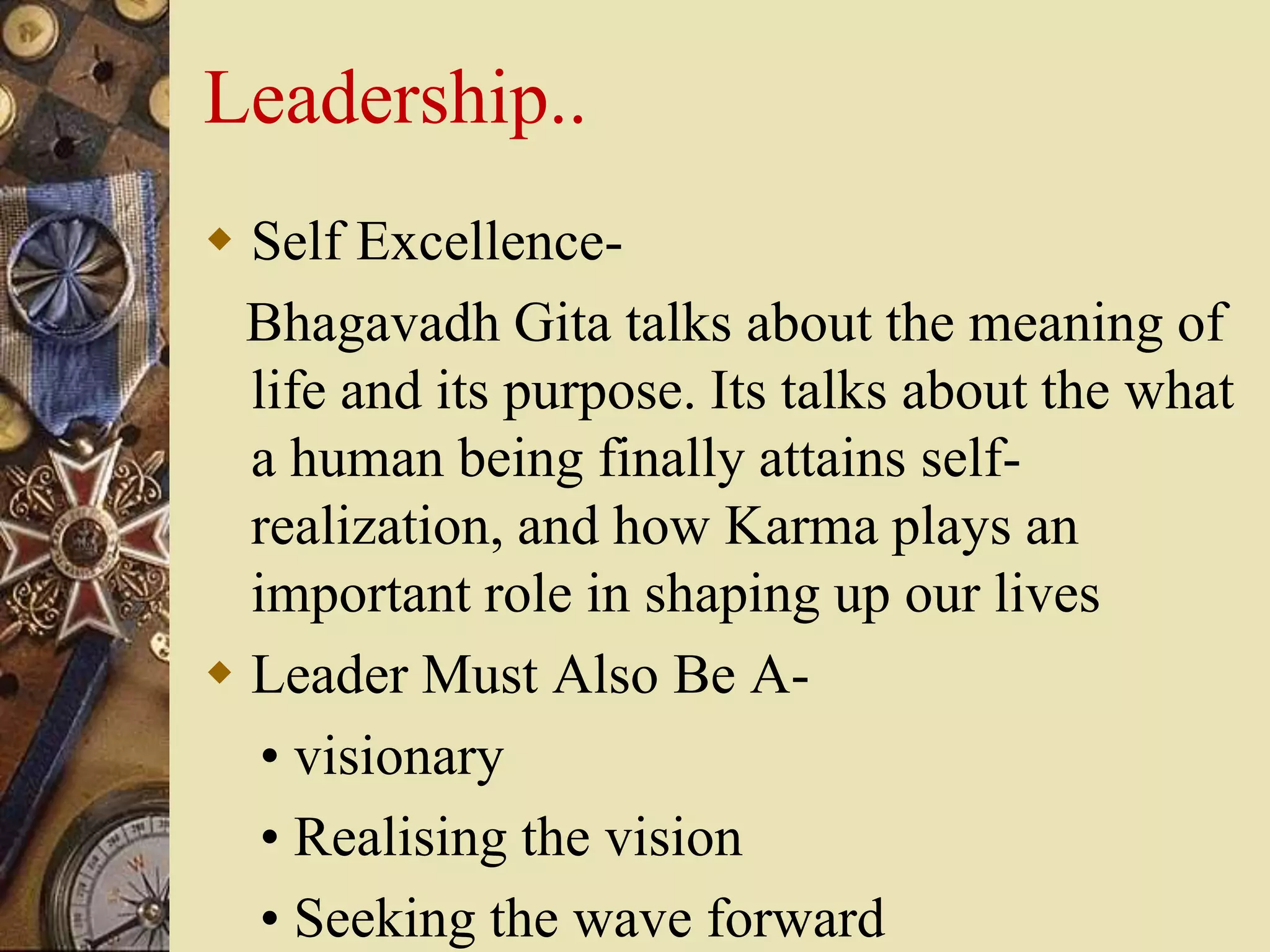
Leadership..
 Self Excellence-
Bhagavadh Gita talks about the meaning of
life and its purpose. Its talks about the what
a human being finally attains self-
realization, and how Karma plays an
important role in shaping up our lives
 Leader Must Also Be A-
• visionary
• Realising the vision
• Seeking the wave forward
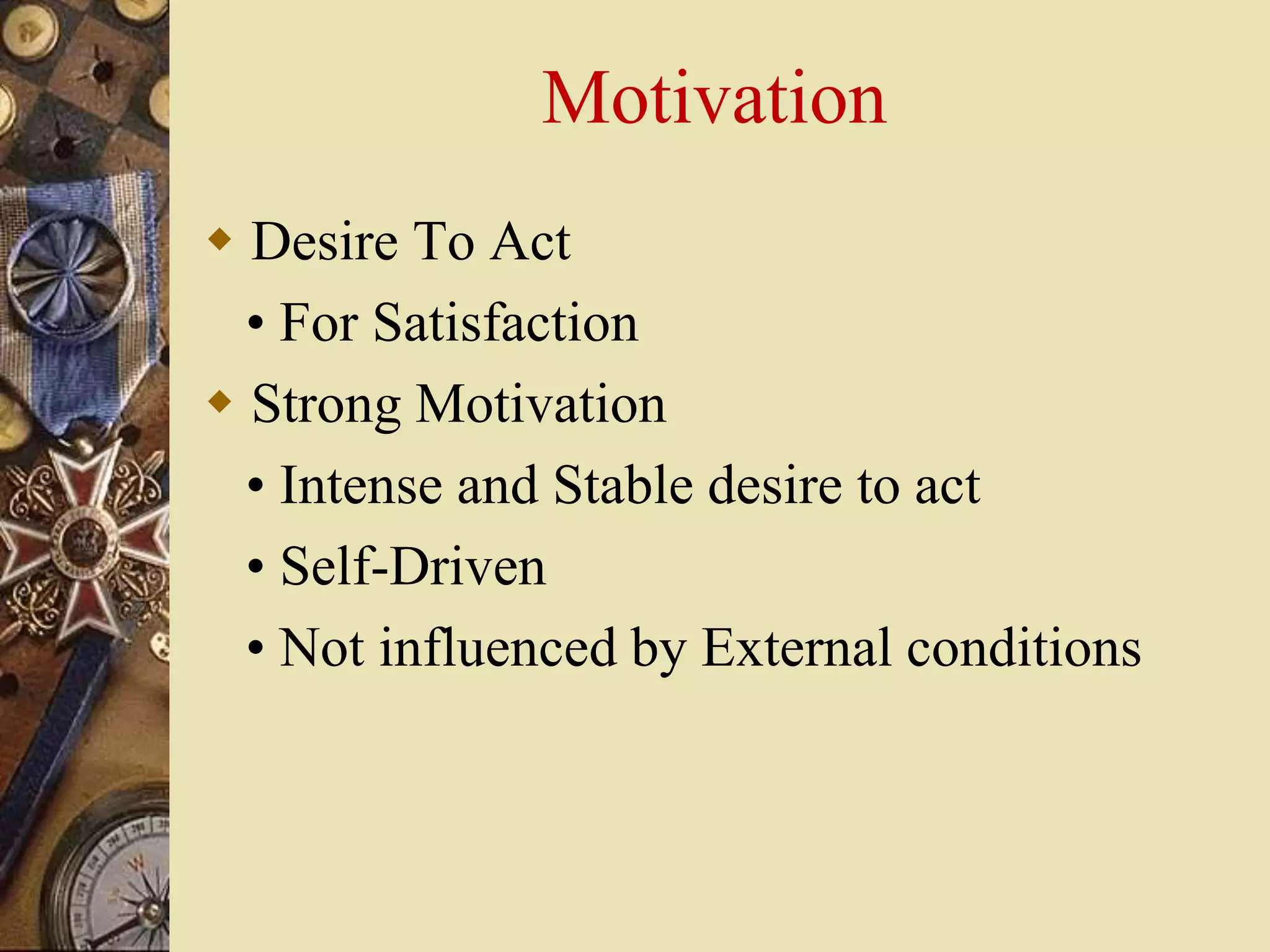
Motivation
 Desire To Act
• For Satisfaction
 Strong Motivation
• Intense and Stable desire to act
• Self-Driven
• Not influenced by External conditions
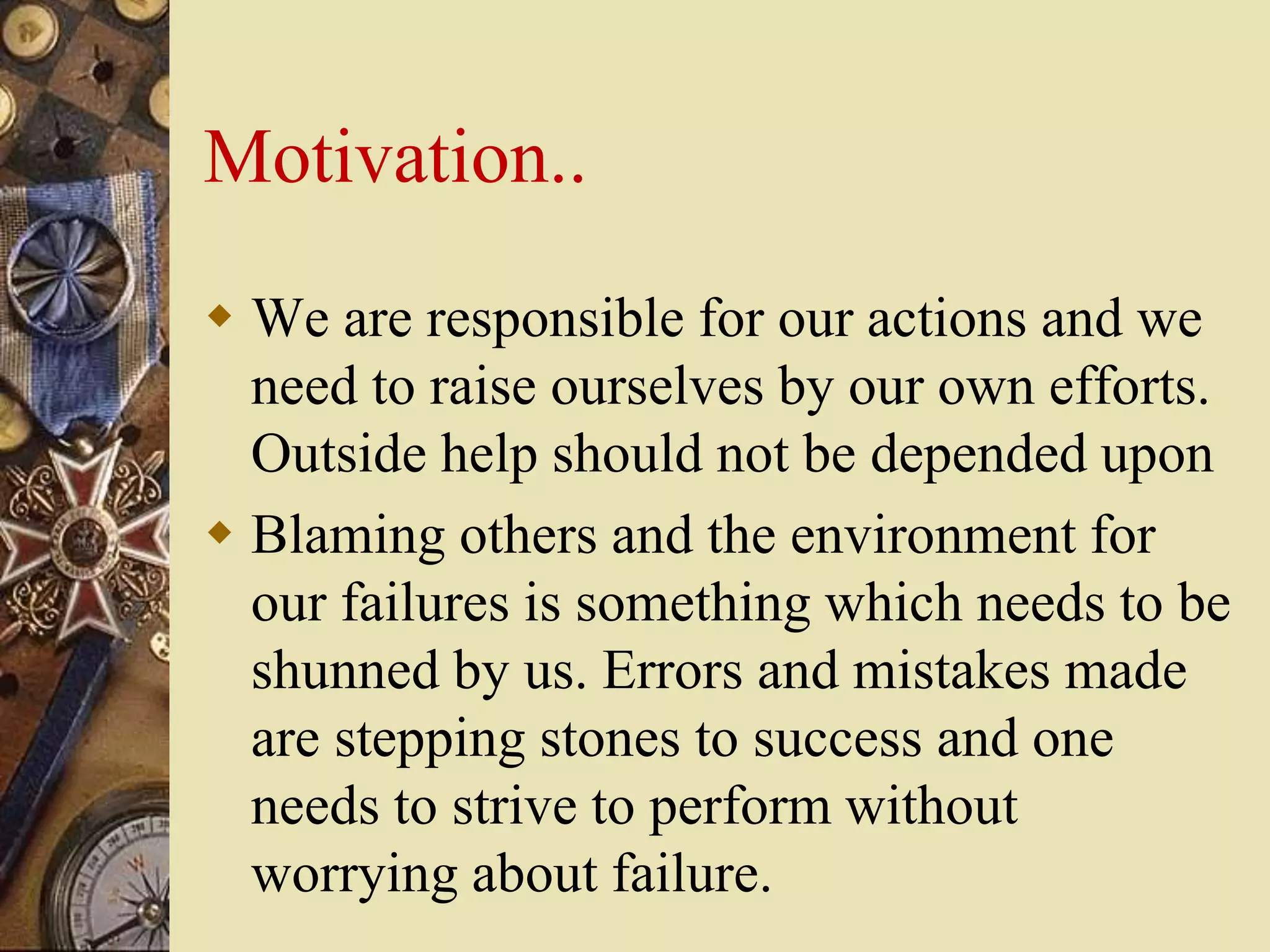
Motivation..
 We are responsible for our actions and we
need to raise ourselves by our own efforts.
Outside help should not be depended upon
 Blaming others and the environment for
our failures is something which needs to be
shunned by us. Errors and mistakes made
are stepping stones to success and one
needs to strive to perform without
worrying about failure.
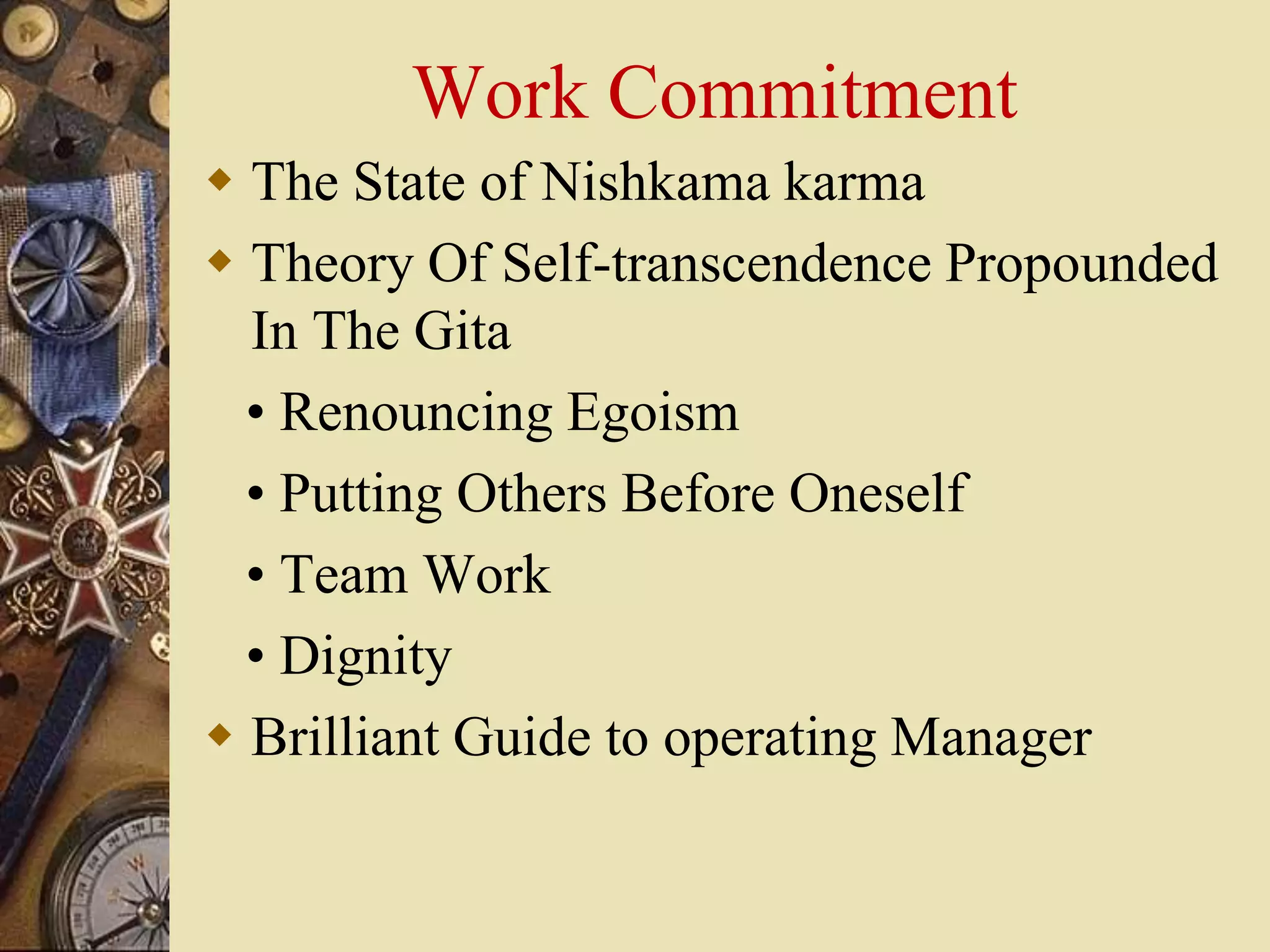
Work Commitment
 The State of Nishkama karma
 Theory Of Self-transcendence Propounded
In The Gita
• Renouncing Egoism
• Putting Others Before Oneself
• Team Work
• Dignity
 Brilliant Guide to operating Manager
Work Commitment..
 The path of spiritual knowledge for the
intellectuals, and path of unselfish work (or
KarmYog, Sevaa) for the average person
 Those who control their six senses by their
intellect, and engage themselves in
unselfish work or Sevaa are considered
superior
 Do your duty to the best of your abilities as
a service to God and the society without
the desire or greed for enjoying the fruits
of your labor
Develop Human Resource
 DAIVI WORK CULTURE
• Fearlessness, Purity, Self-Control
• Straightforwardness, Self-Denial
• Absence of Fault-finding, Absence of
Greed, Gentleness
• Modesty, Absence of Envy and Pride
 ASURI WORK CULTURE
• Egoism, Delusion, Desire-centric
• Improper Performance
Managerial Skills
 Utilisation of Available Resources
• Choose wisely and utilise optimally the
scarce resources
• Duryodhana chose SRI KRISHNA’S
LARGE Army
• Arjuna selected SRI KRISHNA'S WISDOM
for his support
 Attitude towards Work
• Develop the Visionary Perspective in the
work we do
• Develop a Sense of larger Vision in One’s
Work for the Common Good
Way of Knowledge
 The four divisions of labor in human society,
based on individual aptitude, were created by
Me. Though I am the author of this system of
division of labor, one should know that I do
nothing and I am eternal. (The lord has created
people with multitude of skills to run all the
affairs of the world) The one who sees inaction
in action, and action in inaction, is a wise
person
 Acquiring of spiritual knowledge is superior to
any other material activity such as austerity and
charity, because, spiritual knowledge is the goal
and the end result of Karma
Meditation
 When there is no desire for sensual pleasures,
or attachment to the fruits of work, and one
has renounced all selfish desires, then one is
said to have attained yogic perfection
 One can elevate or degrade oneself by one's
own mind. The mind can become one's best
friend, or the worst enemy. The mind
becomes a friend to the one who has control
over it, and becomes an enemy for the one
who is controlled by the mind, because the
uncontrolled mind will take one for a ride on
the dark streets of sin
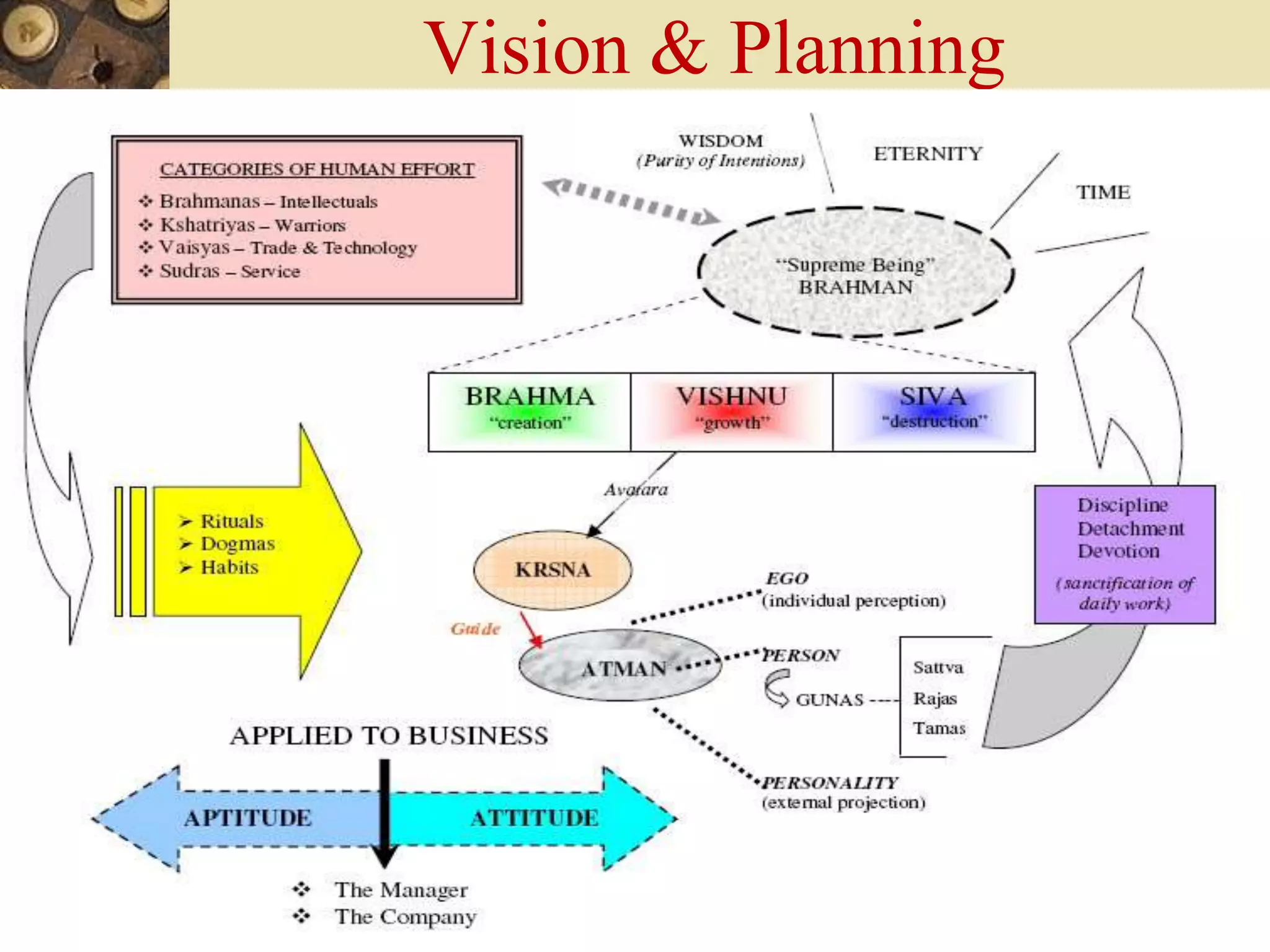
Vision & Planning
Himanshu Kumar
Amity International Business School

vdocument.in_management-lessons-from-bhagavad-gita.ppt

  • 1.
  • 2.
    Introduction  The "Bhagavad-Gita"is a doctrine of universal truth. Its message is universal, sublime, and non-sectarian although it is a part of the scriptural trinity of Sanaatan Dharm, commonly known as Hinduism  The message of Bhagavad-Gita came to humanity due to Arjun's unwillingness to do his duty as a warrior, because fighting involved destruction and killing
  • 3.
    Management Learning  LEADERSHIP MOTIVATION  WORKCOMMITMENT  DEVELOPINGHUMANRESOURCES  MANAGERIALSKILLS  WAYofKNOWLEDGE  MEDITATION  VISION&PLANNING
  • 4.
    Leadership  "I AMTHE STRENGTH OF THOSE WHO ARE DEVOID OF PERSONAL DESIRE AND ATTACHMENT. O ARJUNA, I AM THE LEGITIMATE DESIRE IN THOSE, WHO ARE NOT OPPOSED TO RIGHTEOUSNESS“ -----SRI KRISHNA
  • 5.
    Leadership..  Self Excellence- BhagavadhGita talks about the meaning of life and its purpose. Its talks about the what a human being finally attains self- realization, and how Karma plays an important role in shaping up our lives  Leader Must Also Be A- • visionary • Realising the vision • Seeking the wave forward
  • 6.
    Motivation  Desire ToAct • For Satisfaction  Strong Motivation • Intense and Stable desire to act • Self-Driven • Not influenced by External conditions
  • 7.
    Motivation..  We areresponsible for our actions and we need to raise ourselves by our own efforts. Outside help should not be depended upon  Blaming others and the environment for our failures is something which needs to be shunned by us. Errors and mistakes made are stepping stones to success and one needs to strive to perform without worrying about failure.
  • 8.
    Work Commitment  TheState of Nishkama karma  Theory Of Self-transcendence Propounded In The Gita • Renouncing Egoism • Putting Others Before Oneself • Team Work • Dignity  Brilliant Guide to operating Manager
  • 9.
    Work Commitment..  Thepath of spiritual knowledge for the intellectuals, and path of unselfish work (or KarmYog, Sevaa) for the average person  Those who control their six senses by their intellect, and engage themselves in unselfish work or Sevaa are considered superior  Do your duty to the best of your abilities as a service to God and the society without the desire or greed for enjoying the fruits of your labor
  • 10.
    Develop Human Resource DAIVI WORK CULTURE • Fearlessness, Purity, Self-Control • Straightforwardness, Self-Denial • Absence of Fault-finding, Absence of Greed, Gentleness • Modesty, Absence of Envy and Pride  ASURI WORK CULTURE • Egoism, Delusion, Desire-centric • Improper Performance
  • 11.
    Managerial Skills  Utilisationof Available Resources • Choose wisely and utilise optimally the scarce resources • Duryodhana chose SRI KRISHNA’S LARGE Army • Arjuna selected SRI KRISHNA'S WISDOM for his support  Attitude towards Work • Develop the Visionary Perspective in the work we do • Develop a Sense of larger Vision in One’s Work for the Common Good
  • 12.
    Way of Knowledge The four divisions of labor in human society, based on individual aptitude, were created by Me. Though I am the author of this system of division of labor, one should know that I do nothing and I am eternal. (The lord has created people with multitude of skills to run all the affairs of the world) The one who sees inaction in action, and action in inaction, is a wise person  Acquiring of spiritual knowledge is superior to any other material activity such as austerity and charity, because, spiritual knowledge is the goal and the end result of Karma
  • 13.
    Meditation  When thereis no desire for sensual pleasures, or attachment to the fruits of work, and one has renounced all selfish desires, then one is said to have attained yogic perfection  One can elevate or degrade oneself by one's own mind. The mind can become one's best friend, or the worst enemy. The mind becomes a friend to the one who has control over it, and becomes an enemy for the one who is controlled by the mind, because the uncontrolled mind will take one for a ride on the dark streets of sin
  • 14.
  • 15.