INDIAN ETHOS
Cambridge Advanced Learner’s Dictionary defines Ethos as “the set of beliefs, ideas, etc about social behaviour and relationship of a person or group”. Oxford Advanced Learner’s Dictionary defines it as “the moral ideas and attitudes that belong to a particular group or society”.  Indian Ethos is all about what can be termed as “national ethos”.
Ethos  is an English word based on a Greek word and denotes the guiding beliefs or ideals that characterize a community, a nation or an ideology. There are three categories of ethos. phronesis  - practical skills & wisdom  arete  - virtue, goodness  eunoia  - goodwill towards the audience
ETHICS Set of beliefs, ideas, attitudes Guides to social behaviour Of a Nation / Community / Religion
What u want, Do it to others
PAINT with LEAD
What u don’t want, don't do
What harms u, don't do
The body of knowledge which derives its solutions from the rich and huge Indian system of ethics (moral philosophy) is known as Indian Ethos in Management (IEM). Is IEM some kind of Hindu concept of management? Certainly not.
Not Hindu Concept
Management is behavioral science and it has to be culture specific. IEM has as its basis, the culture base of India and as a country whose culture has its roots in religion - it does draw its lessons from the religions of the land - be it Hinduism, Buddhism, or any other.
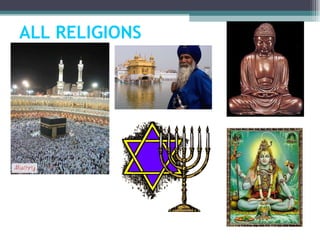
CONCEPT Of ALL RELIGIONS
ALL RELIGIONS
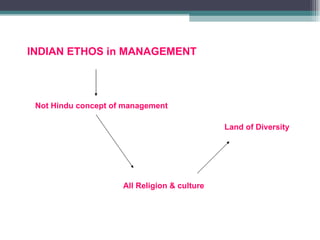
INDIAN ETHOS in MANAGEMENT Not Hindu concept of management All Religion & culture Land of Diversity
Golden Rule of Ethics Everything you want others to do to you, you shall do to others. Do not do to others that which you do not wish them to do to you. Do not do anything to others that if done to you, would cause harm to you.
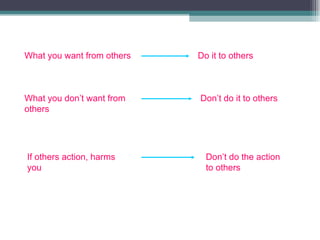
What you want from others Do it to others What you don’t want from others Don’t do it to others If others action, harms  you  Don’t do the action to others
Lord Krishna in the Gita says: “ Karmanyeva Adhtkaraste Ma  Phaleshu Kadhachana  Ma Karma-phala-heturbuhu Ma  The’ Sangab Asthu Akarmani ” “ You have the right only to  action, and never to the fruits  of your actions, nor be  attached to inaction”.
NEED  To develop proper management system in the organisation. Management systems based on principles as per ancient wisdom are of immense help for the smooth conduct of business. Value oriented business can be established with the help of Indian ethos.  To ensure all round growth ,development & prosperity i.e., productivity, marketing & profitability
Ancient Wisdom (Human productivity  than plant capacity) Proper Mgt system Smooth Business Value oriented business Indian Ethos Growth & development
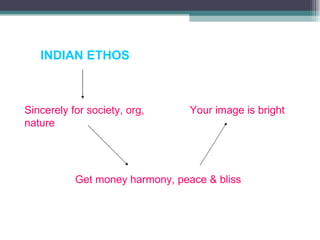
Indian Ethos teaches us that if you work sincerely for the society, for the organisation and for the Nature, you will really enjoy the life through money harmony, peace and bliss. Your image is bright. Indian wisdom indicates that productivity of human being is more important than plant capacity
INDIAN ETHOS Sincerely for society, org, nature Get money harmony, peace & bliss Your image is bright
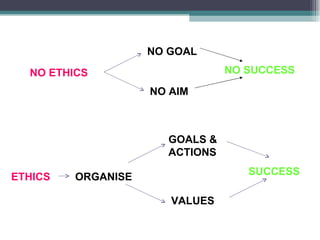
Ethics is a requirement for human life. It is our means of deciding a course of action. Without it, our actions would be random & aimless. There would be no way to work towards a goal because there would be no way to pick between a limitless number of goals. Even with an ethical standard, we may be unable to pursue our goals with the possibility of success. To the degree which a rational ethical standard is taken, we are able to correctly organize our goals and actions to accomplish our most important values. Any flaw in our ethics will reduce our ability to be successful in our endeavors.
NO ETHICS NO GOAL NO AIM NO SUCCESS ETHICS ORGANISE GOALS & ACTIONS  VALUES SUCCESS
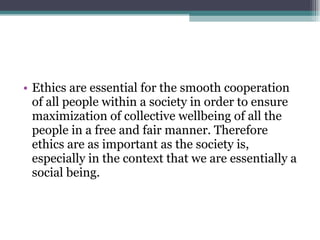
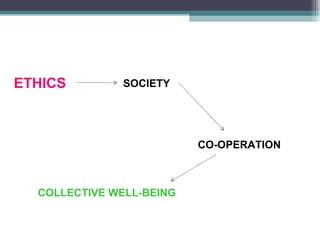
Ethics are essential for the smooth cooperation of all people within a society in order to ensure maximization of collective wellbeing of all the people in a free and fair manner. Therefore ethics are as important as the society is, especially in the context that we are essentially a social being.
ETHICS CO-OPERATION COLLECTIVE WELL-BEING SOCIETY
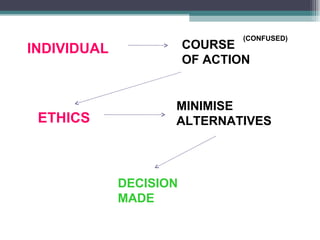
PURPOSE "The philosophy that can't help you do things does nothing."                                                                 -  Aristotle. Establishment of basic guidelines & rules for deciding which behaviour is Good and Bad. So not necessary for the individual to make detailed analyses most of the time.
ETHICS DECISION MADE MINIMISE ALTERNATIVES INDIVIDUAL COURSE OF ACTION (CONFUSED)
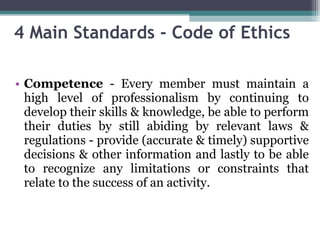
4 Main Standards - Code of Ethics Competence  - Every member must maintain a high level of professionalism by continuing to develop their skills & knowledge, be able to perform their duties by still abiding by relevant laws & regulations - provide (accurate & timely) supportive decisions & other information and lastly to be able to recognize any limitations or constraints that relate to the success of an activity.
Credibility  - Each member being able to communicate information objectively & make sure that they disclose all relevant information and delays of deficiencies that have an effect on the organization or its operations Confidentiality  - Each member of the organization keeping all personal information discrete and secret unless it is necessary that the information is disclosed. All parties involved must be aware & comply to the confidential policy. It is also assumed that under this standard each member will refrain from using information that is considered confidential to have an illegal advantage or promote unethical activities
Integrity  - Ability to adhere to moral & ethical principles & have regular communication to avoid conflicts of interest. Also acting with integrity includes refraining and abstaining from engagement in any activity that with discredit the company or be deemed as unethical. 
Institute of Management Accountants (IMA) - Ethical Principles  Honesty  - Being truthful & sincere is said to be acting honestly and it will help in an organization if everyone possesses those qualities Fairness  – A Co’s financial statements being presents in an understandable, and comprehensive way to not favor one party over another Objectivity   - not acting based on personal feelings or prejudice and being unbiased. Responsibility  - obligation or duty to do things that you feel is right
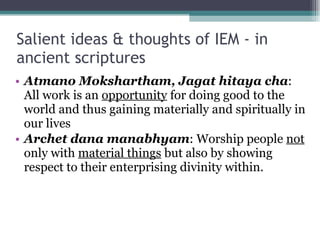
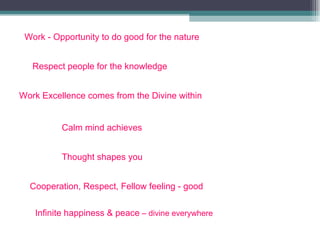
Salient ideas & thoughts of IEM - in ancient scriptures Atmano Mokshartham, Jagat hitaya cha : All work is an  opportunity  for doing good to the world and thus gaining materially and spiritually in our lives Archet dana manabhyam : Worship people  not  only with  material things  but also by showing respect to their enterprising divinity within.
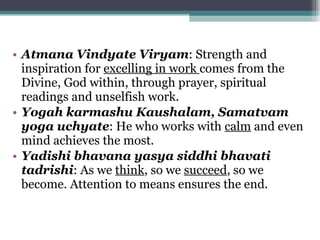
Atmana Vindyate Viryam : Strength and inspiration for  excelling in work  comes from the Divine, God within, through prayer, spiritual readings and unselfish work. Yogah karmashu Kaushalam, Samatvam yoga uchyate : He who works with  calm  and even mind achieves the most. Yadishi bhavana yasya siddhi bhavati tadrishi : As we  think , so we  succeed , so we become. Attention to means ensures the end.
Parasparam bhavayantah shreyah param bhavapsyathah : By mutual  cooperation ,respect and fellow feeling, all of us enjoy the highest good both material and spiritual. Tesham sukhm tesham shanti shaswati : Infinite happiness and infinite peace come to them who  see the Divine  in all beings. Paraspar Devo Bhav : Regard the other person as a divine being. All of us have the  same consciousness  though our packages and containers are different.
Work - Opportunity to do good for the nature Respect people for the knowledge Work Excellence comes from the Divine within Calm mind achieves Thought shapes you Cooperation, Respect, Fellow feeling - good Infinite happiness & peace   – divine everywhere
Basic principles  of (IEM): Immense potential, energy and talents for perfection as human being has the spirit within his heart. Holistic approach indicating unity between the Divine (The Divine means perfection in knowledge, wisdom and power), individual self and the universe.
Subtle, intangible subject and gross tangible objects are equally important. One must develop one’s Third Eye,  Jnana Chaksu, the Eye of Wisdom, Vision, Insight  and Foresight. Inner resources are much more powerful than outer resources. Divine virtues are inner resources. Capital, materials and plant & machinery are outer resources. Karma Yoga  (selfless work) offers double benefits, private benefit in the form of self  purification and public benefit.
Yogah Karmasu Kaushalam  - Excellence at work through self-motivation and self-development  with devotion and without attachment.  Co-operation  is a powerful instrument for team work and success in any enterprise involving collective work.
Immense strength, potential are within Selfless work Cooperation – instrument for success Forecasting the future Unity btn Divine, Universe, Individual Self-motivation in work
Karma Yoga  -  a good pathway for – self purification & self-development, individual as well as collective growth & welfare, minimum play of passion, jealousy, hatred, greed, anger and arrogance, team spirit, team work, autonomous management, minimum control and supervision, etc.  Result  -all round happiness & prosperity.
Karma Yoga  is an end-state or an alias of  Nishkam Karma  (NK) . Yoga -  union between ‘individual consciousness’ & ‘supreme consciousnesses’.  Work is one of the several methods of achieving this union. Juxtaposed against the NK is the other attitude to work called  Sakam Karma  (SK) .
Indian Socio-political Environment Indian Socio-political Environment – Complex – Diversity in cultures, religions, Customs, rituals – from Kashmir to Kanya kumari – Unity in Diversity  2 tenets – Human values (Spiritual, ethical, moral values)  - Holism (oneness, relation of parts ) Indian model of Management is spiritualistic model
Salient features of Indian Socio-political Environment FOCUS ON LIFESTYLE   -  Mgt in Indian socio environment defines Standard of living & Maximizing quality of life – not only quality of consumer goods & services but also enriching quality of life in the society & environment – one thinks, speaks & behaves
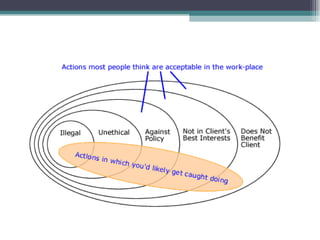
FOCUS TOWARDS BUSINESS POLICY Political parties makes policies during their rule and it is mandatory for business to follow it. Policies are made inline with current situation Sometimes it is unfavorable. Different parties have different ideologies Frame policies for their benefits & interests. Business people though not favorable has to follow those polices
LACK OF NATIONAL PRIDE & COMMITMENT People work for their benefit without any commitment. They work to fulfill the particular role assigned It will benefit him as a person The same work when done with country in mind will make him a better citizen both in attitude & mind It will benefit the country
EXISTENCE OF HUMAN ORIENTATION & VALUES Components of National development activities require human  orientation & values Like hard work, truthfulness, obedience, good manners, peace & Harmony
PLAIN LIVING & HIGH THINKING Essence  of Indian way of living Plain life to give more energy & thought to the development of Spiritualism Mind important than Materialism Ethics important than Economics
 
Management Concepts Redefined Term General Definition (At Present) IEM Definition Management Getting things done Helping other people to produce extraordinary results Productivity Output centric People centric Planning Management by results Management by strategy Effective supervision Concern for task and not for people Produce performers. Help the subordinates to develop leadership quality Motivation of people Maslow’s Theory of Needs with some modifications Emphasis on self-motivation, subordinates encouraged to be creative and given autonomy
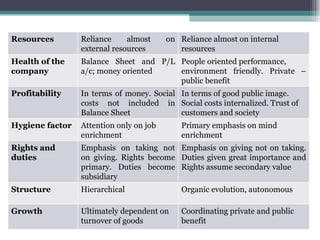
Resources Reliance almost on external resources Reliance almost on internal resources Health of the company Balance Sheet and P/L a/c; money oriented People oriented performance, environment friendly. Private –public benefit Profitability In terms of money. Social costs not included in Balance Sheet In terms of good public image. Social costs internalized. Trust of customers and society Hygiene factor Attention only on job enrichment Primary emphasis on mind enrichment Rights and duties Emphasis on taking not on giving. Rights become primary. Duties become subsidiary Emphasis on giving not on taking. Duties given great importance and Rights assume secondary value Structure Hierarchical Organic evolution, autonomous Growth Ultimately dependent on turnover of goods Coordinating private and public benefit
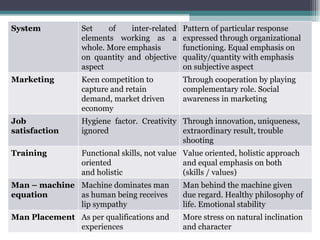
System Set of inter-related elements working as a whole. More emphasis on quantity and objective aspect Pattern of particular response expressed through organizational functioning. Equal emphasis on quality/quantity with emphasis on subjective aspect Marketing Keen competition to capture and retain demand, market driven economy Through cooperation by playing complementary role. Social awareness in marketing Job satisfaction Hygiene factor. Creativity ignored Through innovation, uniqueness, extraordinary result, trouble shooting Training Functional skills, not value oriented and holistic Value oriented, holistic approach and equal emphasis on both (skills / values) Man – machine equation Machine dominates man as human being receives lip sympathy Man behind the machine given due regard. Healthy philosophy of life. Emotional stability Man Placement As per qualifications and experiences More stress on natural inclination and character
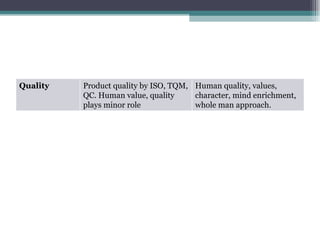
Quality Product quality by ISO, TQM, QC. Human value, quality plays minor role Human quality, values, character, mind enrichment, whole man approach.
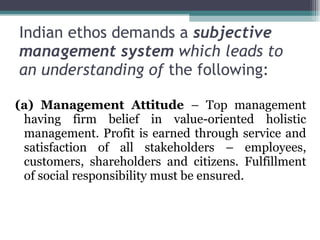
Indian ethos demands a  subjective management system  which leads to an understanding of  the following: (a) Management Attitude  – Top management having firm belief in value-oriented holistic management. Profit is earned through service and satisfaction of all stakeholders – employees, customers, shareholders and citizens. Fulfillment of social responsibility must be ensured.
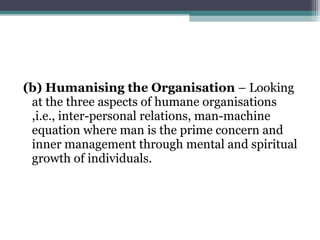
(b) Humanising the Organisation  – Looking at the three aspects of humane organisations ,i.e., inter-personal relations, man-machine equation where man is the prime concern and inner management through mental and spiritual growth of individuals.
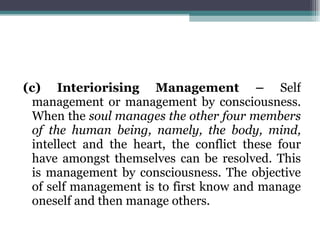
(c) Interiorising Management –  Self management or management by consciousness. When the  soul manages the other four members of the human being, namely, the body, mind,  intellect and the heart, the conflict these four have amongst themselves can be resolved. This is management by consciousness. The objective of self management is to first know and manage oneself and then manage others.
(d) Self-introspection –  Embark upon self-study, self-analysis and self-criticism to locate areas of friction and disharmony, a self examination of one’s own thoughts, feelings, emotions, sensations and passions and a desire to reduce and subdue the ego.
(e) Brain-stilling –  For rational and enduring decisions, silent mind is a necessity. A perfect  Mounum (calm mind enjoying tranquility) is necessary. Brain-stilling or meditative silence is  the most reliable method to discover solutions to problems and difficulties which seem to be difficult to be tackled by reason and intellect because through this one can come into contact with the inner mind or higher consciousness called  Chetana.
(f) Stepping Back (for a while) –  Never decide anything, never speak a word, never throw yourself into action without stepping-back. The stepping back from a situation for a while enables one to control and master a situation.
(g) Self-dynamising Meditation –  A dynamic meditation is meditation of transformation of lower consciousness into higher consciousness and hence is called  transforming meditation.  Through meditation, in a silent and calm mind, one reaches a higher level of consciousness which offers guidance in the form of intuitions to tackle a multitude of problems. This is called  consciousness approach to management.
(h) Role of Intuition  – Intuition is the act of coming to direct knowledge or certainty without reasoning or inferring. It is immediate cognition by the inner mind and when fully developed, is efficient and effective for taking prompt and sound decisions. Intuition skills enable one to cope with confidence the fluctuating environment and rapid changes.  Faith is  a prerequisite to develop and realize the power of intuition.
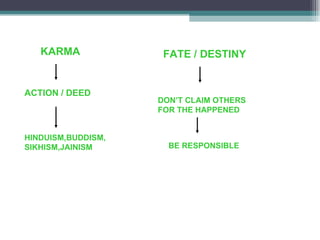
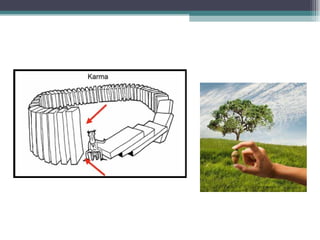
KARMA ( kárma  (help·info),  kárman —"act, action, performance”)  Karma  in Indian religions is the concept of "action" or "deed", understood as that which causes the entire cycle of cause and effect (i.e., the cycle called saṃsāra) originating in ancient India and treated in Hindu, Jain, Buddhist and Sikh philosophies
KARMA ACTION / DEED FATE / DESTINY DON’T CLAIM OTHERS FOR THE HAPPENED BE RESPONSIBLE HINDUISM,BUDDISM,SIKHISM,JAINISM
Learn to live according to spiritual rules of eternal life and improve the quality of your life. Your mind, emotions, speech and actions are affected by this law.  Mankind sometimes gets struck by their "destiny". Some suffer from illness, accidents, from being beaten half death or death and they most if not all the time claim others of being guilty.
This of course is completely wrong. Mankind - made to the image of God - needs to learn to be fully responsible for all they do. The law of Karma explains why illness, accidents and disasters of any kind may occurs to some persons, and why others may enjoy a happy life, free, healthy and joyful.  Learn to properly apply this law for your personal benefit - it will be at the same time for the benefit of all. By properly applying all spiritual principles of God's Divine creation, your life will become instantly easier - provided you follow ALL rules exactly to the word.
 
 
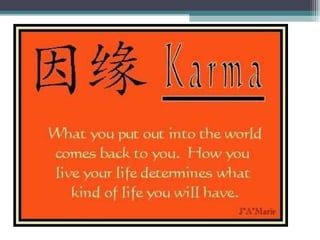
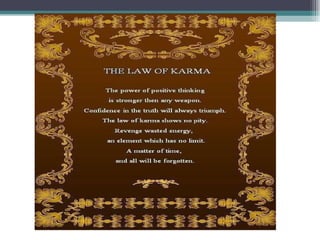
LAW of KARMA Actually the  law of karma  is very simple and has been known for thousands of years. The law of Karma is known in Christian teachings, as well as in many other cultures. It says:  Whatever you do to others - will be done to you, in this or any future incarnation of your soul.
 
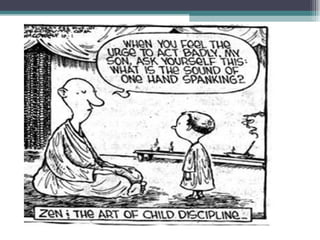
Straightforward & Logical Sometimes is hard to believe, that some persons still think they may somehow get around it. If you knock your head against a wall, it is obvious - it may damage the wall and it may hurt your head. If you knock someone by physically fighting - you may cause harm, pain, injury to the person and the law of Karma requires you to experience the same pain. This is to have you learn to behave in a way that causes but pleasant experiences to others and yourself alike.
 
 
THE 12 LAWS OF KARMA
THE GREAT LAW "As you sow, so shall you reap". This is also known as the "Law of Cause and Effect". Whatever we put out in the Universe is what comes back to us. If what we want is Happiness, Peace, Love, Friendship...Then we should BE Happy, Peaceful, Loving and a True Friend.
 
THE LAW OF CREATION  Life doesn't just HAPPEN, it requires our participation. We are one with the Universe, both inside and out. Whatever surrounds us gives us clues to our inner state. BE yourself, and surround yourself with what you want to have present in your Life.
 
THE LAW OF HUMILITY  What you refuse to accept, will continue for you. If what we see is an enemy, or someone with a character trait that we find to be negative,then we ourselves are not focused on a higher level of existence.
 
THE LAW OF GROWTH "Wherever you go, there you are". For us to GROW in Spirit, it is we who must change - and not the people, places or things around us. The only given we have in our lives is OURSELVES and that is the only factor we have control over. When we change who and what we are within our heart our life follows suit and changes too.
 
THE LAW OF RESPONSIBILITY Whenever there is something wrong in my life, there is something wrong in me. We mirror what surrounds us - and what surrounds us mirrors us; this is a Universal Truth. We must take responsibility what is in our life.
 
THE LAW OF CONNECTION  Even if something we do seems inconsequential, it is very important that it gets done as everything in the Universe is connected. Each step leads to the next step, and so forth and so on. Someone must do the initial work to get a job done. Neither the first step nor the last are of greater significance,As they were both needed to accomplish the task. Past - Present - Future They are all connected...
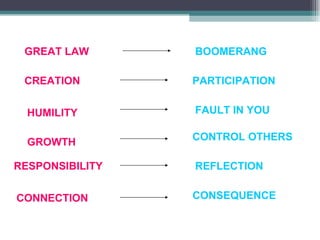
GREAT LAW BOOMERANG HUMILITY CREATION GROWTH RESPONSIBILITY PARTICIPATION FAULT IN YOU CONTROL OTHERS REFLECTION CONNECTION CONSEQUENCE
THE LAW OF FOCUS  You can not think of two things at the same time. When our focus is on Spiritual Values, it is impossible for us to have lower thoughts such as greed or anger
 
THE LAW OF GIVING & HOSPITALITY  If you believe something to be true, then sometime in your life you will be called upon to demonstrate that particular truth. Here is where we put what we CLAIM that we have learned, into actual PRACTICE.
 
THE LAW OF HERE AND NOW  Looking backward to examine what was, prevents us from being totally in the HERE AND NOW. Old thoughts, old patterns of behavior, old dreams... Prevent us from having new ones
 
THE LAW OF CHANGE  History repeats itself until we learn the lessons that we need to change our path
 
THE LAW OF PATIENCE AND REWARD All Rewards require initial toil. Rewards of lasting value require patient and persistent toil. True joy follows doing what we're suppose to be doing, and waiting for the reward to come in on it's own time
 
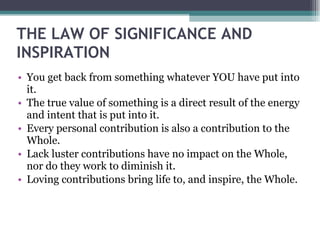
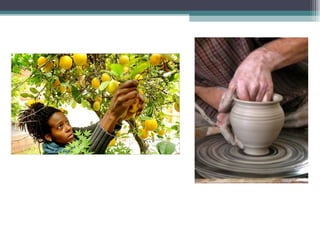
THE LAW OF SIGNIFICANCE AND INSPIRATION  You get back from something whatever YOU have put into it. The true value of something is a direct result of the energy and intent that is put into it. Every personal contribution is also a contribution to the Whole. Lack luster contributions have no impact on the Whole, nor do they work to diminish it. Loving contributions bring life to, and inspire, the Whole.
 
 
FOCUS ENRICH HERE & NOW HOSPITALITY CHANGE PATIENCE & REWARD PARTICIPATION RECTIFIES & PREVENTS REPEATS DESERVES WIN INSPIRATION SYNERGY
 

Indian ethos

  • 1.
  • 2.
    Cambridge Advanced Learner’sDictionary defines Ethos as “the set of beliefs, ideas, etc about social behaviour and relationship of a person or group”. Oxford Advanced Learner’s Dictionary defines it as “the moral ideas and attitudes that belong to a particular group or society”. Indian Ethos is all about what can be termed as “national ethos”.
  • 3.
    Ethos isan English word based on a Greek word and denotes the guiding beliefs or ideals that characterize a community, a nation or an ideology. There are three categories of ethos. phronesis - practical skills & wisdom arete - virtue, goodness eunoia - goodwill towards the audience
  • 4.
    ETHICS Set ofbeliefs, ideas, attitudes Guides to social behaviour Of a Nation / Community / Religion
  • 5.
    What u want,Do it to others
  • 6.
    What u want,Do it to others
  • 7.
  • 8.
    What u don’twant, don't do
  • 9.
    What u don’twant, don't do
  • 10.
    What u don’twant, don't do
  • 11.
    What harms u,don't do
  • 12.
    The body ofknowledge which derives its solutions from the rich and huge Indian system of ethics (moral philosophy) is known as Indian Ethos in Management (IEM). Is IEM some kind of Hindu concept of management? Certainly not.
  • 13.
  • 14.
    Management is behavioralscience and it has to be culture specific. IEM has as its basis, the culture base of India and as a country whose culture has its roots in religion - it does draw its lessons from the religions of the land - be it Hinduism, Buddhism, or any other.
  • 15.
    CONCEPT Of ALLRELIGIONS
  • 16.
  • 17.
    INDIAN ETHOS inMANAGEMENT Not Hindu concept of management All Religion & culture Land of Diversity
  • 18.
    Golden Rule ofEthics Everything you want others to do to you, you shall do to others. Do not do to others that which you do not wish them to do to you. Do not do anything to others that if done to you, would cause harm to you.
  • 19.
    What you wantfrom others Do it to others What you don’t want from others Don’t do it to others If others action, harms you Don’t do the action to others
  • 20.
    Lord Krishna inthe Gita says: “ Karmanyeva Adhtkaraste Ma Phaleshu Kadhachana Ma Karma-phala-heturbuhu Ma The’ Sangab Asthu Akarmani ” “ You have the right only to action, and never to the fruits of your actions, nor be attached to inaction”.
  • 21.
    NEED Todevelop proper management system in the organisation. Management systems based on principles as per ancient wisdom are of immense help for the smooth conduct of business. Value oriented business can be established with the help of Indian ethos. To ensure all round growth ,development & prosperity i.e., productivity, marketing & profitability
  • 22.
    Ancient Wisdom (Humanproductivity than plant capacity) Proper Mgt system Smooth Business Value oriented business Indian Ethos Growth & development
  • 23.
    Indian Ethos teachesus that if you work sincerely for the society, for the organisation and for the Nature, you will really enjoy the life through money harmony, peace and bliss. Your image is bright. Indian wisdom indicates that productivity of human being is more important than plant capacity
  • 24.
    INDIAN ETHOS Sincerelyfor society, org, nature Get money harmony, peace & bliss Your image is bright
  • 25.
    Ethics is arequirement for human life. It is our means of deciding a course of action. Without it, our actions would be random & aimless. There would be no way to work towards a goal because there would be no way to pick between a limitless number of goals. Even with an ethical standard, we may be unable to pursue our goals with the possibility of success. To the degree which a rational ethical standard is taken, we are able to correctly organize our goals and actions to accomplish our most important values. Any flaw in our ethics will reduce our ability to be successful in our endeavors.
  • 26.
    NO ETHICS NOGOAL NO AIM NO SUCCESS ETHICS ORGANISE GOALS & ACTIONS VALUES SUCCESS
  • 27.
    Ethics are essentialfor the smooth cooperation of all people within a society in order to ensure maximization of collective wellbeing of all the people in a free and fair manner. Therefore ethics are as important as the society is, especially in the context that we are essentially a social being.
  • 28.
  • 29.
    PURPOSE "The philosophythat can't help you do things does nothing."                                                                 - Aristotle. Establishment of basic guidelines & rules for deciding which behaviour is Good and Bad. So not necessary for the individual to make detailed analyses most of the time.
  • 30.
    ETHICS DECISION MADEMINIMISE ALTERNATIVES INDIVIDUAL COURSE OF ACTION (CONFUSED)
  • 31.
    4 Main Standards- Code of Ethics Competence - Every member must maintain a high level of professionalism by continuing to develop their skills & knowledge, be able to perform their duties by still abiding by relevant laws & regulations - provide (accurate & timely) supportive decisions & other information and lastly to be able to recognize any limitations or constraints that relate to the success of an activity.
  • 32.
    Credibility -Each member being able to communicate information objectively & make sure that they disclose all relevant information and delays of deficiencies that have an effect on the organization or its operations Confidentiality - Each member of the organization keeping all personal information discrete and secret unless it is necessary that the information is disclosed. All parties involved must be aware & comply to the confidential policy. It is also assumed that under this standard each member will refrain from using information that is considered confidential to have an illegal advantage or promote unethical activities
  • 33.
    Integrity -Ability to adhere to moral & ethical principles & have regular communication to avoid conflicts of interest. Also acting with integrity includes refraining and abstaining from engagement in any activity that with discredit the company or be deemed as unethical. 
  • 34.
    Institute of ManagementAccountants (IMA) - Ethical Principles Honesty - Being truthful & sincere is said to be acting honestly and it will help in an organization if everyone possesses those qualities Fairness – A Co’s financial statements being presents in an understandable, and comprehensive way to not favor one party over another Objectivity - not acting based on personal feelings or prejudice and being unbiased. Responsibility - obligation or duty to do things that you feel is right
  • 35.
    Salient ideas &thoughts of IEM - in ancient scriptures Atmano Mokshartham, Jagat hitaya cha : All work is an opportunity for doing good to the world and thus gaining materially and spiritually in our lives Archet dana manabhyam : Worship people not only with material things but also by showing respect to their enterprising divinity within.
  • 36.
    Atmana Vindyate Viryam: Strength and inspiration for excelling in work comes from the Divine, God within, through prayer, spiritual readings and unselfish work. Yogah karmashu Kaushalam, Samatvam yoga uchyate : He who works with calm and even mind achieves the most. Yadishi bhavana yasya siddhi bhavati tadrishi : As we think , so we succeed , so we become. Attention to means ensures the end.
  • 37.
    Parasparam bhavayantah shreyahparam bhavapsyathah : By mutual cooperation ,respect and fellow feeling, all of us enjoy the highest good both material and spiritual. Tesham sukhm tesham shanti shaswati : Infinite happiness and infinite peace come to them who see the Divine in all beings. Paraspar Devo Bhav : Regard the other person as a divine being. All of us have the same consciousness though our packages and containers are different.
  • 38.
    Work - Opportunityto do good for the nature Respect people for the knowledge Work Excellence comes from the Divine within Calm mind achieves Thought shapes you Cooperation, Respect, Fellow feeling - good Infinite happiness & peace – divine everywhere
  • 39.
    Basic principles of (IEM): Immense potential, energy and talents for perfection as human being has the spirit within his heart. Holistic approach indicating unity between the Divine (The Divine means perfection in knowledge, wisdom and power), individual self and the universe.
  • 40.
    Subtle, intangible subjectand gross tangible objects are equally important. One must develop one’s Third Eye, Jnana Chaksu, the Eye of Wisdom, Vision, Insight and Foresight. Inner resources are much more powerful than outer resources. Divine virtues are inner resources. Capital, materials and plant & machinery are outer resources. Karma Yoga (selfless work) offers double benefits, private benefit in the form of self purification and public benefit.
  • 41.
    Yogah Karmasu Kaushalam - Excellence at work through self-motivation and self-development with devotion and without attachment. Co-operation is a powerful instrument for team work and success in any enterprise involving collective work.
  • 42.
    Immense strength, potentialare within Selfless work Cooperation – instrument for success Forecasting the future Unity btn Divine, Universe, Individual Self-motivation in work
  • 43.
    Karma Yoga - a good pathway for – self purification & self-development, individual as well as collective growth & welfare, minimum play of passion, jealousy, hatred, greed, anger and arrogance, team spirit, team work, autonomous management, minimum control and supervision, etc. Result -all round happiness & prosperity.
  • 44.
    Karma Yoga is an end-state or an alias of Nishkam Karma (NK) . Yoga - union between ‘individual consciousness’ & ‘supreme consciousnesses’. Work is one of the several methods of achieving this union. Juxtaposed against the NK is the other attitude to work called Sakam Karma (SK) .
  • 45.
    Indian Socio-political EnvironmentIndian Socio-political Environment – Complex – Diversity in cultures, religions, Customs, rituals – from Kashmir to Kanya kumari – Unity in Diversity 2 tenets – Human values (Spiritual, ethical, moral values) - Holism (oneness, relation of parts ) Indian model of Management is spiritualistic model
  • 46.
    Salient features ofIndian Socio-political Environment FOCUS ON LIFESTYLE - Mgt in Indian socio environment defines Standard of living & Maximizing quality of life – not only quality of consumer goods & services but also enriching quality of life in the society & environment – one thinks, speaks & behaves
  • 47.
    FOCUS TOWARDS BUSINESSPOLICY Political parties makes policies during their rule and it is mandatory for business to follow it. Policies are made inline with current situation Sometimes it is unfavorable. Different parties have different ideologies Frame policies for their benefits & interests. Business people though not favorable has to follow those polices
  • 48.
    LACK OF NATIONALPRIDE & COMMITMENT People work for their benefit without any commitment. They work to fulfill the particular role assigned It will benefit him as a person The same work when done with country in mind will make him a better citizen both in attitude & mind It will benefit the country
  • 49.
    EXISTENCE OF HUMANORIENTATION & VALUES Components of National development activities require human orientation & values Like hard work, truthfulness, obedience, good manners, peace & Harmony
  • 50.
    PLAIN LIVING &HIGH THINKING Essence of Indian way of living Plain life to give more energy & thought to the development of Spiritualism Mind important than Materialism Ethics important than Economics
  • 51.
  • 52.
    Management Concepts RedefinedTerm General Definition (At Present) IEM Definition Management Getting things done Helping other people to produce extraordinary results Productivity Output centric People centric Planning Management by results Management by strategy Effective supervision Concern for task and not for people Produce performers. Help the subordinates to develop leadership quality Motivation of people Maslow’s Theory of Needs with some modifications Emphasis on self-motivation, subordinates encouraged to be creative and given autonomy
  • 53.
    Resources Reliance almoston external resources Reliance almost on internal resources Health of the company Balance Sheet and P/L a/c; money oriented People oriented performance, environment friendly. Private –public benefit Profitability In terms of money. Social costs not included in Balance Sheet In terms of good public image. Social costs internalized. Trust of customers and society Hygiene factor Attention only on job enrichment Primary emphasis on mind enrichment Rights and duties Emphasis on taking not on giving. Rights become primary. Duties become subsidiary Emphasis on giving not on taking. Duties given great importance and Rights assume secondary value Structure Hierarchical Organic evolution, autonomous Growth Ultimately dependent on turnover of goods Coordinating private and public benefit
  • 54.
    System Set ofinter-related elements working as a whole. More emphasis on quantity and objective aspect Pattern of particular response expressed through organizational functioning. Equal emphasis on quality/quantity with emphasis on subjective aspect Marketing Keen competition to capture and retain demand, market driven economy Through cooperation by playing complementary role. Social awareness in marketing Job satisfaction Hygiene factor. Creativity ignored Through innovation, uniqueness, extraordinary result, trouble shooting Training Functional skills, not value oriented and holistic Value oriented, holistic approach and equal emphasis on both (skills / values) Man – machine equation Machine dominates man as human being receives lip sympathy Man behind the machine given due regard. Healthy philosophy of life. Emotional stability Man Placement As per qualifications and experiences More stress on natural inclination and character
  • 55.
    Quality Product qualityby ISO, TQM, QC. Human value, quality plays minor role Human quality, values, character, mind enrichment, whole man approach.
  • 56.
    Indian ethos demandsa subjective management system which leads to an understanding of the following: (a) Management Attitude – Top management having firm belief in value-oriented holistic management. Profit is earned through service and satisfaction of all stakeholders – employees, customers, shareholders and citizens. Fulfillment of social responsibility must be ensured.
  • 57.
    (b) Humanising theOrganisation – Looking at the three aspects of humane organisations ,i.e., inter-personal relations, man-machine equation where man is the prime concern and inner management through mental and spiritual growth of individuals.
  • 58.
    (c) Interiorising Management– Self management or management by consciousness. When the soul manages the other four members of the human being, namely, the body, mind, intellect and the heart, the conflict these four have amongst themselves can be resolved. This is management by consciousness. The objective of self management is to first know and manage oneself and then manage others.
  • 59.
    (d) Self-introspection – Embark upon self-study, self-analysis and self-criticism to locate areas of friction and disharmony, a self examination of one’s own thoughts, feelings, emotions, sensations and passions and a desire to reduce and subdue the ego.
  • 60.
    (e) Brain-stilling – For rational and enduring decisions, silent mind is a necessity. A perfect Mounum (calm mind enjoying tranquility) is necessary. Brain-stilling or meditative silence is the most reliable method to discover solutions to problems and difficulties which seem to be difficult to be tackled by reason and intellect because through this one can come into contact with the inner mind or higher consciousness called Chetana.
  • 61.
    (f) Stepping Back(for a while) – Never decide anything, never speak a word, never throw yourself into action without stepping-back. The stepping back from a situation for a while enables one to control and master a situation.
  • 62.
    (g) Self-dynamising Meditation– A dynamic meditation is meditation of transformation of lower consciousness into higher consciousness and hence is called transforming meditation. Through meditation, in a silent and calm mind, one reaches a higher level of consciousness which offers guidance in the form of intuitions to tackle a multitude of problems. This is called consciousness approach to management.
  • 63.
    (h) Role ofIntuition – Intuition is the act of coming to direct knowledge or certainty without reasoning or inferring. It is immediate cognition by the inner mind and when fully developed, is efficient and effective for taking prompt and sound decisions. Intuition skills enable one to cope with confidence the fluctuating environment and rapid changes. Faith is a prerequisite to develop and realize the power of intuition.
  • 64.
    KARMA ( kárma (help·info), kárman —"act, action, performance”) Karma in Indian religions is the concept of "action" or "deed", understood as that which causes the entire cycle of cause and effect (i.e., the cycle called saṃsāra) originating in ancient India and treated in Hindu, Jain, Buddhist and Sikh philosophies
  • 65.
    KARMA ACTION /DEED FATE / DESTINY DON’T CLAIM OTHERS FOR THE HAPPENED BE RESPONSIBLE HINDUISM,BUDDISM,SIKHISM,JAINISM
  • 66.
    Learn to liveaccording to spiritual rules of eternal life and improve the quality of your life. Your mind, emotions, speech and actions are affected by this law. Mankind sometimes gets struck by their "destiny". Some suffer from illness, accidents, from being beaten half death or death and they most if not all the time claim others of being guilty.
  • 67.
    This of courseis completely wrong. Mankind - made to the image of God - needs to learn to be fully responsible for all they do. The law of Karma explains why illness, accidents and disasters of any kind may occurs to some persons, and why others may enjoy a happy life, free, healthy and joyful. Learn to properly apply this law for your personal benefit - it will be at the same time for the benefit of all. By properly applying all spiritual principles of God's Divine creation, your life will become instantly easier - provided you follow ALL rules exactly to the word.
  • 68.
  • 69.
  • 70.
    LAW of KARMAActually the law of karma is very simple and has been known for thousands of years. The law of Karma is known in Christian teachings, as well as in many other cultures. It says: Whatever you do to others - will be done to you, in this or any future incarnation of your soul.
  • 71.
  • 72.
    Straightforward & LogicalSometimes is hard to believe, that some persons still think they may somehow get around it. If you knock your head against a wall, it is obvious - it may damage the wall and it may hurt your head. If you knock someone by physically fighting - you may cause harm, pain, injury to the person and the law of Karma requires you to experience the same pain. This is to have you learn to behave in a way that causes but pleasant experiences to others and yourself alike.
  • 73.
  • 74.
  • 75.
    THE 12 LAWSOF KARMA
  • 76.
    THE GREAT LAW"As you sow, so shall you reap". This is also known as the "Law of Cause and Effect". Whatever we put out in the Universe is what comes back to us. If what we want is Happiness, Peace, Love, Friendship...Then we should BE Happy, Peaceful, Loving and a True Friend.
  • 77.
  • 78.
    THE LAW OFCREATION Life doesn't just HAPPEN, it requires our participation. We are one with the Universe, both inside and out. Whatever surrounds us gives us clues to our inner state. BE yourself, and surround yourself with what you want to have present in your Life.
  • 79.
  • 80.
    THE LAW OFHUMILITY What you refuse to accept, will continue for you. If what we see is an enemy, or someone with a character trait that we find to be negative,then we ourselves are not focused on a higher level of existence.
  • 81.
  • 82.
    THE LAW OFGROWTH "Wherever you go, there you are". For us to GROW in Spirit, it is we who must change - and not the people, places or things around us. The only given we have in our lives is OURSELVES and that is the only factor we have control over. When we change who and what we are within our heart our life follows suit and changes too.
  • 83.
  • 84.
    THE LAW OFRESPONSIBILITY Whenever there is something wrong in my life, there is something wrong in me. We mirror what surrounds us - and what surrounds us mirrors us; this is a Universal Truth. We must take responsibility what is in our life.
  • 85.
  • 86.
    THE LAW OFCONNECTION Even if something we do seems inconsequential, it is very important that it gets done as everything in the Universe is connected. Each step leads to the next step, and so forth and so on. Someone must do the initial work to get a job done. Neither the first step nor the last are of greater significance,As they were both needed to accomplish the task. Past - Present - Future They are all connected...
  • 87.
    GREAT LAW BOOMERANGHUMILITY CREATION GROWTH RESPONSIBILITY PARTICIPATION FAULT IN YOU CONTROL OTHERS REFLECTION CONNECTION CONSEQUENCE
  • 88.
    THE LAW OFFOCUS You can not think of two things at the same time. When our focus is on Spiritual Values, it is impossible for us to have lower thoughts such as greed or anger
  • 89.
  • 90.
    THE LAW OFGIVING & HOSPITALITY If you believe something to be true, then sometime in your life you will be called upon to demonstrate that particular truth. Here is where we put what we CLAIM that we have learned, into actual PRACTICE.
  • 91.
  • 92.
    THE LAW OFHERE AND NOW Looking backward to examine what was, prevents us from being totally in the HERE AND NOW. Old thoughts, old patterns of behavior, old dreams... Prevent us from having new ones
  • 93.
  • 94.
    THE LAW OFCHANGE History repeats itself until we learn the lessons that we need to change our path
  • 95.
  • 96.
    THE LAW OFPATIENCE AND REWARD All Rewards require initial toil. Rewards of lasting value require patient and persistent toil. True joy follows doing what we're suppose to be doing, and waiting for the reward to come in on it's own time
  • 97.
  • 98.
    THE LAW OFSIGNIFICANCE AND INSPIRATION You get back from something whatever YOU have put into it. The true value of something is a direct result of the energy and intent that is put into it. Every personal contribution is also a contribution to the Whole. Lack luster contributions have no impact on the Whole, nor do they work to diminish it. Loving contributions bring life to, and inspire, the Whole.
  • 99.
  • 100.
  • 101.
    FOCUS ENRICH HERE& NOW HOSPITALITY CHANGE PATIENCE & REWARD PARTICIPATION RECTIFIES & PREVENTS REPEATS DESERVES WIN INSPIRATION SYNERGY
  • 102.