CHAPTER 2: DETERMINING MORAL BEHAVIOR ETHICAL DILEMMAS AND DECISIONS  IN CRIMINAL JUSTICE 5 th  Edition By Joycelyn M. Pollock Lecture Slides prepared by Mark Kellar to Accompany
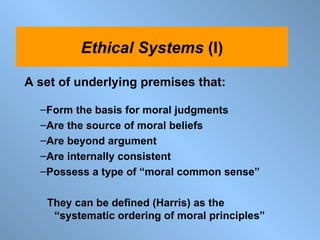
A set of underlying premises that: Form the basis for moral judgments Are the source of moral beliefs Are beyond argument Are internally consistent Possess a type of “moral common sense” They can be defined (Harris) as the  “systematic ordering of moral principles”  Ethical   Systems  (I)
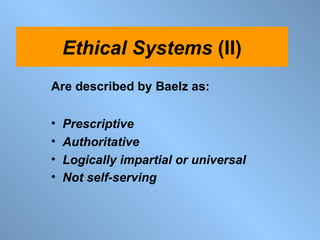
Are described by Baelz as: Prescriptive Authoritative Logically impartial or universal Not self-serving   Ethical   Systems  (II)
MOTIVATION MATTERS.   Some acts are inherently good.  Others are inherently bad. The consequences of the act are irrelevant. Example :  Charity is a moral act.  Giving money to a poor person is morally correct. If the poor person buys drugs with the money,  the original act of charity is  still  moral. Deontological Ethical Systems
RESULTS MATTER.   An act is “good” or “bad” depending on  the results it brings about. The consequences of the act are what is judged. Example :  An act of charity might  not  be moral.  If drug abuse is an immoral consequence,  and an act of charity supports drug abuse, the act of charity could be considered immoral. Teleological Ethical Systems
According to German philosopher Immanuel Kant : Good will  (motivation) is the only thing that is  intrisically good. Duty   is required behavior.  It is self-imposed and  necessary to morality. Ethical Formalism / Absolutism  (I)
Two kinds of  imperatives   (commands) drive human behavior.  Hypothetical imperatives  Drive us to achieve certain ends. Are consequential in nature.  Are neither “moral” nor “immoral”. Categorical imperatives  Are absolute. Are based on  good will . Determine morality.  Ethical Formalism / Absolutism  (II)
Act only on that maxim through which you can at the same time will that it should become a universal law.  Act in such a way that you always treat humanity, whether in your own person, or that of any other, never simply as a means but always at the same time as an end. Act as if you were, through your maxims, a lawmaking member of a kingdom of ends.  How to meet the requirements of the categorical imperative:
The  wording of maxims  is critical in ethical formalism and could lead to confusion or abuse.   (Example: Kant distinguishes “lies” from “untruths”.) It might not apply to  extreme circumstances .  If an action is “wrong”, it is always wrong, regardless of the good consequences that might result. It does not provide guidance for resolving  conflicting duties . It can be used to justify a position after it has been adopted, but it may give little help in  forming a position . Criticisms of Ethical Formalism
(A  teleological  system —the  consequences are judged.) One of its founders was  Jeremy Bentham. An action’s morality depends on how much it contributes to the overall good of society. Humans are  hedonistic .  They seek to maximize pleasure and avoid pain.  An ethical system should be consistent with this. Utilitarianism  (I)
If an act benefits many people  and causes pain to a few,  it is still good because  “ the greatest good for  the greatest number”   is more important than the pain  of the smaller number.   Utilitarianism  (II)
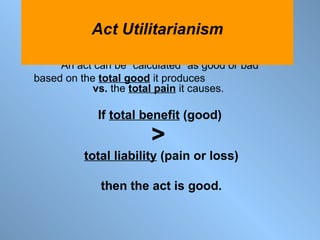
An act can be “calculated” as good or bad  based on the  total good  it produces  vs.  the  total pain  it causes.  If  total benefit  (good)   >   total liability  (pain or loss) then the act is good. Act Utilitarianism
If a principle were to become  a  universal rule  in society,  what would the  social consequences  be? Rule Utilitarianism
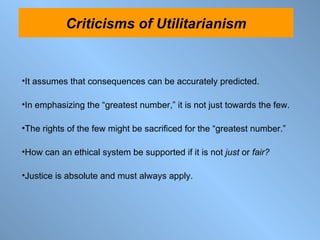
It assumes that consequences can be accurately predicted.  In emphasizing the “greatest number,” it is not just towards the few. The rights of the few might be sacrificed for the “greatest number.” How can an ethical system be supported if it is not  just  or  fair? Justice is absolute and must always apply. Criticisms of   Utilitarianism
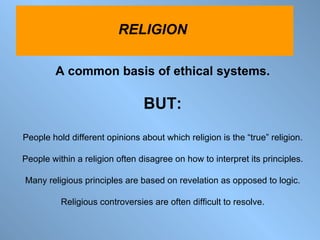
A common basis of ethical systems. BUT: People hold different opinions about which religion is the “true” religion. People within a religion often disagree on how to interpret its principles. Many religious principles are based on revelation as opposed to logic. Religious controversies are often difficult to resolve. RELIGION
Morality is a force of nature, like gravity. The idea of the  social contract  has a basis in nature. Philosophers like  Thomas Hobbes   and  John Locke   were influenced by natural law theory.  Their ideas are reflected in our system of government. But — how do we know exactly what the natural law  is ?  Most social interactions are influenced by natural human tendencies, but can they be considered a “law”? And does that make them  RIGHT ? Natural Law
First taught by the Greek philosopher  Aristotle  : True virtue is the median between extremes of character:  the golden mean . People develop moral virtues through  practice , just like any other strength. The more one practices moral virtues, the more virtuous one becomes. The Ethics of Virtue
Most Western philosophers have been male. Most Western ethical systems focus on issues like  rights, laws, and universalism .  A more “feminine” agenda might emphasize  care, nurture, and empathy . The Ethics of Care  (I)
Relevant Criminal Justice issues: Rehabilitation Restorative justice Peacemaking The Ethics of Care  (II)
What benefits the individual is  good …   regardless of its effect on others. Psychological Egoism  :   People behave in their own best interests.  (Not an ethical system – an observation.) Enlightened Egoism  :   People behave in their own best interests, but think of long-term consequences rather than immediate gratification. The Ethics of Virtue Egoism
Ethical Relativism: Moral systems are products of an individual or group.  “ Good” and “bad” may depend on an individual situation. If people believe different things are good and bad, how can you define what is good? Cultural Relativism:  “ Good” depends on the norms of each society. What is acceptable in one society might not be in another.  Who is to say which society is right? Relativism
Principle of Forfeiture People who violate the rights of others,  forfeit their own rights. An attacker cannot argue self-defense.  The “absolute” right to a defense is  not  absolute, but conditional. Relativism Absolutism
A  compromise  between relativism and absolutism: There are basic principles of right and wrong. They can be applied to ethical dilemmas and moral issues. They may call for different results in different situations.  Situational Ethics

Ethics Chapter 2

  • 1.
    CHAPTER2: DETERMINING MORAL BEHAVIOR ETHICAL DILEMMAS AND DECISIONS IN CRIMINAL JUSTICE 5 th Edition By Joycelyn M. Pollock Lecture Slides prepared by Mark Kellar to Accompany
  • 2.
    A set ofunderlying premises that: Form the basis for moral judgments Are the source of moral beliefs Are beyond argument Are internally consistent Possess a type of “moral common sense” They can be defined (Harris) as the “systematic ordering of moral principles” Ethical Systems (I)
  • 3.
    Are described byBaelz as: Prescriptive Authoritative Logically impartial or universal Not self-serving Ethical Systems (II)
  • 4.
    MOTIVATION MATTERS. Some acts are inherently good. Others are inherently bad. The consequences of the act are irrelevant. Example : Charity is a moral act. Giving money to a poor person is morally correct. If the poor person buys drugs with the money, the original act of charity is still moral. Deontological Ethical Systems
  • 5.
    RESULTS MATTER. An act is “good” or “bad” depending on the results it brings about. The consequences of the act are what is judged. Example : An act of charity might not be moral. If drug abuse is an immoral consequence, and an act of charity supports drug abuse, the act of charity could be considered immoral. Teleological Ethical Systems
  • 6.
    According to Germanphilosopher Immanuel Kant : Good will (motivation) is the only thing that is intrisically good. Duty is required behavior. It is self-imposed and necessary to morality. Ethical Formalism / Absolutism (I)
  • 7.
    Two kinds of imperatives (commands) drive human behavior. Hypothetical imperatives Drive us to achieve certain ends. Are consequential in nature. Are neither “moral” nor “immoral”. Categorical imperatives Are absolute. Are based on good will . Determine morality. Ethical Formalism / Absolutism (II)
  • 8.
    Act only onthat maxim through which you can at the same time will that it should become a universal law. Act in such a way that you always treat humanity, whether in your own person, or that of any other, never simply as a means but always at the same time as an end. Act as if you were, through your maxims, a lawmaking member of a kingdom of ends. How to meet the requirements of the categorical imperative:
  • 9.
    The wordingof maxims is critical in ethical formalism and could lead to confusion or abuse. (Example: Kant distinguishes “lies” from “untruths”.) It might not apply to extreme circumstances . If an action is “wrong”, it is always wrong, regardless of the good consequences that might result. It does not provide guidance for resolving conflicting duties . It can be used to justify a position after it has been adopted, but it may give little help in forming a position . Criticisms of Ethical Formalism
  • 10.
    (A teleological system —the consequences are judged.) One of its founders was Jeremy Bentham. An action’s morality depends on how much it contributes to the overall good of society. Humans are hedonistic . They seek to maximize pleasure and avoid pain. An ethical system should be consistent with this. Utilitarianism (I)
  • 11.
    If an actbenefits many people and causes pain to a few, it is still good because “ the greatest good for the greatest number” is more important than the pain of the smaller number. Utilitarianism (II)
  • 12.
    An act canbe “calculated” as good or bad based on the total good it produces vs. the total pain it causes. If total benefit (good) > total liability (pain or loss) then the act is good. Act Utilitarianism
  • 13.
    If a principlewere to become a universal rule in society, what would the social consequences be? Rule Utilitarianism
  • 14.
    It assumes thatconsequences can be accurately predicted. In emphasizing the “greatest number,” it is not just towards the few. The rights of the few might be sacrificed for the “greatest number.” How can an ethical system be supported if it is not just or fair? Justice is absolute and must always apply. Criticisms of Utilitarianism
  • 15.
    A common basisof ethical systems. BUT: People hold different opinions about which religion is the “true” religion. People within a religion often disagree on how to interpret its principles. Many religious principles are based on revelation as opposed to logic. Religious controversies are often difficult to resolve. RELIGION
  • 16.
    Morality is aforce of nature, like gravity. The idea of the social contract has a basis in nature. Philosophers like Thomas Hobbes and John Locke were influenced by natural law theory. Their ideas are reflected in our system of government. But — how do we know exactly what the natural law is ? Most social interactions are influenced by natural human tendencies, but can they be considered a “law”? And does that make them RIGHT ? Natural Law
  • 17.
    First taught bythe Greek philosopher Aristotle : True virtue is the median between extremes of character: the golden mean . People develop moral virtues through practice , just like any other strength. The more one practices moral virtues, the more virtuous one becomes. The Ethics of Virtue
  • 18.
    Most Western philosophershave been male. Most Western ethical systems focus on issues like rights, laws, and universalism . A more “feminine” agenda might emphasize care, nurture, and empathy . The Ethics of Care (I)
  • 19.
    Relevant Criminal Justiceissues: Rehabilitation Restorative justice Peacemaking The Ethics of Care (II)
  • 20.
    What benefits theindividual is good … regardless of its effect on others. Psychological Egoism : People behave in their own best interests. (Not an ethical system – an observation.) Enlightened Egoism : People behave in their own best interests, but think of long-term consequences rather than immediate gratification. The Ethics of Virtue Egoism
  • 21.
    Ethical Relativism: Moralsystems are products of an individual or group. “ Good” and “bad” may depend on an individual situation. If people believe different things are good and bad, how can you define what is good? Cultural Relativism: “ Good” depends on the norms of each society. What is acceptable in one society might not be in another. Who is to say which society is right? Relativism
  • 22.
    Principle of ForfeiturePeople who violate the rights of others, forfeit their own rights. An attacker cannot argue self-defense. The “absolute” right to a defense is not absolute, but conditional. Relativism Absolutism
  • 23.
    A compromise between relativism and absolutism: There are basic principles of right and wrong. They can be applied to ethical dilemmas and moral issues. They may call for different results in different situations. Situational Ethics