Ethical Theories 
NICOLAS NOVIAN RUSLIM 
INFORMATION SYSTEM AND TECHNOLOGY 
INSTITUT TEKNOLOGI BANDUNG
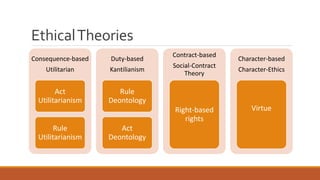
Ethical Theories 
Consequence-based 
Utilitarian 
Act 
Utilitarianism 
Rule 
Utilitarianism 
Duty-based 
Kantilianism 
Rule 
Deontology 
Act 
Deontology 
Contract-based 
Social-Contract 
Theory 
Right-based 
rights 
Character-based 
Character-Ethics 
Virtue
Consequence-based 
Utilitarian Theory 
An individual act (X) or a social policy (Y) is morally permissible if the consequences that result 
from (X) or (Y) produces the greates amount of good for the greates number of persons 
affected by the act or policy. 
Divided into : 
1. Act Utilitarian 
2. Rule Utilitarian
Act Utilitarian 
An act, X, is morally permissible if the consequences produced by doing X result in the greatest 
good for the greatest number of person affected by act X.
Rule Utilitarian 
An act, X, is morally permissible if the consequences of following the general rule, Y, of which 
act X is an instance, would bring about the greatest good for the greatest number.
Consequence-based 
Utilitarian Theory Flawed? 
Example : 
A policy is under consideration in a legislative body in the nation of Tralala, where 1% of 
the population would be forced to work as slaves in a manufacturing facility to produce 
computer chips. Proponents of this policy argue that, if enacted as law,it would result in 
lower prices for desktop computers in Tralala. It would also likely result in more overall 
happiness for the nation’s citizens because the remaining 99% of the population, who 
are not enslaved, would be able to purchase PC and other compute-based appliances at 
a much lower price. 
This policy clearly seems consistent with the principle of producing the greates good for the 
greatest number of Tralala’s population. 
Should it be enacted into law?
Duty-based 
Kantilianism/ Deontological Theory 
Morality must ultimately be grounded in the concept of duty, or obligations that humans have 
to one another, and never in the consequences of human actions. 
Divided into : 
1. Rule Deontology 
2. Act Deontology
Rule Deontology 
Act always on that principle or rule that can be universally binding, without exception, for all 
human beings (principles of universality and impartiality). 
Every individual would be treated fairly since the same rules would apply universally to all 
persons.
Rule Deontology 
Ex : 
A case of a student on submitting his assignment one week late. 
Since the paper is late, the instructor is not sure if he wants to accept the submission. 
Student’s argument: 
◦ He is doing the instructor a favor, thus, if he submitted it on time, the instructor will be swamped with 
papers. By submitting it late, the instructor will be able to read the student’s assignment, without 
having the stress of so many papers to grade at once. 
In deontological grounds, the student can only make an exception for himself if everyone else 
(in his class) had the right to make exceptions for him or herself as well.
Act Deontology 
Does not believe that blind adherence to certain rules can work in every case for determining 
which duties we must ultimately carry out. 
We have a certain prima facie (or self-evident) duties, which, all thing being equal, we must 
follow. 
List of prima facie duties include honesty, benevolence, justice, keeping our promise, and so 
forth. 
If there are no conflicts in a given situation, each prima facie duty is also called an actual duty. 
Every prima facie duty is an absolute duty because it applies to every human being without 
exception. 
Our ability to determine what our actual duty will be in a particular situation is made possible 
through a process of “rational intuitionism”.
What we should do when two or more 
duties conflict? 
Ex : 
◦ You promise to meet one classmate one evening at 7:00 pm in the college library to study together for 
a midterm exam for a computer science course you are taking. While driving in your car to the library, 
you receive a call on your cell phone informing you that your grandmother has been taken to the 
hospital and that you should go immediately to the hospital. You consider calling your classmate from 
your car, but you realize you don’t have his phone number. You also realize you don’t have time to try 
to reach your classmate by email. What should you do in this case? 
All thing being equal, you have a moral obligation to keep your promise to your friend, while you also 
need to visit your grandmother in the hospital. 
You would have to weigh between the 2 prima facie duties in question to determine which will be your 
actual duty in this particular circumstance. 
By weighing, your actual duty is to visit your grandmother or vice versa.
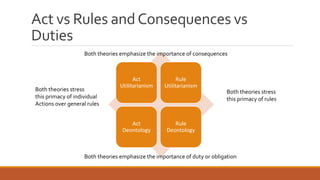
Act vs Rules and Consequences vs 
Duties 
Both theories emphasize the importance of consequences 
Act 
Utilitarianism 
Rule 
Utilitarianism 
Act 
Deontology 
Rule 
Deontology 
Both theories stress 
this primacy of individual 
Actions over general rules 
Both theories stress 
this primacy of rules 
Both theories emphasize the importance of duty or obligation
Contract-based 
Social Contract Theory 
A moral system comes into being by virtue of certain contractual agreements between 
individuals. 
Each individual is free to act in ways that satisfy his or her own natural (physical) desires and to 
avoid our aversions (dislikes). 
While there is a sense of freedom in this natural state, each person must continually fend for 
herself, and must also avoid the constant threats of others, who are inclined to pursue their 
own interests and desires.
Social Contract Theory 
Right-based Contract Theories 
Thomas Hobbes : 
• State of nature 
• We implicitly accept a social contract 
• Establishment of moral rules to govern relations among citizens 
• Government capable of enforcing these rules 
Jean-Jacques Rousseau 
• In ideal society, no one above rules 
• That prevents society from enacting bad rules
Social Contract Theory 
Example : DVD Rental Scenario 
◦ Bill owns chain of DVD rental stores 
◦ Collects information about rentals from customers 
◦ Constructs profiles of customers 
◦ Sells profiles to direct marketing firms 
◦ Some customers happy to receive more mail order catalogs; others unhappy at increase in “junk mail” 
Consider rights of Bill, customers and mail order companies. 
Does customer have right to expect name, address to be kept confidential? 
If customer rents DVD from bill, who owns information about transaction? 
If Bill and customer have equal rights to information, Bill did nothing wrong to sell information. 
If customers have right to expect name and address or transaction to be confidential without giving permission, then 
Bill was wrong to sell information without asking for permission.
Character-based 
Virtue Ethics 
Ignores the special roles that consequences, duties and social contracts play in moral systems. 
Focuses on criteria having to do with the character development of individuals and their 
acquisition of good character traits from the kinds of habits they develop. 
Ethical was something not merely studied, but rather to be lived or practiced. 
To become an ethical person, one is required to develop certain virtues (strength or excellence). 
To be a moral person, one had to acquire the right virtues. 
Through proper training and acquisition of good habits and character traits, one could achieve 
moral virtues such as temperance and courage that are needed to live well.
Character-based 
Virtue Ethics 
Virtue ethics focuses primarily on character development and moral education, it does not 
need to rely on a system of formal rules. 
Emphasis on being a moral person, and not simply on understanding what moral rules are and 
how they apply in certain situations.
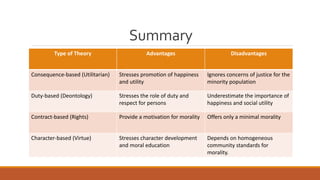
Summary 
Type of Theory Advantages Disadvantages 
Consequence-based (Utilitarian) Stresses promotion of happiness 
and utility 
Ignores concerns of justice for the 
minority population 
Duty-based (Deontology) Stresses the role of duty and 
respect for persons 
Underestimate the importance of 
happiness and social utility 
Contract-based (Rights) Provide a motivation for morality Offers only a minimal morality 
Character-based (Virtue) Stresses character development 
and moral education 
Depends on homogeneous 
community standards for 
morality.

Ethical theories

  • 1.
    Ethical Theories NICOLASNOVIAN RUSLIM INFORMATION SYSTEM AND TECHNOLOGY INSTITUT TEKNOLOGI BANDUNG
  • 2.
    Ethical Theories Consequence-based Utilitarian Act Utilitarianism Rule Utilitarianism Duty-based Kantilianism Rule Deontology Act Deontology Contract-based Social-Contract Theory Right-based rights Character-based Character-Ethics Virtue
  • 3.
    Consequence-based Utilitarian Theory An individual act (X) or a social policy (Y) is morally permissible if the consequences that result from (X) or (Y) produces the greates amount of good for the greates number of persons affected by the act or policy. Divided into : 1. Act Utilitarian 2. Rule Utilitarian
  • 4.
    Act Utilitarian Anact, X, is morally permissible if the consequences produced by doing X result in the greatest good for the greatest number of person affected by act X.
  • 5.
    Rule Utilitarian Anact, X, is morally permissible if the consequences of following the general rule, Y, of which act X is an instance, would bring about the greatest good for the greatest number.
  • 6.
    Consequence-based Utilitarian TheoryFlawed? Example : A policy is under consideration in a legislative body in the nation of Tralala, where 1% of the population would be forced to work as slaves in a manufacturing facility to produce computer chips. Proponents of this policy argue that, if enacted as law,it would result in lower prices for desktop computers in Tralala. It would also likely result in more overall happiness for the nation’s citizens because the remaining 99% of the population, who are not enslaved, would be able to purchase PC and other compute-based appliances at a much lower price. This policy clearly seems consistent with the principle of producing the greates good for the greatest number of Tralala’s population. Should it be enacted into law?
  • 7.
    Duty-based Kantilianism/ DeontologicalTheory Morality must ultimately be grounded in the concept of duty, or obligations that humans have to one another, and never in the consequences of human actions. Divided into : 1. Rule Deontology 2. Act Deontology
  • 8.
    Rule Deontology Actalways on that principle or rule that can be universally binding, without exception, for all human beings (principles of universality and impartiality). Every individual would be treated fairly since the same rules would apply universally to all persons.
  • 9.
    Rule Deontology Ex: A case of a student on submitting his assignment one week late. Since the paper is late, the instructor is not sure if he wants to accept the submission. Student’s argument: ◦ He is doing the instructor a favor, thus, if he submitted it on time, the instructor will be swamped with papers. By submitting it late, the instructor will be able to read the student’s assignment, without having the stress of so many papers to grade at once. In deontological grounds, the student can only make an exception for himself if everyone else (in his class) had the right to make exceptions for him or herself as well.
  • 10.
    Act Deontology Doesnot believe that blind adherence to certain rules can work in every case for determining which duties we must ultimately carry out. We have a certain prima facie (or self-evident) duties, which, all thing being equal, we must follow. List of prima facie duties include honesty, benevolence, justice, keeping our promise, and so forth. If there are no conflicts in a given situation, each prima facie duty is also called an actual duty. Every prima facie duty is an absolute duty because it applies to every human being without exception. Our ability to determine what our actual duty will be in a particular situation is made possible through a process of “rational intuitionism”.
  • 11.
    What we shoulddo when two or more duties conflict? Ex : ◦ You promise to meet one classmate one evening at 7:00 pm in the college library to study together for a midterm exam for a computer science course you are taking. While driving in your car to the library, you receive a call on your cell phone informing you that your grandmother has been taken to the hospital and that you should go immediately to the hospital. You consider calling your classmate from your car, but you realize you don’t have his phone number. You also realize you don’t have time to try to reach your classmate by email. What should you do in this case? All thing being equal, you have a moral obligation to keep your promise to your friend, while you also need to visit your grandmother in the hospital. You would have to weigh between the 2 prima facie duties in question to determine which will be your actual duty in this particular circumstance. By weighing, your actual duty is to visit your grandmother or vice versa.
  • 12.
    Act vs Rulesand Consequences vs Duties Both theories emphasize the importance of consequences Act Utilitarianism Rule Utilitarianism Act Deontology Rule Deontology Both theories stress this primacy of individual Actions over general rules Both theories stress this primacy of rules Both theories emphasize the importance of duty or obligation
  • 13.
    Contract-based Social ContractTheory A moral system comes into being by virtue of certain contractual agreements between individuals. Each individual is free to act in ways that satisfy his or her own natural (physical) desires and to avoid our aversions (dislikes). While there is a sense of freedom in this natural state, each person must continually fend for herself, and must also avoid the constant threats of others, who are inclined to pursue their own interests and desires.
  • 14.
    Social Contract Theory Right-based Contract Theories Thomas Hobbes : • State of nature • We implicitly accept a social contract • Establishment of moral rules to govern relations among citizens • Government capable of enforcing these rules Jean-Jacques Rousseau • In ideal society, no one above rules • That prevents society from enacting bad rules
  • 15.
    Social Contract Theory Example : DVD Rental Scenario ◦ Bill owns chain of DVD rental stores ◦ Collects information about rentals from customers ◦ Constructs profiles of customers ◦ Sells profiles to direct marketing firms ◦ Some customers happy to receive more mail order catalogs; others unhappy at increase in “junk mail” Consider rights of Bill, customers and mail order companies. Does customer have right to expect name, address to be kept confidential? If customer rents DVD from bill, who owns information about transaction? If Bill and customer have equal rights to information, Bill did nothing wrong to sell information. If customers have right to expect name and address or transaction to be confidential without giving permission, then Bill was wrong to sell information without asking for permission.
  • 16.
    Character-based Virtue Ethics Ignores the special roles that consequences, duties and social contracts play in moral systems. Focuses on criteria having to do with the character development of individuals and their acquisition of good character traits from the kinds of habits they develop. Ethical was something not merely studied, but rather to be lived or practiced. To become an ethical person, one is required to develop certain virtues (strength or excellence). To be a moral person, one had to acquire the right virtues. Through proper training and acquisition of good habits and character traits, one could achieve moral virtues such as temperance and courage that are needed to live well.
  • 17.
    Character-based Virtue Ethics Virtue ethics focuses primarily on character development and moral education, it does not need to rely on a system of formal rules. Emphasis on being a moral person, and not simply on understanding what moral rules are and how they apply in certain situations.
  • 18.
    Summary Type ofTheory Advantages Disadvantages Consequence-based (Utilitarian) Stresses promotion of happiness and utility Ignores concerns of justice for the minority population Duty-based (Deontology) Stresses the role of duty and respect for persons Underestimate the importance of happiness and social utility Contract-based (Rights) Provide a motivation for morality Offers only a minimal morality Character-based (Virtue) Stresses character development and moral education Depends on homogeneous community standards for morality.