UTILITARIANISM
2 major types of ethical systems have dominated the field
1-deontological ethics-the locus of the value is the act or the kind of act
2-teleological ethics-the locus of the value is the outcome or
consequences of the act
Teleological System
• -teleological system see the ultimate criterion of morality in some
non moral value that results from acts
• -a teleologist would judge lying was morally right or wrong by the
consequences it produces
• -a teleologist is a person whose ethical decision making aims solely
at maximizing non moral goods such as pleasure, happiness n
betterment of suffering
• -the standard of right n wrong for the teleologist is the comparative
consequences of the available actions
• -if one can reasonably calculate that a lie will do more good than
telling the truth, then one has an obligation to lie
• -utilitarianism is a universal teleological system, which call for the
greatest goodness for the greatest number
Deontological ethics
• -see certain features in the act itself as having intrinsic value (it is
good simply for what it is).
• -a deontologist would see something intrinsically wrong in the act of
lying
• -a deontologist is concerned with the rightness of the act itself
UTILIARIANISM
INTRODUCTION
• -as a moral philosophy , utilitarianism begins with the work of
Frances Hutcheson (1694-1746), David Hume (1711-1776), Adam
Smith (1723-1790)and comes into its classical stage in the writings
of Jeremy Bentham (1748-1832) and John Stuart Mill (1806-1873)
• -they were secular humanists, optimistic about human nature n our
ability to solve our problems
• -tried to make the law serve human needs and interests
MEANING
• -utility, in a philosophical context, refers to what is good for a human
being.
• -utilitarianism is a moral theory according to which welfare
(happiness, pleasure) is the fundamental human good.
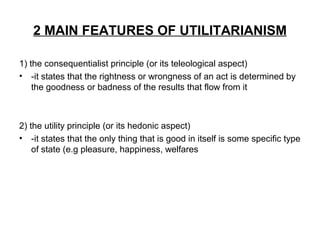
2 MAIN FEATURES OF UTILITARIANISM
1) the consequentialist principle (or its teleological aspect)
• -it states that the rightness or wrongness of an act is determined by
the goodness or badness of the results that flow from it
2) the utility principle (or its hedonic aspect)
• -it states that the only thing that is good in itself is some specific type
of state (e.g pleasure, happiness, welfares
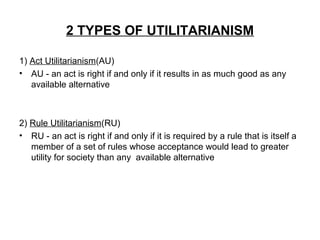
2 TYPES OF UTILITARIANISM
1) Act Utilitarianism(AU)
• AU - an act is right if and only if it results in as much good as any
available alternative
2) Rule Utilitarianism(RU)
• RU - an act is right if and only if it is required by a rule that is itself a
member of a set of rules whose acceptance would lead to greater
utility for society than any available alternative
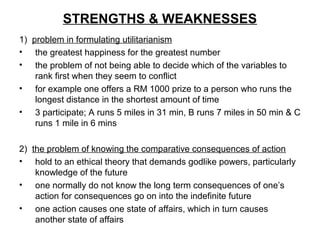
STRENGTHS & WEAKNESSES
1) problem in formulating utilitarianism
• the greatest happiness for the greatest number
• the problem of not being able to decide which of the variables to
rank first when they seem to conflict
• for example one offers a RM 1000 prize to a person who runs the
longest distance in the shortest amount of time
• 3 participate; A runs 5 miles in 31 min, B runs 7 miles in 50 min & C
runs 1 mile in 6 mins
2) the problem of knowing the comparative consequences of action
• hold to an ethical theory that demands godlike powers, particularly
knowledge of the future
• one normally do not know the long term consequences of one’s
action for consequences go on into the indefinite future
• one action causes one state of affairs, which in turn causes
another state of affairs
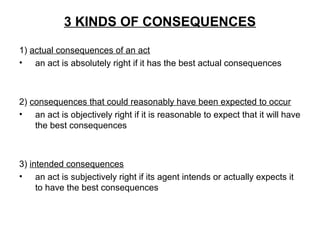
3 KINDS OF CONSEQUENCES
1) actual consequences of an act
• an act is absolutely right if it has the best actual consequences
2) consequences that could reasonably have been expected to occur
• an act is objectively right if it is reasonable to expect that it will have
the best consequences
3) intended consequences
• an act is subjectively right if its agent intends or actually expects it
to have the best consequences
• -it is the 2nd
kind of rightness, that based on reasonable
expectation, that is central here, for only the subsequent
observer of the consequences is in a position to determine the
actual result
• -suppose, for example, while Hitler’s gmother was carrying
little Adollph up the stairs to her home, she slipped and had to
choose between dropping infant Adolph, allowing him to be
injured, and breaking her arm
• -according to the formula, what would be absolutely right for
her, do u think??
ISLAMIC VIEW POINTS
1) Utilitarian belief is one should always do the act that promises to
promote the most utility
• -it makes morality too demanding and creates a disincentive to
work
• -it goes beyond man’s capability
• -it does not feed a balance needs to man’s nature to work and to
rest as well
2) Utilitarian belief is to apply rules, which have grown up as
experience has shown that certain actions have certain effect on
man’s happiness
• -man is the source of moral values
• -self mastery and a free exercise of one’s creative power
• -man is naturally superior in intelligence
3) for utilitarian morality & law were made to man, not man for morality
• -man’s position above the law is against Islam
4) utilitarian thought to qualify happiness as final and self sufficient is
not enough for
• -it is not permanent–it is hard to see the condition of permanence
can be met in this life
• -its attachment to the physical world
• -it is unstable-it not universal
• -no standard
• -moralities assume different forms depending on the qualities of the
person & circumstances

Utilitarianism

  • 1.
    UTILITARIANISM 2 major typesof ethical systems have dominated the field 1-deontological ethics-the locus of the value is the act or the kind of act 2-teleological ethics-the locus of the value is the outcome or consequences of the act
  • 2.
    Teleological System • -teleologicalsystem see the ultimate criterion of morality in some non moral value that results from acts • -a teleologist would judge lying was morally right or wrong by the consequences it produces • -a teleologist is a person whose ethical decision making aims solely at maximizing non moral goods such as pleasure, happiness n betterment of suffering • -the standard of right n wrong for the teleologist is the comparative consequences of the available actions • -if one can reasonably calculate that a lie will do more good than telling the truth, then one has an obligation to lie • -utilitarianism is a universal teleological system, which call for the greatest goodness for the greatest number
  • 3.
    Deontological ethics • -seecertain features in the act itself as having intrinsic value (it is good simply for what it is). • -a deontologist would see something intrinsically wrong in the act of lying • -a deontologist is concerned with the rightness of the act itself
  • 4.
    UTILIARIANISM INTRODUCTION • -as amoral philosophy , utilitarianism begins with the work of Frances Hutcheson (1694-1746), David Hume (1711-1776), Adam Smith (1723-1790)and comes into its classical stage in the writings of Jeremy Bentham (1748-1832) and John Stuart Mill (1806-1873) • -they were secular humanists, optimistic about human nature n our ability to solve our problems • -tried to make the law serve human needs and interests MEANING • -utility, in a philosophical context, refers to what is good for a human being. • -utilitarianism is a moral theory according to which welfare (happiness, pleasure) is the fundamental human good.
  • 5.
    2 MAIN FEATURESOF UTILITARIANISM 1) the consequentialist principle (or its teleological aspect) • -it states that the rightness or wrongness of an act is determined by the goodness or badness of the results that flow from it 2) the utility principle (or its hedonic aspect) • -it states that the only thing that is good in itself is some specific type of state (e.g pleasure, happiness, welfares
  • 6.
    2 TYPES OFUTILITARIANISM 1) Act Utilitarianism(AU) • AU - an act is right if and only if it results in as much good as any available alternative 2) Rule Utilitarianism(RU) • RU - an act is right if and only if it is required by a rule that is itself a member of a set of rules whose acceptance would lead to greater utility for society than any available alternative
  • 7.
    STRENGTHS & WEAKNESSES 1)problem in formulating utilitarianism • the greatest happiness for the greatest number • the problem of not being able to decide which of the variables to rank first when they seem to conflict • for example one offers a RM 1000 prize to a person who runs the longest distance in the shortest amount of time • 3 participate; A runs 5 miles in 31 min, B runs 7 miles in 50 min & C runs 1 mile in 6 mins 2) the problem of knowing the comparative consequences of action • hold to an ethical theory that demands godlike powers, particularly knowledge of the future • one normally do not know the long term consequences of one’s action for consequences go on into the indefinite future • one action causes one state of affairs, which in turn causes another state of affairs
  • 8.
    3 KINDS OFCONSEQUENCES 1) actual consequences of an act • an act is absolutely right if it has the best actual consequences 2) consequences that could reasonably have been expected to occur • an act is objectively right if it is reasonable to expect that it will have the best consequences 3) intended consequences • an act is subjectively right if its agent intends or actually expects it to have the best consequences
  • 9.
    • -it isthe 2nd kind of rightness, that based on reasonable expectation, that is central here, for only the subsequent observer of the consequences is in a position to determine the actual result • -suppose, for example, while Hitler’s gmother was carrying little Adollph up the stairs to her home, she slipped and had to choose between dropping infant Adolph, allowing him to be injured, and breaking her arm • -according to the formula, what would be absolutely right for her, do u think??
  • 10.
    ISLAMIC VIEW POINTS 1)Utilitarian belief is one should always do the act that promises to promote the most utility • -it makes morality too demanding and creates a disincentive to work • -it goes beyond man’s capability • -it does not feed a balance needs to man’s nature to work and to rest as well 2) Utilitarian belief is to apply rules, which have grown up as experience has shown that certain actions have certain effect on man’s happiness • -man is the source of moral values • -self mastery and a free exercise of one’s creative power • -man is naturally superior in intelligence
  • 11.
    3) for utilitarianmorality & law were made to man, not man for morality • -man’s position above the law is against Islam 4) utilitarian thought to qualify happiness as final and self sufficient is not enough for • -it is not permanent–it is hard to see the condition of permanence can be met in this life • -its attachment to the physical world • -it is unstable-it not universal • -no standard • -moralities assume different forms depending on the qualities of the person & circumstances