



Sensation- awareness or mental process which is
aroused due to stimulation of a sense organ.
ACQUIRING SENSORY AWARENESS
1ST
CONDITION:
1. Stimulation – anything which rouses a sense
organ to activity.
2 types of stimulus
1. physical energy
2. chemical form energy
Receptor Organ – highly specialized part of the
body and selecting sensitive to a definite
stimulus.
- doorway of the body responsible for all the
sensation we experience.
- “sense organ”
2nd
Condition:
Presence of Receptor Cell
- the sense organ detect stimuli from the
environment and transmit information to the
appropriate areas of the brain.
3rd
Condition:
Sense Receptor is stimulated by certain “stimulus”.
 Stimulus must be transferred into a code of
electrochemical impulses which is travel to the
brain.
Transduction – process of converting physical
energy into activity in the nervous system which
takes place in the receptor.
 QUESTION: When a stimulus is said to be detected?
 ANSWER: Stimulus to be detected must be strong
enough and to produce sensation.
 1. Absolute threshold – stimulus is in the inner limit or
does not go or reach beyond the threshold.
 2. Subliminal threshold – stimuli are way above the
threshold.
 3. Terminal threshold – stimuli reach an increased
intensity it produces pain and individual
uncomfortable.
 Sensory Adaptation :
1. Sense Receptor – ability to make adaptation to
changes/ adjust to a particular stimulus.
2. Sense Organ:
a. Distal senses – sensitive to stimuli coming
from a distance in the outside environment.
b. Proximal senses – bring information when we
come direct contact with the objects that
stimulates them.
 A. DISTAL SENSES
 1. Vision
- utilize the physical characteristic of light.
EYE (receptor organ of Vision).
Light Waves ( stimuli for seeing)
waves of radiant energy coming from the sun.
Eye utilizes 2 basic properties of light:
1. brightness – intensity of light (the amount of radiant
energy coming from the sun.
2. color – wave length or frequency
 Parts of the Eye:
 1. Sclerotic coat (SCLERA) – hard and outer most
covering , it protects the eye.
 2. Choroid coat – full of bloody tissues, gives
nourishment to the eye.
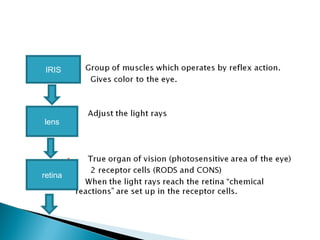
 3. Retina – inner most covering of the eye.
Photosensitive plate of the eye. Regarded as the
true organ of vision.
 RODS and CONS (receptors cells) embedded on
in the coat.
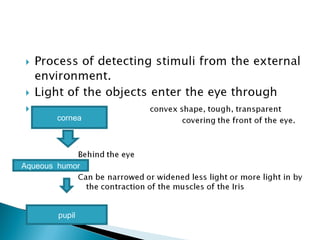
cornea
Aqueous humor
pupil
IRIS
lens
retina
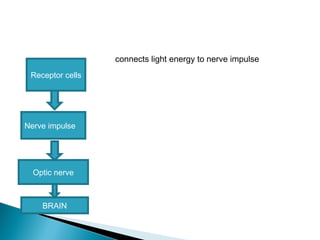
connects light energy to nerve impulse
Receptor cells
Nerve impulse
Optic nerve
BRAIN
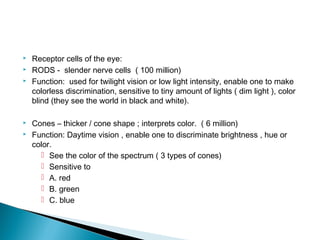
 Receptor cells of the eye:
 RODS - slender nerve cells ( 100 million)
 Function: used for twilight vision or low light intensity, enable one to make
colorless discrimination, sensitive to tiny amount of lights ( dim light ), color
blind (they see the world in black and white).
 Cones – thicker / cone shape ; interprets color. ( 6 million)
 Function: Daytime vision , enable one to discriminate brightness , hue or
color.
 See the color of the spectrum ( 3 types of cones)
 Sensitive to
 A. red
 B. green
 C. blue
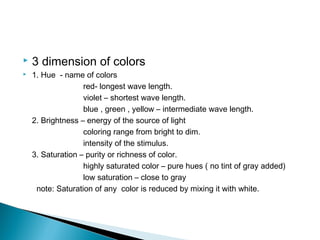
 3 dimension of colors
 1. Hue - name of colors
red- longest wave length.
violet – shortest wave length.
blue , green , yellow – intermediate wave length.
2. Brightness – energy of the source of light
coloring range from bright to dim.
intensity of the stimulus.
3. Saturation – purity or richness of color.
highly saturated color – pure hues ( no tint of gray added)
low saturation – close to gray
note: Saturation of any color is reduced by mixing it with white.
 Visual defects
 1. myopia
 2.Hyperopia
 3.Presbyopia
 4. Astigmatism
 5. Diplopia
 6. Scotoma
 Parts of the retina:
 Fovea – in the central region, the point of
clearest and sharpest vision
 Blind spot – are where all the nerve
fibers converge to form optic nerve which carries
impulse to the brain.
2 kinds of Blind spot
1. Dichromatic – 2 or 3 primary colors
2. Achromatic – no cones in the retina
 2. AUDITION
 Sound Waves
 1. pitch – highness or lowness of a sound.
 2. loudness – intensity sound pursue that
activates the eardrum.
 3. timbre – quality of musical tone.
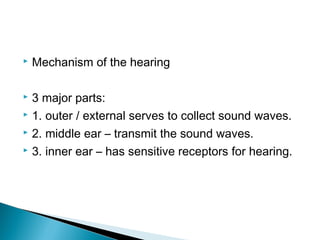
 Mechanism of the hearing
 3 major parts:
 1. outer / external serves to collect sound waves.
 2. middle ear – transmit the sound waves.
 3. inner ear – has sensitive receptors for hearing.
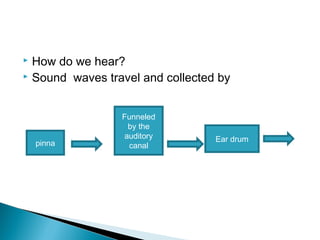
 How do we hear?
 Sound waves travel and collected by
pinna
Funneled
by the
auditory
canal
Ear drum
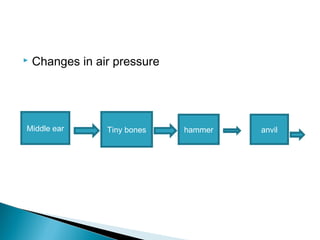
 Changes in air pressure
Middle ear Tiny bones hammer anvil
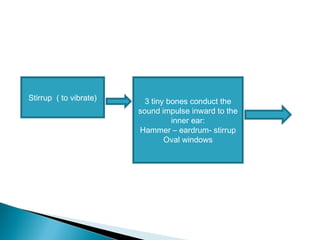
Stirrup ( to vibrate) 3 tiny bones conduct the
sound impulse inward to the
inner ear:
Hammer – eardrum- stirrup
Oval windows
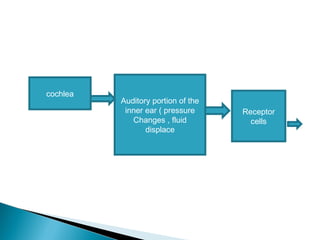
cochlea
Auditory portion of the
inner ear ( pressure
Changes , fluid
displace
Receptor
cells
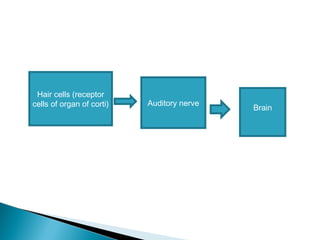
Hair cells (receptor
cells of organ of corti) Auditory nerve
Brain
 II. Proximal Distance:
 1. Olfaction – sense of smell
stimulus substance : gaseous substance( must
be dissolved in the air “ vaporous form.
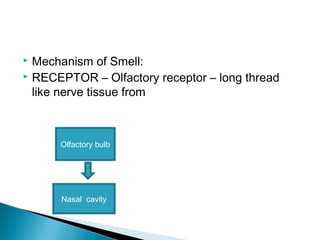
 Mechanism of Smell:
 RECEPTOR – Olfactory receptor – long thread
like nerve tissue from
Olfactory bulb
Nasal cavity
 Process:
 1. Anything that is sniffed must best dissolved in
the air.
 2. Receptor cells detect the molecules dissolved
in the air that is sucked up in the nasal cavity.
 3. Move up to the olfactory bulbs of the brain.
 4. Physical Energy is transduced in the olfactory
epithelium to be able to reach the brain.
 2. Gustation
“ Tongue” organ for the sense of taste
Stimulus – chemicals – must transform into soluble
substance to penetrate into the taste cells.
Receptor – taste receptor
Papillae – tongue elevation
Taste buds – lie between the papillae ( taste receptor)
Pore – opening of the taste buds.
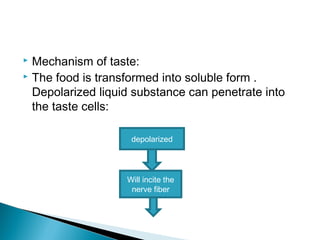
 Mechanism of taste:
 The food is transformed into soluble form .
Depolarized liquid substance can penetrate into
the taste cells:
depolarized
Will incite the
nerve fiber
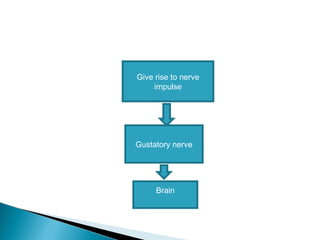
Give rise to nerve
impulse
Gustatory nerve
Brain
Sensation and Perception

Sensation and Perception

  • 3.
    Sensation- awareness ormental process which is aroused due to stimulation of a sense organ. ACQUIRING SENSORY AWARENESS 1ST CONDITION: 1. Stimulation – anything which rouses a sense organ to activity. 2 types of stimulus 1. physical energy 2. chemical form energy
  • 4.
    Receptor Organ –highly specialized part of the body and selecting sensitive to a definite stimulus. - doorway of the body responsible for all the sensation we experience. - “sense organ”
  • 5.
    2nd Condition: Presence of ReceptorCell - the sense organ detect stimuli from the environment and transmit information to the appropriate areas of the brain. 3rd Condition: Sense Receptor is stimulated by certain “stimulus”.
  • 6.
     Stimulus mustbe transferred into a code of electrochemical impulses which is travel to the brain. Transduction – process of converting physical energy into activity in the nervous system which takes place in the receptor.
  • 7.
     QUESTION: Whena stimulus is said to be detected?  ANSWER: Stimulus to be detected must be strong enough and to produce sensation.  1. Absolute threshold – stimulus is in the inner limit or does not go or reach beyond the threshold.  2. Subliminal threshold – stimuli are way above the threshold.  3. Terminal threshold – stimuli reach an increased intensity it produces pain and individual uncomfortable.
  • 8.
     Sensory Adaptation: 1. Sense Receptor – ability to make adaptation to changes/ adjust to a particular stimulus. 2. Sense Organ: a. Distal senses – sensitive to stimuli coming from a distance in the outside environment. b. Proximal senses – bring information when we come direct contact with the objects that stimulates them.
  • 10.
     A. DISTALSENSES  1. Vision - utilize the physical characteristic of light. EYE (receptor organ of Vision). Light Waves ( stimuli for seeing) waves of radiant energy coming from the sun. Eye utilizes 2 basic properties of light: 1. brightness – intensity of light (the amount of radiant energy coming from the sun. 2. color – wave length or frequency
  • 11.
     Parts ofthe Eye:  1. Sclerotic coat (SCLERA) – hard and outer most covering , it protects the eye.  2. Choroid coat – full of bloody tissues, gives nourishment to the eye.  3. Retina – inner most covering of the eye. Photosensitive plate of the eye. Regarded as the true organ of vision.  RODS and CONS (receptors cells) embedded on in the coat.
  • 12.
  • 13.
  • 14.
    connects light energyto nerve impulse Receptor cells Nerve impulse Optic nerve BRAIN
  • 15.
     Receptor cellsof the eye:  RODS - slender nerve cells ( 100 million)  Function: used for twilight vision or low light intensity, enable one to make colorless discrimination, sensitive to tiny amount of lights ( dim light ), color blind (they see the world in black and white).  Cones – thicker / cone shape ; interprets color. ( 6 million)  Function: Daytime vision , enable one to discriminate brightness , hue or color.  See the color of the spectrum ( 3 types of cones)  Sensitive to  A. red  B. green  C. blue
  • 17.
     3 dimensionof colors  1. Hue - name of colors red- longest wave length. violet – shortest wave length. blue , green , yellow – intermediate wave length. 2. Brightness – energy of the source of light coloring range from bright to dim. intensity of the stimulus. 3. Saturation – purity or richness of color. highly saturated color – pure hues ( no tint of gray added) low saturation – close to gray note: Saturation of any color is reduced by mixing it with white.
  • 18.
     Visual defects 1. myopia  2.Hyperopia  3.Presbyopia  4. Astigmatism  5. Diplopia  6. Scotoma
  • 19.
     Parts ofthe retina:  Fovea – in the central region, the point of clearest and sharpest vision  Blind spot – are where all the nerve fibers converge to form optic nerve which carries impulse to the brain. 2 kinds of Blind spot 1. Dichromatic – 2 or 3 primary colors 2. Achromatic – no cones in the retina
  • 21.
     2. AUDITION Sound Waves  1. pitch – highness or lowness of a sound.  2. loudness – intensity sound pursue that activates the eardrum.  3. timbre – quality of musical tone.
  • 23.
     Mechanism ofthe hearing  3 major parts:  1. outer / external serves to collect sound waves.  2. middle ear – transmit the sound waves.  3. inner ear – has sensitive receptors for hearing.
  • 24.
     How dowe hear?  Sound waves travel and collected by pinna Funneled by the auditory canal Ear drum
  • 25.
     Changes inair pressure Middle ear Tiny bones hammer anvil
  • 26.
    Stirrup ( tovibrate) 3 tiny bones conduct the sound impulse inward to the inner ear: Hammer – eardrum- stirrup Oval windows
  • 27.
    cochlea Auditory portion ofthe inner ear ( pressure Changes , fluid displace Receptor cells
  • 28.
    Hair cells (receptor cellsof organ of corti) Auditory nerve Brain
  • 29.
     II. ProximalDistance:  1. Olfaction – sense of smell stimulus substance : gaseous substance( must be dissolved in the air “ vaporous form.
  • 31.
     Mechanism ofSmell:  RECEPTOR – Olfactory receptor – long thread like nerve tissue from Olfactory bulb Nasal cavity
  • 32.
     Process:  1.Anything that is sniffed must best dissolved in the air.  2. Receptor cells detect the molecules dissolved in the air that is sucked up in the nasal cavity.  3. Move up to the olfactory bulbs of the brain.  4. Physical Energy is transduced in the olfactory epithelium to be able to reach the brain.
  • 33.
     2. Gustation “Tongue” organ for the sense of taste Stimulus – chemicals – must transform into soluble substance to penetrate into the taste cells. Receptor – taste receptor Papillae – tongue elevation Taste buds – lie between the papillae ( taste receptor) Pore – opening of the taste buds.
  • 35.
     Mechanism oftaste:  The food is transformed into soluble form . Depolarized liquid substance can penetrate into the taste cells: depolarized Will incite the nerve fiber
  • 36.
    Give rise tonerve impulse Gustatory nerve Brain