Chapter 4:Relativism and TeleologyReggie Hall / Leslie Mills / Heather Ortiz
RelativismMorals vary from society to society and between different time periods.
Moral PhilosophersDavid Hume (1711-1776)Based his theory of ethics on human experience and psychology rather than the divine law and natural law.Our morals are based on the idea of justice and compassion and our ultimate goal is to improvement of the human race.
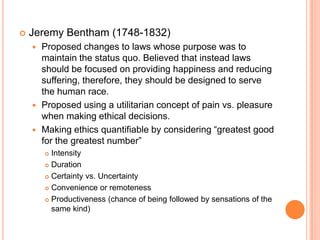
Jeremy Bentham (1748-1832)Proposed changes to laws whose purpose was to maintain the status quo. Believed that instead laws should be focused on providing happiness and reducing suffering, therefore, they should be designed to serve the human race.Proposed using a utilitarian concept of pain vs. pleasure when making ethical decisions. Making ethics quantifiable by considering “greatest good for the greatest number” IntensityDurationCertainty vs. UncertaintyConvenience or remotenessProductiveness (chance of being followed by sensations of the same kind)
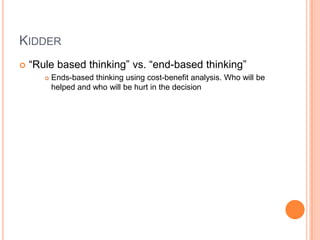
Kidder“Rule based thinking” vs. “end-based thinking”Ends-based thinking using cost-benefit analysis. Who will be helped and who will be hurt in the decision
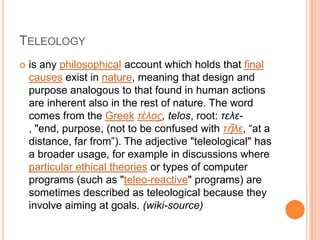
Teleologyis any philosophical account which holds that final causes exist in nature, meaning that design and purpose analogous to that found in human actions are inherent also in the rest of nature. The word comes from the Greekτέλος, telos, root: τελε-, "end, purpose, (not to be confused with τῆλε, “at a distance, far from”). The adjective "teleological" has a broader usage, for example in discussions where particular ethical theories or types of computer programs (such as "teleo-reactive" programs) are sometimes described as teleological because they involve aiming at goals. (wiki-source)
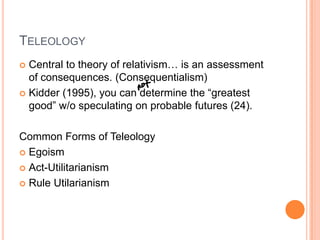
TeleologyCentral to theory of relativism… is an assessment of consequences. (Consequentialism)Kidder (1995), you can determine the “greatest good” w/o speculating on probable futures (24).  Common Forms of TeleologyEgoismAct-UtilitarianismRule Utilarianism
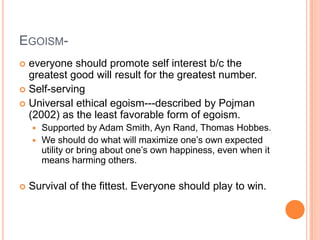
Egoism-everyone should promote self interest b/c the greatest good will result for the greatest number.Self-servingUniversal ethical egoism---described by Pojman (2002) as the least favorable form of egoism.Supported by Adam Smith, Ayn Rand, Thomas Hobbes.We should do what will maximize one’s own expected utility or bring about one’s own happiness, even when it means harming others.Survival of the fittest. Everyone should play to win.
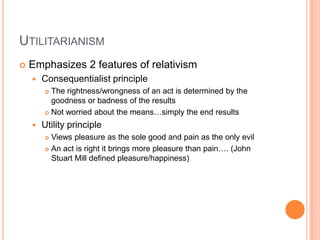
UtilitarianismEmphasizes 2 features of relativismConsequentialist principleThe rightness/wrongness of an act is determined by the goodness or badness of the resultsNot worried about the means…simply the end resultsUtility principleViews pleasure as the sole good and pain as the only evilAn act is right it brings more pleasure than pain…. (John Stuart Mill defined pleasure/happiness)
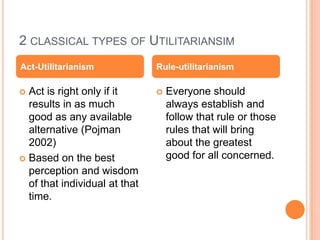
2 classical types of UtilitariansimAct is right only if it results in as much good as any available alternative (Pojman 2002)Based on the best perception and wisdom of that individual at that time.  Everyone should always establish and follow that rule or those rules that will bring about the greatest good for all concerned.   Act-UtilitarianismRule-utilitarianism
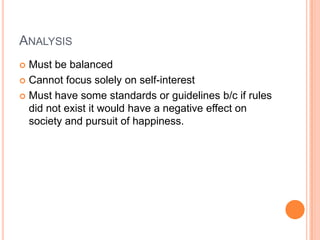
AnalysisMust be balancedCannot focus solely on self-interestMust have some standards or guidelines b/c if rules did not exist it would have a negative effect on society and pursuit of happiness.
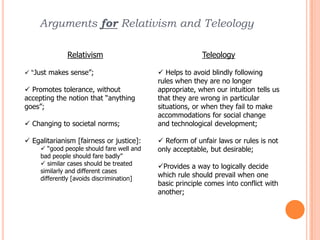
Arguments for Relativism and TeleologyRelativism “Just makes sense”;
Promotes tolerance, without accepting the notion that “anything goes”;
Changing to societal norms;

Ethics and Educational Leaders (4)

  • 1.
    Chapter 4:Relativism andTeleologyReggie Hall / Leslie Mills / Heather Ortiz
  • 2.
    RelativismMorals vary fromsociety to society and between different time periods.
  • 3.
    Moral PhilosophersDavid Hume(1711-1776)Based his theory of ethics on human experience and psychology rather than the divine law and natural law.Our morals are based on the idea of justice and compassion and our ultimate goal is to improvement of the human race.
  • 4.
    Jeremy Bentham (1748-1832)Proposedchanges to laws whose purpose was to maintain the status quo. Believed that instead laws should be focused on providing happiness and reducing suffering, therefore, they should be designed to serve the human race.Proposed using a utilitarian concept of pain vs. pleasure when making ethical decisions. Making ethics quantifiable by considering “greatest good for the greatest number” IntensityDurationCertainty vs. UncertaintyConvenience or remotenessProductiveness (chance of being followed by sensations of the same kind)
  • 5.
    Kidder“Rule based thinking”vs. “end-based thinking”Ends-based thinking using cost-benefit analysis. Who will be helped and who will be hurt in the decision
  • 6.
    Teleologyis any philosophicalaccount which holds that final causes exist in nature, meaning that design and purpose analogous to that found in human actions are inherent also in the rest of nature. The word comes from the Greekτέλος, telos, root: τελε-, "end, purpose, (not to be confused with τῆλε, “at a distance, far from”). The adjective "teleological" has a broader usage, for example in discussions where particular ethical theories or types of computer programs (such as "teleo-reactive" programs) are sometimes described as teleological because they involve aiming at goals. (wiki-source)
  • 7.
    TeleologyCentral to theoryof relativism… is an assessment of consequences. (Consequentialism)Kidder (1995), you can determine the “greatest good” w/o speculating on probable futures (24). Common Forms of TeleologyEgoismAct-UtilitarianismRule Utilarianism
  • 8.
    Egoism-everyone should promoteself interest b/c the greatest good will result for the greatest number.Self-servingUniversal ethical egoism---described by Pojman (2002) as the least favorable form of egoism.Supported by Adam Smith, Ayn Rand, Thomas Hobbes.We should do what will maximize one’s own expected utility or bring about one’s own happiness, even when it means harming others.Survival of the fittest. Everyone should play to win.
  • 9.
    UtilitarianismEmphasizes 2 featuresof relativismConsequentialist principleThe rightness/wrongness of an act is determined by the goodness or badness of the resultsNot worried about the means…simply the end resultsUtility principleViews pleasure as the sole good and pain as the only evilAn act is right it brings more pleasure than pain…. (John Stuart Mill defined pleasure/happiness)
  • 10.
    2 classical typesof UtilitariansimAct is right only if it results in as much good as any available alternative (Pojman 2002)Based on the best perception and wisdom of that individual at that time. Everyone should always establish and follow that rule or those rules that will bring about the greatest good for all concerned. Act-UtilitarianismRule-utilitarianism
  • 11.
    AnalysisMust be balancedCannotfocus solely on self-interestMust have some standards or guidelines b/c if rules did not exist it would have a negative effect on society and pursuit of happiness.
  • 12.
    Arguments for Relativismand TeleologyRelativism “Just makes sense”;
  • 13.
    Promotes tolerance, withoutaccepting the notion that “anything goes”;
  • 14.