The word "teleology" is
derived from the Greek word
"telos" that means "ends." In
this theory, you would
consider the ends, or the
outcomes of your decision.
Since this theory is
concerned about the
consequences of the
decision, it is also referred to
as consequentialist
Teleological theories of Change
According to this theory, human
actions are purposive; goal is
the final cause for guiding
movement of an entity.
TELEOLOGICAL EXAMPLE
EMPLOYER&EMPLOYEE
Basic Insights of Utilitarianism
The purpose of morality is to make the
world a better place.
Morality is about producing good
consequences, not having good
intentions
We should do whatever will bring the
most benefit (i.e., intrinsic value) to all
of humanity.
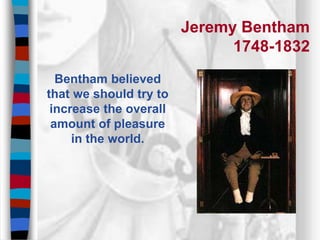
Jeremy Bentham
1748-1832
Bentham believed
that we should try to
increase the overall
amount of pleasure
in the world.
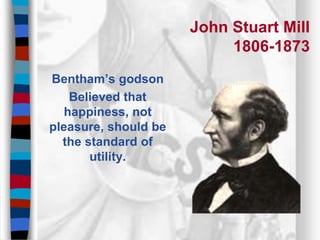
John Stuart Mill
1806-1873
Bentham’s godson
Believed that
happiness, not
pleasure, should be
the standard of
utility.
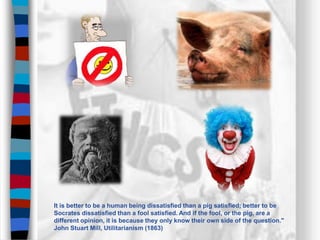
It is better to be a human being dissatisfied than a pig satisfied; better to be
Socrates dissatisfied than a fool satisfied. And if the fool, or the pig, are a
different opinion, it is because they only know their own side of the question."
John Stuart Mill, Utilitarianism (1863)
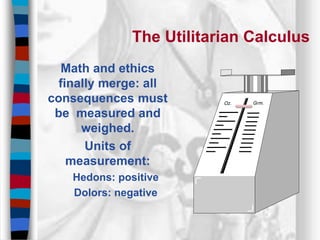
The Utilitarian Calculus
Math and ethics
finally merge: all
consequences must
be measured and
weighed.
Units of
measurement:
Hedons: positive
Dolors: negative
Act and Rule Utilitarianism
Act utilitarianism
Looks at the consequences of each
individual act and calculate utility each
time the act is performed.
Rule utilitarianism
Looks at the consequences of having
everyone follow a particular rule and
calculates the overall utility of accepting
or rejecting the rule.
Criticisms
of Utilitarianism
1. Responsibility
2. Integrity
3. Intentions
4. Moral Luck
5. Who does the calculating?
6. Who is included?
Concluding Assessment
Utilitarianism is most appropriate for
policy decisions, as long as a strong
notion of fundamental human rights
guarantees that it will not violate rights
of small minorities.
*DUTIES OF FIDELITY
*DUTIES OF REPARATION
*DUTIES OF GRATITUDE
*DUTIES OF JUSTICE
*DUTIES OF BENEFICENCE
*DUTIES OF SELF-
IIIMPROVEMENT
*DUTIES OF
;NONMALEFICENCE
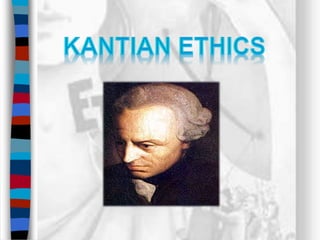
Kantian ethics is based upon
teachings ot the german
philosopher Immanurl Kant
According to kant the concept
of motive is the most important
factor in determining what is
ethical
“Sense of duty”
“This is what I ought
to do”
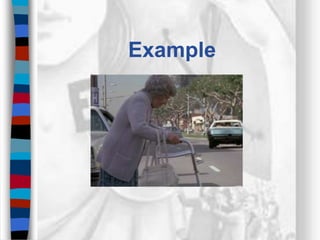
Example
Motive is the most
important factor in
kanatian ethics
Criticisms
Virtue ethics is a frame work
that suggests that societal rules
provide a moral minimum, and
based on that individuals can
translate these societal rules
into personal values and virtues
such as honesty integrity trust
and faith
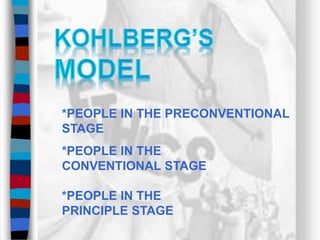
*PEOPLE IN THE PRECONVENTIONAL
STAGE
*PEOPLE IN THE
CONVENTIONAL STAGE
*PEOPLE IN THE
PRINCIPLE STAGE
WITH EDUCATION, EXPERIENCE
AND EXPOSURE PEOPLE MAY
CHANGE THEIR VALUES AND
ETHICAL BEHAVIOUR OVER TIME
Presentation1

Presentation1

  • 3.
    The word "teleology"is derived from the Greek word "telos" that means "ends." In this theory, you would consider the ends, or the outcomes of your decision. Since this theory is concerned about the consequences of the decision, it is also referred to as consequentialist
  • 4.
    Teleological theories ofChange According to this theory, human actions are purposive; goal is the final cause for guiding movement of an entity.
  • 5.
  • 7.
    Basic Insights ofUtilitarianism The purpose of morality is to make the world a better place. Morality is about producing good consequences, not having good intentions We should do whatever will bring the most benefit (i.e., intrinsic value) to all of humanity.
  • 8.
    Jeremy Bentham 1748-1832 Bentham believed thatwe should try to increase the overall amount of pleasure in the world.
  • 9.
    John Stuart Mill 1806-1873 Bentham’sgodson Believed that happiness, not pleasure, should be the standard of utility.
  • 10.
    It is betterto be a human being dissatisfied than a pig satisfied; better to be Socrates dissatisfied than a fool satisfied. And if the fool, or the pig, are a different opinion, it is because they only know their own side of the question." John Stuart Mill, Utilitarianism (1863)
  • 11.
    The Utilitarian Calculus Mathand ethics finally merge: all consequences must be measured and weighed. Units of measurement: Hedons: positive Dolors: negative
  • 12.
    Act and RuleUtilitarianism Act utilitarianism Looks at the consequences of each individual act and calculate utility each time the act is performed. Rule utilitarianism Looks at the consequences of having everyone follow a particular rule and calculates the overall utility of accepting or rejecting the rule.
  • 13.
    Criticisms of Utilitarianism 1. Responsibility 2.Integrity 3. Intentions 4. Moral Luck 5. Who does the calculating? 6. Who is included?
  • 14.
    Concluding Assessment Utilitarianism ismost appropriate for policy decisions, as long as a strong notion of fundamental human rights guarantees that it will not violate rights of small minorities.
  • 16.
    *DUTIES OF FIDELITY *DUTIESOF REPARATION *DUTIES OF GRATITUDE *DUTIES OF JUSTICE *DUTIES OF BENEFICENCE *DUTIES OF SELF- IIIMPROVEMENT *DUTIES OF ;NONMALEFICENCE
  • 18.
    Kantian ethics isbased upon teachings ot the german philosopher Immanurl Kant According to kant the concept of motive is the most important factor in determining what is ethical
  • 19.
    “Sense of duty” “Thisis what I ought to do”
  • 20.
  • 21.
    Motive is themost important factor in kanatian ethics
  • 22.
  • 25.
    Virtue ethics isa frame work that suggests that societal rules provide a moral minimum, and based on that individuals can translate these societal rules into personal values and virtues such as honesty integrity trust and faith
  • 26.
    *PEOPLE IN THEPRECONVENTIONAL STAGE *PEOPLE IN THE CONVENTIONAL STAGE *PEOPLE IN THE PRINCIPLE STAGE
  • 27.
    WITH EDUCATION, EXPERIENCE ANDEXPOSURE PEOPLE MAY CHANGE THEIR VALUES AND ETHICAL BEHAVIOUR OVER TIME