Ethics: Discovering
Right and Wrong
Louis P. Pojman and James Fieser
8th edition
Chapter Seven: Utilitarianism
 A dying millionaire asks you to give his $5 million to the
New York Yankees. Do you fulfill his dying wish or give
the money to the World Hunger Relief Organization?
 Conscience, love, and the Golden Rule are guiding
principles, but when there are conflicts of interest, they
are limited.
 A more promising strategy for solving dilemmas is
following definite moral rules.
© 2017 Cengage Learning. All Rights Reserved.
Two Types of Ethical Systems
 Deontology: From the Greek word deon meaning “duty.”
 The center of value is the act or kind of act; certain
features in the act itself have intrinsic value.
 Teleological ethics: From the Greek word telos meaning
“goal directed.”
 The center of value is the outcome or consequences of the
act.
© 2017 Cengage Learning. All Rights Reserved.
Utilitarianism
 Utilitarianism is a universal teleological system.
 It calls for the maximization of goodness in society—that
is, the greatest amount of goodness for the greatest
number of people—and not merely the good of the agent.
© 2017 Cengage Learning. All Rights Reserved.
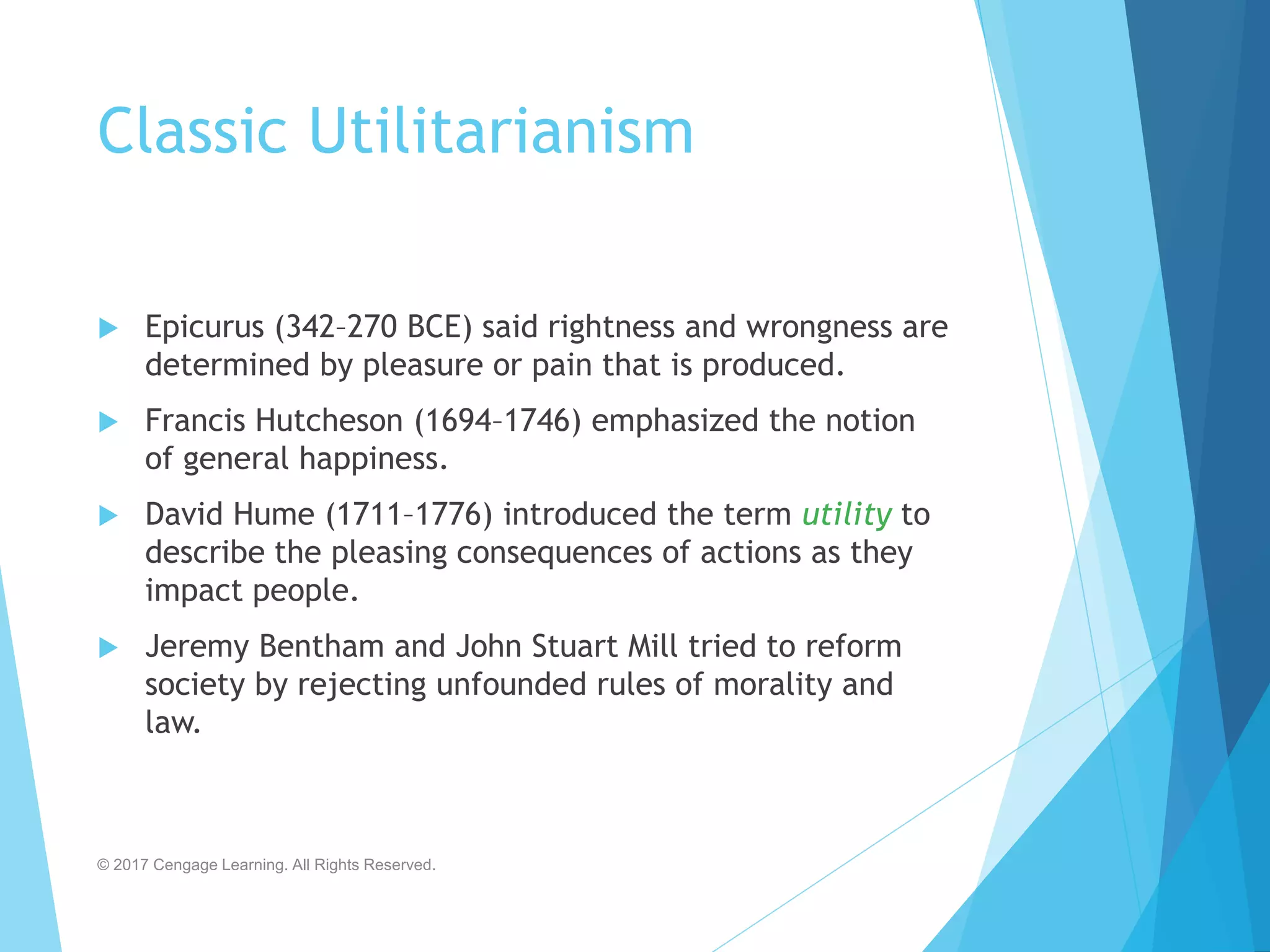
Classic Utilitarianism
 Epicurus (342–270 BCE) said rightness and wrongness are
determined by pleasure or pain that is produced.
 Francis Hutcheson (1694–1746) emphasized the notion
of general happiness.
 David Hume (1711–1776) introduced the term utility to
describe the pleasing consequences of actions as they
impact people.
 Jeremy Bentham and John Stuart Mill tried to reform
society by rejecting unfounded rules of morality and
law.
© 2017 Cengage Learning. All Rights Reserved.
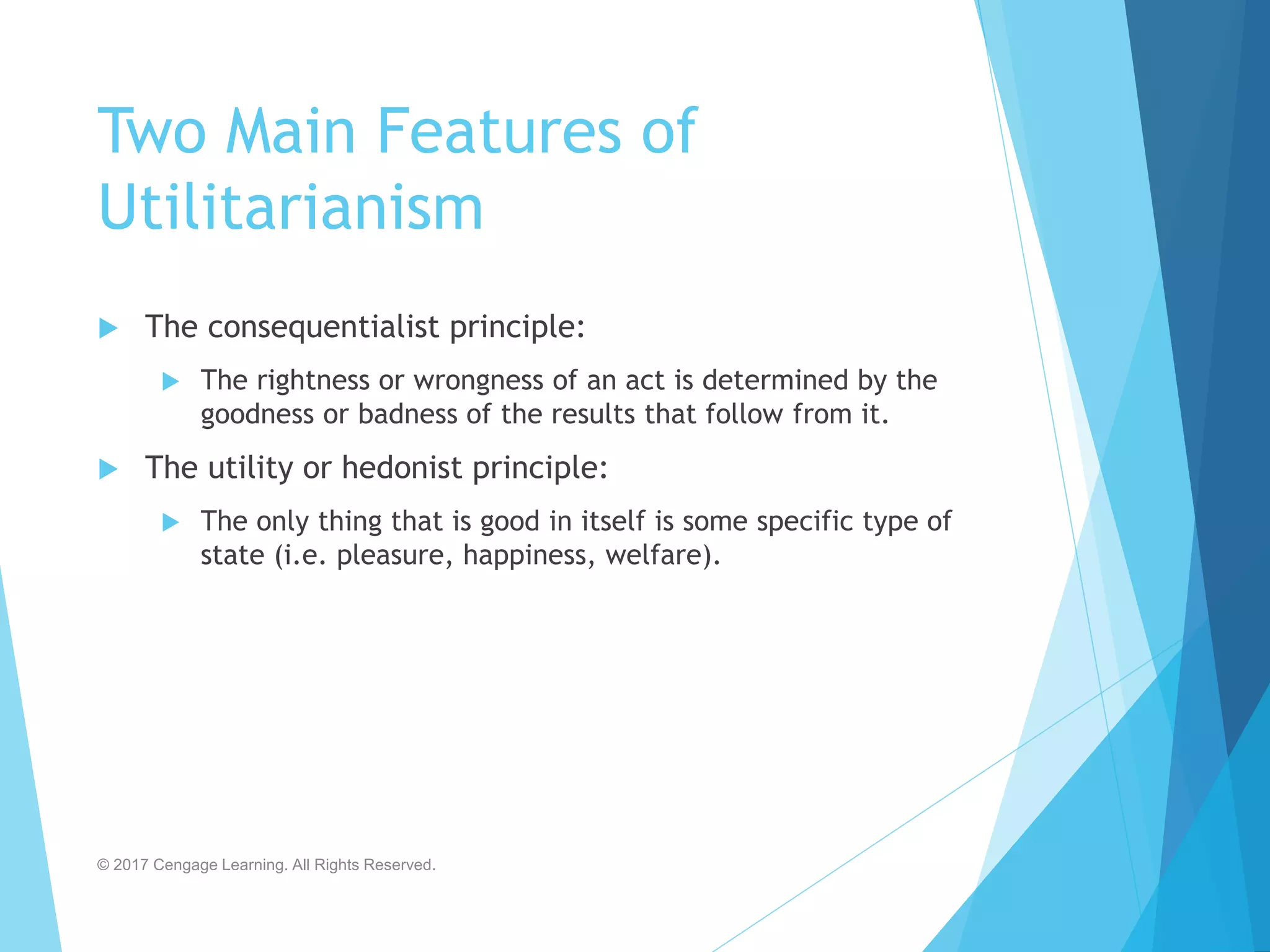
Two Main Features of
Utilitarianism
 The consequentialist principle:
 The rightness or wrongness of an act is determined by the
goodness or badness of the results that follow from it.
 The utility or hedonist principle:
 The only thing that is good in itself is some specific type of
state (i.e. pleasure, happiness, welfare).
© 2017 Cengage Learning. All Rights Reserved.
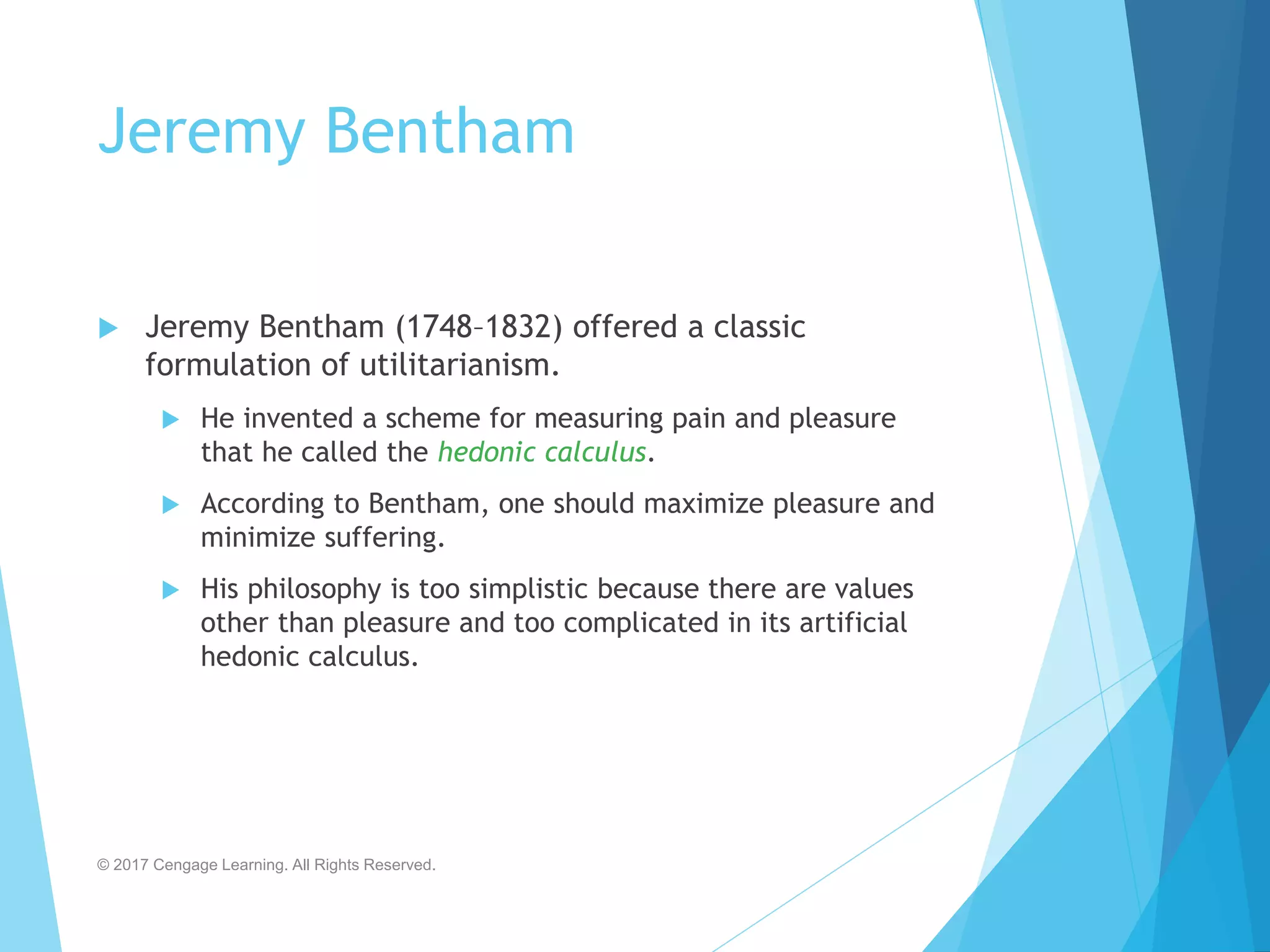
Jeremy Bentham
 Jeremy Bentham (1748–1832) offered a classic
formulation of utilitarianism.
 He invented a scheme for measuring pain and pleasure
that he called the hedonic calculus.
 According to Bentham, one should maximize pleasure and
minimize suffering.
 His philosophy is too simplistic because there are values
other than pleasure and too complicated in its artificial
hedonic calculus.
© 2017 Cengage Learning. All Rights Reserved.
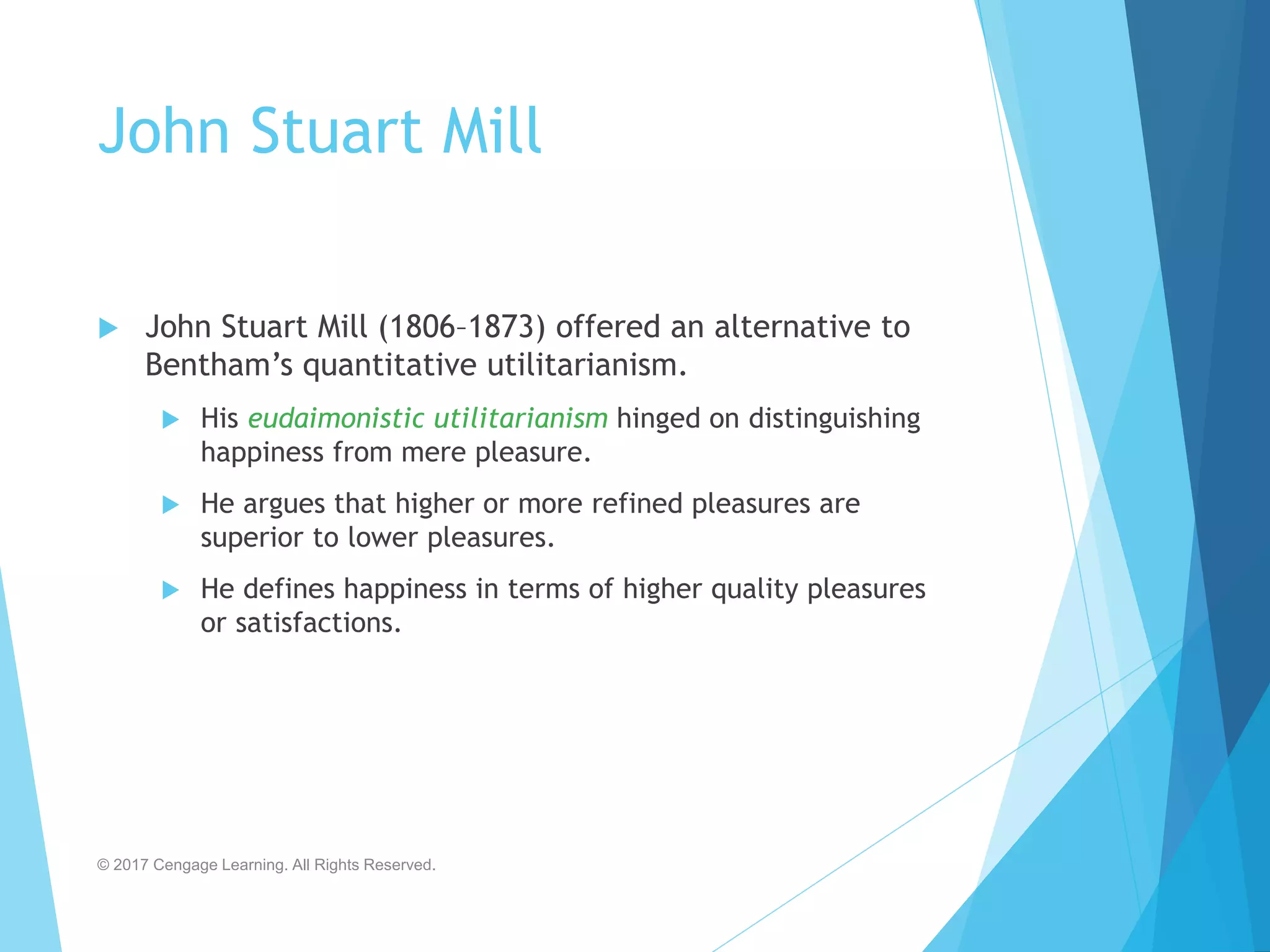
John Stuart Mill
 John Stuart Mill (1806–1873) offered an alternative to
Bentham’s quantitative utilitarianism.
 His eudaimonistic utilitarianism hinged on distinguishing
happiness from mere pleasure.
 He argues that higher or more refined pleasures are
superior to lower pleasures.
 He defines happiness in terms of higher quality pleasures
or satisfactions.
© 2017 Cengage Learning. All Rights Reserved.
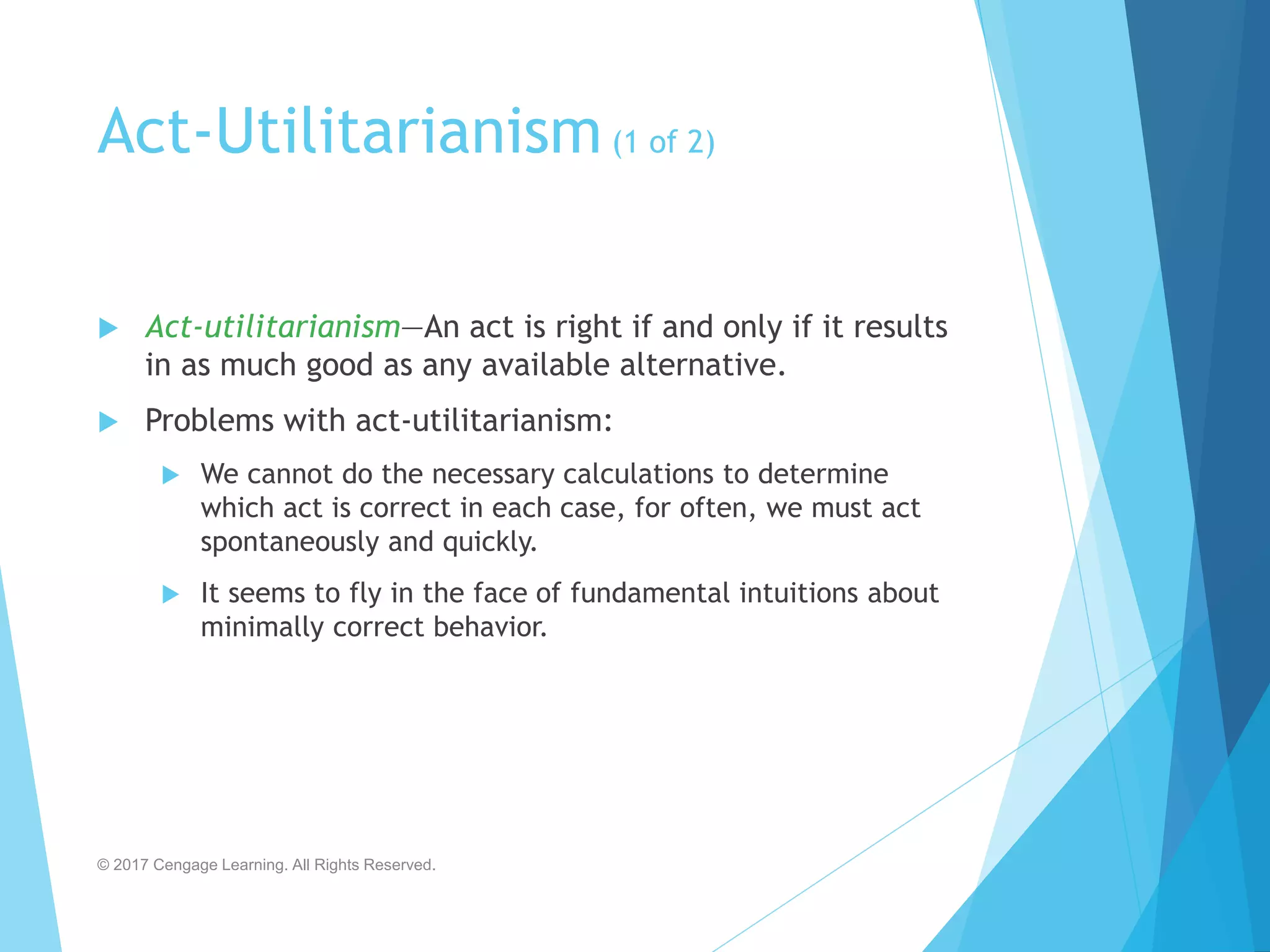
Act-Utilitarianism(1 of 2)
 Act-utilitarianism—An act is right if and only if it results
in as much good as any available alternative.
 Problems with act-utilitarianism:
 We cannot do the necessary calculations to determine
which act is correct in each case, for often, we must act
spontaneously and quickly.
 It seems to fly in the face of fundamental intuitions about
minimally correct behavior.
© 2017 Cengage Learning. All Rights Reserved.
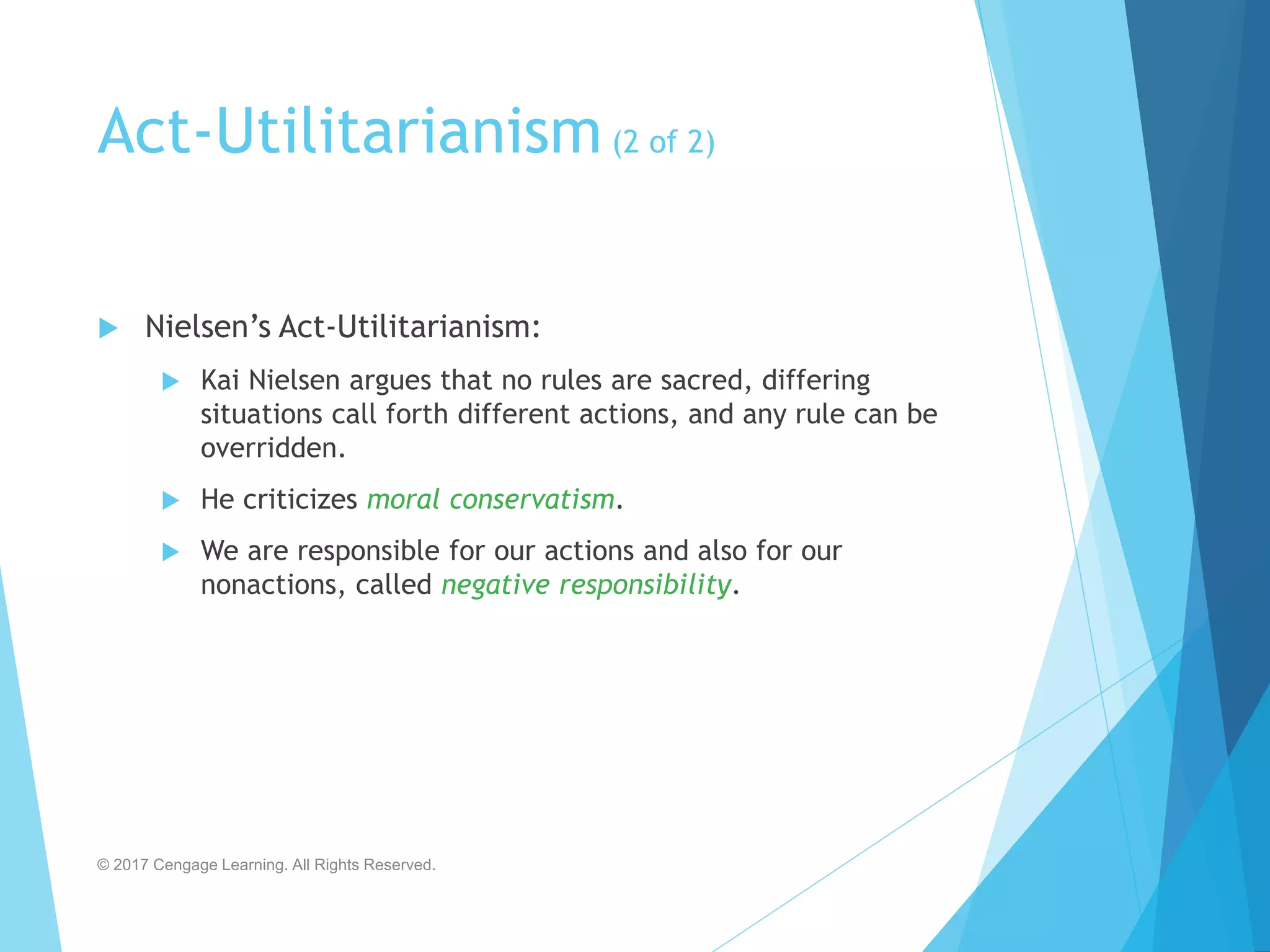
Act-Utilitarianism(2 of 2)
 Nielsen’s Act-Utilitarianism:
 Kai Nielsen argues that no rules are sacred, differing
situations call forth different actions, and any rule can be
overridden.
 He criticizes moral conservatism.
 We are responsible for our actions and also for our
nonactions, called negative responsibility.
© 2017 Cengage Learning. All Rights Reserved.
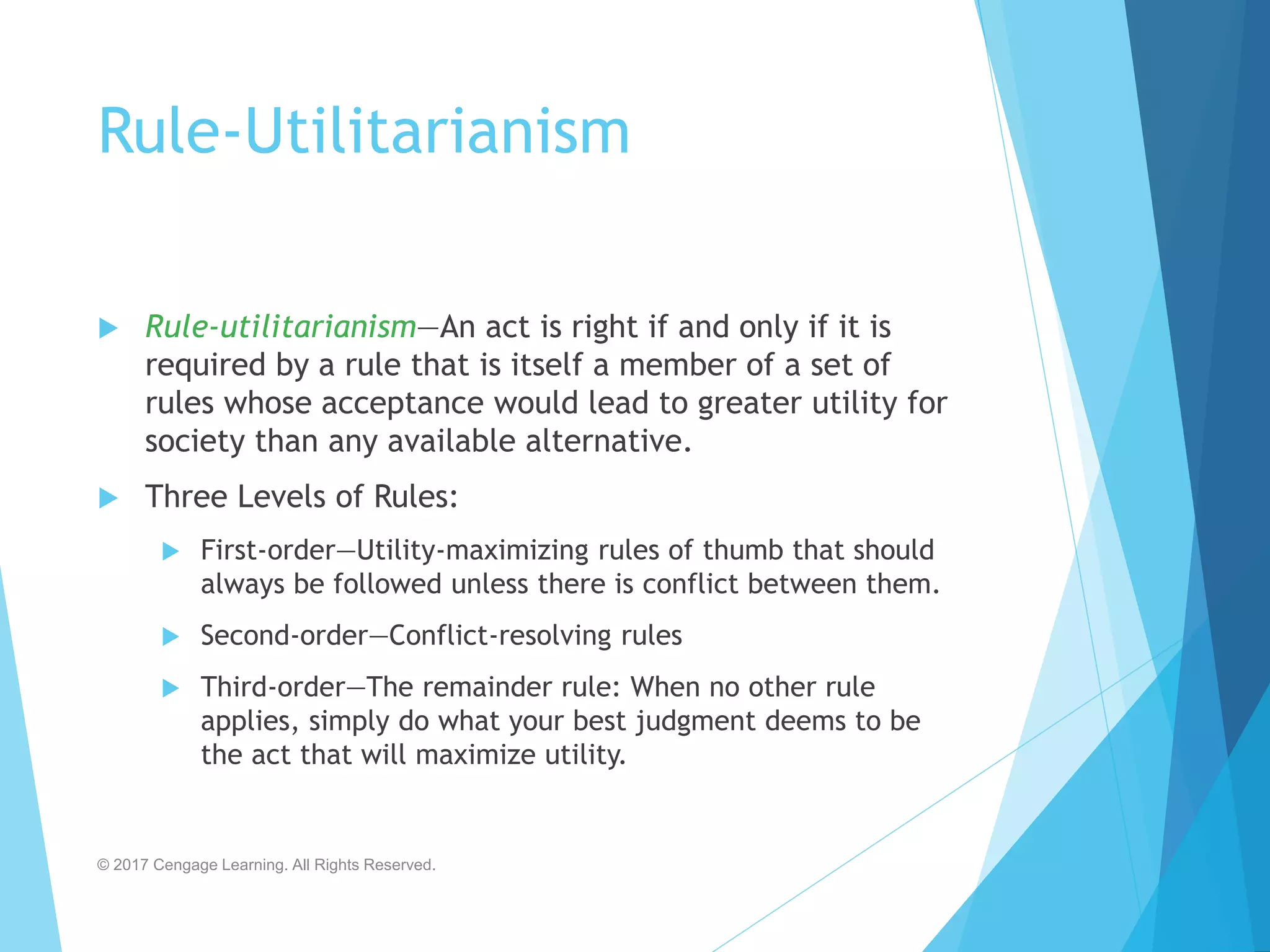
Rule-Utilitarianism
 Rule-utilitarianism—An act is right if and only if it is
required by a rule that is itself a member of a set of
rules whose acceptance would lead to greater utility for
society than any available alternative.
 Three Levels of Rules:
 First-order—Utility-maximizing rules of thumb that should
always be followed unless there is conflict between them.
 Second-order—Conflict-resolving rules
 Third-order—The remainder rule: When no other rule
applies, simply do what your best judgment deems to be
the act that will maximize utility.
© 2017 Cengage Learning. All Rights Reserved.
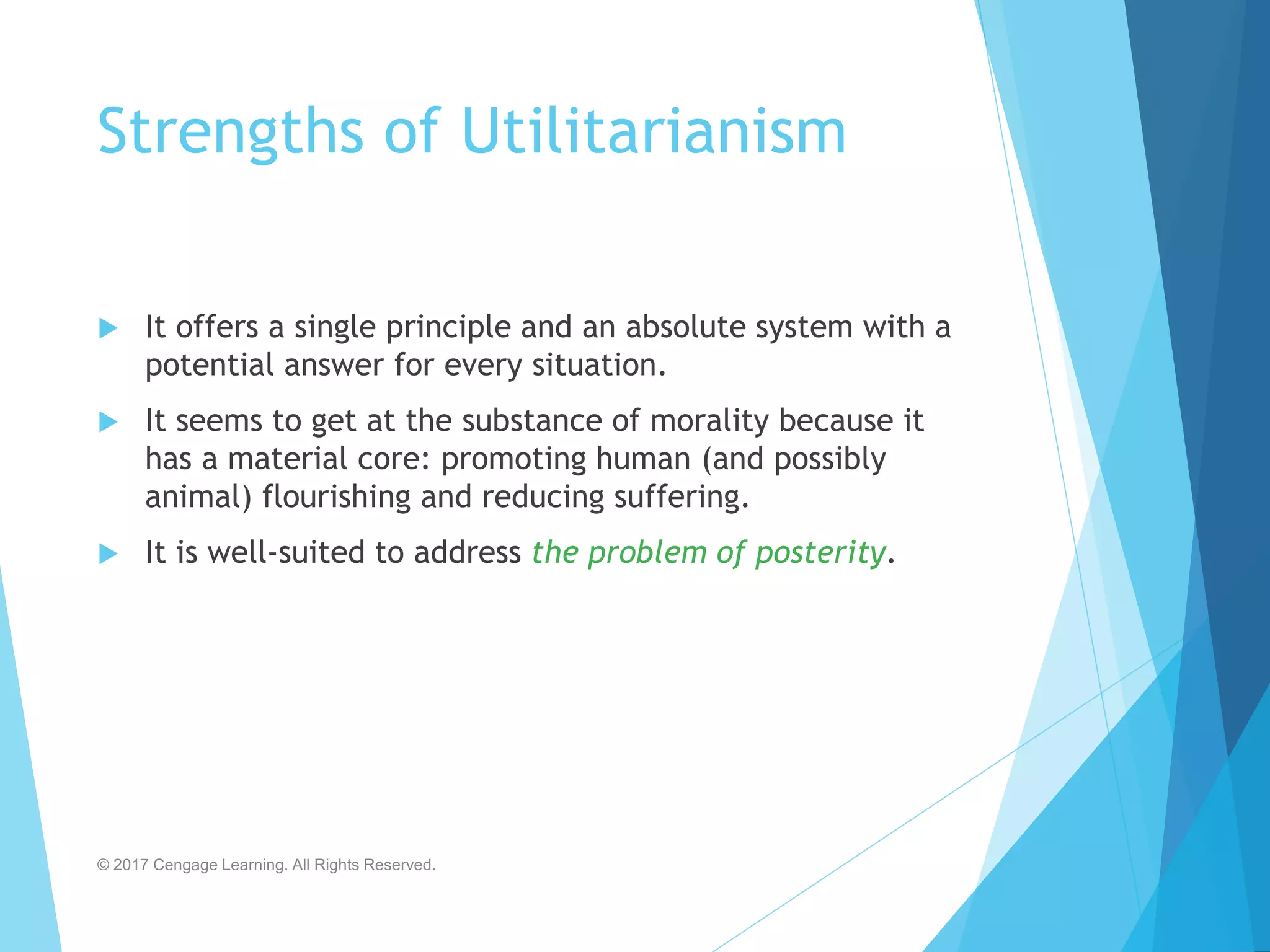
Strengths of Utilitarianism
 It offers a single principle and an absolute system with a
potential answer for every situation.
 It seems to get at the substance of morality because it
has a material core: promoting human (and possibly
animal) flourishing and reducing suffering.
 It is well-suited to address the problem of posterity.
© 2017 Cengage Learning. All Rights Reserved.
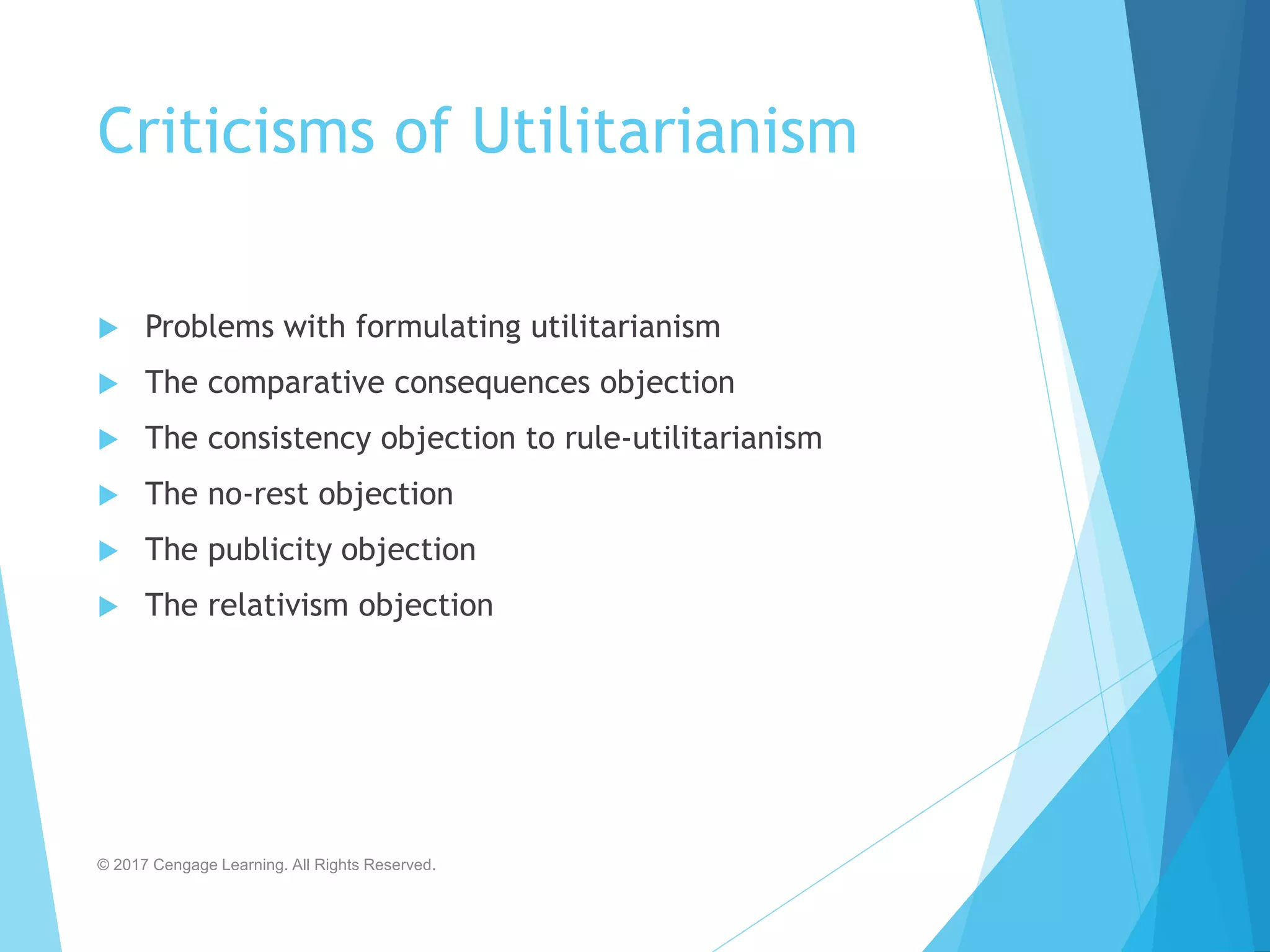
Criticisms of Utilitarianism
 Problems with formulating utilitarianism
 The comparative consequences objection
 The consistency objection to rule-utilitarianism
 The no-rest objection
 The publicity objection
 The relativism objection
© 2017 Cengage Learning. All Rights Reserved.
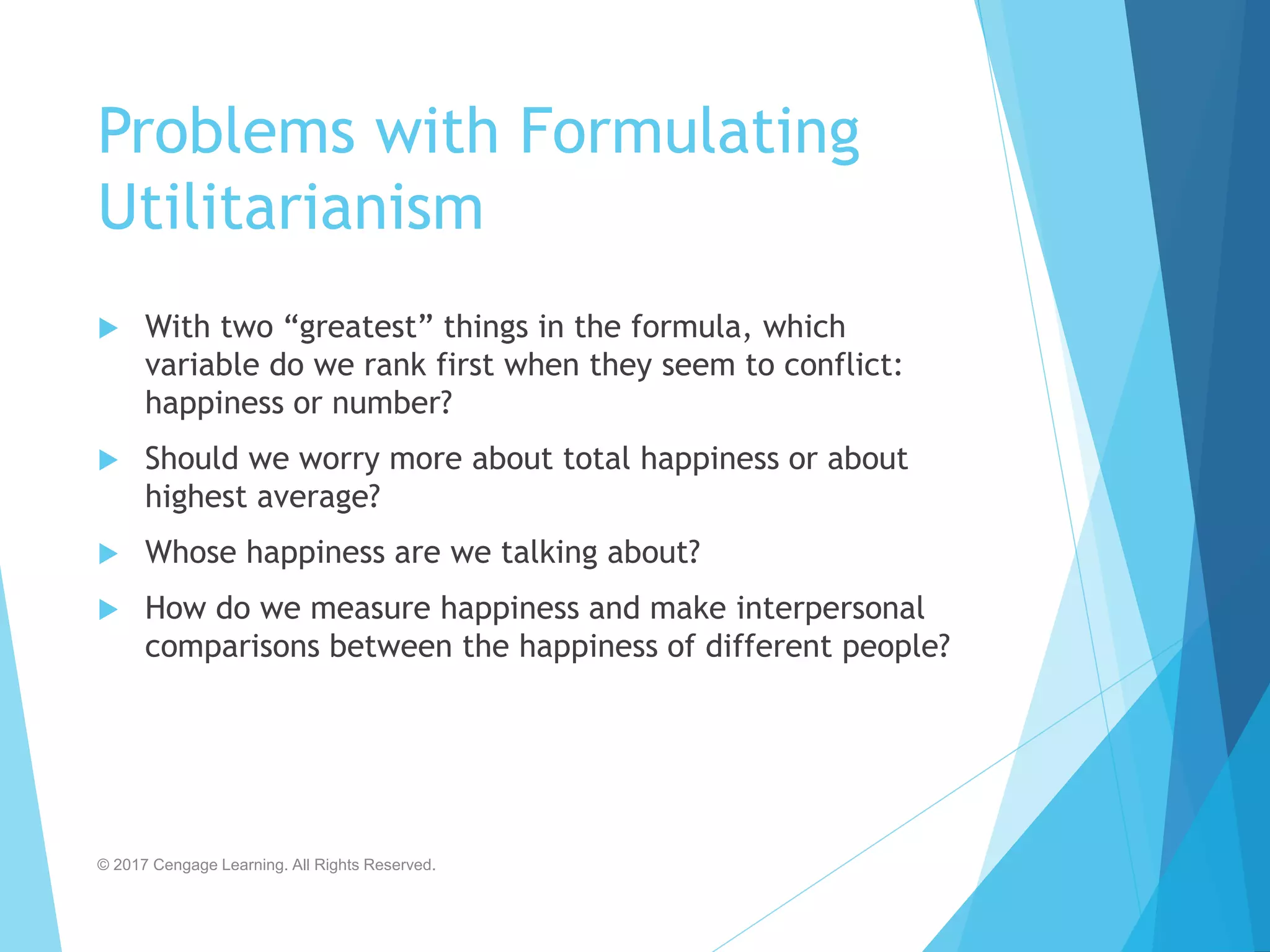
Problems with Formulating
Utilitarianism
 With two “greatest” things in the formula, which
variable do we rank first when they seem to conflict:
happiness or number?
 Should we worry more about total happiness or about
highest average?
 Whose happiness are we talking about?
 How do we measure happiness and make interpersonal
comparisons between the happiness of different people?
© 2017 Cengage Learning. All Rights Reserved.
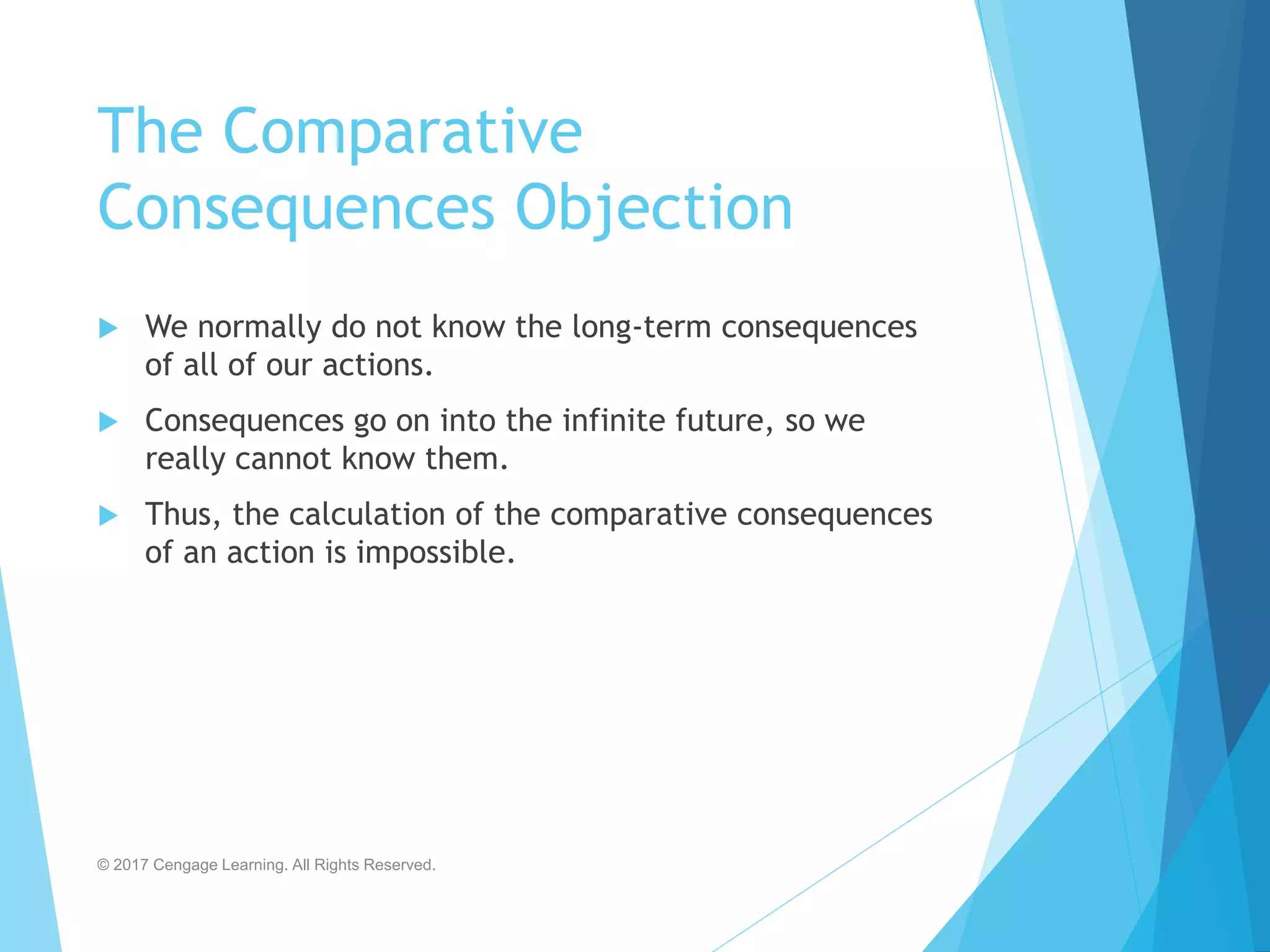
The Comparative
Consequences Objection
 We normally do not know the long-term consequences
of all of our actions.
 Consequences go on into the infinite future, so we
really cannot know them.
 Thus, the calculation of the comparative consequences
of an action is impossible.
© 2017 Cengage Learning. All Rights Reserved.
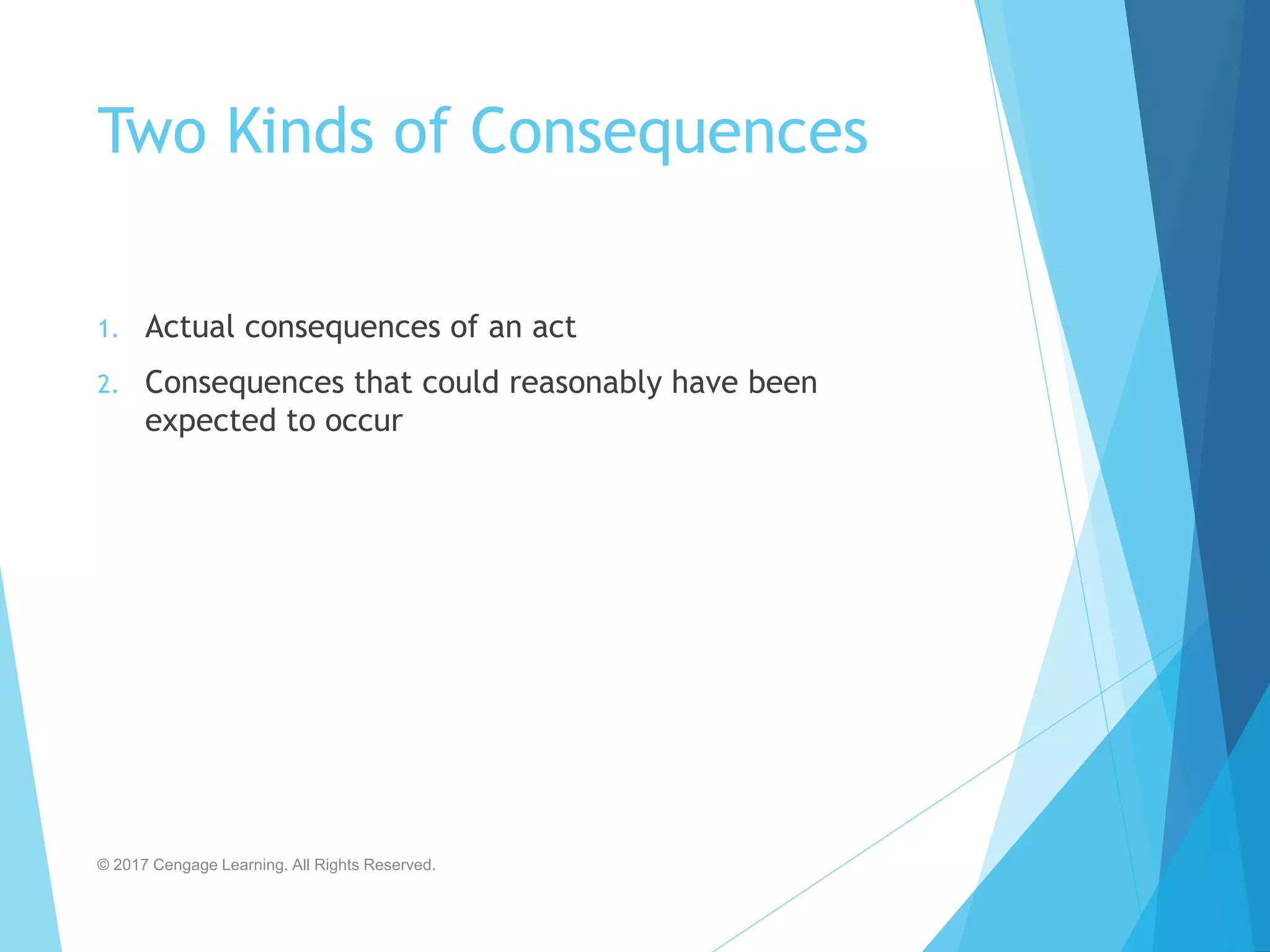
Two Kinds of Consequences
1. Actual consequences of an act
2. Consequences that could reasonably have been
expected to occur
© 2017 Cengage Learning. All Rights Reserved.
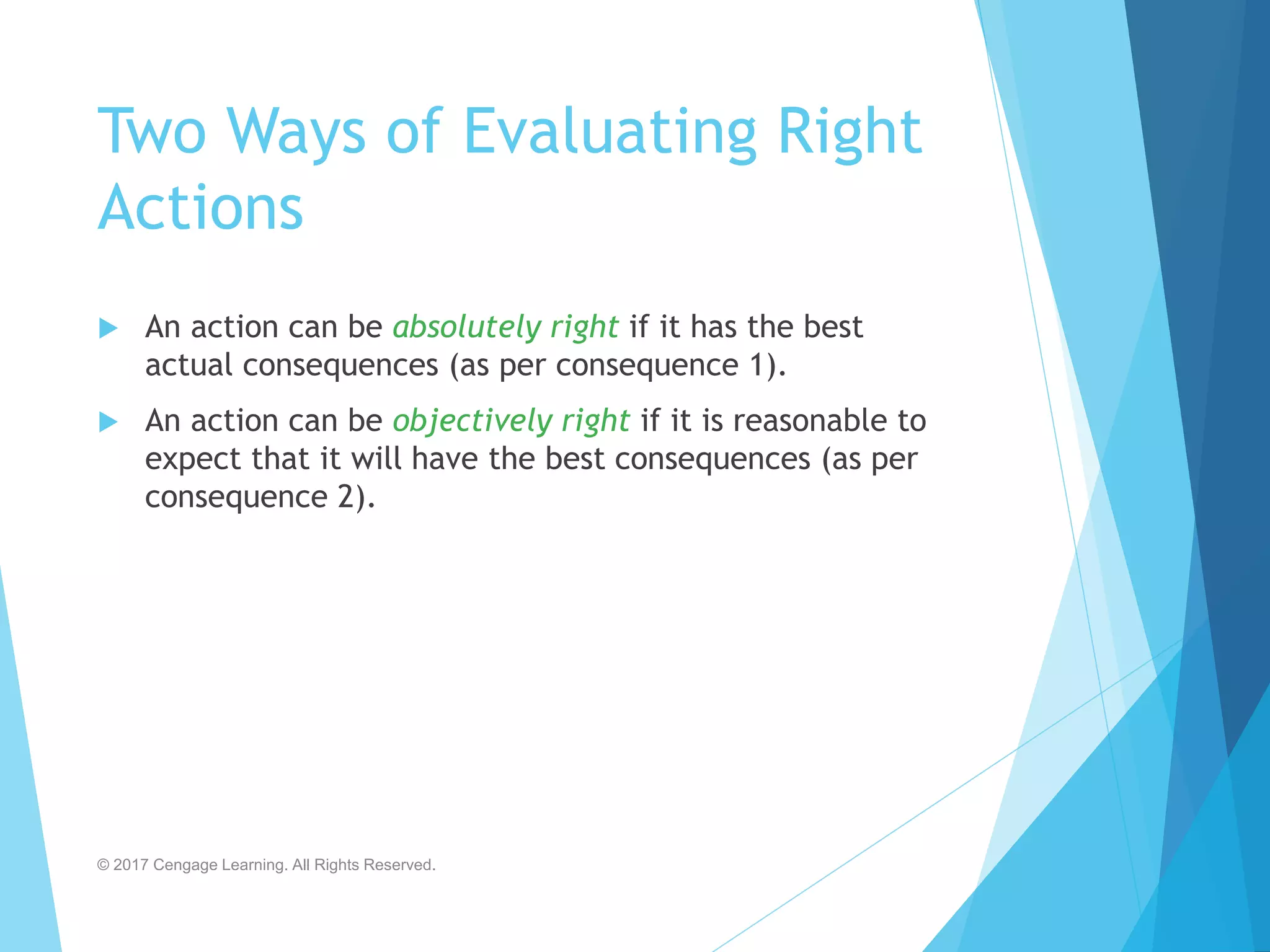
Two Ways of Evaluating Right
Actions
 An action can be absolutely right if it has the best
actual consequences (as per consequence 1).
 An action can be objectively right if it is reasonable to
expect that it will have the best consequences (as per
consequence 2).
© 2017 Cengage Learning. All Rights Reserved.
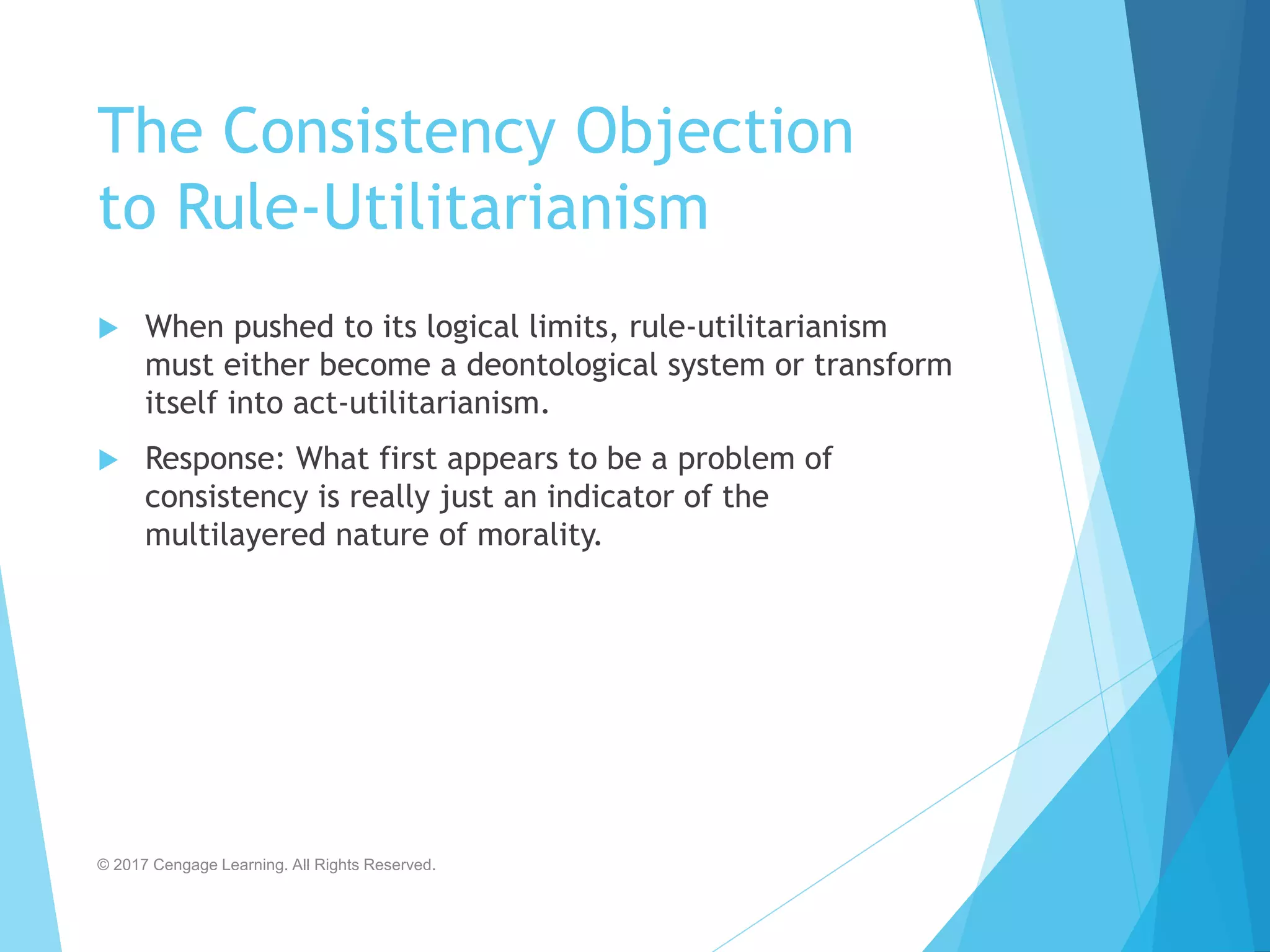
The Consistency Objection
to Rule-Utilitarianism
 When pushed to its logical limits, rule-utilitarianism
must either become a deontological system or transform
itself into act-utilitarianism.
 Response: What first appears to be a problem of
consistency is really just an indicator of the
multilayered nature of morality.
© 2017 Cengage Learning. All Rights Reserved.
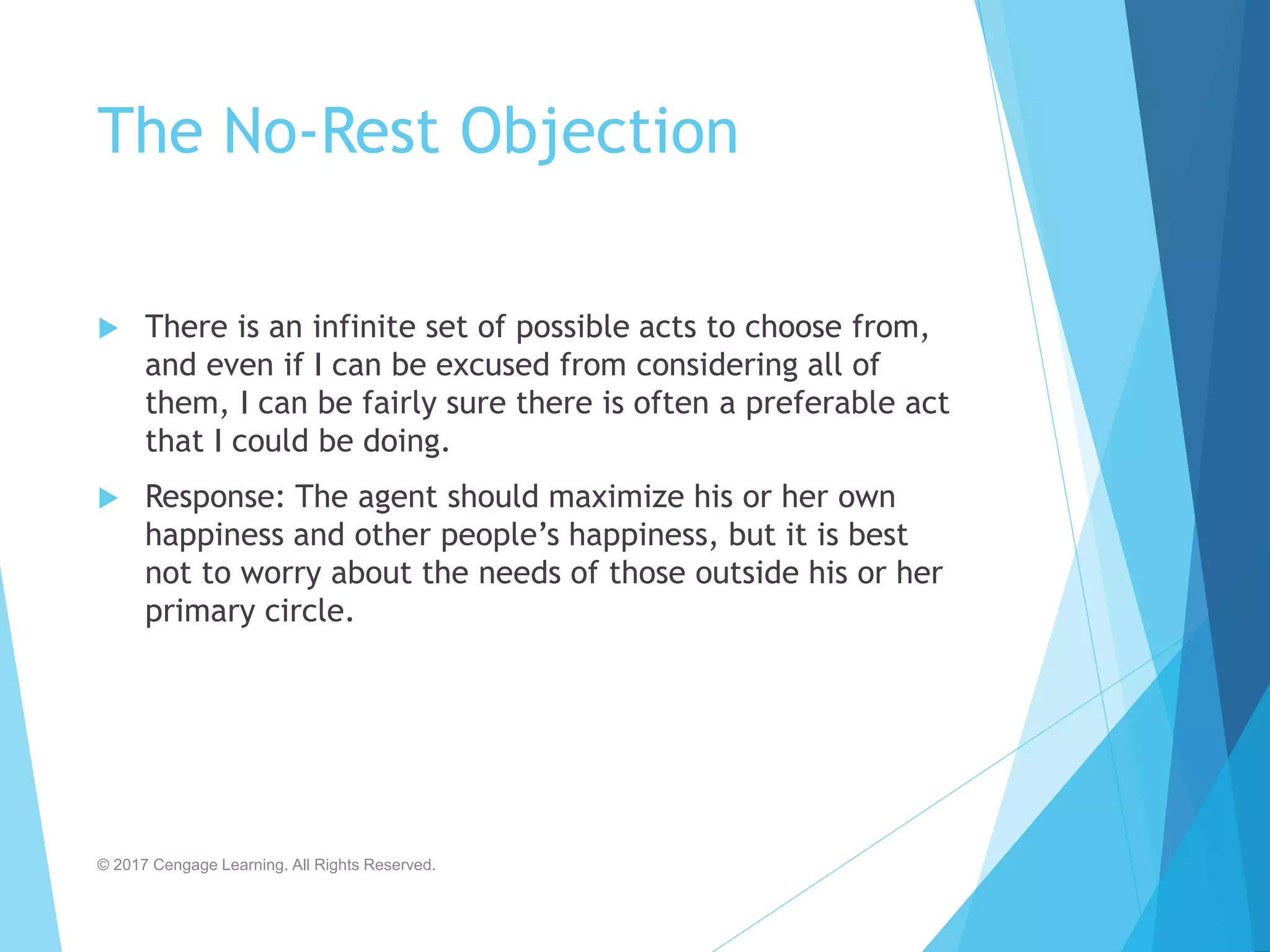
The No-Rest Objection
 There is an infinite set of possible acts to choose from,
and even if I can be excused from considering all of
them, I can be fairly sure there is often a preferable act
that I could be doing.
 Response: The agent should maximize his or her own
happiness and other people’s happiness, but it is best
not to worry about the needs of those outside his or her
primary circle.
© 2017 Cengage Learning. All Rights Reserved.
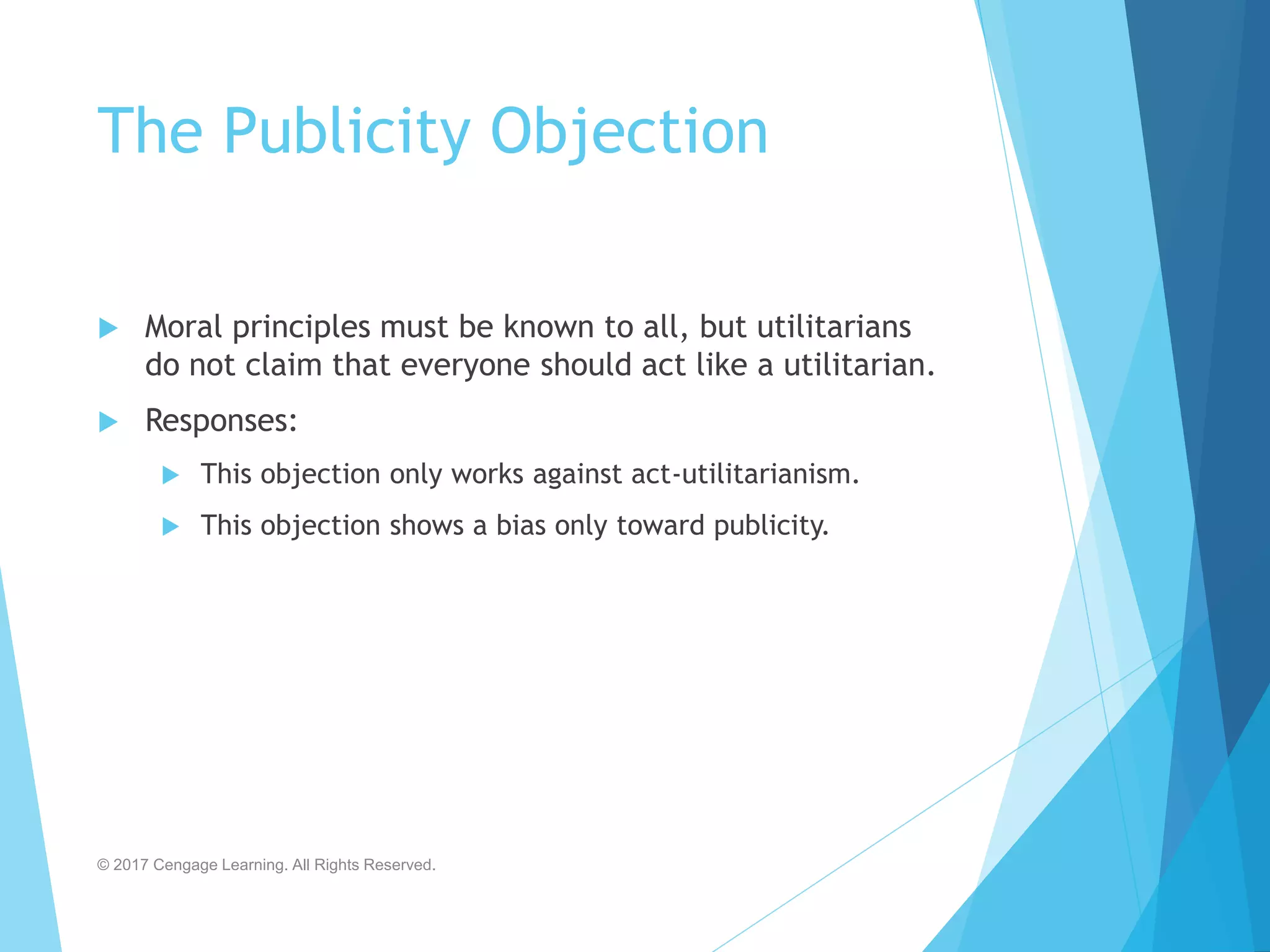
The Publicity Objection
 Moral principles must be known to all, but utilitarians
do not claim that everyone should act like a utilitarian.
 Responses:
 This objection only works against act-utilitarianism.
 This objection shows a bias only toward publicity.
© 2017 Cengage Learning. All Rights Reserved.
The Relativism Objection
 Rule-utilitarianism seems to endorse different rules in
different societies.
 The more serious worry is that it might become so
flexible that it justifies any moral rule.
 Response: Human nature causes consistency in our
moral assessments.
© 2017 Cengage Learning. All Rights Reserved.
Criticism of the Ends
Justifying Immoral Means
1. If a moral theory justifies actions that we universally
deem impermissible, then that moral theory must be
rejected.
2. Utilitarianism justifies actions that we universally deem
impermissible.
3. Therefore, utilitarianism must be rejected.
© 2017 Cengage Learning. All Rights Reserved.
Versions of the Ends Justifying
Immoral Means Argument
 The lying objection
 The integrity objection
 The justice objection
© 2017 Cengage Learning. All Rights Reserved.
The Lying Objection
 William D. Ross argues that utilitarianism should be
rejected because it leads to the counterintuitive
endorsement of lying when it serves the greater good.
 Response: There is something counterintuitive in the
calculus of equating an act of lying with one of honesty,
and we must be ready to change our culturally induced
moral biases.
© 2017 Cengage Learning. All Rights Reserved.
The Integrity Objection
 Bernard Williams argues that utilitarianism violates
personal integrity by commanding that we violate our
most central and deeply held principles.
 Response: Integrity is not an absolute that must be
adhered to at all costs.
© 2017 Cengage Learning. All Rights Reserved.
The Justice Objection
 Utilitarians could consider actions that go against
standards of justice that most of us think should never
be dispensed with.
 Response: Justice is just one more lower-order principle
within utilitarianism.
© 2017 Cengage Learning. All Rights Reserved.
Conclusion
 Multilevel rule-utilitarianism:
 Satisfies the purposes of ethics
 Gives a clear decision procedure for moral conduct
 Focuses on helping people and reducing suffering in the
world
 Offers a compelling solution to the problem of posterity
 Has responses to all the criticisms directed at it
© 2017 Cengage Learning. All Rights Reserved.

Pojman ethics 8e_ppt_ch07

  • 1.
    Ethics: Discovering Right andWrong Louis P. Pojman and James Fieser 8th edition
  • 2.
    Chapter Seven: Utilitarianism A dying millionaire asks you to give his $5 million to the New York Yankees. Do you fulfill his dying wish or give the money to the World Hunger Relief Organization?  Conscience, love, and the Golden Rule are guiding principles, but when there are conflicts of interest, they are limited.  A more promising strategy for solving dilemmas is following definite moral rules. © 2017 Cengage Learning. All Rights Reserved.
  • 3.
    Two Types ofEthical Systems  Deontology: From the Greek word deon meaning “duty.”  The center of value is the act or kind of act; certain features in the act itself have intrinsic value.  Teleological ethics: From the Greek word telos meaning “goal directed.”  The center of value is the outcome or consequences of the act. © 2017 Cengage Learning. All Rights Reserved.
  • 4.
    Utilitarianism  Utilitarianism isa universal teleological system.  It calls for the maximization of goodness in society—that is, the greatest amount of goodness for the greatest number of people—and not merely the good of the agent. © 2017 Cengage Learning. All Rights Reserved.
  • 5.
    Classic Utilitarianism  Epicurus(342–270 BCE) said rightness and wrongness are determined by pleasure or pain that is produced.  Francis Hutcheson (1694–1746) emphasized the notion of general happiness.  David Hume (1711–1776) introduced the term utility to describe the pleasing consequences of actions as they impact people.  Jeremy Bentham and John Stuart Mill tried to reform society by rejecting unfounded rules of morality and law. © 2017 Cengage Learning. All Rights Reserved.
  • 6.
    Two Main Featuresof Utilitarianism  The consequentialist principle:  The rightness or wrongness of an act is determined by the goodness or badness of the results that follow from it.  The utility or hedonist principle:  The only thing that is good in itself is some specific type of state (i.e. pleasure, happiness, welfare). © 2017 Cengage Learning. All Rights Reserved.
  • 7.
    Jeremy Bentham  JeremyBentham (1748–1832) offered a classic formulation of utilitarianism.  He invented a scheme for measuring pain and pleasure that he called the hedonic calculus.  According to Bentham, one should maximize pleasure and minimize suffering.  His philosophy is too simplistic because there are values other than pleasure and too complicated in its artificial hedonic calculus. © 2017 Cengage Learning. All Rights Reserved.
  • 8.
    John Stuart Mill John Stuart Mill (1806–1873) offered an alternative to Bentham’s quantitative utilitarianism.  His eudaimonistic utilitarianism hinged on distinguishing happiness from mere pleasure.  He argues that higher or more refined pleasures are superior to lower pleasures.  He defines happiness in terms of higher quality pleasures or satisfactions. © 2017 Cengage Learning. All Rights Reserved.
  • 9.
    Act-Utilitarianism(1 of 2) Act-utilitarianism—An act is right if and only if it results in as much good as any available alternative.  Problems with act-utilitarianism:  We cannot do the necessary calculations to determine which act is correct in each case, for often, we must act spontaneously and quickly.  It seems to fly in the face of fundamental intuitions about minimally correct behavior. © 2017 Cengage Learning. All Rights Reserved.
  • 10.
    Act-Utilitarianism(2 of 2) Nielsen’s Act-Utilitarianism:  Kai Nielsen argues that no rules are sacred, differing situations call forth different actions, and any rule can be overridden.  He criticizes moral conservatism.  We are responsible for our actions and also for our nonactions, called negative responsibility. © 2017 Cengage Learning. All Rights Reserved.
  • 11.
    Rule-Utilitarianism  Rule-utilitarianism—An actis right if and only if it is required by a rule that is itself a member of a set of rules whose acceptance would lead to greater utility for society than any available alternative.  Three Levels of Rules:  First-order—Utility-maximizing rules of thumb that should always be followed unless there is conflict between them.  Second-order—Conflict-resolving rules  Third-order—The remainder rule: When no other rule applies, simply do what your best judgment deems to be the act that will maximize utility. © 2017 Cengage Learning. All Rights Reserved.
  • 12.
    Strengths of Utilitarianism It offers a single principle and an absolute system with a potential answer for every situation.  It seems to get at the substance of morality because it has a material core: promoting human (and possibly animal) flourishing and reducing suffering.  It is well-suited to address the problem of posterity. © 2017 Cengage Learning. All Rights Reserved.
  • 13.
    Criticisms of Utilitarianism Problems with formulating utilitarianism  The comparative consequences objection  The consistency objection to rule-utilitarianism  The no-rest objection  The publicity objection  The relativism objection © 2017 Cengage Learning. All Rights Reserved.
  • 14.
    Problems with Formulating Utilitarianism With two “greatest” things in the formula, which variable do we rank first when they seem to conflict: happiness or number?  Should we worry more about total happiness or about highest average?  Whose happiness are we talking about?  How do we measure happiness and make interpersonal comparisons between the happiness of different people? © 2017 Cengage Learning. All Rights Reserved.
  • 15.
    The Comparative Consequences Objection We normally do not know the long-term consequences of all of our actions.  Consequences go on into the infinite future, so we really cannot know them.  Thus, the calculation of the comparative consequences of an action is impossible. © 2017 Cengage Learning. All Rights Reserved.
  • 16.
    Two Kinds ofConsequences 1. Actual consequences of an act 2. Consequences that could reasonably have been expected to occur © 2017 Cengage Learning. All Rights Reserved.
  • 17.
    Two Ways ofEvaluating Right Actions  An action can be absolutely right if it has the best actual consequences (as per consequence 1).  An action can be objectively right if it is reasonable to expect that it will have the best consequences (as per consequence 2). © 2017 Cengage Learning. All Rights Reserved.
  • 18.
    The Consistency Objection toRule-Utilitarianism  When pushed to its logical limits, rule-utilitarianism must either become a deontological system or transform itself into act-utilitarianism.  Response: What first appears to be a problem of consistency is really just an indicator of the multilayered nature of morality. © 2017 Cengage Learning. All Rights Reserved.
  • 19.
    The No-Rest Objection There is an infinite set of possible acts to choose from, and even if I can be excused from considering all of them, I can be fairly sure there is often a preferable act that I could be doing.  Response: The agent should maximize his or her own happiness and other people’s happiness, but it is best not to worry about the needs of those outside his or her primary circle. © 2017 Cengage Learning. All Rights Reserved.
  • 20.
    The Publicity Objection Moral principles must be known to all, but utilitarians do not claim that everyone should act like a utilitarian.  Responses:  This objection only works against act-utilitarianism.  This objection shows a bias only toward publicity. © 2017 Cengage Learning. All Rights Reserved.
  • 21.
    The Relativism Objection Rule-utilitarianism seems to endorse different rules in different societies.  The more serious worry is that it might become so flexible that it justifies any moral rule.  Response: Human nature causes consistency in our moral assessments. © 2017 Cengage Learning. All Rights Reserved.
  • 22.
    Criticism of theEnds Justifying Immoral Means 1. If a moral theory justifies actions that we universally deem impermissible, then that moral theory must be rejected. 2. Utilitarianism justifies actions that we universally deem impermissible. 3. Therefore, utilitarianism must be rejected. © 2017 Cengage Learning. All Rights Reserved.
  • 23.
    Versions of theEnds Justifying Immoral Means Argument  The lying objection  The integrity objection  The justice objection © 2017 Cengage Learning. All Rights Reserved.
  • 24.
    The Lying Objection William D. Ross argues that utilitarianism should be rejected because it leads to the counterintuitive endorsement of lying when it serves the greater good.  Response: There is something counterintuitive in the calculus of equating an act of lying with one of honesty, and we must be ready to change our culturally induced moral biases. © 2017 Cengage Learning. All Rights Reserved.
  • 25.
    The Integrity Objection Bernard Williams argues that utilitarianism violates personal integrity by commanding that we violate our most central and deeply held principles.  Response: Integrity is not an absolute that must be adhered to at all costs. © 2017 Cengage Learning. All Rights Reserved.
  • 26.
    The Justice Objection Utilitarians could consider actions that go against standards of justice that most of us think should never be dispensed with.  Response: Justice is just one more lower-order principle within utilitarianism. © 2017 Cengage Learning. All Rights Reserved.
  • 27.
    Conclusion  Multilevel rule-utilitarianism: Satisfies the purposes of ethics  Gives a clear decision procedure for moral conduct  Focuses on helping people and reducing suffering in the world  Offers a compelling solution to the problem of posterity  Has responses to all the criticisms directed at it © 2017 Cengage Learning. All Rights Reserved.