By: Rose Fe M. Wamar
MAEd-Educ.Mngt.
MAEd-Educ.Mngt.
Structure of Discussion
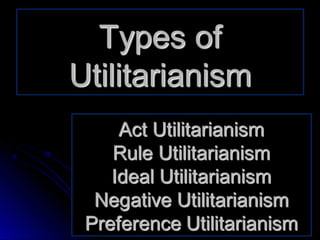
Utilitarianism and its Types
Utilitarianism and its Types
Article relate to Utilitarianism
Article relate to Utilitarianism
Theory applying Utilitarianism
Theory applying Utilitarianism
in research studies
in research studies
Utilitarianism
Utilitarianism
Utilitarianism is a universal teleological
system.
system.
It calls for the maximization of
goodness in society.
It asks for the greatest amount of
goodness for the greatest number of
people.
people.
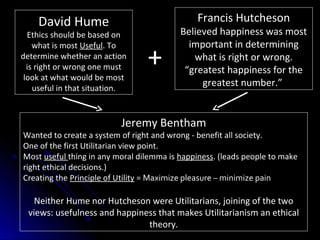
David Hume
Ethics should be based on
what is most Useful. To
determine whether an action
is right or wrong one must
look at what would be most
useful in that situation.
Francis Hutcheson
Believed happiness was most
important in determining
what is right or wrong.
“greatest happiness for the
greatest number.”
Jeremy Bentham
Wanted to create a system of right and wrong - benefit all society.
One of the first Utilitarian view point.
Most useful thing in any moral dilemma is happiness. (leads people to make
right ethical decisions.)
Creating the Principle of Utility = Maximize pleasure – minimize pain
Neither Hume nor Hutcheson were Utilitarians, joining of the two
views: usefulness and happiness that makes Utilitarianism an ethical
theory.
+
Making Ethical Judgments in
Utilitarianism
Utilitarianism
 Utilitarianism says that the
Utilitarianism says that the Result
Result or the
or the
Consequence
Consequence of an Act is the real
of an Act is the real
measure of whether it is good or bad.
 This theory emphasizes
This theory emphasizes Ends over
Ends over
Means.
Means.
 Theories, like this one, that emphasize
Theories, like this one, that emphasize
the results or consequences are called
teleological
teleological or
or consequentialist
consequentialist.
.
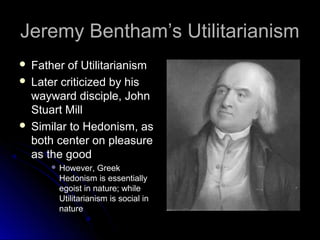
Jeremy Bentham’s Utilitarianism
 Father of Utilitarianism
Father of Utilitarianism
 Later criticized by his
Later criticized by his
wayward disciple, John
Stuart Mill
Stuart Mill
 Similar to Hedonism, as
Similar to Hedonism, as
both center on pleasure
as the good
as the good
 However, Greek
However, Greek
Hedonism is essentially
egoist in nature; while
Utilitarianism is social in
nature
nature
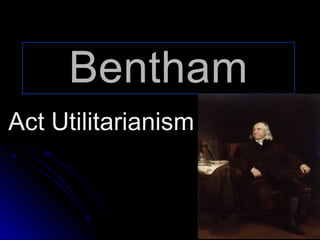
 Act-utilitarianism: An act is right if and
Act-utilitarianism: An act is right if and
only if it results in as much good as any
available.
available.
 Looks at the consequences of an action
Looks at the consequences of an action
 Apply Hedonic Calculus to every act to
Apply Hedonic Calculus to every act to
work out if it will maximise pleasure
minimise pain.
minimise pain.
 Strong
Strong: Bentham following one principle –
: Bentham following one principle –
Principle of Utility. Must be adhered to
without exception.
without exception.
Bentham
Bentham
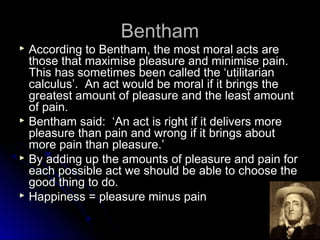
 According to Bentham, the most moral acts are
According to Bentham, the most moral acts are
those that maximise pleasure and minimise pain.
This has sometimes been called the ‘utilitarian
calculus’. An act would be moral if it brings the
greatest amount of pleasure and the least amount
of pain.
of pain.
 Bentham said: ‘An act is right if it delivers more
Bentham said: ‘An act is right if it delivers more
pleasure than pain and wrong if it brings about
more pain than pleasure.’
 By adding up the amounts of pleasure and pain for
By adding up the amounts of pleasure and pain for
each possible act we should be able to choose the
good thing to do.
good thing to do.
 Happiness = pleasure minus pain
Happiness = pleasure minus pain
Bentham’s Calculus of Felicity
 Like Hobbes, Bentham assumes that we humans
Like Hobbes, Bentham assumes that we humans
are all governed by the desire for pleasure and the
aversion to pain. He seeks to give advice on how
one should pursue the goal of pleasure.
 However unlike Hobbes, he did not rule out the possibility of
However unlike Hobbes, he did not rule out the possibility of
altruism
altruism
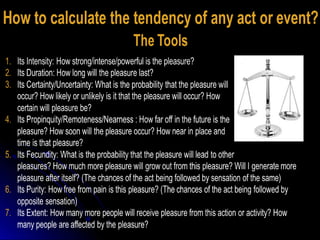
 His advice on pursuing pleasure is called the
His advice on pursuing pleasure is called the
Calculus of Felicity
Calculus of Felicity, made up of seven
, made up of seven
categories intended to provide a rational analysis
of pleasure. Whenever one considers performing
any action one can analyze its value in terms of
the Calculus of Felicity and contrast it with
alternatives
alternatives
Bentham’s Calculus of Felicity
 Bentham believed that his
Bentham believed that his Calculus of Felicity
Calculus of Felicity was
was
actually the schematization of something we do
semiconsciously anyway
 The 7
The 7th
th
category allows for altruism: if an act will bring
a great amount of happiness to a great number of
people, then I should perform it, regardless of whether
or not it brings misery to me.
 In fact, there is even a democratic bias built into it. When it
In fact, there is even a democratic bias built into it. When it
comes to evaluating acts, Bentham subscribes to the “one
person, one vote” principle
 To quote Bentham, “Prejudice apart, the game of
To quote Bentham, “Prejudice apart, the game of
push-pin is of equal value with the arts and sciences of
music and poetry. If the game of push-pin furnishes
more pleasure, it is more valuable than either.”
Application of Utilitarian Theory
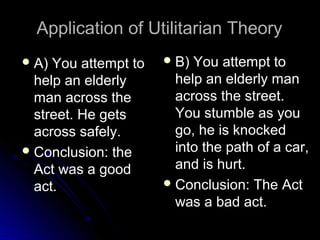
 A) You attempt to
A) You attempt to
help an elderly
help an elderly
man across the
man across the
street. He gets
street. He gets
across safely.
across safely.
 Conclusion: the
Conclusion: the
Act was a good
Act was a good
act.
act.
 B) You attempt to
B) You attempt to
help an elderly man
help an elderly man
across the street.
across the street.
You stumble as you
You stumble as you
go, he is knocked
go, he is knocked
into the path of a car,
and is hurt.
and is hurt.
 Conclusion: The Act
Conclusion: The Act
was a bad act.
was a bad act.
Application of Utilitarian Theory
 If you can use eighty soldiers as a bait in
If you can use eighty soldiers as a bait in
war, and thereby attack an enemy force
and kill several hundred enemy soldiers,
that is a morally good choice even though
the eighty might be lost.
 If lying will actually bring about more
If lying will actually bring about more
happiness and/or reduce pain, Act
Utilitarianism says we
Utilitarianism says we should
should lie in those
lie in those
cases.
cases.
Act Utilitarianism
Act Utilitarianism
 What would be the problems if everyone
What would be the problems if everyone
acted as an Act Utilitarian all the time?
 Are all actions only good because they
Are all actions only good because they
have good results?
have good results?
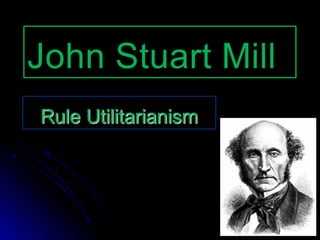
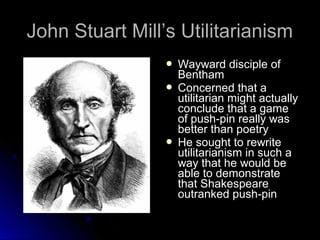
John Stuart Mill’s Utilitarianism
 Wayward disciple of
Wayward disciple of
Bentham
Bentham
 Concerned that a
Concerned that a
utilitarian might actually
conclude that a game
of push-pin really was
better than poetry
better than poetry
 He sought to rewrite
He sought to rewrite
utilitarianism in such a
way that he would be
able to demonstrate
able to demonstrate
that Shakespeare
that Shakespeare
outranked push-pin
outranked push-pin
Rule-utilitarianism
Rule-utilitarianism
 Rule-utilitarianism: An act is right if it
Rule-utilitarianism: An act is right if it
conforms to a valid rule within a system of
rules whose acceptance leads to greater
utility for society.
• applied Universally across societies to
applied Universally across societies to
promote happiness
promote happiness
• These rules should not be broken as they
These rules should not be broken as they
are the basis of morality.
• Mill was a
Mill was a Weak
Weak Rule Utilitarian
Rule Utilitarian
• He believed that the rules sometimes need
He believed that the rules sometimes need
to be broken in
to be broken in extreme
extreme situations.
situations.
J. S. Mill’s Utilitarianism
 Part of the problem, according to Mill, is the
Part of the problem, according to Mill, is the
Calculus
Calculus generates a purely quantitative analysis,
generates a purely quantitative analysis,
and pays no attention to the “quality” of the
pleasure
pleasure
 Mill feared that over time, the
Mill feared that over time, the Calculus of Felicity
Calculus of Felicity would gradually
would gradually
erode culture, leaving behind a society of belching, beer-swilling
Nascar enthusiasts
Nascar enthusiasts
 In order to combat this “lowering” of culture, Mill
In order to combat this “lowering” of culture, Mill
differentiated between “lower desires” and “higher
desires”
desires”
 Lower desires (food, sleep, etc.) may be dealt with using the
Lower desires (food, sleep, etc.) may be dealt with using the
Calculus
Calculus
 Higher desires, on the other hand, may only be discussed in
Higher desires, on the other hand, may only be discussed in
terms of quality – which Mill claimed no calculus could evaluate
Application of Utilitarian Theory
Actual Cases
Actual Cases
The Ford Pinto case: A defective vehicle
The Ford Pinto case: A defective vehicle
would sometimes explode when hit.
The model was not recalled and repaired by
The model was not recalled and repaired by
Ford because they felt it was cheaper to pay
the liability suits than to recall and repair all
the defective cars.
the defective cars.
John Stuart Mill ( 1806-1873) had some problems with
Bentham's Utilitarian arguments:
1.
1. The hedonic calculus attempts to
The hedonic calculus attempts to quantify
quantify happiness, is
happiness, is
this possible? Hard to apply when faced with an
immediate ethical dilemma.
2.
2. Bentham's utilitarian argument is
Bentham's utilitarian argument is teleological
teleological =
=
accurately predicting the consequences of an action. Not
always possible.
always possible.
3.
3. What counts as pleasure? One person’s
What counts as pleasure? One person’s pleasure
pleasure is
is
another's
another's pain
pain.
.
4.
4. Does not distinguish between
Does not distinguish between different sorts
different sorts of pleasures
of pleasures
or give them a rank order
5.
5. What about
What about minorities
minorities?
?
6.
6. The emphasis on
The emphasis on pleasure
pleasure Mill saw little more than
Mill saw little more than
animal instincts
animal instincts e.g. sex, food, drink
e.g. sex, food, drink
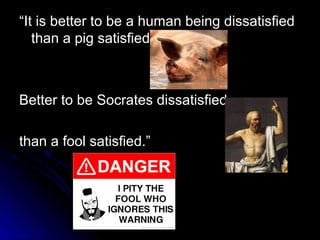
“
“It is better to be a human being dissatisfied
It is better to be a human being dissatisfied
than a pig satisfied:
Better to be Socrates dissatisfied
than a fool satisfied.”
Altruism
Altruism
 Altruism (unselfishness/ love for others) was very
important to Mill
So he produced his Principle of Utility:
1.
1. Happiness is desirable.
Happiness is desirable.
2.
2. Happiness only thing desirable as an end in itself.
Happiness only thing desirable as an end in itself.
3.
3. General happiness of all is desirable.
General happiness of all is desirable. Increase
Increase
happiness of others increases your own.
Also made links to Jesus’ Golden Rule: “To do as one
would be done by, and to love one’s neighbour as
oneself, constitutes the ideal perfection of Utilitarian
morality.” Mill
morality.” Mill
(Why is Mill linking Utilitarianism with Christianity?)
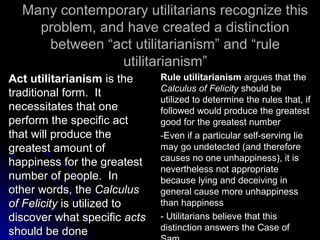
Many contemporary utilitarians recognize this
problem, and have created a distinction
between “act utilitarianism” and “rule
utilitarianism”
utilitarianism”
Act utilitarianism
Act utilitarianism is the
is the
traditional form. It
necessitates that one
perform the specific act
that will produce the
greatest amount of
greatest amount of
happiness for the greatest
number of people. In
other words, the
other words, the Calculus
Calculus
of Felicity
of Felicity is utilized to
is utilized to
discover what specific
discover what specific acts
acts
should be done
should be done
Rule utilitarianism
Rule utilitarianism argues that the
argues that the
Calculus of Felicity
Calculus of Felicity should be
should be
utilized to determine the rules that, if
followed would produce the greatest
good for the greatest number
-Even if a particular self-serving lie
may go undetected (and therefore
causes no one unhappiness), it is
nevertheless not appropriate
because lying and deceiving in
general cause more unhappiness
than happiness
than happiness
- Utilitarians believe that this
distinction answers the Case of
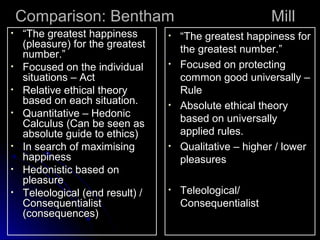
Comparison: Bentham
Comparison: Bentham Mill
Mill
• “
“The greatest happiness
The greatest happiness
(pleasure) for the greatest
number.”
number.”
• Focused on the individual
Focused on the individual
situations – Act
situations – Act
• Relative ethical theory
Relative ethical theory
based on each situation.
• Quantitative – Hedonic
Quantitative – Hedonic
Calculus (Can be seen as
absolute guide to ethics)
• In search of maximising
In search of maximising
happiness
happiness
• Hedonistic based on
Hedonistic based on
pleasure
pleasure
• Teleological (end result) /
Teleological (end result) /
Consequentialist
Consequentialist
(consequences)
(consequences)
• “
“The greatest happiness for
The greatest happiness for
the greatest number.”
• Focused on protecting
Focused on protecting
common good universally –
Rule
Rule
• Absolute ethical theory
Absolute ethical theory
based on universally
applied rules.
applied rules.
• Qualitative – higher / lower
Qualitative – higher / lower
pleasures
pleasures
• Teleological/
Teleological/
Consequentialist
Consequentialist
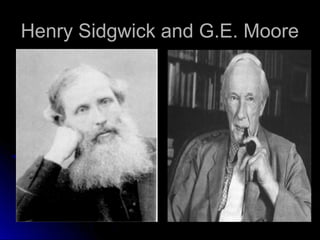
Henry Sidgwick and G.E. Moore
Ideal Utilitarianism
 A Utilitarian theory which denies that the sole object
A Utilitarian theory which denies that the sole object
of moral concern is the maximising of pleasure or
happiness.
happiness.
 In G.E. Moore’s version of Ideal Utilitarianism in
In G.E. Moore’s version of Ideal Utilitarianism in
Principia Ethica
Principia Ethica 1903, it is aesthetic experiences
1903, it is aesthetic experiences
and relations of friendship that have intrinsic value,
and therefore ought to be sought and promoted.
 Consciousness of pain, hatred or contempt of what
Consciousness of pain, hatred or contempt of what
is good or beautiful, and the love, admiration or
enjoyment of what is evil or ugly are the three
things that have intrinsic disvalue and should
therefore be shunned and prevented.
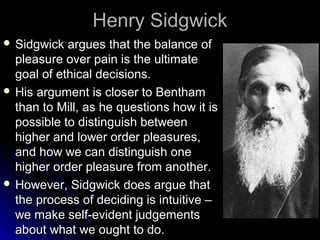
Henry Sidgwick
Henry Sidgwick
 Sidgwick argues that the balance of
Sidgwick argues that the balance of
pleasure over pain is the ultimate
goal of ethical decisions.
 His argument is closer to Bentham
His argument is closer to Bentham
than to Mill, as he questions how it is
possible to distinguish between
higher and lower order pleasures,
and how we can distinguish one
higher order pleasure from another.
 However, Sidgwick does argue that
However, Sidgwick does argue that
the process of deciding is intuitive –
we make self-evident judgements
about what we ought to do.
Henry Sidgwick
Henry Sidgwick
 He argued that justice is the similar and injustice
He argued that justice is the similar and injustice
the dissimilar treatment of similar cases: ‘whatever
action any of us judges to be right for himself, he
implicitly judges to be right for all similar persons in
similar circumstances’.
 So it is wrong for person A to treat person B in a
So it is wrong for person A to treat person B in a
way in which it would be wrong for B to treat A,
simply on the grounds that they are two different
individuals and without there being any difference
in their circumstances or their natures.
 Saying that people must act according to just laws
Saying that people must act according to just laws
raises the issue of which laws are just and sits
uncomfortably with the principle of utility and the
Act Utilitarian position.
Ideal Utilitarianism
 A Utilitarian theory which denies that the
A Utilitarian theory which denies that the
sole object of moral concern is the
maximising of pleasure or happiness.
 In G.E. Moore’s version of Ideal
In G.E. Moore’s version of Ideal
Utilitarianism in
Utilitarianism in Principia Ethica
Principia Ethica 1903, it is
1903, it is
aesthetic experiences and relations of
friendship that have intrinsic value, and
therefore ought to be sought and promoted.
 Consciousness of pain, hatred or contempt
Consciousness of pain, hatred or contempt
of what is good or beautiful, and the love,
admiration or enjoyment of what is evil or
ugly are the three things that have intrinsic
disvalue and should therefore be shunned
and prevented.
and prevented.
Negative Utilitarianism
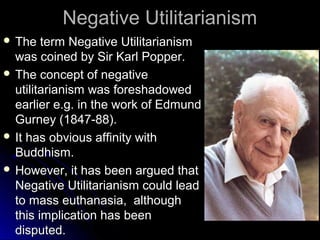
 The term Negative Utilitarianism
The term Negative Utilitarianism
was coined by Sir Karl Popper.
 The concept of negative
The concept of negative
utilitarianism was foreshadowed
earlier e.g. in the work of Edmund
Gurney (1847-88).
Gurney (1847-88).
 It has obvious affinity with
It has obvious affinity with
Buddhism.
Buddhism.
 However, it has been argued that
However, it has been argued that
Negative Utilitarianism could lead
to mass euthanasia, although
this implication has been
disputed.
disputed.
Negative Utilitarianism
 Popper’s ‘negative utilitarian’ principle is
Popper’s ‘negative utilitarian’ principle is
that we should act to minimise suffering
rather than maximise pleasure.
 Classical utilitarian philosophers such as
Classical utilitarian philosophers such as
Sidgwick had explicitly argued for the
moral symmetry of happiness and
suffering.
suffering.
 Complications aside, they supposed that
Complications aside, they supposed that
increases in happiness, and reductions in
suffering, are essentially of equal value
when of equal magnitude.
Negative Utilitarianism
 Popper disagreed.
Popper disagreed.
 He believed that the practical consequences of
He believed that the practical consequences of
the supposed moral symmetry were also
dangerous.
dangerous.
 “
“Philosophers should consider the fact that the
Philosophers should consider the fact that the
greatest happiness principle can easily be made
an excuse for a benevolent dictatorship. We
should replace it by a more modest and more
realistic principle: the principle that the fight
against avoidable misery should be a recognized
aim of public policy, while the increase of
happiness should be left, in the main, to private
Negative Utilitarianism
 “
“I believe that there is, from the ethical point of view,
I believe that there is, from the ethical point of view,
no symmetry between suffering and happiness, or
between pain and pleasure.
 Both the greatest happiness principle of the
Both the greatest happiness principle of the
Utilitarians and Kant’s principle, promote other
people’s happiness..., [and] seem to me (at least in
their formulations) fundamentally wrong in this point,
which is, however, not one for rational argument....
 In my opinion... human suffering makes a direct
In my opinion... human suffering makes a direct
moral appeal for help, while there is no similar call to
increase the happiness of a man who is doing well
anyway.”
anyway.”
 Karl Popper (
Karl Popper (The Open Society and Its Enemies
The Open Society and Its Enemies,
,
1952)
1952)
Negative Utilitarianism
 Popper believed that by acting to minimise
Popper believed that by acting to minimise
suffering, we avoid the terrible risks of
‘utopianism’, by which he had in mind the
communist and fascist dictatorships of the
twentieth century.
twentieth century.
“
“Those who promise us paradise on earth
Those who promise us paradise on earth
never produced anything but a hell.”
 A staunch advocate of the ‘open society’,
A staunch advocate of the ‘open society’,
Popper defended ‘piecemeal social
engineering’ rather than grandiose state
planning.
planning.
Negative Utilitarianism
 Ironically, the full realisation of a negative
Ironically, the full realisation of a negative
utilitarian ethic depends inescapably on the
‘utopian’ planning that Popper abhorred.
 Only a global bio-engineering project of
Only a global bio-engineering project of
unparalleled ambition could bring about the
eradication of suffering throughout the living
world - not piecemeal social engineering.
 In seeking to liberate the world from the tyranny
In seeking to liberate the world from the tyranny
of pain, Negative Utilitarianism is no less
‘totalitarian’ in its policy implications than
communism or fascism, albeit vastly more
compassionate.
compassionate.
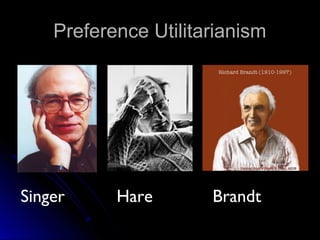
Preference Utilitarianism
Singer Hare Brandt
Preference Utilitarianism
 An Act Utilitarian judges right or wrong according to
An Act Utilitarian judges right or wrong according to
the maximising of pleasure and minimising of pain.
 A Rule Utilitarian judges right or wrong according to
A Rule Utilitarian judges right or wrong according to
the keeping of rules derived from utility.
 A Preference (or Interest) Utilitarian judges moral
A Preference (or Interest) Utilitarian judges moral
actions according to whether they fit in with the
preferences of the individuals involved. This
approach to Utilitarianism asks:
 What is in my own interest? What would I prefer in this
What is in my own interest? What would I prefer in this
situation? Which outcome would I prefer?’ However,
because Utilitarianism aims to create the greatest good
for the greatest number, it is necessary to consider the
preferences of others in order to achieve this.
Preference Utilitarianism
R. M. Hare (1919-2002) – taught Peter Singer
 Need to consider our own preferences + those of
Need to consider our own preferences + those of
others.
others.
 Need to “
Need to “stand in someone else’s shoes
stand in someone else’s shoes” and
” and
try to imagine what someone else might prefer –
universally
universally
 What would I prefer in this situation?’
What would I prefer in this situation?’
 However, remember that it is a Utilitarian argument so
However, remember that it is a Utilitarian argument so
aims to create greatest good for greatest number so is
necessary to consider the preferences of others in order
to achieve this.
to achieve this.
He says that “ equal
preferences count equally,
whatever their content.”
Peter Singer
Peter Singer
“
“Our preferences cannot count any more than the
Our preferences cannot count any more than the
preferences of others” + equal value
 Focus on 7
Focus on 7th
th
stage of HC – number of people affected.
 Everyone’s individual preferences must be taken into
Everyone’s individual preferences must be taken into
consideration when deciding what was in the best
interest of the group – “
interest of the group – “act as an impartial spectator
act as an impartial spectator.”
.”
 So in Singer’s view, killing a person who prefers to go
So in Singer’s view, killing a person who prefers to go
on living would be wrong and not killing a person who
prefers to die would also be wrong.
 Singer’s approach to Utilitarianism is to minimise
Singer’s approach to Utilitarianism is to minimise
suffering rather than maximise pleasure.
 Far greater agreement about what causes pain that
Far greater agreement about what causes pain that
what gives pleasure.
 Pleasure is more subjective to individuals than pain.
Pleasure is more subjective to individuals than pain.
Richard Brandt
Richard Brandt
 Richard Brandt talks about the preferences
Richard Brandt talks about the preferences
someone would have if they had gone through a
process of cognitive psychotherapy and explored
all the reasons for their preferences and rejected
any they felt were not true to their real values.
 He argued that the morality someone would then
He argued that the morality someone would then
accept would be a form of Utilitarianism – with
their preferences free from any psychological
blocks and them in full possession of all the facts.
 Such a person would not, therefore, be influenced
Such a person would not, therefore, be influenced
by advertising.
by advertising.
Article and Theory
Article and Theory
relate to
relate to
Utilitarianism
Utilitarianism
Questions:
Questions:
Suppose a surgeon could use the
Suppose a surgeon could use the
organs of one healthy patient to save
the lives of several others. Would the
surgeon be justified in killing the
healthy patient for the sake of the
others?
others?
Does the Center Hold: The Case of
Sam (Donald Palmer,)
“
“Sam, a basically normal, rather nondescript but ‘nice’ human being,
Sam, a basically normal, rather nondescript but ‘nice’ human being,
goes to the hospital to visit his only living relative, his senile, sick
aunt. His visit coincides with five medical emergencies at the
hospital. One person needs a liver transplant, another a spleen
transplant, another a lung transplant, another a new heart, and a fifth
a new pineal gland. Each of the five patients is a tremendously
important, much-loved person whose death would bring a great deal
of grief and actual physical discomfort to a great number of people.
Sam’s death, on the other hand, would be mourned by no one (except
possibly his aunt in her lucid moments). The top members of the
hospital administration, all strict utilitarians, lure Sam into an
operating room, remove all his vital organs, and distribute them to the
other needy patients, thereby operating (literally) in accordance with
the principle of utility: the greatest amount of happiness for the
greatest number of people.” Donald Palmer,
greatest number of people.” Donald Palmer, Does the Center Hold
Does the Center Hold,
,
pg. 270-71
pg. 270-71
Can we used the three brain-
damaged infants so we could
remove their hearts for
transplantation into three other
infants who suffered from severe
heart problems?
Pure Utilitarianism: Doctors Justifying Killing Infant Patients for Organ Donation
By Hilary White
LONDON, August 28, 2008 (LifeSiteNews.com) - "Very few people," says the head of Britain’s leading pro-
life organization, "realize that the pro-abortion and pro-euthanasia lobby believes it can be right intentionally
to kill innocent human beings." John Smeaton, Director of the Society for the Protection of Unborn Children,
wrote that a report by a group of scientists, published in the New England Journal of Medicine (NEJM),that
said doctors should be able to remove organs from patients, even if this would cause the patient’s death.
"The essential line taken by the paper’s authors is that it really doesn’t matter whether the patient is dead or
not." Smeaton wrote, "This new, further slide down the slippery slope of anti-life thinking is truly disturbing."
In the paper, heart transplant surgeons described how they simply "modified" the definition of death for
three brain-damaged infants so they could justify removing their hearts for transplantation into three other
infants who suffered from severe heart problems.
Two bioethicists, Robert Truog and Franklin Miller, made the case that it is "perfectly ethical" to remove
organs from patients who are not really or convincingly dead.
They said, "whether death occurs as the result of ventilator withdrawal or organ procurement, the ethically
relevant precondition is valid consent by the patient or surrogate. With such consent, there is no harm or
wrong done in retrieving vital organs before death, provided that anaesthesia is administered."
SPUC commissioned the Southern Cross Bioethics Institute (SCBI) to examine the NEJM paper. SCBI
concluded that the authors are utilitarians for whom the only ethical consideration is whether such patients
have given "informed consent". The SCBI report concluded that Truog and Miller are asserting that the
ultimate outcome of such organ transplant operations, "is really so good that traditionally unethical means
can be justified".
SCBI explains that the two new definitions of death, "brain death" and "cardiac death", widely adopted by
the medical community, are merely manipulations of language devised to make organs available from living
patients.
"Truog and Miller," the SCBI report says, "think the concept of brain death has ‘served us well’ because
without it, procuring organs would not happen and so organs for transplantation would be scarce. Rather
than the concept being right, they instead consider ‘being served well’ to be what counts."
Read related LifeSiteNews.com coverage: New England Journal of Medicine: ‘Brain Death’ is not Death -
Organ Donors are Alive http://www.lifesitenews.com/ldn/2008/aug/08081406.html
 You are an army officer who has just
You are an army officer who has just
captured an enemy soldier who knows
where a secret time bomb is planted. If it
explodes it will kill thousands. Will it be
morally permissible to torture the soldier
so that he reveals the bomb’s location? If
you knew where the soldier’s children
were, would it also be permissible to
torture them to get him to reveal the
bomb’s whereabouts?
bomb’s whereabouts?
 You are an army officer who has just
You are an army officer who has just
captured an enemy soldier who knows
where a secret time bomb is planted. If it
explodes it will kill thousands. Will it be
morally permissible to torture the soldier
so that he reveals the bomb’s location? If
you knew where the soldier’s children
were, would it also be permissible to
torture them to get him to reveal the
bomb’s whereabouts?
bomb’s whereabouts?
there are five railway workmen in the
path of a runaway carriage. The men
will surely be killed unless a bystander
does something. Next to him is a big,
heavy stranger. He’s informed that his
own body would be too light to stop the
train, but that if he pushes the stranger
onto the tracks, the stranger's large
body will stop the train and save the five
lives. That, unfortunately, would kill the
stranger.
Beating a retreat by: Dr. Bartels and Dr. Pizarro
One of the classic techniques used to measure a person's willingness to behave in a
utilitarian way is known as trolleyology. The subject of the study is challenged with thought
experiments involving a runaway railway trolley or train carriage. All involve choices, each of
which leads to people's deaths. For example: there are five railway workmen in the path of a
runaway carriage. The men will surely be killed unless the subject of the experiment, a
bystander in the story, does something. The subject is told he is on a bridge over the tracks.
Next to him is a big, heavy stranger. The subject is informed that his own body would be too
light to stop the train, but that if he pushes the stranger onto the tracks, the stranger's large
body will stop the train and save the five lives. That, unfortunately, would kill the stranger.
Dr. Bartels and Dr. Pizarro knew from previous research that around 90% of people refuse
the utilitarian act of killing one individual to save five. What no one had previously inquired
about, though, was the nature of the remaining 10%.
Dr. Bartels and Dr. Pizarro then correlated the results from the trolleyology with those from
the personality tests. They found a strong link between utilitarian answers to moral dilemmas
(push the fat guy off the bridge) and personalities that were psychopathic, Machiavellian or
tended to view life as meaningless. Utilitarians, this suggests, may add to the sum of human
happiness, but they are not very happy people themselves.
That does not make utilitarianism wrong. Crafting legislation—one of the main things that
Bentham and Mill wanted to improve—inevitably involves riding roughshod over someone's
interests. Utilitarianism provides a plausible framework for deciding who should get trampled.
The results obtained by Dr Bartels and Dr Pizarro do, though, raise questions about the type
of people who you want making the laws. Psychopathic, Machiavellian misanthropes?
Apparently, yes.
HTTPS://ITHINKTHEREFOREITEA
Thank You!!!
Thank You!!!
If you would like further information
please follow the link below :

maed-utilitarianism-161129015812.pdffffff

  • 1.
    By: Rose FeM. Wamar By: Rose Fe M. Wamar MAEd-Educ.Mngt. MAEd-Educ.Mngt.
  • 2.
    Structure of Discussion Structureof Discussion Utilitarianism and its Types Utilitarianism and its Types Article relate to Utilitarianism Article relate to Utilitarianism Theory applying Utilitarianism Theory applying Utilitarianism in research studies in research studies
  • 3.
    Utilitarianism Utilitarianism Utilitarianism is auniversal teleological Utilitarianism is a universal teleological system. system. It calls for the maximization of It calls for the maximization of goodness in society. goodness in society. It asks for the greatest amount of It asks for the greatest amount of goodness for the greatest number of goodness for the greatest number of people. people.
  • 4.
    David Hume Ethics shouldbe based on what is most Useful. To determine whether an action is right or wrong one must look at what would be most useful in that situation. Francis Hutcheson Believed happiness was most important in determining what is right or wrong. “greatest happiness for the greatest number.” Jeremy Bentham Wanted to create a system of right and wrong - benefit all society. One of the first Utilitarian view point. Most useful thing in any moral dilemma is happiness. (leads people to make right ethical decisions.) Creating the Principle of Utility = Maximize pleasure – minimize pain Neither Hume nor Hutcheson were Utilitarians, joining of the two views: usefulness and happiness that makes Utilitarianism an ethical theory. +
  • 6.
    Making Ethical Judgmentsin Making Ethical Judgments in Utilitarianism Utilitarianism  Utilitarianism says that the Utilitarianism says that the Result Result or the or the Consequence Consequence of an Act is the real of an Act is the real measure of whether it is good or bad. measure of whether it is good or bad.  This theory emphasizes This theory emphasizes Ends over Ends over Means. Means.  Theories, like this one, that emphasize Theories, like this one, that emphasize the results or consequences are called the results or consequences are called teleological teleological or or consequentialist consequentialist. .
  • 8.
    Jeremy Bentham’s Utilitarianism JeremyBentham’s Utilitarianism  Father of Utilitarianism Father of Utilitarianism  Later criticized by his Later criticized by his wayward disciple, John wayward disciple, John Stuart Mill Stuart Mill  Similar to Hedonism, as Similar to Hedonism, as both center on pleasure both center on pleasure as the good as the good  However, Greek However, Greek Hedonism is essentially Hedonism is essentially egoist in nature; while egoist in nature; while Utilitarianism is social in Utilitarianism is social in nature nature
  • 9.
     Act-utilitarianism: Anact is right if and Act-utilitarianism: An act is right if and only if it results in as much good as any only if it results in as much good as any available. available.  Looks at the consequences of an action Looks at the consequences of an action  Apply Hedonic Calculus to every act to Apply Hedonic Calculus to every act to work out if it will maximise pleasure work out if it will maximise pleasure minimise pain. minimise pain.  Strong Strong: Bentham following one principle – : Bentham following one principle – Principle of Utility. Must be adhered to Principle of Utility. Must be adhered to without exception. without exception.
  • 10.
    Bentham Bentham  According toBentham, the most moral acts are According to Bentham, the most moral acts are those that maximise pleasure and minimise pain. those that maximise pleasure and minimise pain. This has sometimes been called the ‘utilitarian This has sometimes been called the ‘utilitarian calculus’. An act would be moral if it brings the calculus’. An act would be moral if it brings the greatest amount of pleasure and the least amount greatest amount of pleasure and the least amount of pain. of pain.  Bentham said: ‘An act is right if it delivers more Bentham said: ‘An act is right if it delivers more pleasure than pain and wrong if it brings about pleasure than pain and wrong if it brings about more pain than pleasure.’ more pain than pleasure.’  By adding up the amounts of pleasure and pain for By adding up the amounts of pleasure and pain for each possible act we should be able to choose the each possible act we should be able to choose the good thing to do. good thing to do.  Happiness = pleasure minus pain Happiness = pleasure minus pain
  • 11.
    Bentham’s Calculus ofFelicity Bentham’s Calculus of Felicity  Like Hobbes, Bentham assumes that we humans Like Hobbes, Bentham assumes that we humans are all governed by the desire for pleasure and the are all governed by the desire for pleasure and the aversion to pain. He seeks to give advice on how aversion to pain. He seeks to give advice on how one should pursue the goal of pleasure. one should pursue the goal of pleasure.  However unlike Hobbes, he did not rule out the possibility of However unlike Hobbes, he did not rule out the possibility of altruism altruism  His advice on pursuing pleasure is called the His advice on pursuing pleasure is called the Calculus of Felicity Calculus of Felicity, made up of seven , made up of seven categories intended to provide a rational analysis categories intended to provide a rational analysis of pleasure. Whenever one considers performing of pleasure. Whenever one considers performing any action one can analyze its value in terms of any action one can analyze its value in terms of the Calculus of Felicity and contrast it with the Calculus of Felicity and contrast it with alternatives alternatives
  • 12.
    Bentham’s Calculus ofFelicity Bentham’s Calculus of Felicity  Bentham believed that his Bentham believed that his Calculus of Felicity Calculus of Felicity was was actually the schematization of something we do actually the schematization of something we do semiconsciously anyway semiconsciously anyway  The 7 The 7th th category allows for altruism: if an act will bring category allows for altruism: if an act will bring a great amount of happiness to a great number of a great amount of happiness to a great number of people, then I should perform it, regardless of whether people, then I should perform it, regardless of whether or not it brings misery to me. or not it brings misery to me.  In fact, there is even a democratic bias built into it. When it In fact, there is even a democratic bias built into it. When it comes to evaluating acts, Bentham subscribes to the “one comes to evaluating acts, Bentham subscribes to the “one person, one vote” principle person, one vote” principle  To quote Bentham, “Prejudice apart, the game of To quote Bentham, “Prejudice apart, the game of push-pin is of equal value with the arts and sciences of push-pin is of equal value with the arts and sciences of music and poetry. If the game of push-pin furnishes music and poetry. If the game of push-pin furnishes more pleasure, it is more valuable than either.” more pleasure, it is more valuable than either.”
  • 13.
    Application of UtilitarianTheory Application of Utilitarian Theory  A) You attempt to A) You attempt to help an elderly help an elderly man across the man across the street. He gets street. He gets across safely. across safely.  Conclusion: the Conclusion: the Act was a good Act was a good act. act.  B) You attempt to B) You attempt to help an elderly man help an elderly man across the street. across the street. You stumble as you You stumble as you go, he is knocked go, he is knocked into the path of a car, into the path of a car, and is hurt. and is hurt.  Conclusion: The Act Conclusion: The Act was a bad act. was a bad act.
  • 15.
    Application of UtilitarianTheory Application of Utilitarian Theory  If you can use eighty soldiers as a bait in If you can use eighty soldiers as a bait in war, and thereby attack an enemy force war, and thereby attack an enemy force and kill several hundred enemy soldiers, and kill several hundred enemy soldiers, that is a morally good choice even though that is a morally good choice even though the eighty might be lost. the eighty might be lost.  If lying will actually bring about more If lying will actually bring about more happiness and/or reduce pain, Act happiness and/or reduce pain, Act Utilitarianism says we Utilitarianism says we should should lie in those lie in those cases. cases.
  • 16.
    Act Utilitarianism Act Utilitarianism What would be the problems if everyone What would be the problems if everyone acted as an Act Utilitarian all the time? acted as an Act Utilitarian all the time?  Are all actions only good because they Are all actions only good because they have good results? have good results?
  • 18.
    John Stuart Mill’sUtilitarianism John Stuart Mill’s Utilitarianism  Wayward disciple of Wayward disciple of Bentham Bentham  Concerned that a Concerned that a utilitarian might actually utilitarian might actually conclude that a game conclude that a game of push-pin really was of push-pin really was better than poetry better than poetry  He sought to rewrite He sought to rewrite utilitarianism in such a utilitarianism in such a way that he would be way that he would be able to demonstrate able to demonstrate that Shakespeare that Shakespeare outranked push-pin outranked push-pin
  • 19.
    Rule-utilitarianism Rule-utilitarianism  Rule-utilitarianism: Anact is right if it Rule-utilitarianism: An act is right if it conforms to a valid rule within a system of conforms to a valid rule within a system of rules whose acceptance leads to greater rules whose acceptance leads to greater utility for society. utility for society. • applied Universally across societies to applied Universally across societies to promote happiness promote happiness • These rules should not be broken as they These rules should not be broken as they are the basis of morality. are the basis of morality. • Mill was a Mill was a Weak Weak Rule Utilitarian Rule Utilitarian • He believed that the rules sometimes need He believed that the rules sometimes need to be broken in to be broken in extreme extreme situations. situations.
  • 20.
    J. S. Mill’sUtilitarianism J. S. Mill’s Utilitarianism  Part of the problem, according to Mill, is the Part of the problem, according to Mill, is the Calculus Calculus generates a purely quantitative analysis, generates a purely quantitative analysis, and pays no attention to the “quality” of the and pays no attention to the “quality” of the pleasure pleasure  Mill feared that over time, the Mill feared that over time, the Calculus of Felicity Calculus of Felicity would gradually would gradually erode culture, leaving behind a society of belching, beer-swilling erode culture, leaving behind a society of belching, beer-swilling Nascar enthusiasts Nascar enthusiasts  In order to combat this “lowering” of culture, Mill In order to combat this “lowering” of culture, Mill differentiated between “lower desires” and “higher differentiated between “lower desires” and “higher desires” desires”  Lower desires (food, sleep, etc.) may be dealt with using the Lower desires (food, sleep, etc.) may be dealt with using the Calculus Calculus  Higher desires, on the other hand, may only be discussed in Higher desires, on the other hand, may only be discussed in terms of quality – which Mill claimed no calculus could evaluate terms of quality – which Mill claimed no calculus could evaluate
  • 21.
    Application of UtilitarianTheory Application of Utilitarian Theory Actual Cases Actual Cases The Ford Pinto case: A defective vehicle The Ford Pinto case: A defective vehicle would sometimes explode when hit. would sometimes explode when hit. The model was not recalled and repaired by The model was not recalled and repaired by Ford because they felt it was cheaper to pay Ford because they felt it was cheaper to pay the liability suits than to recall and repair all the liability suits than to recall and repair all the defective cars. the defective cars.
  • 22.
    John Stuart Mill( 1806-1873) had some problems with John Stuart Mill ( 1806-1873) had some problems with Bentham's Utilitarian arguments: Bentham's Utilitarian arguments: 1. 1. The hedonic calculus attempts to The hedonic calculus attempts to quantify quantify happiness, is happiness, is this possible? Hard to apply when faced with an this possible? Hard to apply when faced with an immediate ethical dilemma. immediate ethical dilemma. 2. 2. Bentham's utilitarian argument is Bentham's utilitarian argument is teleological teleological = = accurately predicting the consequences of an action. Not accurately predicting the consequences of an action. Not always possible. always possible. 3. 3. What counts as pleasure? One person’s What counts as pleasure? One person’s pleasure pleasure is is another's another's pain pain. . 4. 4. Does not distinguish between Does not distinguish between different sorts different sorts of pleasures of pleasures or give them a rank order or give them a rank order 5. 5. What about What about minorities minorities? ? 6. 6. The emphasis on The emphasis on pleasure pleasure Mill saw little more than Mill saw little more than animal instincts animal instincts e.g. sex, food, drink e.g. sex, food, drink
  • 23.
    “ “It is betterto be a human being dissatisfied It is better to be a human being dissatisfied than a pig satisfied: than a pig satisfied: Better to be Socrates dissatisfied Better to be Socrates dissatisfied than a fool satisfied.” than a fool satisfied.”
  • 24.
    Altruism Altruism  Altruism (unselfishness/love for others) was very important to Mill So he produced his Principle of Utility: So he produced his Principle of Utility: 1. 1. Happiness is desirable. Happiness is desirable. 2. 2. Happiness only thing desirable as an end in itself. Happiness only thing desirable as an end in itself. 3. 3. General happiness of all is desirable. General happiness of all is desirable. Increase Increase happiness of others increases your own. happiness of others increases your own. Also made links to Jesus’ Golden Rule: “To do as one Also made links to Jesus’ Golden Rule: “To do as one would be done by, and to love one’s neighbour as would be done by, and to love one’s neighbour as oneself, constitutes the ideal perfection of Utilitarian oneself, constitutes the ideal perfection of Utilitarian morality.” Mill morality.” Mill (Why is Mill linking Utilitarianism with Christianity?) (Why is Mill linking Utilitarianism with Christianity?)
  • 25.
    Many contemporary utilitariansrecognize this Many contemporary utilitarians recognize this problem, and have created a distinction problem, and have created a distinction between “act utilitarianism” and “rule between “act utilitarianism” and “rule utilitarianism” utilitarianism” Act utilitarianism Act utilitarianism is the is the traditional form. It traditional form. It necessitates that one necessitates that one perform the specific act perform the specific act that will produce the that will produce the greatest amount of greatest amount of happiness for the greatest happiness for the greatest number of people. In number of people. In other words, the other words, the Calculus Calculus of Felicity of Felicity is utilized to is utilized to discover what specific discover what specific acts acts should be done should be done Rule utilitarianism Rule utilitarianism argues that the argues that the Calculus of Felicity Calculus of Felicity should be should be utilized to determine the rules that, if utilized to determine the rules that, if followed would produce the greatest followed would produce the greatest good for the greatest number good for the greatest number -Even if a particular self-serving lie -Even if a particular self-serving lie may go undetected (and therefore may go undetected (and therefore causes no one unhappiness), it is causes no one unhappiness), it is nevertheless not appropriate nevertheless not appropriate because lying and deceiving in because lying and deceiving in general cause more unhappiness general cause more unhappiness than happiness than happiness - Utilitarians believe that this - Utilitarians believe that this distinction answers the Case of distinction answers the Case of
  • 26.
    Comparison: Bentham Comparison: BenthamMill Mill • “ “The greatest happiness The greatest happiness (pleasure) for the greatest (pleasure) for the greatest number.” number.” • Focused on the individual Focused on the individual situations – Act situations – Act • Relative ethical theory Relative ethical theory based on each situation. based on each situation. • Quantitative – Hedonic Quantitative – Hedonic Calculus (Can be seen as Calculus (Can be seen as absolute guide to ethics) absolute guide to ethics) • In search of maximising In search of maximising happiness happiness • Hedonistic based on Hedonistic based on pleasure pleasure • Teleological (end result) / Teleological (end result) / Consequentialist Consequentialist (consequences) (consequences) • “ “The greatest happiness for The greatest happiness for the greatest number.” the greatest number.” • Focused on protecting Focused on protecting common good universally – common good universally – Rule Rule • Absolute ethical theory Absolute ethical theory based on universally based on universally applied rules. applied rules. • Qualitative – higher / lower Qualitative – higher / lower pleasures pleasures • Teleological/ Teleological/ Consequentialist Consequentialist
  • 28.
    Henry Sidgwick andG.E. Moore Henry Sidgwick and G.E. Moore
  • 29.
    Ideal Utilitarianism Ideal Utilitarianism A Utilitarian theory which denies that the sole object A Utilitarian theory which denies that the sole object of moral concern is the maximising of pleasure or of moral concern is the maximising of pleasure or happiness. happiness.  In G.E. Moore’s version of Ideal Utilitarianism in In G.E. Moore’s version of Ideal Utilitarianism in Principia Ethica Principia Ethica 1903, it is aesthetic experiences 1903, it is aesthetic experiences and relations of friendship that have intrinsic value, and relations of friendship that have intrinsic value, and therefore ought to be sought and promoted. and therefore ought to be sought and promoted.  Consciousness of pain, hatred or contempt of what Consciousness of pain, hatred or contempt of what is good or beautiful, and the love, admiration or is good or beautiful, and the love, admiration or enjoyment of what is evil or ugly are the three enjoyment of what is evil or ugly are the three things that have intrinsic disvalue and should things that have intrinsic disvalue and should therefore be shunned and prevented. therefore be shunned and prevented.
  • 30.
    Henry Sidgwick Henry Sidgwick Sidgwick argues that the balance of Sidgwick argues that the balance of pleasure over pain is the ultimate pleasure over pain is the ultimate goal of ethical decisions. goal of ethical decisions.  His argument is closer to Bentham His argument is closer to Bentham than to Mill, as he questions how it is than to Mill, as he questions how it is possible to distinguish between possible to distinguish between higher and lower order pleasures, higher and lower order pleasures, and how we can distinguish one and how we can distinguish one higher order pleasure from another. higher order pleasure from another.  However, Sidgwick does argue that However, Sidgwick does argue that the process of deciding is intuitive – the process of deciding is intuitive – we make self-evident judgements we make self-evident judgements about what we ought to do. about what we ought to do.
  • 31.
    Henry Sidgwick Henry Sidgwick He argued that justice is the similar and injustice He argued that justice is the similar and injustice the dissimilar treatment of similar cases: ‘whatever the dissimilar treatment of similar cases: ‘whatever action any of us judges to be right for himself, he action any of us judges to be right for himself, he implicitly judges to be right for all similar persons in implicitly judges to be right for all similar persons in similar circumstances’. similar circumstances’.  So it is wrong for person A to treat person B in a So it is wrong for person A to treat person B in a way in which it would be wrong for B to treat A, way in which it would be wrong for B to treat A, simply on the grounds that they are two different simply on the grounds that they are two different individuals and without there being any difference individuals and without there being any difference in their circumstances or their natures. in their circumstances or their natures.  Saying that people must act according to just laws Saying that people must act according to just laws raises the issue of which laws are just and sits raises the issue of which laws are just and sits uncomfortably with the principle of utility and the uncomfortably with the principle of utility and the Act Utilitarian position. Act Utilitarian position.
  • 32.
    Ideal Utilitarianism Ideal Utilitarianism A Utilitarian theory which denies that the A Utilitarian theory which denies that the sole object of moral concern is the sole object of moral concern is the maximising of pleasure or happiness. maximising of pleasure or happiness.  In G.E. Moore’s version of Ideal In G.E. Moore’s version of Ideal Utilitarianism in Utilitarianism in Principia Ethica Principia Ethica 1903, it is 1903, it is aesthetic experiences and relations of aesthetic experiences and relations of friendship that have intrinsic value, and friendship that have intrinsic value, and therefore ought to be sought and promoted. therefore ought to be sought and promoted.  Consciousness of pain, hatred or contempt Consciousness of pain, hatred or contempt of what is good or beautiful, and the love, of what is good or beautiful, and the love, admiration or enjoyment of what is evil or admiration or enjoyment of what is evil or ugly are the three things that have intrinsic ugly are the three things that have intrinsic disvalue and should therefore be shunned disvalue and should therefore be shunned and prevented. and prevented.
  • 34.
    Negative Utilitarianism Negative Utilitarianism The term Negative Utilitarianism The term Negative Utilitarianism was coined by Sir Karl Popper. was coined by Sir Karl Popper.  The concept of negative The concept of negative utilitarianism was foreshadowed utilitarianism was foreshadowed earlier e.g. in the work of Edmund earlier e.g. in the work of Edmund Gurney (1847-88). Gurney (1847-88).  It has obvious affinity with It has obvious affinity with Buddhism. Buddhism.  However, it has been argued that However, it has been argued that Negative Utilitarianism could lead Negative Utilitarianism could lead to mass euthanasia, although to mass euthanasia, although this implication has been this implication has been disputed. disputed.
  • 35.
    Negative Utilitarianism Negative Utilitarianism Popper’s ‘negative utilitarian’ principle is Popper’s ‘negative utilitarian’ principle is that we should act to minimise suffering that we should act to minimise suffering rather than maximise pleasure. rather than maximise pleasure.  Classical utilitarian philosophers such as Classical utilitarian philosophers such as Sidgwick had explicitly argued for the Sidgwick had explicitly argued for the moral symmetry of happiness and moral symmetry of happiness and suffering. suffering.  Complications aside, they supposed that Complications aside, they supposed that increases in happiness, and reductions in increases in happiness, and reductions in suffering, are essentially of equal value suffering, are essentially of equal value when of equal magnitude. when of equal magnitude.
  • 36.
    Negative Utilitarianism Negative Utilitarianism Popper disagreed. Popper disagreed.  He believed that the practical consequences of He believed that the practical consequences of the supposed moral symmetry were also the supposed moral symmetry were also dangerous. dangerous.  “ “Philosophers should consider the fact that the Philosophers should consider the fact that the greatest happiness principle can easily be made greatest happiness principle can easily be made an excuse for a benevolent dictatorship. We an excuse for a benevolent dictatorship. We should replace it by a more modest and more should replace it by a more modest and more realistic principle: the principle that the fight realistic principle: the principle that the fight against avoidable misery should be a recognized against avoidable misery should be a recognized aim of public policy, while the increase of aim of public policy, while the increase of happiness should be left, in the main, to private happiness should be left, in the main, to private
  • 37.
    Negative Utilitarianism Negative Utilitarianism “ “I believe that there is, from the ethical point of view, I believe that there is, from the ethical point of view, no symmetry between suffering and happiness, or no symmetry between suffering and happiness, or between pain and pleasure. between pain and pleasure.  Both the greatest happiness principle of the Both the greatest happiness principle of the Utilitarians and Kant’s principle, promote other Utilitarians and Kant’s principle, promote other people’s happiness..., [and] seem to me (at least in people’s happiness..., [and] seem to me (at least in their formulations) fundamentally wrong in this point, their formulations) fundamentally wrong in this point, which is, however, not one for rational argument.... which is, however, not one for rational argument....  In my opinion... human suffering makes a direct In my opinion... human suffering makes a direct moral appeal for help, while there is no similar call to moral appeal for help, while there is no similar call to increase the happiness of a man who is doing well increase the happiness of a man who is doing well anyway.” anyway.”  Karl Popper ( Karl Popper (The Open Society and Its Enemies The Open Society and Its Enemies, , 1952) 1952)
  • 38.
    Negative Utilitarianism Negative Utilitarianism Popper believed that by acting to minimise Popper believed that by acting to minimise suffering, we avoid the terrible risks of suffering, we avoid the terrible risks of ‘utopianism’, by which he had in mind the ‘utopianism’, by which he had in mind the communist and fascist dictatorships of the communist and fascist dictatorships of the twentieth century. twentieth century. “ “Those who promise us paradise on earth Those who promise us paradise on earth never produced anything but a hell.” never produced anything but a hell.”  A staunch advocate of the ‘open society’, A staunch advocate of the ‘open society’, Popper defended ‘piecemeal social Popper defended ‘piecemeal social engineering’ rather than grandiose state engineering’ rather than grandiose state planning. planning.
  • 39.
    Negative Utilitarianism Negative Utilitarianism Ironically, the full realisation of a negative Ironically, the full realisation of a negative utilitarian ethic depends inescapably on the utilitarian ethic depends inescapably on the ‘utopian’ planning that Popper abhorred. ‘utopian’ planning that Popper abhorred.  Only a global bio-engineering project of Only a global bio-engineering project of unparalleled ambition could bring about the unparalleled ambition could bring about the eradication of suffering throughout the living eradication of suffering throughout the living world - not piecemeal social engineering. world - not piecemeal social engineering.  In seeking to liberate the world from the tyranny In seeking to liberate the world from the tyranny of pain, Negative Utilitarianism is no less of pain, Negative Utilitarianism is no less ‘totalitarian’ in its policy implications than ‘totalitarian’ in its policy implications than communism or fascism, albeit vastly more communism or fascism, albeit vastly more compassionate. compassionate.
  • 41.
  • 42.
    Preference Utilitarianism Preference Utilitarianism An Act Utilitarian judges right or wrong according to An Act Utilitarian judges right or wrong according to the maximising of pleasure and minimising of pain. the maximising of pleasure and minimising of pain.  A Rule Utilitarian judges right or wrong according to A Rule Utilitarian judges right or wrong according to the keeping of rules derived from utility. the keeping of rules derived from utility.  A Preference (or Interest) Utilitarian judges moral A Preference (or Interest) Utilitarian judges moral actions according to whether they fit in with the actions according to whether they fit in with the preferences of the individuals involved. This preferences of the individuals involved. This approach to Utilitarianism asks: approach to Utilitarianism asks:  What is in my own interest? What would I prefer in this What is in my own interest? What would I prefer in this situation? Which outcome would I prefer?’ However, situation? Which outcome would I prefer?’ However, because Utilitarianism aims to create the greatest good because Utilitarianism aims to create the greatest good for the greatest number, it is necessary to consider the for the greatest number, it is necessary to consider the preferences of others in order to achieve this. preferences of others in order to achieve this.
  • 43.
    Preference Utilitarianism Preference Utilitarianism R.M. Hare (1919-2002) – taught Peter Singer R. M. Hare (1919-2002) – taught Peter Singer  Need to consider our own preferences + those of Need to consider our own preferences + those of others. others.  Need to “ Need to “stand in someone else’s shoes stand in someone else’s shoes” and ” and try to imagine what someone else might prefer – try to imagine what someone else might prefer – universally universally  What would I prefer in this situation?’ What would I prefer in this situation?’  However, remember that it is a Utilitarian argument so However, remember that it is a Utilitarian argument so aims to create greatest good for greatest number so is aims to create greatest good for greatest number so is necessary to consider the preferences of others in order necessary to consider the preferences of others in order to achieve this. to achieve this. He says that “ equal preferences count equally, whatever their content.”
  • 44.
    Peter Singer Peter Singer “ “Ourpreferences cannot count any more than the Our preferences cannot count any more than the preferences of others” + equal value preferences of others” + equal value  Focus on 7 Focus on 7th th stage of HC – number of people affected. stage of HC – number of people affected.  Everyone’s individual preferences must be taken into Everyone’s individual preferences must be taken into consideration when deciding what was in the best consideration when deciding what was in the best interest of the group – “ interest of the group – “act as an impartial spectator act as an impartial spectator.” .”  So in Singer’s view, killing a person who prefers to go So in Singer’s view, killing a person who prefers to go on living would be wrong and not killing a person who on living would be wrong and not killing a person who prefers to die would also be wrong. prefers to die would also be wrong.  Singer’s approach to Utilitarianism is to minimise Singer’s approach to Utilitarianism is to minimise suffering rather than maximise pleasure. suffering rather than maximise pleasure.  Far greater agreement about what causes pain that Far greater agreement about what causes pain that what gives pleasure. what gives pleasure.  Pleasure is more subjective to individuals than pain. Pleasure is more subjective to individuals than pain.
  • 45.
    Richard Brandt Richard Brandt Richard Brandt talks about the preferences Richard Brandt talks about the preferences someone would have if they had gone through a someone would have if they had gone through a process of cognitive psychotherapy and explored process of cognitive psychotherapy and explored all the reasons for their preferences and rejected all the reasons for their preferences and rejected any they felt were not true to their real values. any they felt were not true to their real values.  He argued that the morality someone would then He argued that the morality someone would then accept would be a form of Utilitarianism – with accept would be a form of Utilitarianism – with their preferences free from any psychological their preferences free from any psychological blocks and them in full possession of all the facts. blocks and them in full possession of all the facts.  Such a person would not, therefore, be influenced Such a person would not, therefore, be influenced by advertising. by advertising.
  • 46.
    Article and Theory Articleand Theory relate to relate to Utilitarianism Utilitarianism
  • 47.
    Questions: Questions: Suppose a surgeoncould use the Suppose a surgeon could use the organs of one healthy patient to save organs of one healthy patient to save the lives of several others. Would the the lives of several others. Would the surgeon be justified in killing the surgeon be justified in killing the healthy patient for the sake of the healthy patient for the sake of the others? others?
  • 48.
    Does the CenterHold: The Case of Does the Center Hold: The Case of Sam (Donald Palmer,) Sam (Donald Palmer,) “ “Sam, a basically normal, rather nondescript but ‘nice’ human being, Sam, a basically normal, rather nondescript but ‘nice’ human being, goes to the hospital to visit his only living relative, his senile, sick goes to the hospital to visit his only living relative, his senile, sick aunt. His visit coincides with five medical emergencies at the aunt. His visit coincides with five medical emergencies at the hospital. One person needs a liver transplant, another a spleen hospital. One person needs a liver transplant, another a spleen transplant, another a lung transplant, another a new heart, and a fifth transplant, another a lung transplant, another a new heart, and a fifth a new pineal gland. Each of the five patients is a tremendously a new pineal gland. Each of the five patients is a tremendously important, much-loved person whose death would bring a great deal important, much-loved person whose death would bring a great deal of grief and actual physical discomfort to a great number of people. of grief and actual physical discomfort to a great number of people. Sam’s death, on the other hand, would be mourned by no one (except Sam’s death, on the other hand, would be mourned by no one (except possibly his aunt in her lucid moments). The top members of the possibly his aunt in her lucid moments). The top members of the hospital administration, all strict utilitarians, lure Sam into an hospital administration, all strict utilitarians, lure Sam into an operating room, remove all his vital organs, and distribute them to the operating room, remove all his vital organs, and distribute them to the other needy patients, thereby operating (literally) in accordance with other needy patients, thereby operating (literally) in accordance with the principle of utility: the greatest amount of happiness for the the principle of utility: the greatest amount of happiness for the greatest number of people.” Donald Palmer, greatest number of people.” Donald Palmer, Does the Center Hold Does the Center Hold, , pg. 270-71 pg. 270-71
  • 49.
    Can we usedthe three brain- damaged infants so we could remove their hearts for transplantation into three other infants who suffered from severe heart problems?
  • 50.
    Pure Utilitarianism: DoctorsJustifying Killing Infant Patients for Organ Donation By Hilary White LONDON, August 28, 2008 (LifeSiteNews.com) - "Very few people," says the head of Britain’s leading pro- life organization, "realize that the pro-abortion and pro-euthanasia lobby believes it can be right intentionally to kill innocent human beings." John Smeaton, Director of the Society for the Protection of Unborn Children, wrote that a report by a group of scientists, published in the New England Journal of Medicine (NEJM),that said doctors should be able to remove organs from patients, even if this would cause the patient’s death. "The essential line taken by the paper’s authors is that it really doesn’t matter whether the patient is dead or not." Smeaton wrote, "This new, further slide down the slippery slope of anti-life thinking is truly disturbing." In the paper, heart transplant surgeons described how they simply "modified" the definition of death for three brain-damaged infants so they could justify removing their hearts for transplantation into three other infants who suffered from severe heart problems. Two bioethicists, Robert Truog and Franklin Miller, made the case that it is "perfectly ethical" to remove organs from patients who are not really or convincingly dead. They said, "whether death occurs as the result of ventilator withdrawal or organ procurement, the ethically relevant precondition is valid consent by the patient or surrogate. With such consent, there is no harm or wrong done in retrieving vital organs before death, provided that anaesthesia is administered." SPUC commissioned the Southern Cross Bioethics Institute (SCBI) to examine the NEJM paper. SCBI concluded that the authors are utilitarians for whom the only ethical consideration is whether such patients have given "informed consent". The SCBI report concluded that Truog and Miller are asserting that the ultimate outcome of such organ transplant operations, "is really so good that traditionally unethical means can be justified". SCBI explains that the two new definitions of death, "brain death" and "cardiac death", widely adopted by the medical community, are merely manipulations of language devised to make organs available from living patients. "Truog and Miller," the SCBI report says, "think the concept of brain death has ‘served us well’ because without it, procuring organs would not happen and so organs for transplantation would be scarce. Rather than the concept being right, they instead consider ‘being served well’ to be what counts." Read related LifeSiteNews.com coverage: New England Journal of Medicine: ‘Brain Death’ is not Death - Organ Donors are Alive http://www.lifesitenews.com/ldn/2008/aug/08081406.html
  • 51.
     You arean army officer who has just You are an army officer who has just captured an enemy soldier who knows captured an enemy soldier who knows where a secret time bomb is planted. If it where a secret time bomb is planted. If it explodes it will kill thousands. Will it be explodes it will kill thousands. Will it be morally permissible to torture the soldier morally permissible to torture the soldier so that he reveals the bomb’s location? If so that he reveals the bomb’s location? If you knew where the soldier’s children you knew where the soldier’s children were, would it also be permissible to were, would it also be permissible to torture them to get him to reveal the torture them to get him to reveal the bomb’s whereabouts? bomb’s whereabouts?
  • 52.
     You arean army officer who has just You are an army officer who has just captured an enemy soldier who knows captured an enemy soldier who knows where a secret time bomb is planted. If it where a secret time bomb is planted. If it explodes it will kill thousands. Will it be explodes it will kill thousands. Will it be morally permissible to torture the soldier morally permissible to torture the soldier so that he reveals the bomb’s location? If so that he reveals the bomb’s location? If you knew where the soldier’s children you knew where the soldier’s children were, would it also be permissible to were, would it also be permissible to torture them to get him to reveal the torture them to get him to reveal the bomb’s whereabouts? bomb’s whereabouts?
  • 53.
    there are fiverailway workmen in the path of a runaway carriage. The men will surely be killed unless a bystander does something. Next to him is a big, heavy stranger. He’s informed that his own body would be too light to stop the train, but that if he pushes the stranger onto the tracks, the stranger's large body will stop the train and save the five lives. That, unfortunately, would kill the stranger.
  • 54.
    Beating a retreatby: Dr. Bartels and Dr. Pizarro One of the classic techniques used to measure a person's willingness to behave in a utilitarian way is known as trolleyology. The subject of the study is challenged with thought experiments involving a runaway railway trolley or train carriage. All involve choices, each of which leads to people's deaths. For example: there are five railway workmen in the path of a runaway carriage. The men will surely be killed unless the subject of the experiment, a bystander in the story, does something. The subject is told he is on a bridge over the tracks. Next to him is a big, heavy stranger. The subject is informed that his own body would be too light to stop the train, but that if he pushes the stranger onto the tracks, the stranger's large body will stop the train and save the five lives. That, unfortunately, would kill the stranger. Dr. Bartels and Dr. Pizarro knew from previous research that around 90% of people refuse the utilitarian act of killing one individual to save five. What no one had previously inquired about, though, was the nature of the remaining 10%. Dr. Bartels and Dr. Pizarro then correlated the results from the trolleyology with those from the personality tests. They found a strong link between utilitarian answers to moral dilemmas (push the fat guy off the bridge) and personalities that were psychopathic, Machiavellian or tended to view life as meaningless. Utilitarians, this suggests, may add to the sum of human happiness, but they are not very happy people themselves. That does not make utilitarianism wrong. Crafting legislation—one of the main things that Bentham and Mill wanted to improve—inevitably involves riding roughshod over someone's interests. Utilitarianism provides a plausible framework for deciding who should get trampled. The results obtained by Dr Bartels and Dr Pizarro do, though, raise questions about the type of people who you want making the laws. Psychopathic, Machiavellian misanthropes? Apparently, yes.
  • 55.
    HTTPS://ITHINKTHEREFOREITEA HTTPS://ITHINKTHEREFOREITEA Thank You!!! Thank You!!! Ifyou would like further information If you would like further information please follow the link below : please follow the link below :