Streptomycin: --- It’s
history,production,
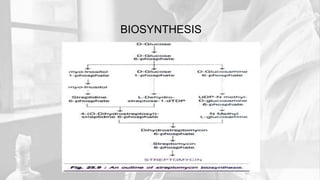
BIOSYNTHESIS and importance--
-treatment of various diseases
PREPARED BY
DEBANGANA MOITRA
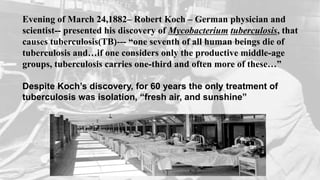
Evening of March 24,1882– Robert Koch – German physician and
scientist-- presented his discovery of Mycobacterium tuberculosis, that
causes tuberculosis(TB)--- “one seventh of all human beings die of
tuberculosis and…if one considers only the productive middle-age
groups, tuberculosis carries one-third and often more of these…”
Despite Koch’s discovery, for 60 years the only treatment of
tuberculosis was isolation, “fresh air, and sunshine”
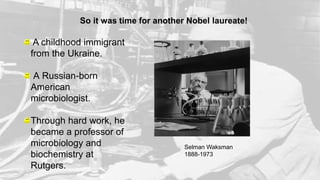
So it was time for another Nobel laureate!
Selman Waksman
1888-1973
A childhood immigrant
from the Ukraine.
A Russian-born
American
microbiologist.
Through hard work, he
became a professor of
microbiology and
biochemistry at
Rutgers.
The mass manufacture of penicillin during World War II
stimulated urgent interest in other medicinally important soil
microorganisms.
Waksman, had been engaged in a study of soil microbes for a
number of years.
One of his students, French-born René Jules Dubos (1901-
1981), was searching for antibacterial substances in soil.
In 1939 Dubos discovered the first antibiotic drug, gramicidin.
Although it fought pneumococcus, staphylococcus, and
streptococcus bacteria, it was too toxic (poisonous) for use in
humans.
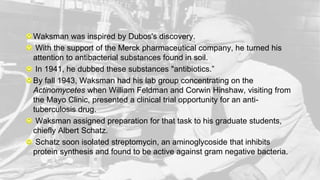
Waksman was inspired by Dubos's discovery.
With the support of the Merck pharmaceutical company, he turned his
attention to antibacterial substances found in soil.
In 1941, he dubbed these substances "antibiotics.”
By fall 1943, Waksman had his lab group concentrating on the
Actinomycetes when William Feldman and Corwin Hinshaw, visiting from
the Mayo Clinic, presented a clinical trial opportunity for an anti-
tuberculosis drug.
Waksman assigned preparation for that task to his graduate students,
chiefly Albert Schatz.
Schatz soon isolated streptomycin, an aminoglycoside that inhibits
protein synthesis and found to be active against gram negative bacteria.
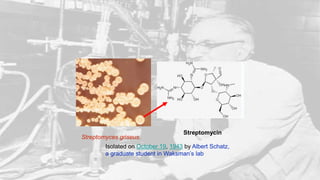
Streptomycin
Streptomyces griseus.
Isolated on October 19, 1943 by Albert Schatz,
a graduate student in Waksman’s lab
WHAT IS ANTIBIOTIC?
• Antibiotic, also called antibacterial, is a type
of antimicrobial drug.
• Used in the treatment and prevention of
bacterial infections.
• They may either kill or inhibit the growth of
bacteria.
• They are derived from bacterial
sources(microorganisms) or plant sources.
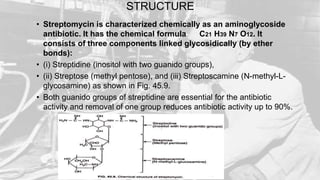
STRUCTURE
• Streptomycin is characterized chemically as an aminoglycoside
antibiotic. It has the chemical formula C21 H39 N7 O12. It
consists of three components linked glycosidically (by ether
bonds):
• (i) Streptidine (inositol with two guanido groups),
• (ii) Streptose (methyl pentose), and (iii) Streptoscamine (N-methyl-L-
glycosamine) as shown in Fig. 45.9.
• Both guanido groups of streptidine are essential for the antibiotic
activity and removal of one group reduces antibiotic activity up to 90%.
PROPERTIES OF STREPTOMYCIN
• Streptomycin is soluble in water but insoluble in acetone, chloroform, and
ether.
• Streptomycin is relatively stable. According to Regna, Wassele, and
Solomon, there was no loss of potency in commercial samples that were
stored at room temperature for 12 months containing less than 1% of
moisture.
• Strong alkaline solutions are destructive to streptomycin, the action being
very rapid when the solutions are boiled.
• Streptomycin is highly resistant to the action of enzymes and other
biological agents.
• Streptomycin is relatively nontoxic to man. But after the use of
streptomycin, reactions such as presence of pain, irritation, headache,
fever, blood pressure drop, disturbances in eighth cranial nerve, skin
eruption, albumin in urine may take place.
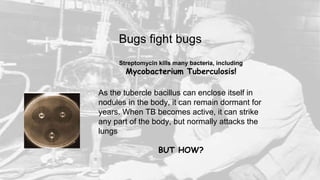
Streptomycin kills many bacteria, including
Mycobacterium Tuberculosis!
As the tubercle bacillus can enclose itself in
nodules in the body, it can remain dormant for
years. When TB becomes active, it can strike
any part of the body, but normally attacks the
lungs
BUT HOW?
Bugs fight bugs
The central dogma--
anybody remember that?
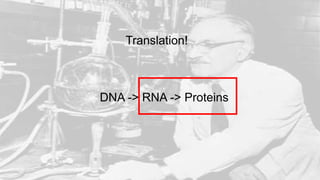
DNA -> RNA -> Proteins
And we call that step?
DNA -> RNA -> Proteins
Translation!
DNA -> RNA -> Proteins
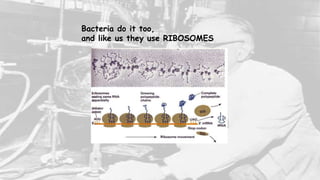
Bacteria do it too,
and like us they use RIBOSOMES
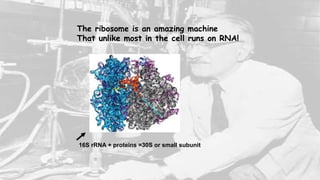
The ribosome is an amazing machine
That unlike most in the cell runs on RNA!
16S rRNA + proteins =30S or small subunit
MECHANISM OF ACTION
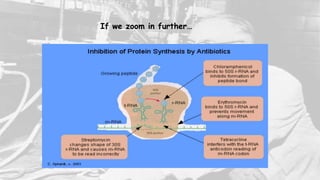
• Streptomycin is a protein synthesis inhibitor. It binds to the small 16S
rRNA of the 30S subunit of the bacterial ribosome, interfering with the
binding of formyl-methionyl-tRNA to the 30S subunit.
• This leads to codon misreading, eventual inhibition of protein synthesis
and ultimately death of microbial cells through mechanisms that are still
not understood.
• Speculation on this mechanism indicates that the binding of the
molecule to the 30S subunit interferes with 50S subunit association with
the mRNA strand.
• This results in an unstable ribosomal-mRNA complex, leading to
a frame shift mutation and defective protein synthesis; leading to cell
death.
MECHANISM OF ACTION
• Humans have ribosomes which are structurally different from those in
bacteria, so the drug does not have this effect in human cells.
• At low concentrations, however, streptomycin only inhibits growth of the
bacteria by inducing prokaryotic ribosomes to misread mRNA.
• Streptomycin is an antibiotic that inhibits both Gram-positive and Gram-
negative bacteria, and is therefore a useful broad-spectrum antibiotic
MECHANISM OF ACTION
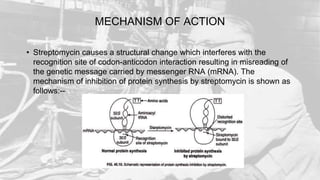
• Streptomycin causes a structural change which interferes with the
recognition site of codon-anticodon interaction resulting in misreading of
the genetic message carried by messenger RNA (mRNA). The
mechanism of inhibition of protein synthesis by streptomycin is shown as
follows:--
If we zoom in further…
Okay. So, streptomycin kills bugs in
a flask in the lab. What about
inside a patient?
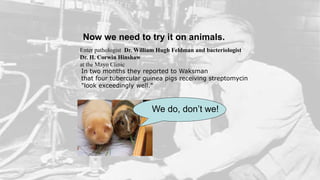
Now we need to try it on animals.
Enter pathologist Dr. William Hugh Feldman and bacteriologist
Dr. H. Corwin Hinshaw
at the Mayo Clinic
In two months they reported to Waksman
that four tubercular guinea pigs receiving streptomycin
"look exceedingly well."
We do, don’t we!
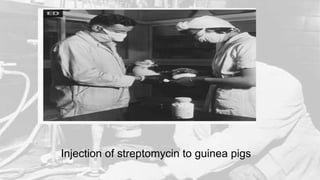
Injection of streptomycin to guinea pigs
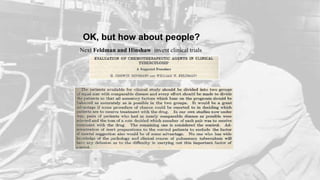
OK, but how about people?
Next Feldman and Hinshaw invent clinical trials
OK, but how about people?
In August 1945 Hinshaw reported that
thirty-three patients had been treated
"and [we] continue to be quite optimistic”.
Streptomycin
appeared to be a miracle cure
• After Feldman and Hinshaw carried out animal testing ,they treated
"Patricia T." between November 1944 and February 1945. She was
streptomycin's first success against TB.
• At the end of World War II, the United States Army experimented with
streptomycin to treat life-threatening infections at a military hospital
in Battle Creek, Michigan. The first patient treated did not survive; the
second patient survived but became blind as a side effect of the treatment.
In March 1946, the third patient—Robert J. Dole, later Majority Leader of
the United States Senate and Presidential nominee—experienced a rapid
and robust recovery.[24]
• The first randomized trial of streptomycin against pulmonary tuberculosis
was carried out in 1946 through 1948 by the MRC Tuberculosis
Research Unit under the chairmanship of Geoffrey Marshall (1887–
1982). The trial was both double-blind and placebo-controlled. It is widely
accepted to have been the first randomized curative trial.
• Results showed efficacy against TB, albeit with minor toxicity and
acquired bacterial resistance to the drug.[26]
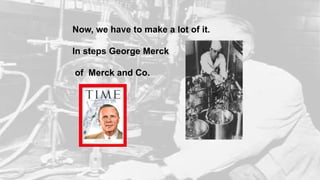
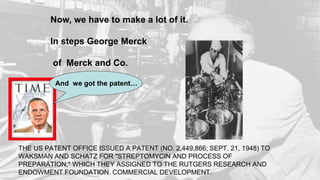
Now, we have to make a lot of it.
In steps George Merck
of Merck and Co.
Now, we have to make a lot of it.
In steps George Merck
of Merck and Co.
And we got the patent…
THE US PATENT OFFICE ISSUED A PATENT (NO. 2,449,866; SEPT. 21, 1948) TO
WAKSMAN AND SCHATZ FOR "STREPTOMYCIN AND PROCESS OF
PREPARATION," WHICH THEY ASSIGNED TO THE RUTGERS RESEARCH AND
ENDOWMENT FOUNDATION. COMMERCIAL DEVELOPMENT.
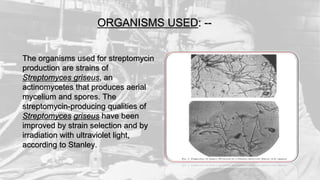
ORGANISMS USED: --
The organisms used for streptomycin
production are strains of
Streptomyces griseus, an
actinomycetes that produces aerial
mycelium and spores. The
streptomycin-producing qualities of
Streptomyces griseus have been
improved by strain selection and by
irradiation with ultraviolet light,
according to Stanley.
MATERIALS AND METHODS
• Instruments: --- Laminar air flow, Autoclave, Hot air oven, Shaker
incubator, Microscope, Cooling centrifuge, HPLC.
• Sample collection: --- The soil sample was collected from Chamundi hill
at Mysore city.
• Isolation and identification of S. griseus: --- The strain of S. griseus was
isolated form soil sample by using serial dilution technique and spread
plate method with Starch casein agar medium. S. griseus was identified
by following tests:
• Gram staining, Starch hydrolysis, Casein hydrolysis, Fermentation of
carbohydrate (glucose fermentation), Hydrogen sulfide (H2S) production,
Urease production, Methyl-Red and Voges-Proskauer (MRVP), Indole
production, Citrate utilization, Hydrolysis of gelatin and Catalase test.
MEDIA COMPOSITION: -
•Following is the
composition of medium
in 1000 ml distilled
water: --
Soya bean
meal
10 gm.
Glucose 10 gm.
Peptone 5 gm.
Meat
extract
5 gm.
Sodium
chloride
5 gm.
MEDIA COMPOSITION: --
• The pH is kept at 7.6-8.0 before sterilization and after
inoculation the culture is incubated at 28 C.
• Bennett reported that the following raw materials
gave comparable yields of streptomycin on a laboratory
scale: corn-steep water, soya bean flour, some
peptones, acid hydrolyzed rabbit fur, acid hydrolyzed
wheat gluten, acid hydrolyzed stillage obtained from
the yeast-alcohol fermentation of wheat mash, and
asparagus butt juice.
COMMERCIAL PRODUCTION: ---
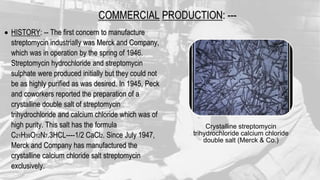
 HISTORY: -- The first concern to manufacture
streptomycin industrially was Merck and Company,
which was in operation by the spring of 1946.
Streptomycin hydrochloride and streptomycin
sulphate were produced initially but they could not
be as highly purified as was desired. In 1945, Peck
and coworkers reported the preparation of a
crystalline double salt of streptomycin
trihydrochloride and calcium chloride which was of
high purity. This salt has the formula
C21H39O12N7.3HCL----1/2 CaCl2. Since July 1947,
Merck and Company has manufactured the
crystalline calcium chloride salt streptomycin
exclusively.
Crystalline streptomycin
trihydrochloride calcium chloride
double salt (Merck & Co.)
1. The raw materials are mixed with water in a mixing tank at about
10 times the concentration in which they will be used and pumped
to a storage tank.
2. From the storage tank, the concentration is pumped
into each of a series of four fermenters of increasing sizes as
required.
3. The fermented medium, diluted with water to the desired
concentration, is then sterilized at 120 C., cooled and inoculated
with a starter.
FERMENTATION
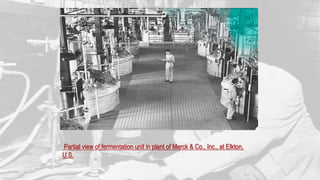
Partial view of fermentation unit in plant of Merck & Co., Inc., at Elkton,
U.S.
FERMENTATION
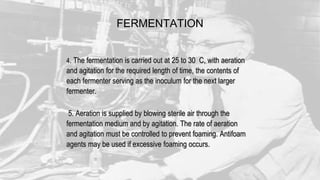
4. The fermentation is carried out at 25 to 30 C, with aeration
and agitation for the required length of time, the contents of
each fermenter serving as the inoculum for the next larger
fermenter.
5. Aeration is supplied by blowing sterile air through the
fermentation medium and by agitation. The rate of aeration
and agitation must be controlled to prevent foaming. Antifoam
agents may be used if excessive foaming occurs.
FERMENTATION
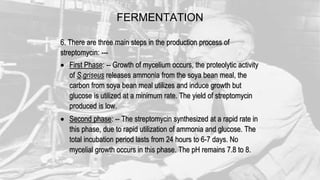
6. There are three main steps in the production process of
streptomycin: ---
 First Phase: -- Growth of mycelium occurs, the proteolytic activity
of S.griseus releases ammonia from the soya bean meal, the
carbon from soya bean meal utilizes and induce growth but
glucose is utilized at a minimum rate. The yield of streptomycin
produced is low.
 Second phase: -- The streptomycin synthesized at a rapid rate in
this phase, due to rapid utilization of ammonia and glucose. The
total incubation period lasts from 24 hours to 6-7 days. No
mycelial growth occurs in this phase. The pH remains 7.8 to 8.
FERMENTATION
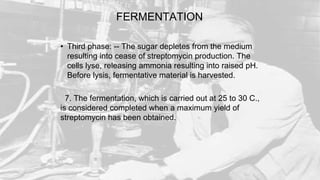
• Third phase: -- The sugar depletes from the medium
resulting into cease of streptomycin production. The
cells lyse, releasing ammonia resulting into raised pH.
Before lysis, fermentative material is harvested.
7. The fermentation, which is carried out at 25 to 30 C.,
is considered completed when a maximum yield of
streptomycin has been obtained.
FILTRATION: ---
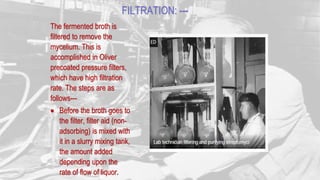
The fermented broth is
filtered to remove the
mycelium. This is
accomplished in Oliver
precoated pressure filters,
which have high filtration
rate. The steps are as
follows---
 Before the broth goes to
the filter, filter aid (non-
adsorbing) is mixed with
it in a slurry mixing tank,
the amount added
depending upon the
rate of flow of liquor.
FILTRATION
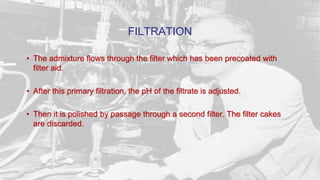
• The admixture flows through the filter which has been precoated with
filter aid.
• After this primary filtration, the pH of the filtrate is adjusted.
• Then it is polished by passage through a second filter. The filter cakes
are discarded.
ADSORPTION OF ACTIVATED
CARBON: --
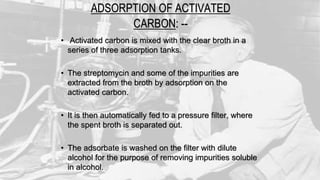
• Activated carbon is mixed with the clear broth in a
series of three adsorption tanks.
• The streptomycin and some of the impurities are
extracted from the broth by adsorption on the
activated carbon.
• It is then automatically fed to a pressure filter, where
the spent broth is separated out.
• The adsorbate is washed on the filter with dilute
alcohol for the purpose of removing impurities soluble
in alcohol.
ELUTION
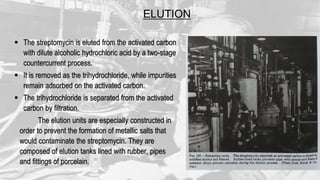
 The streptomycin is eluted from the activated carbon
with dilute alcoholic hydrochloric acid by a two-stage
countercurrent process.
 It is removed as the trihydrochloride, while impurities
remain adsorbed on the activated carbon.
 The trihydrochloride is separated from the activated
carbon by filtration.
The elution units are especially constructed in
order to prevent the formation of metallic salts that
would contaminate the streptomycin. They are
composed of elution tanks lined with rubber, pipes
and fittings of porcelain.
CONCENTRATION
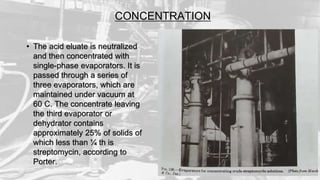
• The acid eluate is neutralized
and then concentrated with
single-phase evaporators. It is
passed through a series of
three evaporators, which are
maintained under vacuum at
60 C. The concentrate leaving
the third evaporator or
dehydrator contains
approximately 25% of solids of
which less than ¼ th is
streptomycin, according to
Porter.
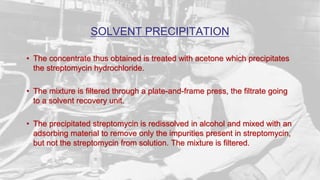
SOLVENT PRECIPITATION
• The concentrate thus obtained is treated with acetone which precipitates
the streptomycin hydrochloride.
• The mixture is filtered through a plate-and-frame press, the filtrate going
to a solvent recovery unit.
• The precipitated streptomycin is redissolved in alcohol and mixed with an
adsorbing material to remove only the impurities present in streptomycin,
but not the streptomycin from solution. The mixture is filtered.
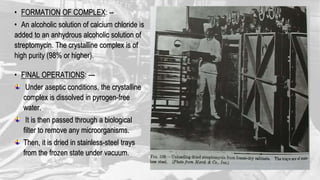
• FORMATION OF COMPLEX: --
• An alcoholic solution of calcium chloride is
added to an anhydrous alcoholic solution of
streptomycin. The crystalline complex is of
high purity (98% or higher).
• FINAL OPERATIONS: ---
Under aseptic conditions, the crystalline
complex is dissolved in pyrogen-free
water.
It is then passed through a biological
filter to remove any microorganisms.
Then, it is dried in stainless-steel trays
from the frozen state under vacuum.
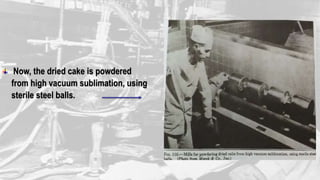
Now, the dried cake is powdered
from high vacuum sublimation, using
sterile steel balls.
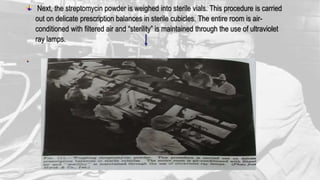
Next, the streptomycin powder is weighed into sterile vials. This procedure is carried
out on delicate prescription balances in sterile cubicles. The entire room is air-
conditioned with filtered air and “sterility” is maintained through the use of ultraviolet
ray lamps.
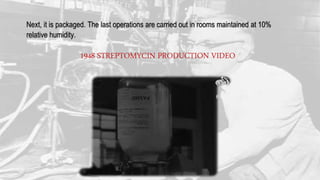
Next, it is packaged. The last operations are carried out in rooms maintained at 10%
relative humidity.
1948 STREPTOMYCIN PRODUCTION VIDEO
PREVENTION OF CONTAMINATION: --
To prevent contamination of the product, the workers must use special cleaning
techniques and change into sterile uniforms and shoes before going to the processing
areas.
In order to reduce the numbers of microorganisms in the air, all the air entering the
building is passed through special filters.
Triethylene glycol is used as a disinfecting aerosol.
Ultraviolet lamps are used in the cubicles where the antibiotic is exposed to the air for
a short time.
STANDARDIZATION
Waksman proposed the establishment of the following units: -
1. An S unit, or that amount of material which will inhibit the growth of a
standard strain of E.coli in 1 ml of nutrient broth or other suitable
medium. This unit would thus correspond to the original E.coli unit.
2. An L unit, or that amount of material which will inhibit the growth of a
standard train of E.coli in 1 liter of medium. An L unit is thus equivalent to
1000 S units.
3. A G unit comparable to one gram of the crystalline material.
METHODS OF ASSAY
Biological and chemical methods of assay have been employed but the
biological methods are the most suitable at the present time.
BIOLOGICAL METHODS: --
• Cup method of Stebbins and Robinson.
• Paper disc method of Loo and associates.
• Broth dilution methods of Donovick and his co workers and of Price,
Nielsen, and Welch.
• Slide cell method of Heilman for estimating the amount of streptomycin in
body fluids.
• Turbidimetric method of Osgood and Graham.
• Streak plate method of Waksman and Reilly.
METHODS OF ASSAY
CHEMICAL METHODS by: --
• Schenck and Spielman.
• Scudi, Boxer and Jelinek.
• Levy, Schwed, and Sackett.
STRAINS USED: --
The test organism used depends upon the method and purpose of assay.
The special strains used are: --
1. Staphylococcus aureus and Bacillus subtilis in the agar diffusion assays.
2. Klebsiella pneumonia, Staphylococcus aureus and B. circulans in broth
dilution methods.
3. B. megatherium in the slide cell method.
INACTIVATION OF STREPTOMYCIN
• Chemical agents: --
1. Cysteine, B-mercaptoethylamine (sulfhydryl compounds) inhibited the
action of streptomycin against B.subtilis.
2. Hydrazine(0.002 M), phenylhydrazine(0.002 M), semicarbazide(0.002
M), methylphenylhydrazine(0.001 M), hydroxylamine(0.002 M)—ketone
reagents reduce the efficacy of streptomycin against either B.subtilis or
E.coli
3. Cevitamic acid(against A.aerogenes, S.aureus, E.coli, B.subtilis)
4. 2 aminoethanediol
INACTIVATION OF STREPTOMYCIN
• Unfavorable reaction: -- The use of a sugar, such as glucose, levulose, or
sucrose, medium which may be fermented by B.subtilis, E.coli, or other
organisms with the production of sufficient acid to reduce the pH, has
usually resulted in diminished activity on the part of streptomycin.
• Anaerobic conditions
• Age of culture: -- Actively growing young cultures of bacteria are
apparently more susceptible to streptomycin than older ones(24 to 48
hrs. old) where the growth rate has decreased.
Compounds made from streptomycin
1. Streptomycin B: -- this compound was isolated from streptomycin
concentrates by Fried and Titus. In the case of experimental infections
with M. tuberculosis, streptomycin B was about 1/3rd as active as
streptomycin on a weight basis and of about equal activity on a unit
basis.
2. Dihydrostreptomycin: -- Peck, Hoffhine, Jr., and Folkers reported on
the formation of this compound by the catalytic hydrogenation of
streptomycin.
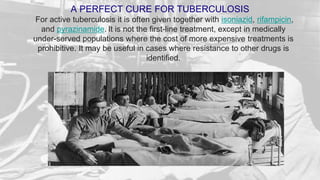
A PERFECT CURE FOR TUBERCULOSIS
For active tuberculosis it is often given together with isoniazid, rifampicin,
and pyrazinamide. It is not the first-line treatment, except in medically
under-served populations where the cost of more expensive treatments is
prohibitive. It may be useful in cases where resistance to other drugs is
identified.
OTHER USES OF STREPTOMYCIN
Treatment of diseases: --
• Infective endocarditis caused by enterococcus when the organism is not
sensitive to gentamicin.
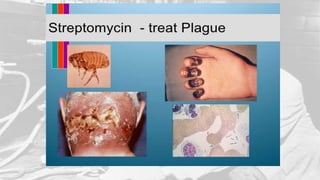
• Plague (Yersinia pestis) has historically been treated with it as the first-
line treatment. However streptomycin is approved for this purpose only
by the U.S. Food and Drug Administration.
OTHER USES OF STREPTOMYCIN
• In veterinary medicine, streptomycin is the first-line antibiotic for use
against gram negative bacteria in large animals (horses, cattle, sheep,
etc.). It is commonly combined with procaine penicillin for intramuscular
injection.
• Tularemia infections have been treated mostly with streptomycin.
• Streptomycin is traditionally given intramuscularly, and in many nations is
only licensed to be administered intramuscularly, though in some regions
the drug may also be administered intravenously.
• Pesticide and fungicide
• Streptomycin also is used as a pesticide, to combat the growth of
bacteria, fungi, and algae. Streptomycin controls bacterial and fungal
diseases of certain fruit, vegetables, seed, and ornamental crops, and it
controls algae in ornamental ponds and aquaria. A major use is in the
control of fire blight on apple and pear trees. As in medical applications,
extensive use can be associated with the development of resistant
strains.
• Cell culture
• Streptomycin, in combination with penicillin, is used in a standard
antibiotic cocktail to prevent bacterial infection in cell culture.
• Protein purification
• When purifying protein from a biological extract, streptomycin sulfate is
sometimes added as a means of removing nucleic acids. Since it binds to
ribosomes and precipitates out of solution, it serves as a method for
removing rRNA, mRNA, and even DNA if the extract is from a prokaryote.
BIOSYNTHESIS
STREPTOMYCIN

STREPTOMYCIN

  • 1.
    Streptomycin: --- It’s history,production, BIOSYNTHESISand importance-- -treatment of various diseases PREPARED BY DEBANGANA MOITRA
  • 2.
    Evening of March24,1882– Robert Koch – German physician and scientist-- presented his discovery of Mycobacterium tuberculosis, that causes tuberculosis(TB)--- “one seventh of all human beings die of tuberculosis and…if one considers only the productive middle-age groups, tuberculosis carries one-third and often more of these…” Despite Koch’s discovery, for 60 years the only treatment of tuberculosis was isolation, “fresh air, and sunshine”
  • 3.
    So it wastime for another Nobel laureate! Selman Waksman 1888-1973 A childhood immigrant from the Ukraine. A Russian-born American microbiologist. Through hard work, he became a professor of microbiology and biochemistry at Rutgers.
  • 4.
    The mass manufactureof penicillin during World War II stimulated urgent interest in other medicinally important soil microorganisms. Waksman, had been engaged in a study of soil microbes for a number of years. One of his students, French-born René Jules Dubos (1901- 1981), was searching for antibacterial substances in soil. In 1939 Dubos discovered the first antibiotic drug, gramicidin. Although it fought pneumococcus, staphylococcus, and streptococcus bacteria, it was too toxic (poisonous) for use in humans.
  • 5.
    Waksman was inspiredby Dubos's discovery. With the support of the Merck pharmaceutical company, he turned his attention to antibacterial substances found in soil. In 1941, he dubbed these substances "antibiotics.” By fall 1943, Waksman had his lab group concentrating on the Actinomycetes when William Feldman and Corwin Hinshaw, visiting from the Mayo Clinic, presented a clinical trial opportunity for an anti- tuberculosis drug. Waksman assigned preparation for that task to his graduate students, chiefly Albert Schatz. Schatz soon isolated streptomycin, an aminoglycoside that inhibits protein synthesis and found to be active against gram negative bacteria.
  • 6.
    Streptomycin Streptomyces griseus. Isolated onOctober 19, 1943 by Albert Schatz, a graduate student in Waksman’s lab
  • 7.
    WHAT IS ANTIBIOTIC? •Antibiotic, also called antibacterial, is a type of antimicrobial drug. • Used in the treatment and prevention of bacterial infections. • They may either kill or inhibit the growth of bacteria. • They are derived from bacterial sources(microorganisms) or plant sources.
  • 8.
    STRUCTURE • Streptomycin ischaracterized chemically as an aminoglycoside antibiotic. It has the chemical formula C21 H39 N7 O12. It consists of three components linked glycosidically (by ether bonds): • (i) Streptidine (inositol with two guanido groups), • (ii) Streptose (methyl pentose), and (iii) Streptoscamine (N-methyl-L- glycosamine) as shown in Fig. 45.9. • Both guanido groups of streptidine are essential for the antibiotic activity and removal of one group reduces antibiotic activity up to 90%.
  • 9.
    PROPERTIES OF STREPTOMYCIN •Streptomycin is soluble in water but insoluble in acetone, chloroform, and ether. • Streptomycin is relatively stable. According to Regna, Wassele, and Solomon, there was no loss of potency in commercial samples that were stored at room temperature for 12 months containing less than 1% of moisture. • Strong alkaline solutions are destructive to streptomycin, the action being very rapid when the solutions are boiled. • Streptomycin is highly resistant to the action of enzymes and other biological agents. • Streptomycin is relatively nontoxic to man. But after the use of streptomycin, reactions such as presence of pain, irritation, headache, fever, blood pressure drop, disturbances in eighth cranial nerve, skin eruption, albumin in urine may take place.
  • 10.
    Streptomycin kills manybacteria, including Mycobacterium Tuberculosis! As the tubercle bacillus can enclose itself in nodules in the body, it can remain dormant for years. When TB becomes active, it can strike any part of the body, but normally attacks the lungs BUT HOW? Bugs fight bugs
  • 11.
    The central dogma-- anybodyremember that? DNA -> RNA -> Proteins
  • 12.
    And we callthat step? DNA -> RNA -> Proteins
  • 13.
  • 14.
    Bacteria do ittoo, and like us they use RIBOSOMES
  • 15.
    The ribosome isan amazing machine That unlike most in the cell runs on RNA! 16S rRNA + proteins =30S or small subunit
  • 16.
    MECHANISM OF ACTION •Streptomycin is a protein synthesis inhibitor. It binds to the small 16S rRNA of the 30S subunit of the bacterial ribosome, interfering with the binding of formyl-methionyl-tRNA to the 30S subunit. • This leads to codon misreading, eventual inhibition of protein synthesis and ultimately death of microbial cells through mechanisms that are still not understood. • Speculation on this mechanism indicates that the binding of the molecule to the 30S subunit interferes with 50S subunit association with the mRNA strand. • This results in an unstable ribosomal-mRNA complex, leading to a frame shift mutation and defective protein synthesis; leading to cell death.
  • 17.
    MECHANISM OF ACTION •Humans have ribosomes which are structurally different from those in bacteria, so the drug does not have this effect in human cells. • At low concentrations, however, streptomycin only inhibits growth of the bacteria by inducing prokaryotic ribosomes to misread mRNA. • Streptomycin is an antibiotic that inhibits both Gram-positive and Gram- negative bacteria, and is therefore a useful broad-spectrum antibiotic
  • 18.
    MECHANISM OF ACTION •Streptomycin causes a structural change which interferes with the recognition site of codon-anticodon interaction resulting in misreading of the genetic message carried by messenger RNA (mRNA). The mechanism of inhibition of protein synthesis by streptomycin is shown as follows:--
  • 19.
    If we zoomin further…
  • 20.
    Okay. So, streptomycinkills bugs in a flask in the lab. What about inside a patient?
  • 21.
    Now we needto try it on animals. Enter pathologist Dr. William Hugh Feldman and bacteriologist Dr. H. Corwin Hinshaw at the Mayo Clinic In two months they reported to Waksman that four tubercular guinea pigs receiving streptomycin "look exceedingly well." We do, don’t we!
  • 22.
  • 23.
    OK, but howabout people? Next Feldman and Hinshaw invent clinical trials
  • 24.
    OK, but howabout people? In August 1945 Hinshaw reported that thirty-three patients had been treated "and [we] continue to be quite optimistic”. Streptomycin appeared to be a miracle cure • After Feldman and Hinshaw carried out animal testing ,they treated "Patricia T." between November 1944 and February 1945. She was streptomycin's first success against TB.
  • 25.
    • At theend of World War II, the United States Army experimented with streptomycin to treat life-threatening infections at a military hospital in Battle Creek, Michigan. The first patient treated did not survive; the second patient survived but became blind as a side effect of the treatment. In March 1946, the third patient—Robert J. Dole, later Majority Leader of the United States Senate and Presidential nominee—experienced a rapid and robust recovery.[24]
  • 26.
    • The firstrandomized trial of streptomycin against pulmonary tuberculosis was carried out in 1946 through 1948 by the MRC Tuberculosis Research Unit under the chairmanship of Geoffrey Marshall (1887– 1982). The trial was both double-blind and placebo-controlled. It is widely accepted to have been the first randomized curative trial. • Results showed efficacy against TB, albeit with minor toxicity and acquired bacterial resistance to the drug.[26]
  • 27.
    Now, we haveto make a lot of it. In steps George Merck of Merck and Co.
  • 28.
    Now, we haveto make a lot of it. In steps George Merck of Merck and Co. And we got the patent… THE US PATENT OFFICE ISSUED A PATENT (NO. 2,449,866; SEPT. 21, 1948) TO WAKSMAN AND SCHATZ FOR "STREPTOMYCIN AND PROCESS OF PREPARATION," WHICH THEY ASSIGNED TO THE RUTGERS RESEARCH AND ENDOWMENT FOUNDATION. COMMERCIAL DEVELOPMENT.
  • 29.
    ORGANISMS USED: -- Theorganisms used for streptomycin production are strains of Streptomyces griseus, an actinomycetes that produces aerial mycelium and spores. The streptomycin-producing qualities of Streptomyces griseus have been improved by strain selection and by irradiation with ultraviolet light, according to Stanley.
  • 30.
    MATERIALS AND METHODS •Instruments: --- Laminar air flow, Autoclave, Hot air oven, Shaker incubator, Microscope, Cooling centrifuge, HPLC. • Sample collection: --- The soil sample was collected from Chamundi hill at Mysore city. • Isolation and identification of S. griseus: --- The strain of S. griseus was isolated form soil sample by using serial dilution technique and spread plate method with Starch casein agar medium. S. griseus was identified by following tests: • Gram staining, Starch hydrolysis, Casein hydrolysis, Fermentation of carbohydrate (glucose fermentation), Hydrogen sulfide (H2S) production, Urease production, Methyl-Red and Voges-Proskauer (MRVP), Indole production, Citrate utilization, Hydrolysis of gelatin and Catalase test.
  • 31.
    MEDIA COMPOSITION: - •Followingis the composition of medium in 1000 ml distilled water: -- Soya bean meal 10 gm. Glucose 10 gm. Peptone 5 gm. Meat extract 5 gm. Sodium chloride 5 gm.
  • 32.
    MEDIA COMPOSITION: -- •The pH is kept at 7.6-8.0 before sterilization and after inoculation the culture is incubated at 28 C. • Bennett reported that the following raw materials gave comparable yields of streptomycin on a laboratory scale: corn-steep water, soya bean flour, some peptones, acid hydrolyzed rabbit fur, acid hydrolyzed wheat gluten, acid hydrolyzed stillage obtained from the yeast-alcohol fermentation of wheat mash, and asparagus butt juice.
  • 33.
    COMMERCIAL PRODUCTION: --- HISTORY: -- The first concern to manufacture streptomycin industrially was Merck and Company, which was in operation by the spring of 1946. Streptomycin hydrochloride and streptomycin sulphate were produced initially but they could not be as highly purified as was desired. In 1945, Peck and coworkers reported the preparation of a crystalline double salt of streptomycin trihydrochloride and calcium chloride which was of high purity. This salt has the formula C21H39O12N7.3HCL----1/2 CaCl2. Since July 1947, Merck and Company has manufactured the crystalline calcium chloride salt streptomycin exclusively. Crystalline streptomycin trihydrochloride calcium chloride double salt (Merck & Co.)
  • 34.
    1. The rawmaterials are mixed with water in a mixing tank at about 10 times the concentration in which they will be used and pumped to a storage tank. 2. From the storage tank, the concentration is pumped into each of a series of four fermenters of increasing sizes as required. 3. The fermented medium, diluted with water to the desired concentration, is then sterilized at 120 C., cooled and inoculated with a starter. FERMENTATION
  • 35.
    Partial view offermentation unit in plant of Merck & Co., Inc., at Elkton, U.S.
  • 36.
    FERMENTATION 4. The fermentationis carried out at 25 to 30 C, with aeration and agitation for the required length of time, the contents of each fermenter serving as the inoculum for the next larger fermenter. 5. Aeration is supplied by blowing sterile air through the fermentation medium and by agitation. The rate of aeration and agitation must be controlled to prevent foaming. Antifoam agents may be used if excessive foaming occurs.
  • 37.
    FERMENTATION 6. There arethree main steps in the production process of streptomycin: ---  First Phase: -- Growth of mycelium occurs, the proteolytic activity of S.griseus releases ammonia from the soya bean meal, the carbon from soya bean meal utilizes and induce growth but glucose is utilized at a minimum rate. The yield of streptomycin produced is low.  Second phase: -- The streptomycin synthesized at a rapid rate in this phase, due to rapid utilization of ammonia and glucose. The total incubation period lasts from 24 hours to 6-7 days. No mycelial growth occurs in this phase. The pH remains 7.8 to 8.
  • 38.
    FERMENTATION • Third phase:-- The sugar depletes from the medium resulting into cease of streptomycin production. The cells lyse, releasing ammonia resulting into raised pH. Before lysis, fermentative material is harvested. 7. The fermentation, which is carried out at 25 to 30 C., is considered completed when a maximum yield of streptomycin has been obtained.
  • 39.
    FILTRATION: --- The fermentedbroth is filtered to remove the mycelium. This is accomplished in Oliver precoated pressure filters, which have high filtration rate. The steps are as follows---  Before the broth goes to the filter, filter aid (non- adsorbing) is mixed with it in a slurry mixing tank, the amount added depending upon the rate of flow of liquor.
  • 40.
    FILTRATION • The admixtureflows through the filter which has been precoated with filter aid. • After this primary filtration, the pH of the filtrate is adjusted. • Then it is polished by passage through a second filter. The filter cakes are discarded.
  • 41.
    ADSORPTION OF ACTIVATED CARBON:-- • Activated carbon is mixed with the clear broth in a series of three adsorption tanks. • The streptomycin and some of the impurities are extracted from the broth by adsorption on the activated carbon. • It is then automatically fed to a pressure filter, where the spent broth is separated out. • The adsorbate is washed on the filter with dilute alcohol for the purpose of removing impurities soluble in alcohol.
  • 42.
    ELUTION  The streptomycinis eluted from the activated carbon with dilute alcoholic hydrochloric acid by a two-stage countercurrent process.  It is removed as the trihydrochloride, while impurities remain adsorbed on the activated carbon.  The trihydrochloride is separated from the activated carbon by filtration. The elution units are especially constructed in order to prevent the formation of metallic salts that would contaminate the streptomycin. They are composed of elution tanks lined with rubber, pipes and fittings of porcelain.
  • 43.
    CONCENTRATION • The acideluate is neutralized and then concentrated with single-phase evaporators. It is passed through a series of three evaporators, which are maintained under vacuum at 60 C. The concentrate leaving the third evaporator or dehydrator contains approximately 25% of solids of which less than ¼ th is streptomycin, according to Porter.
  • 44.
    SOLVENT PRECIPITATION • Theconcentrate thus obtained is treated with acetone which precipitates the streptomycin hydrochloride. • The mixture is filtered through a plate-and-frame press, the filtrate going to a solvent recovery unit. • The precipitated streptomycin is redissolved in alcohol and mixed with an adsorbing material to remove only the impurities present in streptomycin, but not the streptomycin from solution. The mixture is filtered.
  • 45.
    • FORMATION OFCOMPLEX: -- • An alcoholic solution of calcium chloride is added to an anhydrous alcoholic solution of streptomycin. The crystalline complex is of high purity (98% or higher). • FINAL OPERATIONS: --- Under aseptic conditions, the crystalline complex is dissolved in pyrogen-free water. It is then passed through a biological filter to remove any microorganisms. Then, it is dried in stainless-steel trays from the frozen state under vacuum.
  • 46.
    Now, the driedcake is powdered from high vacuum sublimation, using sterile steel balls.
  • 47.
    Next, the streptomycinpowder is weighed into sterile vials. This procedure is carried out on delicate prescription balances in sterile cubicles. The entire room is air- conditioned with filtered air and “sterility” is maintained through the use of ultraviolet ray lamps.
  • 48.
    Next, it ispackaged. The last operations are carried out in rooms maintained at 10% relative humidity. 1948 STREPTOMYCIN PRODUCTION VIDEO
  • 49.
    PREVENTION OF CONTAMINATION:-- To prevent contamination of the product, the workers must use special cleaning techniques and change into sterile uniforms and shoes before going to the processing areas. In order to reduce the numbers of microorganisms in the air, all the air entering the building is passed through special filters. Triethylene glycol is used as a disinfecting aerosol. Ultraviolet lamps are used in the cubicles where the antibiotic is exposed to the air for a short time.
  • 50.
    STANDARDIZATION Waksman proposed theestablishment of the following units: - 1. An S unit, or that amount of material which will inhibit the growth of a standard strain of E.coli in 1 ml of nutrient broth or other suitable medium. This unit would thus correspond to the original E.coli unit. 2. An L unit, or that amount of material which will inhibit the growth of a standard train of E.coli in 1 liter of medium. An L unit is thus equivalent to 1000 S units. 3. A G unit comparable to one gram of the crystalline material.
  • 51.
    METHODS OF ASSAY Biologicaland chemical methods of assay have been employed but the biological methods are the most suitable at the present time. BIOLOGICAL METHODS: -- • Cup method of Stebbins and Robinson. • Paper disc method of Loo and associates. • Broth dilution methods of Donovick and his co workers and of Price, Nielsen, and Welch. • Slide cell method of Heilman for estimating the amount of streptomycin in body fluids. • Turbidimetric method of Osgood and Graham. • Streak plate method of Waksman and Reilly.
  • 52.
    METHODS OF ASSAY CHEMICALMETHODS by: -- • Schenck and Spielman. • Scudi, Boxer and Jelinek. • Levy, Schwed, and Sackett. STRAINS USED: -- The test organism used depends upon the method and purpose of assay. The special strains used are: -- 1. Staphylococcus aureus and Bacillus subtilis in the agar diffusion assays. 2. Klebsiella pneumonia, Staphylococcus aureus and B. circulans in broth dilution methods. 3. B. megatherium in the slide cell method.
  • 53.
    INACTIVATION OF STREPTOMYCIN •Chemical agents: -- 1. Cysteine, B-mercaptoethylamine (sulfhydryl compounds) inhibited the action of streptomycin against B.subtilis. 2. Hydrazine(0.002 M), phenylhydrazine(0.002 M), semicarbazide(0.002 M), methylphenylhydrazine(0.001 M), hydroxylamine(0.002 M)—ketone reagents reduce the efficacy of streptomycin against either B.subtilis or E.coli 3. Cevitamic acid(against A.aerogenes, S.aureus, E.coli, B.subtilis) 4. 2 aminoethanediol
  • 54.
    INACTIVATION OF STREPTOMYCIN •Unfavorable reaction: -- The use of a sugar, such as glucose, levulose, or sucrose, medium which may be fermented by B.subtilis, E.coli, or other organisms with the production of sufficient acid to reduce the pH, has usually resulted in diminished activity on the part of streptomycin. • Anaerobic conditions • Age of culture: -- Actively growing young cultures of bacteria are apparently more susceptible to streptomycin than older ones(24 to 48 hrs. old) where the growth rate has decreased.
  • 55.
    Compounds made fromstreptomycin 1. Streptomycin B: -- this compound was isolated from streptomycin concentrates by Fried and Titus. In the case of experimental infections with M. tuberculosis, streptomycin B was about 1/3rd as active as streptomycin on a weight basis and of about equal activity on a unit basis. 2. Dihydrostreptomycin: -- Peck, Hoffhine, Jr., and Folkers reported on the formation of this compound by the catalytic hydrogenation of streptomycin.
  • 56.
    A PERFECT CUREFOR TUBERCULOSIS For active tuberculosis it is often given together with isoniazid, rifampicin, and pyrazinamide. It is not the first-line treatment, except in medically under-served populations where the cost of more expensive treatments is prohibitive. It may be useful in cases where resistance to other drugs is identified.
  • 57.
    OTHER USES OFSTREPTOMYCIN Treatment of diseases: -- • Infective endocarditis caused by enterococcus when the organism is not sensitive to gentamicin. • Plague (Yersinia pestis) has historically been treated with it as the first- line treatment. However streptomycin is approved for this purpose only by the U.S. Food and Drug Administration.
  • 59.
    OTHER USES OFSTREPTOMYCIN • In veterinary medicine, streptomycin is the first-line antibiotic for use against gram negative bacteria in large animals (horses, cattle, sheep, etc.). It is commonly combined with procaine penicillin for intramuscular injection. • Tularemia infections have been treated mostly with streptomycin. • Streptomycin is traditionally given intramuscularly, and in many nations is only licensed to be administered intramuscularly, though in some regions the drug may also be administered intravenously.
  • 60.
    • Pesticide andfungicide • Streptomycin also is used as a pesticide, to combat the growth of bacteria, fungi, and algae. Streptomycin controls bacterial and fungal diseases of certain fruit, vegetables, seed, and ornamental crops, and it controls algae in ornamental ponds and aquaria. A major use is in the control of fire blight on apple and pear trees. As in medical applications, extensive use can be associated with the development of resistant strains. • Cell culture • Streptomycin, in combination with penicillin, is used in a standard antibiotic cocktail to prevent bacterial infection in cell culture. • Protein purification • When purifying protein from a biological extract, streptomycin sulfate is sometimes added as a means of removing nucleic acids. Since it binds to ribosomes and precipitates out of solution, it serves as a method for removing rRNA, mRNA, and even DNA if the extract is from a prokaryote.
  • 61.