Presented by:
M.Shahbaz ( f2022084034)
Department of ILA
UNIVERSITY OF MANAGEMENT AND
TECHNOLOGY
 Objective
 Introduction to error analysis
 Difference between error and mistakes
 Types of error in linguistics
 Causes of errors
 Steps in error analysis
 Conclusion
?
 An error is systematic deviation from the rules
of the target language
 Errors occurs when learner deviates from
norms of the language being learned.
 An error is the use of a word, speech or
grammatical items in such a way it seems
imperfect and indicates an incomplete learning
 Difference between error and mistake
 What is an error analysis ?
 Why error analysis is done?
 Types of errors
I. Interlingual error
II. Intralingual
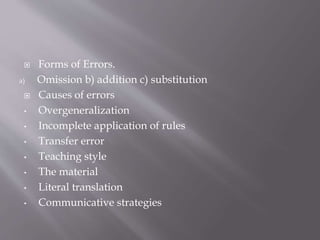
 Forms of Errors.
a) Omission b) addition c) substitution
 Causes of errors
• Overgeneralization
• Incomplete application of rules
• Transfer error
• Teaching style
• The material
• Literal translation
• Communicative strategies
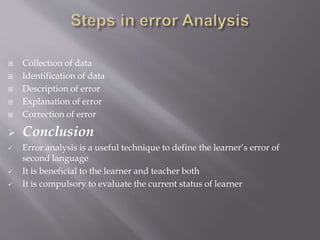
 Collection of data
 Identification of data
 Description of error
 Explanation of error
 Correction of error
 Conclusion
 Error analysis is a useful technique to define the learner’s error of
second language
 It is beneficial to the learner and teacher both
 It is compulsory to evaluate the current status of learner
Types and steps in error analysis

Types and steps in error analysis

  • 1.
    Presented by: M.Shahbaz (f2022084034) Department of ILA UNIVERSITY OF MANAGEMENT AND TECHNOLOGY
  • 2.
     Objective  Introductionto error analysis  Difference between error and mistakes  Types of error in linguistics  Causes of errors  Steps in error analysis  Conclusion
  • 3.
  • 4.
     An erroris systematic deviation from the rules of the target language  Errors occurs when learner deviates from norms of the language being learned.  An error is the use of a word, speech or grammatical items in such a way it seems imperfect and indicates an incomplete learning
  • 5.
     Difference betweenerror and mistake  What is an error analysis ?  Why error analysis is done?  Types of errors I. Interlingual error II. Intralingual
  • 6.
     Forms ofErrors. a) Omission b) addition c) substitution  Causes of errors • Overgeneralization • Incomplete application of rules • Transfer error • Teaching style • The material • Literal translation • Communicative strategies
  • 7.
     Collection ofdata  Identification of data  Description of error  Explanation of error  Correction of error  Conclusion  Error analysis is a useful technique to define the learner’s error of second language  It is beneficial to the learner and teacher both  It is compulsory to evaluate the current status of learner