ERP Features and Its
Implementation
Agenda
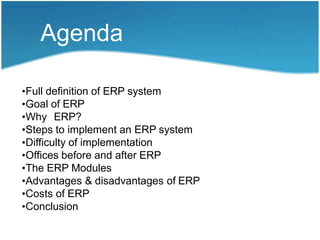
•Full definition of ERP system
•Goal of ERP
•Why ERP?
•Steps to implement an ERP system
•Difficulty of implementation
•Offices before and after ERP
•The ERP Modules
•Advantages & disadvantages of ERP
•Costs of ERP
•Conclusion
What is
ERP ?
..E..
An Enterprise is a group of people with a common goal,
which has certain resources at its disposal to achieve
that goal.
..R..
Resources included are money, and all other things
that are required to run the enterprise.
..P..
Planning is done to ensure that nothing goes wrong.
In general ERP is :
“a business strategy and set of industry-
domain-specific applications that build customer
and shareholder communities value network
system by enabling and optimizing enterprise
and inter-enterprise collaborative operational
and financial processes”(Source: Gartner’s Research Note
SPA-12-0420)
.
Goal of
ERP
The goal of our enterprise is simply to get, keep, and grow
customers.
GET
• Acquire profitable customers
KEEP
•
•
•
Retain profitable customers
longer. Win back profitable
customers Eliminate
unprofitable customers
GRO
W
•
•
•
Up sell additional products in a
solution Cross sell other products
to customers Reduce service and
operations cost.
Why ERP?
•ERP offers solutions for all
business functions
•Packages available for
organizations of all sizes and
types
•Global nature (multi
currency)
Steps to implement an ERP
system :
Definitio
n and
analysis
desig
n
buil
d
transactio
n
productio
n
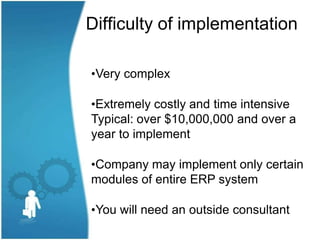
•Very complex
•Extremely costly and time intensive
Typical: over $10,000,000 and over a
year to implement
•Company may implement only certain
modules of entire ERP system
•You will need an outside consultant
Difficulty of implementation
Offices b ef o r e ERP
Offices a f t e r ERP
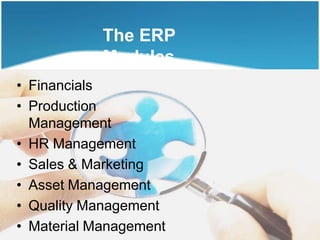
• Financials
• Production
Management
• HR Management
• Sales & Marketing
• Asset Management
• Quality Management
• Material Management
The ERP
Modules
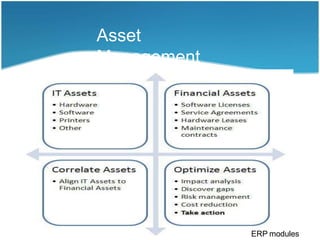
Asset
Management
ERP modules
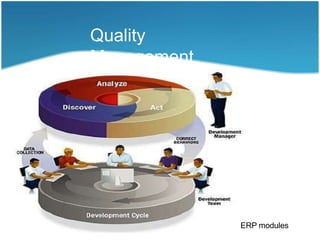
Quality
Management
ERP modules
• FINANCIAL
ACCOUNTING
• CONTROLLING
• INVESTMENT
MANAGEMENT
• CASH MANAGEMENT
Financia
ls
ERP modules
Production
Management
ERP modules
Sales &
Marketing
•Developing strategies for market penetration for new products
as well asincreasing the share of the existing products.
• Reviewing & interpreting the competition&
market information to fine-tunestrategies.
• Selecting & deciding the right distribution channel for the
product& implementing the right pricing & promotionalpolicies.
• Coordinating marketing activities, obtainingleads
for new projects
ERP modules
HR
Management
ERP modules
Advantages of
ERP
•
•
•
•
•
Integratio
n
Efficiency
Cost
reduction
Less
personnel
Accuracy
Disadvantag
es
•
•
Take time to
implement Security
issues
Costs of
ERP
• Direct costs
..hardware
.. Software
..and people on the project
• Indirect costs
..the total cycle life of ERP
..maintenance and upgrades
..increasing salaries and the on going production
Conclusion
•To successfully implement; a proper
mix of people, processes and
technology should be maintained
•Technology is an enabler, not the
driver (it is there to assist the
organization to achieve business
goals)

ERP Features and Implementation.pptx

  • 1.
    ERP Features andIts Implementation
  • 2.
    Agenda •Full definition ofERP system •Goal of ERP •Why ERP? •Steps to implement an ERP system •Difficulty of implementation •Offices before and after ERP •The ERP Modules •Advantages & disadvantages of ERP •Costs of ERP •Conclusion
  • 4.
    What is ERP ? ..E.. AnEnterprise is a group of people with a common goal, which has certain resources at its disposal to achieve that goal. ..R.. Resources included are money, and all other things that are required to run the enterprise. ..P.. Planning is done to ensure that nothing goes wrong.
  • 5.
    In general ERPis : “a business strategy and set of industry- domain-specific applications that build customer and shareholder communities value network system by enabling and optimizing enterprise and inter-enterprise collaborative operational and financial processes”(Source: Gartner’s Research Note SPA-12-0420) .
  • 6.
    Goal of ERP The goalof our enterprise is simply to get, keep, and grow customers. GET • Acquire profitable customers KEEP • • • Retain profitable customers longer. Win back profitable customers Eliminate unprofitable customers GRO W • • • Up sell additional products in a solution Cross sell other products to customers Reduce service and operations cost.
  • 7.
    Why ERP? •ERP offerssolutions for all business functions •Packages available for organizations of all sizes and types •Global nature (multi currency)
  • 8.
    Steps to implementan ERP system : Definitio n and analysis desig n buil d transactio n productio n
  • 9.
    •Very complex •Extremely costlyand time intensive Typical: over $10,000,000 and over a year to implement •Company may implement only certain modules of entire ERP system •You will need an outside consultant Difficulty of implementation
  • 10.
    Offices b efo r e ERP
  • 11.
    Offices a ft e r ERP
  • 12.
    • Financials • Production Management •HR Management • Sales & Marketing • Asset Management • Quality Management • Material Management The ERP Modules
  • 13.
  • 14.
  • 15.
    • FINANCIAL ACCOUNTING • CONTROLLING •INVESTMENT MANAGEMENT • CASH MANAGEMENT Financia ls ERP modules
  • 16.
  • 17.
    Sales & Marketing •Developing strategiesfor market penetration for new products as well asincreasing the share of the existing products. • Reviewing & interpreting the competition& market information to fine-tunestrategies. • Selecting & deciding the right distribution channel for the product& implementing the right pricing & promotionalpolicies. • Coordinating marketing activities, obtainingleads for new projects ERP modules
  • 18.
  • 19.
  • 20.
    Costs of ERP • Directcosts ..hardware .. Software ..and people on the project • Indirect costs ..the total cycle life of ERP ..maintenance and upgrades ..increasing salaries and the on going production
  • 21.
    Conclusion •To successfully implement;a proper mix of people, processes and technology should be maintained •Technology is an enabler, not the driver (it is there to assist the organization to achieve business goals)